B.C. Climate Action Dividend

Since I filed my 2006 taxes in British Columbia, I was eligable for the $100 Climate Action Dividend that accompanies their new carbon tax. It was an unexpected thing to receive, since I have been a legal resident of Ontario for almost a year, but welcome nonetheless.

The question is: how could I spend $100 in a way that would yield the most climatic benefits?

  • Transport: I don’t drive and am trying to avoid flying to the greatest possible extent. Within the Ottawa-Montreal-Toronto area, I travel by bus, train, and bicycle almost exclusively. There don’t seem to be too many opportunities here.
  • Home: I have been replacing light bulbs with compact fluorescents as they burn out, but could take the plunge and replace them all at once. The oil furnace and poor insulation in my flat are big problems, but they are the property of my landlord and cannot be meaningfully improved for $100 anyhow. I suppose I could offer to contribute towards an efficiency improvement of some kind.
  • Food: I am already a vegetarian, but spending the $100 on local organic produce would probably have some small carbon impact. That said, it is possible that the net carbon impacts of local food in this area are actually greater than those for some imported choices. Food calculations are very tricky.
  • Carbon offsets: For C$100, I can buy about 8.3 tonnes worth of offsets from Native Energy. They offer methane capture offsets, which are much more credible than forestry offsets, but there will always be questions about whether the gasses were captured specifically because of your payment, or whether the capture would have happened anyhow.
  • Donations: I could give some or all of the money to a political or non-governmental group that is having a positive impact on climate policy.
  • Books: While buying books about climate change science and policy will not directly lower my emissions, they may help put me in a better position to help aid the transition to a low-carbon society.

Do people have any other ideas?

Contesting city streets

Self-portrait with pink handlebars

At present, I am reading a book about how the ‘motor city’ emerged as the dominant North American standard. It is quite interesting, really. The fact that automobile promoters played a role in the demise of streetcars is well known. What seems to be less well known is how the very idea of urban streets was contested and ultimately redefined in the period between 1920 and 1930. At the beginning of that span, automobiles were seem as a deadly and dangerous new element in street life: particularly effective at killing children. Now, thanks to school safety campaigns devised during the transformative period, automobiles are recognized as the road-going default: the normal thing to find on urban streets.

Only 20% into the book, I cannot comment on it comprehensively. Still, I have the sense that the next such conflict may be between fossil fuel automobiles and greener options – particularly cyclists and transit.

Our personal experiences often leave us incapable of glimpsing the assumptions that underlie the way we live. Good historical writing gives one a sense of how things were seen before. So far, this book has been accomplishing that task well.

Artificial geothermal sites

Geothermal energy has generally been seen as limited to areas lucky enough to have hot water bubbling to the surface. Iceland, for instance, manages to produce about 19% of its electricity and about 90% of the heat for homes from geothermal sources (though they also manage to have higher per capita emissions than France or Spain). The Philippines manages to generate 25% of its energy from geothermal sources. One intriguing suggestion to broader the applicability is to create by design what plate tectonics has sometimes produce by chance. The idea is to drill two shafts into hot dry rock, pump cool water down one, and exploit the hot and high-pressure water coming up from the other. If successful, such techniques could make geothermal energy dramatically more widely available. One estimate holds that 100 gigawatts worth of engineered geothermal could be created in the United States by 2050, at a ‘commercially acceptable price.’

There are problems, of course. Our drilling expertise mostly relates to porous oil-bearing rocks: not the more solid sorts that would be between the shafts. There are also concerns that building artificial geothermal sites will destabilize the surrounding land. A project in Switzerland apparently caused a small earthquake back in 2006.

Hopefully, the technology will prove viable in some areas. The more renewable power options we have, the less we need fossil-fuel powered plants to balance the grid. Furthermore, the more different types of renewable energy are in use, the more resilient the system is to climatic changes and other shocks.

Carbon taxes abounding

Light with condensation

This month, the British Columbian carbon tax came into force. The tax is starting off at $10 per tonne, rising to $30 in 2012. The tax will be revenue neutral: with extra costs associated with greenhouse gas emissions being balanced overall by reductions in personal and corporate taxes. The approach seems well designed and economically sound, as well as likely to help B.C. move towards a sustainable low-carbon economy. It is quite a pity, therefore, that the provincial New Democratic Party has taken such a wrong-headed and opportunistic stance on the thing. Surely they must realize that their overall agenda of helping the poor and marginalized can only be accomplished alongside effective climate change mitigation action. It is the poor who have the least capability to adapt: to the effects of climate change, to harsher carbon pricing policies later, and to the ever-increasing prices of fossil fuels. As such, setting incentives early is an important mechanism for smoothing the transition.

At the same time as B.C. is moving forward, other jurisdictions are consolidating past actions. Norway is toughening the carbon tax they have had in place since 1991. Unfortunately, a fuel-price-induced backlash seems to be rising there too. If gasoline taxation continues to be the biggest public opinion stumbling block to carbon pricing, perhaps those who argue for its exclusion are correct. It is better to start the bulk of society on a low-carbon transition, leaving some sectors behind, than to have the whole project kept in limbo due to objections arising from short-term thinking.

While not a tax on carbon, it is interesting to note that American police departments are even imposing fuel surcharges on traffic tickets. The policy is prompted by high oil prices, rather than environmental concern, but it is an illustration of the ways in which fuel costs, economic activity, and government fiscal policy interact.

EU taxing aviation carbon

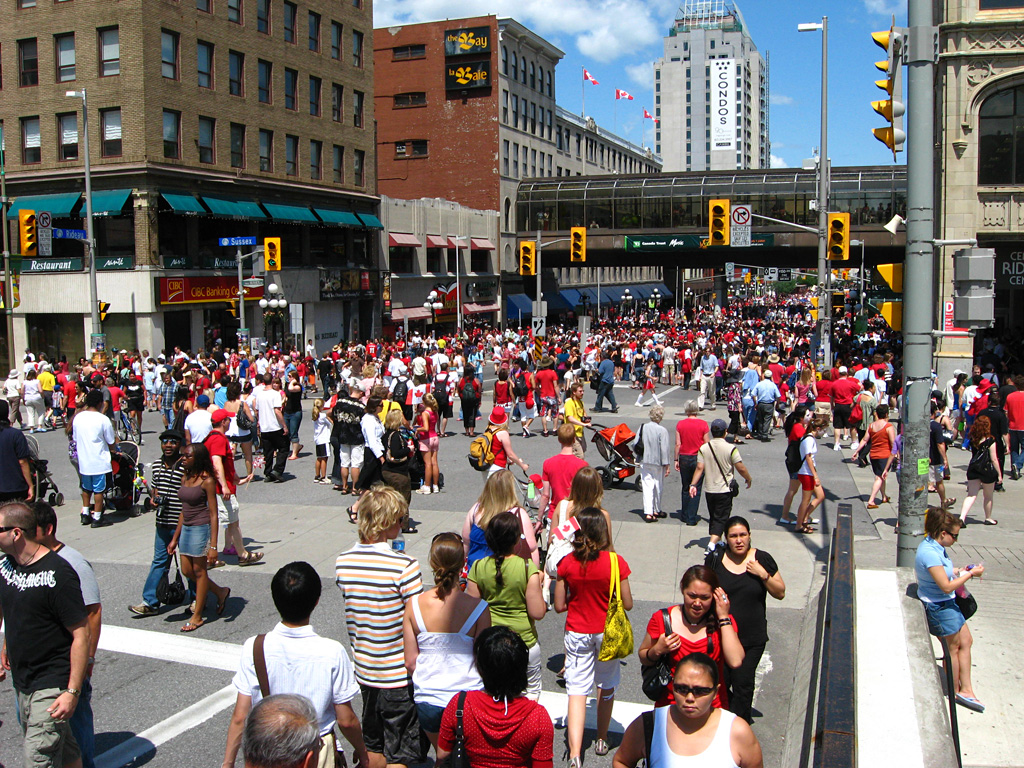
Canada Day 2008, Ottawa

The European Union has agreed to start integrating air travel into its emissions trading system. This is a big step, given how the industry has often been excluded from carbon pricing schemes – especially where international travel is involved.

Arguably, the biggest piece of news is that they want to charge non-EU carriers for emission permits when they enter EU countries. This is certainly going to kick up a stink in the WTO and other multilateral trading bodies. That being said, if a global regime of carbon pricing is not to be forthcoming, the regional arrangements will need mechanisms for ensuring that imports meet their standards.

Hashing out how such standards can be applied is sure to be a difficult and extended affair.

Pigs eat more fish than all of Japan

Apparently, 17% of wild-caught fish ends up getting fed to livestock. That’s pretty astonishing, given the increasingly dire state of global fish stocks, and it underscores the way in which most modern agriculture is fundamentally unsustainable.

As long as it is dependent on outside inputs where the supply is growing scarcer, it won’t be a mechanism for feeding humanity indefinitely.

Much better to leave those fish in the sea or, failing that, at least feed them to people.

CCS skepticism

The headline of a recent Economist article is one that policy-makers around the world should pay heed to: Carbon storage will be expensive at best. At worst, it may not work. There are two over-riding reasons for which the danger of a CCS-flop needs to be borne in mind:

  1. First, many governments are assigning a big chunk of their planned emissions reductions to the new technology. If they find themselves in need of alternatives later, it may prove to be quite a scramble. Likewise, being able to ‘bank’ the CCS reductions now may make their plans seem both more viable and more certain than they really are.
  2. Secondly, the very prospect of CCS is a lifeline to the coal industry. Power plants built to be ‘carbon capture ready’ may never do anything of the kind. If so, citizens should be even more concerned about the greenhouse gasses they are going to spew. Those financing the construction should also be wary, since carbon pricing is more likely than not to be on the way.

None of this is to say we shouldn’t welcome cheap, effective CCS if it does emerge. Not only could it allow the US and China to use their coal reserves while not wrecking the climate (local pollution is another matter), CCS coupled with biomass-fired generating stations could be carbon-negative.

Just don’t count those megatonnes before they’re buried.

Hansen on 350ppm

Rideau Canal locks

The most common position among climate change analysts is that we need to stabilize the atmospheric concentration of carbon dioxide somewhere between 450 and 550 parts per million (ppm). That is, for instance, the target range endorsed by Nicholas Stern. It is also thought by many to be compatible with the EU goal of generating less than two degrees Celsius of temperature increase, though that is only really plausible at the low end.

In recent Congressional testimony, James Hansen, director of the NASA Goddard Institute for Space Studies, argued that we actually need to cut concentrations from the present 385ppm to 350ppm or less. Basically, his argument is that even stabilization at the present level would have unacceptable consequences: both directly, in terms of impacts on physical and biological systems, and by kicking off feedback loops that will further worsen things. The distinction between the numbers may seem abstract to those not familiar with climate policy, but the practical differences between stabilizing between 550, 450, or 350ppm are massive. Each scenario requires that emissions peak at a different date, and that they fall more or less rapidly afterwards. Even staying below 450ppm requires that global emissions peak within 10-15 years, and that they fall to a small fraction of present levels by 2050.

If accurate, the 350ppm target invalidates a great deal of climate change planning. The general view is that we still have a cushion for additional emissions, to be split up between developed and developing countries. The former would lead the way, showing the latter how they can also do so once they reach a somewhat higher level of affluence. Getting back to 350ppm in a reasonable amount of time requires much more aggressive cuts, universally. It would also require that India and China move to a low-carbon economy long before any significant proportion of their population has reached Western levels of affluence.

Personally, I hope Hansen’s most recent testimony is not as prescient as that he gave twenty years ago. If we need to get the planet on a rapid path towards 350ppm, the disjoint between what is physically necessary and what is politically possible is far wider a chasm than has hitherto seemed to be the case.

Tomorrow’s electrical generation: distributed or concentrated?

There is an interesting debate ongoing on the Gristmill blog about whether the future of electrical generation lies primarily with big centralized power plants, like today, or with distributed systems.

Naturally, there are many factors that influence which is more attractive, many of which are regulatory rather than inherent to the physics or economics. I suspect the key dynamics will be the relative efficiency of differently sized facilities, the rate at which low-loss high voltage direct current (HVDC) transmission emerges, and the rate at which financing options for small facilities proliferate. Other important considerations will be the rate of improvement in the economics of solar photovoltaic systems, as well as the development and deployment of demand management and energy storage options for the grid.

In any event, it is doubtful whether one approach or the other will ever truly dominate. In all probability, a low-carbon society will incorporate both approaches in keeping with the strengths of different technologies and the needs of different areas.

Overfishing and the EU

Emily Horn on her bike

Long-time readers will remember the saga of the ‘fish paper’ – my research piece on the sustainability and legality of European Union fisheries policy in West Africa, eventually published in the MIT International Review.

Fisheries being an area of acute concern for me, I was gratified to see an unusually hard-hitting column in this week’s Economist about fish and the EU. It argues that EU goverments have shown “abject cowardice” in relation to their fishers for years. Meanwhile, overcapacity and unsustainable quotas have put the industry into a “suicidal spiral.” The article reports straightforwardly that: “More subsidies would reduce the already slim chance that Europe will ever have a sustainable fishing industry.”

I have argued previously that fishing should never be subsidized. There are far too many dangers of people selfishly exploiting a common good even without them. Indeed, I don’t have much hope when it comes to the long-term viability of world fisheries. That being said, if more people develop the understanding and candour displayed in this article, perhaps the madness can eventually be brought to heel.