Development, equity, and the WTO

My opinion of the World Trade Organization has probably shifted more than that for any other international institution, during the course of university study. The conception of the WTO as some sort of monolithic and powerful body, forcing countries to do things against their will does not seem like an accurate one. Where such pressures do exist, they are more parallel to the WTO (caused and driven by the preferences of member states) than self-arising from within. The inability of the WTO to enforce its rulings on trade – save through the highly problematic vehicle of allowing the country sinned against to raise its own tariffs – seems to underscore how weak the organization really is.

Naturally, all of the above assumes that free trade is generally a good thing. While there are undeniably problems – some of which can be well expressed using an economic framework of analysis – there are myriad advantages to global economic integration. Globalization needs to be modified so as to operate better as a process that aids in poverty reduction; likewise, it needs to become more environmentally balanced. With the Doha Round utterly stalled it isn’t clear how the WTO could contribute to either aim, a reasonable case can be made that it is at least not worsening either. A rules-based system like the WTO seems to hold out at least the possibility of a more just relationship between rich and powerful states and those that are poor. While the system is highly imperfect in practice, it does seem to have a small net positive effect.

All that said, since I need to argue that the WTO is a bad thing for developing countries this Thursday, I should start looking at the most eloquent and well defended expressions of the the position.

People interested in economic issues should have a look at Trade Diversion: a blog run by Jonathan Dingel, an M.Phil student in economics.

Conservatism and the environment

In the northern lower reading room of the Bodeleian, I read a really interesting chapter on ecology and conservatism by Roger Scruton, from the University of Buckingham.1 He makes a surprisingly solid argument that a greening of conservatism would be more of a return to its roots than a departure into uncertain territory. He evokes the position of Burke that all living people are involved in a trusteeship involving both the living and the dead. The moral onus is to maintain, resist damage, and pass along that which has been inherited.

The problems with this position are twofold, and both problems arise from the parochialism of conservative environmentalism. I have always admired the sensible conservative caution about grand projects and the building of utopias. That said, encouraging enclaves to behave in environmentally responsible ways does nothing to protect those within from their neighbours (or those across the world) who do not behave similarly. When the greatest environmental threat in the world (climate change) arises from collective economic activity, a love of one’s home and country, and the fervent desire to protect both, will come to nothing without international cooperation and the changing of behaviour, using some combination of consent and coercion.

The second problem is that of material equality. Protection of what you have inherited for those who are to follow may be a noble individual pursuit (think of the shame attached to those who squander fortunes and wreck empires), but it is not a path towards greater global justice. Now, greater global justice may be exactly the kind of Utopian project that conservatives are smart to be wary about. That said, there can be moral impulses strong enough to make us embark upon difficult and uncertain projects, simply because it would be profoundly unethical to behave otherwise. When it comes to extreme poverty and the deprivation and danger under which so much of the world’s population lives, I think those impulses are justification enough.

Strategically, it seems essential to foster an emergence of green conservatism in the political mainstream. We cannot oscillate between relatively responsible governments and those that act as wreckers. Moreover, once both sides of the mainstream have accepted how vital the environment is, and the sacrifices that must be made to protect it, there is a better chance that the debate and policy can move forward. If one group is forging ahead with more far-thinking ideas, they risk excessive electoral punishment. If, however, the thinking of both politicians and the population as a whole evolves towards a more serious way of thinking about environmental management, there is a much greater chance that the push will be sustained and effective.

[1] Scruton, Roger. “Conservatism.” in Dobson, Andrew and Robyn Eckersley. “Political Theory and the Ecological Challenge.” Cambridge: Cambridge University Press. 2006.

Experts: scientists and economists

Here’s a little bit of irony:

According to BBC business correspondent Hugh Pym, the report will carry weight because Sir Nicholas, a former World Bank economist, is seen as a neutral figure.

Unlike earlier reports, his conclusions are likely to be seen as objective and based on cold, hard economic fact, our correspondent said.

The idea that economists are more objective than scientists is a very difficult one for me to swallow. While scientific theories are pretty much all testable on the basis of observations, economic theories are much more abstract. Indeed, when people have actually gone and empirically examined economic theories, they have often been found to be lacking.

Part of the problem may be the insistence of media sources in finding the 0.5% of scientists who hold the opposite view from the other 99.5%. While balance is certainly important in reporting, ignoring relative weights of opinion is misleading. In a study published in Science, Naomi Oreskes from the University of California, San Diego examined 10% of all peer-reviewed scientific articles on climate change from the previous ten years (n=928).1 In that set, three quarters discussed the causes of climate change. Among those, all of them agreed that human-induced CO2 emissions are the prime culprit. 53% of 636 articles in the mainstream press, from the same period, expressed doubts about the antropogenic nature of climate change.

I suppose this says something about the relative levels of trust assigned to different expert groups. Economists study money, so they naturally must know what they are talking about.

[Update: 25 February 2007] I recently saw Nicholas Stern speak about his report. My entry about it contains a link to detailed notes on the wiki.

[1] Oreskes, Naomi. “Beyond the Ivory Tower: The Scientific Consensus on Climate Change.” Science 3 December 2004: Vol. 306. no. 5702, p. 1686. (Oxford full text / Google Scholar)

Inequality a problem in itself?

House in North Oxford

A serious moral question arose during today’s seminar: Is inequality in wealth a problem, in and of itself?

Specifically, if there are two individuals or states where one is poor and one is rich, and both are getting wealthier but the richer state is getting even richer faster, is this a problem?

Within the question, there are two sub-cases. In the first of those, the growth in the rich state is completely separate from that of the poor state. Imagine they are completely disconnected and have no engagement with one another. Does the fact that the GDP of the rich state has risen by 50% and that of the poor state by only 5% matter, in a moral sense?

The other case is that the 50% growth in the rich state is somehow causally tied to the 5% growth in the poor state. Specifically, the latter would be higher if the former was lower. Now, that is entirely possible, but this is a different moral category. In the first case, one would have to appeal to general moral cosmopolitanism. In the latter case, we can refer to a moral tradition akin to that of the law of tort: you have harmed me, and you owe me something. This does not speak to the fundamentally immorality of inequality.

All contributions to this discussion are encouraged.

[Update: 7:00pm] To be clear, I do not dispute the fact that it is virtuous for the rich to help the poor. I am a firm believer in the moral value of philanthropy. The question above is about obligation, not charity.

Morality of climate inaction

Bryony Lau and Alex Stummvoll

Happy Birthday Sasha W

One of the most interesting statements made at the climate change conference was Henry Shue’s moral categorization for inaction on climate change: he called it ‘the infliction of harm upon the defenceless.’ This, he said, is true independently from whether abrupt and harmful climate change scenarios arise. Given what we know, it is akin to forcing someone to play Russian Roulette: even if there is no bullet in the chamber, when the hammer falls, the imposition of the risk is immoral.

The idea of future generations being in a position of helplessness, relative to us, had not occurred to me before. Historical progress has generally involved increases in human capability. I suppose it is only now that we have the widescale ability to threaten vital biological systems that we stand to undermine whatever new capabilities our forebears will have, both technical and economic, by presenting problems insoluble even with future technology.

Scenarios like the disruption of the Thermohaline circulation circulation of the liberation of methane hydrate from the ocean floors definitely seem insoluble, even given vastly increased capability. Perhaps such arguments can help to generate the impetus in the minds of people and policymakers that will be required to move forward with GHG controls.

Back to the moon? But why?

Apparently, Lockheed-Martin got the contract to serve as prime contractor for a return to the moon, and possibly further travel from there to Mars. Now, when I first heard the ‘back to the moon’ proposal, I assumed it was electoral fluff. How can an agency that decided to scrap such a useful piece of scientific equipment as the Hubble Space Telescope possibly be considering the scientifically pointless mission of putting human beings back on the moon?

I believe that humanity will eventually expand outwards into space. It is advisable due to the small but catastrophic risk of asteroid or comet impact, as well as generally in keeping with an agenda of exploration that I find personally inspiring. The first moon landings were an astonishing demonstration of human ingenuity and American technical and economic might. With present technology, manned spaceflight is a symbolic and political endeavour, not a scientific one. That said, returning to the moon serves no purpose, scientific or political. If we could do it in the 1960s, we can do it again now. Even if you accept the argument that a moon base is necessary for a manned mission to Mars, the enormous question remains of why we should take on such an expedition at this time, with this technology, and the present financial circumstances of the United States.

When it comes to space science, people are very expensive and delicate instruments. Robots might not always work (note all the failed Mars landers), but they don’t require all the food, air, space, and temperature and acceleration control that people do. The things we hope to learn about our solar system and the space beyond are almost certainly better investigated by robots, at this time. And the moon is hardly a profitable place to go looking for new scientific insights. A robot sent somewhere interesting – like Europa – would almost certainly advance science more than sending scores of people to that great airless ball that lights up our night sky and causes our tides.

This plan is especially absurd given the magnitude of public debt in the United States right now. The existing level of federal debt is more than $8.5 trillion, more than $28,000 per person, and the federal budget is sharply in deficit. If we could choose to send people to the moon instead of developing one of the two hugely expensive fighter jets now being rolled out (the F-22 and the Joint Strike Fighter, a $256 billion program), I would be all for it. At least, going back to the moon would do relatively little harm (wasted resources aside). Of course, no such trade-off is being offered. This would be spending over and above the sums already being expended on pricey little projects like the JSF, the DDX destroyer (about $4 billion per ship), and the war in Iraq (more than $300 billion, so far). The comparison to military hardware is a sensible one, since manned spaceflight is, to a large extent, just another massive subsidy to the military aerospace industry. Hopefully, the passing of the mid-term elections will put this white elephant to sleep again.

Related items:

Sulfate injection to stop global warming?

Apparently, Paul Crutzen, an environmental scientist who shared a Nobel Prize in 1995 for his work on the role of CFCs in ozone layer depletion, thinks we should correct for global warming by injecting two million tonnes per year of sulphate particles into the upper atmosphere. According to Wikipedia: “sulfates occur as microscopic particles (aerosols) resulting from fossil fuel and biomass combustion. They increase the acidity of the atmosphere and form acid rain.” He predicts that the process of injecting them into the upper atmosphere using balloons or artillery would cost between $25 and $50 billion a year, but would save more by mitigating the effects of global warming.

While I am no environmental scientist, what strikes me as most interesting about this is the ‘technical fix’ mindset that it embodies: a bit like those who decided to stabilize dune formation on parts of the Oregon coast by importing Spanish beach grass, or those who have sought to kill off one accidentally imported pest with an intentionally imported predator. Often, such schemes don’t work at all. When they do, they risk working much too well. Thanks to Spanish beach grass, the Oregon dunes will be a thing of the past in a few decades. The point is simply that, at a stage when we really don’t know the consequences of climate change or their magnitude, it seems awfully bold to predict that such a scheme will both work and do more good than harm.

As is so often the case, the most trenchant criticism of such schemes was expressed humorously on The Simpsons:

SKINNER: Well, I was wrong. The lizards are a godsend.

LISA: But isn’t that a bit short-sighted? What happens when we’re overrun by lizards?

SKINNER: No problem. We simply unleash wave after wave of Chinese needle snakes. They’ll wipe out the lizards.

LISA: But aren’t the snakes even worse?

SKINNER: Yes, but we’re prepared for that. We’ve lined up a fabulous type of gorilla that thrives on snake meat.

LISA: But then we’re stuck with gorillas!

SKINNER: No, that’s the beautiful part. When wintertime rolls around, the gorillas simply freeze to death.

The comparison between atmospheric science and ecology is less dubious than one might think. Both systems are complex and dynamic – they feed back upon themselves in ways which are both powerful and difficult to predict. Furthermore, both atmospheric and ecological systems both affect and are affected by other complex systems with which they are integrated. Consider, for instance, how the construction of the Aswan High Dam (the product of political and economic changes, above all) altered the salinity in the eastern Mediterranean, allowing for the migration of species from the Red Sea.

What would the consequences of blasting artillery shells full of sulfates into the upper atmosphere? Far be it for me to speculate. The intentional modification of atmospheric chemistry and physics is something we have never done as a species, though we have done a lot of unintentional tinkering. What I would venture is that it is likely to have unpredictable effects and that it is a particularly curious way of trying to deal with the problem of global warming.

George Monbiot, who I met at a short conference at the Environmental Change Centre, has his own objections.

Power conservation through geothermal temperature regulation

For those concerned about climate change or dependency on foreign energy, a home geothermal heating and cooling system may be just the ticket. Such systems take advantage of how the temperature is relatively constant underground, whether it is overly hot at the surface or overly cold. As such, it can be used to heat in the winter and cool in the summer, while using only a minimal amount of energy to carry out the heat exchange. While this is a pretty expensive thing to install in a single existing house after the fact, it seems plausible that it could be scaled in ways that make it economically viable in a good number of environments.

If electricity, oil, and gas really started to get expensive, you would start seeing a lot more such systems. Another example is the pipelines that draw cold water from the bottom of Lake Superior to cool office towers in Toronto during the summer.

Conservation may not be as technologically engrossing as genetically modified biofuels and hydrogen fuel cells, but it is definitely a proven approach.

Global warming damage curves

Perhaps the biggest question about global warming is what environmental economists refer to as ‘the shape of the damage curve.’ I would say that the scientific evidence that global warming is taking place is essentially ironclad (though the relationships of some events, such as more severe hurricanes, to it are rather more tenuous). Equally true is the fact that human beings are contributing to the warming of the planet. What the damage curve represents is the amount of harm caused by each additional unit of global warming, expressed in terms of the cost that would be required to mitigate it. Mitigation costs include everything from relocating people to dealing with larger malarial areas, making agricultural changes, and increased building heating and cooling costs in different areas. The costs are net of any benefits that global warming provides: such as being able to grow certain crops farther north, or having a longer growing season overall.

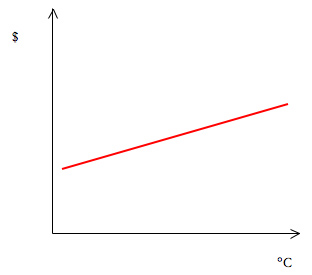
The most benign possibility would look something like this:

The damage increases steadily with the amount of mean global temperature change. This is helpful because it allows us to predict the degree of future damage quite effectively and make reasonably good choices with regard to how much reduction in greenhouse gas (GHG) emissions we should undertake.

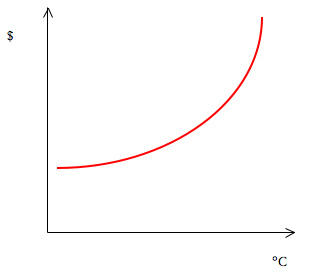
A worse option looks like this:

The damage increases at an increasing rate, as temperature does. This seems intuitively more likely than the first option, since bigger increases are likely to unbalance more and more complex biological and climatological systems.

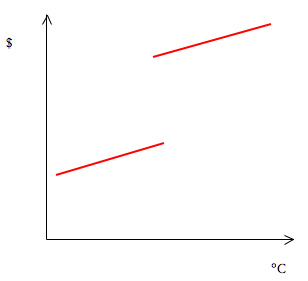
An even worse option looks like this:

It is possible that climate change would involve a big jump that we wouldn’t see coming until it was too late. An example would be the much talked about possibility that the Gulf Stream, which warms Western Europe, could be disrupted. The biggest reason this is problematic is because we might believe we were in a scenario like the one in chart one, only to be proved spectacularly wrong.

The trillion dollar question, of course, is which of these approximations we should adopt as the basis for policymaking, until such a time as compelling evidence for one of the possibilities or another emerges (hopefully not by means of humanity actually following one of those curves too far). The most cautious option is to assume that the progression would be like chart 3, with the break at an unknown location. The prudent policy, then, would be to try and stabilize GHG levels at their present positions. Of course, that could involve massive reductions in possibilities for economic growth in the rich world and poverty reduction in the poor world. A tricky decision to make, in the face of such important considerations on both sides.

Personally, I don’t think any serious action will be taken until some very real evidence of the harm that can be caused by global warming has manifest itself. As for the question of what should be done, in the ideal circumstance, I am profoundly uncertain. What do other people think?

The moral choices in assigning rights

Tree at St. Hugh's College

The best piece of writing I have come across in the last week or so is a chapter from the Bromley and Paavola book on environmental economics that I have been reading. By A. Allan Schmid, it is called “All Environmental Policy Instruments Require a Moral Choice as to Whose Interests Count.” The argument is that the idea of solving environmental problems in a purely technical way (internalizing externalities, to borrow from the economics lingo) is impossible. When a policy is represented that way, there is always a moral choice being concealed. In tort law, this becomes explicit through an instrument called nuisance.

If my neighbours are making homemade beer and the process produces a constant cloud of nasty smelling gas that wafts into my yard and through my windows, I could seek remedy in court. It would then be decided whether or not the smell constitutes nuisance. If not, the court effectively grants a right to produce the smell to my neighbours. I would then be free to try to convince them to use that right differently, for instance by paying them not to make beer.

If the court rules in my favour one of two things can take place. They can grant an injunction, forbidding my neighbours to make beer without my permission. This is great for me, since I can effectively sell them the right to make beer if the amount they are willing to pay exceeds the amount the smell bothers me. This is what Coase is alluding to in his argument that it doesn’t matter who you assign rights to, as long as bargaining can occur (See: Coase Theorem). Of course, he ignores the distributional consequences of assigning the rights one way or another. As an alternative to an injunction, the court can fix a set amount of damages to be paid. This relieves the nuisance, but gives me less scope to take advantage of the court’s decision.

What the example illustrates is that in creating policies to deal with externalities, the rights in question must be effectively assigned to one party or another. We either assign companies the right to pollute, which people around them can negotiate for them not to do, or we assign those people the right not to live in a polluted place, in which case the company has to go to them with an offer. The assigning of rights, then, isn’t a mere technical instrument for achieving an environmental end, but a matter of distributive justice.

Consider the case of fisheries access agreements in West Africa. West African governments have the sovereign right to exploit the waters in their Exclusive Economic Zones (EEZs). They can also choose to sell that right, as many have done, to the EU. The governments end up getting about 10% of the value of the fish that are caught, while suffering the loss of future revenue that is associated with the depletion of the fisheries (since they are exploited at an unsustainable level). In this case, the distributional consequences of West African governments being rights holders are fairly adverse. The incentives generated inflict harm on the life prospects of those whose protein intake previously came from fish caught by artisinal fisheries now rendered less productive due to EU industrial fishing. Likewise, the life prospects of future generations of citizens are harmed.

One of the best bits of the Schmid piece is the following:

A popular phrase contrasts “command and control” with voluntary choice. Another contrasts “coercive” regulations with “free” markets. This is mischievous, if not devious. At least, it is certainly selective perception. First of all, the market is not a single unique thing. There are as many markets as there are starting place ownership structures. I personally love markets, but of course I always want to be a seller of opportunities and not a buyer. Equally mischievous is the idea that externalities are a special case where markets fail. Indeed, externalities are the ubiquitous stuff of scarcity and interdependence.

He puts to paid the idea that there is a tradeoff between economic efficiency and moral principles. That is simple enough when you realize there is an infinite set of economically efficient outcomes, given different possible preferences and starting distributions.

Those wanting to read the entire piece should see: Schmid, A. Allen. “All Environmental Policy Instruments Require a Moral Choice as to Whose Interests Count.” in Bromley, Daniel and Jouni Paavola (eds). Economics, Ethics, and Environmental Policy: Contested Choices. Oxford : Blackwell Publishing. 2002. pp. 133-147.