Power conservation through geothermal temperature regulation

For those concerned about climate change or dependency on foreign energy, a home geothermal heating and cooling system may be just the ticket. Such systems take advantage of how the temperature is relatively constant underground, whether it is overly hot at the surface or overly cold. As such, it can be used to heat in the winter and cool in the summer, while using only a minimal amount of energy to carry out the heat exchange. While this is a pretty expensive thing to install in a single existing house after the fact, it seems plausible that it could be scaled in ways that make it economically viable in a good number of environments.

If electricity, oil, and gas really started to get expensive, you would start seeing a lot more such systems. Another example is the pipelines that draw cold water from the bottom of Lake Superior to cool office towers in Toronto during the summer.

Conservation may not be as technologically engrossing as genetically modified biofuels and hydrogen fuel cells, but it is definitely a proven approach.

Global warming damage curves

Perhaps the biggest question about global warming is what environmental economists refer to as ‘the shape of the damage curve.’ I would say that the scientific evidence that global warming is taking place is essentially ironclad (though the relationships of some events, such as more severe hurricanes, to it are rather more tenuous). Equally true is the fact that human beings are contributing to the warming of the planet. What the damage curve represents is the amount of harm caused by each additional unit of global warming, expressed in terms of the cost that would be required to mitigate it. Mitigation costs include everything from relocating people to dealing with larger malarial areas, making agricultural changes, and increased building heating and cooling costs in different areas. The costs are net of any benefits that global warming provides: such as being able to grow certain crops farther north, or having a longer growing season overall.

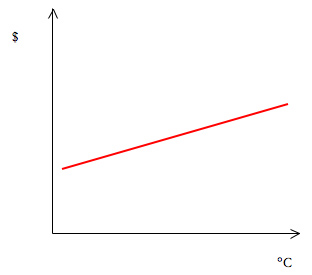
The most benign possibility would look something like this:

The damage increases steadily with the amount of mean global temperature change. This is helpful because it allows us to predict the degree of future damage quite effectively and make reasonably good choices with regard to how much reduction in greenhouse gas (GHG) emissions we should undertake.

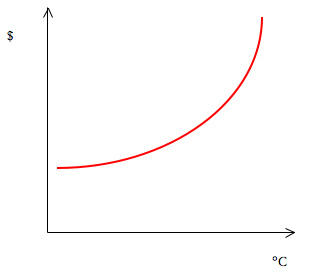
A worse option looks like this:

The damage increases at an increasing rate, as temperature does. This seems intuitively more likely than the first option, since bigger increases are likely to unbalance more and more complex biological and climatological systems.

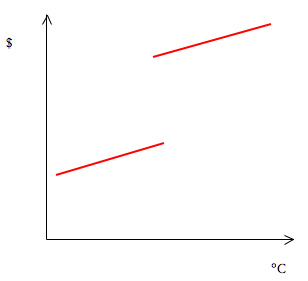
An even worse option looks like this:

It is possible that climate change would involve a big jump that we wouldn’t see coming until it was too late. An example would be the much talked about possibility that the Gulf Stream, which warms Western Europe, could be disrupted. The biggest reason this is problematic is because we might believe we were in a scenario like the one in chart one, only to be proved spectacularly wrong.

The trillion dollar question, of course, is which of these approximations we should adopt as the basis for policymaking, until such a time as compelling evidence for one of the possibilities or another emerges (hopefully not by means of humanity actually following one of those curves too far). The most cautious option is to assume that the progression would be like chart 3, with the break at an unknown location. The prudent policy, then, would be to try and stabilize GHG levels at their present positions. Of course, that could involve massive reductions in possibilities for economic growth in the rich world and poverty reduction in the poor world. A tricky decision to make, in the face of such important considerations on both sides.

Personally, I don’t think any serious action will be taken until some very real evidence of the harm that can be caused by global warming has manifest itself. As for the question of what should be done, in the ideal circumstance, I am profoundly uncertain. What do other people think?

The moral choices in assigning rights

Tree at St. Hugh's College

The best piece of writing I have come across in the last week or so is a chapter from the Bromley and Paavola book on environmental economics that I have been reading. By A. Allan Schmid, it is called “All Environmental Policy Instruments Require a Moral Choice as to Whose Interests Count.” The argument is that the idea of solving environmental problems in a purely technical way (internalizing externalities, to borrow from the economics lingo) is impossible. When a policy is represented that way, there is always a moral choice being concealed. In tort law, this becomes explicit through an instrument called nuisance.

If my neighbours are making homemade beer and the process produces a constant cloud of nasty smelling gas that wafts into my yard and through my windows, I could seek remedy in court. It would then be decided whether or not the smell constitutes nuisance. If not, the court effectively grants a right to produce the smell to my neighbours. I would then be free to try to convince them to use that right differently, for instance by paying them not to make beer.

If the court rules in my favour one of two things can take place. They can grant an injunction, forbidding my neighbours to make beer without my permission. This is great for me, since I can effectively sell them the right to make beer if the amount they are willing to pay exceeds the amount the smell bothers me. This is what Coase is alluding to in his argument that it doesn’t matter who you assign rights to, as long as bargaining can occur (See: Coase Theorem). Of course, he ignores the distributional consequences of assigning the rights one way or another. As an alternative to an injunction, the court can fix a set amount of damages to be paid. This relieves the nuisance, but gives me less scope to take advantage of the court’s decision.

What the example illustrates is that in creating policies to deal with externalities, the rights in question must be effectively assigned to one party or another. We either assign companies the right to pollute, which people around them can negotiate for them not to do, or we assign those people the right not to live in a polluted place, in which case the company has to go to them with an offer. The assigning of rights, then, isn’t a mere technical instrument for achieving an environmental end, but a matter of distributive justice.

Consider the case of fisheries access agreements in West Africa. West African governments have the sovereign right to exploit the waters in their Exclusive Economic Zones (EEZs). They can also choose to sell that right, as many have done, to the EU. The governments end up getting about 10% of the value of the fish that are caught, while suffering the loss of future revenue that is associated with the depletion of the fisheries (since they are exploited at an unsustainable level). In this case, the distributional consequences of West African governments being rights holders are fairly adverse. The incentives generated inflict harm on the life prospects of those whose protein intake previously came from fish caught by artisinal fisheries now rendered less productive due to EU industrial fishing. Likewise, the life prospects of future generations of citizens are harmed.

One of the best bits of the Schmid piece is the following:

A popular phrase contrasts “command and control” with voluntary choice. Another contrasts “coercive” regulations with “free” markets. This is mischievous, if not devious. At least, it is certainly selective perception. First of all, the market is not a single unique thing. There are as many markets as there are starting place ownership structures. I personally love markets, but of course I always want to be a seller of opportunities and not a buyer. Equally mischievous is the idea that externalities are a special case where markets fail. Indeed, externalities are the ubiquitous stuff of scarcity and interdependence.

He puts to paid the idea that there is a tradeoff between economic efficiency and moral principles. That is simple enough when you realize there is an infinite set of economically efficient outcomes, given different possible preferences and starting distributions.

Those wanting to read the entire piece should see: Schmid, A. Allen. “All Environmental Policy Instruments Require a Moral Choice as to Whose Interests Count.” in Bromley, Daniel and Jouni Paavola (eds). Economics, Ethics, and Environmental Policy: Contested Choices. Oxford : Blackwell Publishing. 2002. pp. 133-147.

First eBay sale

I’ve joined the ranks of those who have at least listed an item on eBay. In this case, it’s the Sony headphones that I want to sell in order to get money for a snazzier pair. These are brand new and in the original packaging.

I may have set the minimum bid a bit high, but you can’t set a reserve price under £50 and I’m really not willing to sell these for less than £15 after spending almost £25 on them. In any case, we will see how this experiment in commerce goes.

[Update: 21 June 2006] With exactly 12 seconds left in the auction, someone placed a bid. Looks like I am offloading these headphones for £15 plus the cost of shipping.

The economics of it all:

Price initially paid on Amazon: £25.66 C$53.01

Payment received from eBay: £15.00 C$30.99
Shipping fee from eBay: £2.00 C$4.13

eBay listing fee: £1.29 C$2.68
PayPal currency fee: £0.86 C$1.77
Cost of packaging: £0.49 C$1.01
Cost of shipping: £0.68 C$1.40
Net eBay income: £13.68 C$28.26

Amazon cost – eBay income: -£11.98 -C$24.75

In the end, choosing to buy these headphones cost me about twenty-five bucks for three months’ usage. Let’s hope the ones I choose to replace them with last much longer.

On luxury notebooks

Encouraged by the approval of friends like Emily and Tarun, as well as the endorsement on Tony’s blog, I bought a Moleskine notebook today. I am quite ambivalent with regards to the symbolism of the things: they try to cultivate artistic chic, but through their absurd price, coupled with ready availability, they can easily be seen as absurdly pompous. This might be called ‘Powerbook syndrome:’ only very marginally better than iBooks, yet nearly twice the price.

I was able to justify spending eight quid on a 120-page notebook only because it is an eighteen month weekly calendar. As such, it is worth spending more for something that will not fall apart or lead to you cursing it daily for a year and a half. It is a better alternative to telling people: “Yes, Thursday might be good. Just email me and I will check in Outlook that I don’t already have something sorted out.”

The choice was between developing a memory for appointment-type details and getting some kind of day-planner. The redeeming qualities of spending money on something long-lived should be a useful antidote to accusations of notebook snobbery. As for the question of whether Moleskine notebooks are really all they’re cracked up to be, I will get back to you.

Hunger and disease

Flowers at St. Antony's

I promised myself the other day that I would write a post about something that I view as a serious fallacy related to development: the notion that dealing with infectious disease will just shift the death toll to hunger, rather than genuinely saving people. This view is misguided for reasons both moral and pragmatic. I will focus on the pragmatic here, since people who advance this neo-Malthusian argument tend to think of themselves as well-meaning but realistic. The first set of arguments have to do with the local capabilities of communities. The second, lesser, set have to do with the nature of the provision of aid. I will quickly examine each in turn.

The three big diseases upon which I will concentrate are HIV/AIDS, malaria, and tuberculosis (TB). These have been rightly banded together as the three most serious global health concerns, with regards to infectious diseases. Each kills more than a million people a year, as well as making far more ill. As a bacterial illness, effective cures exist for all but the most resistant strains of tuberculosis. While no effective cure exists for either malaria or HIV/AIDS, drugs exist that can extend survival dramatically, and mechanisms exist to greatly restrict the spread of such illnesses. The notion that doing so would produce an equally severe problem elsewhere is based on a misconception about how such illnesses affect communities.

Local capabilities

Sick people are not productive people. Communities with high prevalance rates of infectious diseases lose agricultural productivity as members of the working population either become ill or need to spend their time caring for those who are. This is especially bad with regards to HIV/AIDS, which tends to kill people during their most productive years. That has left behind millions of orphans, who further draw upon the capabilities of the community in which they live. All manner of grim statistics could be brought to bear upon this point, but it seems intuitively obvious enough to stand on its own.

The possibilities of simultaneously dealing with the various factors that make extreme poverty endemic are demonstrated by the ’12 research villages’ that Jeffrey Sachs has established throughout Africa. The plan is to have 1000 by 2009. Each receives practical aid at the level of $250 per inhabitant: directed towards dealing with disease, boosting agricultural output, education, and other objectives espoused by the Millennium Development Goals. The whole program can be expressed in terms of seven simple goals:

Fertiliser and seed to improve food yield; anti-malarial bed nets; improved water sources; diversification from staple into cash crops; a school feeding programme; deworming for all; and the introduction of new technologies, such as energy-saving stoves and mobile phones.

The results so far seem to be very good, in terms of declining levels of infectious disease, improved crop yields and educational results, and the like. As with so many other projects, the difficulty is in scaling up the the point where millions of lives can be changed, but the example demonstrates how even a relatively inexpensive aid policy can produce tangible results in a number of crucial areas, without hitting any of the Malthusian barriers imagined by those who say that feeding hungry children just makes hungry adults. Another laudable feature of the program: all aspects of it are implemented and directed at a local level, reducing the extent that neocolonialist intentions can be attributed to the donors or international organizers.

World capabilities

Even in those cases where a sudden burst of attention enormously lessens the burden of disease in a food-strapped community, the difficulties of dealing with that situation are far easier than those of dealing with a place where one of these big three diseases has become endemic.

That’s partly because food provision doesn’t require the delivery of expertise into an area. The lack of qualified medical personnel in places like Sub-Saharan Africa is a major reason for which infectuous disease is so problematic there. The rich world has a double guilt in this capacity: because the austerity programs that were part of the structural adjustment policies of the IMF and World Bank have prevented governments from investing in such human capital, and because lots of rich countries (including Canada and the UK) have been doing all they can to buy up doctors and nurses from the poor world to help address problems in their own health systems.

Conclusions

Obviously, just providing food aid or help with specific problems isn’t adequate for dealing with persistent extreme poverty. That said, it seems foolish to voluntarily refrain from deploying such assistance as is politically and economically viable because of concerns about “feeding those who will die anyhow.” On the global level, the economic emergence of Asia – in which extreme poverty levels have seen amazing reductions in recent decades – shows what is possible even in the face of considerable levels of corruption, disease, and mismanagement.

Malaria in the 21st century

Painting in Magdalen CollegeTonight’s lectures on malaria, presented by the Oxford Global Health Group, demonstrated once more the kind of opportunity that is being missed with regards to global development. According to the World Health Organization (WHO), one million people per year die from the parasite. In addition, the direct economic costs imposed exceed $12B a year: a figure agreed upon by the two scientists and the representative from GlaxoSmithKline. By contrast, the WHO estimate for the cost of controlling malaria globally is just $3.2B a year. While money alone can’t solve so complex a problem, the gap between what is possible and what is being done remains unacceptable.

Like HIV/AIDS, while efforts are being made to find an effective vaccine, the state of affairs at the moment includes treatment and prevention measures. As Adrian Hill – the Director of Oxford’s Jenner Institute – discussed, there has never been an effective vaccine developed against any human parasitic illness, and the incredible complexity of the malarial life cycle and the long period of endemic coexistence between people, mosquitos, and parasites makes it a task of fiendish difficulty. That doesn’t mean that a vaccine is impossible. Indeed, Dr. Hill stressed how two moderately effective vaccines based on different approaches could combine into a single highly effective treatment. What it does mean is that the existence of effective mitigation mechanisms like pesticide-coated bednets and combination anti-malarial therapies should be focused upon.

I was pleased to learn that Oxford is presently the only organization in the world that is carrying out any level of clinical trial for vaccines addressing tuberculosis, HIV/AIDS, and malaria. Each has an enormous global toll, in terms of lives lost and societies disrupted, and all are well within the present financial means of the world to reduce in significance enormously. When the constant refrain is that official development assistance gets spirited off by corrupt governments and into foreign bank accounts and BMWs, the case for funding large-scale research into the development and cost-reduction of medical responses to devastating illnesses of the poor world is clear and compelling.

The comparison everybody makes is with arms expenditures. That’s fair enough. Discretionary spending on armaments in the 2004 American federal budget was $399B. Three times more was spent on just missile defence than would cover the WHO’s estimated cost for global malarial control. $1.2B was allocated just for the V-22 Osprey aircraft: a design that many, even within the Air Force, consider hopelessly flawed and too dangerous to ever put into operation.

Though of another way, Canada’s GDP is about $1000B. The WHO estimate is therefore just 0.32% of the GDP of a single, relatively unpopulous, member of the rich country club. If anything, the global experience of smallpox and polio has shown that bold and properly funded global health strategies can yield fantastic returns. The chance to capitalize on that potential for AIDS, malaria, and TB is sitting right there for us to grasp.

Science, the environment, and development

Today’s seminar for the Global Economic Governance Program was really excellent, discussing the future of the World Bank and International Monetary Fund. On the panel were Jon Cuncliffe, Paul Collier, and Ngaire Woods. Overall, I would say that they agreed more than they disagreed. They primarily identified and discussed two areas of interest: the global financial consequences of the emergence of China and India and the role the Bank and the Fund should play in assisting development within countries that are either stagnating, or finding themselves at the start of an awkward path to reasonable prosperity.

While there, I realized that development might be the missing factor for my thesis. Conversing with Peter Dauvergne by email, he has identified the incredible variety of work already being done in the field of science and environmental politics. I need more of a focus if I am to say something new. To focus on the scientific and environmental questions that exist within the two areas listed above might be a good way to move forward. It captures concerns like China’s growing need for energy and resources, as well as issues like the problems of desertification and lack of decent access to water in sub-Saharan Africa.

Potentially, this is a way of bringing a lot of reading I’ve been doing that is somewhat peripheral to both the program and my thesis back into line. I don’t think it would be wise to extent the topic to consider health, which is also a fascinating intersection between science and development, but to use development to create a balanced triad between science and environmental politics might lend direction and balance, without going off topic.

Dr. Dauvergne also suggested that I read the last few years worth of issues of Environmental Politics: the journal from the MIT Press which he edits, as well as a thesis entitled Advocates, Experts or Collaborative Epistemic Communities by Lindsay Johnson, an MA student of his.

Comments would be especially appreciated on this, since I need to present my preliminary research plan on Tuesday at 11:00am.

On the price of oil

Tristan asked me a few days ago whether the status of oil as a non-renewable resource means that it must rise in price over the long term. It’s an interesting question. Here is a fairly classical economic answer. The point here is not to consider the possibility of short-term price shocks, which are quite a different sort of phenomenon, and one not related directly to the scarcity or abundance of oil in the ground. Rather, the point is to consider whether the fact that oil reserves develop at a rate that is negligible compared to the rate at which they are exploited means that oil as a commodity is destined to become ever-dearer.

I would contend that there are three prices of oil which we can consider, and two of them are highly relevant. The first cost is simply the nominal cost of any particular grade of oil at a point in time. That is to say, the cost in whatever unit of currency you care to use. These are not directly comparable, over time, because they do not factor in inflation. The second, more relevant, price is the nominal price adjusted for the rate of inflation. While there are difficulties in properly assessing the rate of inflation, a price that takes it into account as can best be managed does a better job of reflecting what the price of oil is, relative to other commodities. Economists call this the ‘real’ price of oil. The third price, which I will get into further below, is the relative price of oil as a factor of production, from the perspective of any firm and firms in aggregate.

Examining the price trend, firstly, there are considerations of supply and demand. These are fundamentally related to the rate of oil extraction, not to the total available reserves. That said, those watching the levels of reserves might anticipate future scarcity (doing things like choosing less oil intensive technology or making bets on higher oil prices in commodity markets). Sticking to flows for the moment, there does seem to be a considerable extent to which oil production can be increased in the medium term. Especially given today’s high oil prices, fields that were previously not commercially viable have become so. Likewise, fields that were depleted to the point where the cost of extracting an extra barrel of oil was at or below the value of that oil have become viable again. This kind of incentive will emerge whenever the real price of oil rises. The potential to bring new oilfields onstream in the medium turn should act to mitigate – though not eliminate – price rises in oil.

The next big issue is substitution. We use oil for a great many purposes: from powering vehicles to making plastics and fertilizers to generating electrical power. In some of these applications, it can be more easily replaced with alternatives than it can in others. While you would be hard-pressed to make many plastics without oil, electricity can certainly be generated in other ways. At present, the global system for distributing natural gas is far less extensive than the one for distributing oil. As greater scarcity and higher oil prices are experienced and anticipated, states will shift their energy production strategies towards those based on other technology. The degree to which such shifts can take place is called the elasticity of demand: the easier is it to substitute, the smaller price rises will be, both in the short and long term. In almost all cases, elasticity of demand becomes greater with time, as firms and individuals have more scope to modify their consumption and production choices.

Relative factor prices provide one market mechanism by which production choices are made. That is to say, if the price of an input – say labour – rises, firms will modify their production strategy in the short, medium, and long term to reduce the usage of that factor to an efficient level. How big the changes they make have to do with their anticipation of future movements in factor prices. Through the existence or anticipation of higher oil prices, firms will be driven to make production decisions that reduce their usage of oil, while increasing their usage of other commodities.

In the long term, major technological change also promises to help us shift away from oil. Biotechnology and genetic engineering promise ways to produce fuels and polymers from plants. Electrical generation based on renewable sources can offset that from hydrocarbons. Organizational change can also play a role. Power sources and power usage can be brought physically closer together, reducing the cost of transport. Likewise, the amount of travel undertaken by individuals and firms can be reduced through planning that minimizes it.

A final inductive point is that, while people have predicted for hundreds of years that all manner of minerals are in danger of running out, this has not taken place for any. Indeed, the real prices of commodities like gold, silver, and copper have been falling in the long term. For a lengthy statistical treatment of this, see Bjorn Lomborg’s The Skeptical Environmentalist.

The short answer, then, is that we have reasons to believe that the real price of oil does not need to increase as the commodity itself becomes scarcer, provided the above assumptions about the capacity for factor substitution and technological change are accurate. Even if not, the same considerations indicate that price rises will at least be moderated in the medium and long-term. It should also be remembered that the overall phenomenon of economic growth increases the buying power of individuals and firms. That is to say, they can each afford more goods and services than they could before. As such, the total proportion of an individual or firms spending power devoted to oil need not grow at the same rate as the price of oil.

Thinking about the Copenhagen Consensus

The Copenhagen Consensus was a project organized by Denmark’s Environmental Assesment Institute, meant to identify areas where relatively modest sums could lead to large improvements in human welfare. Unsurprisingly, most of the initiatives most strongly endorsed involved things like improving basic health and nutrition, as well as the control of infectious diseases. Almost without a doubt, these are the things that can produce the biggest gains in human welfare for the lowest cost. They should all be funded, using any available mechanisms for doing so.

At the bottom of their cost-benefit ranking come schemes to tackle climate change. This is a methodology that I feel inclined to challenge on a couple of grounds. Firstly, it’s fallacious to say that we have a simple choice between providing clean water in impoverished areas and developing less carbon intensive forms of electrical generation. There isn’t a set lump of spending to be allocated to one activity or another. When a government spends money to deploy aid supplies and sandbags to a flooded area, it should do so by dipping into funds for long-term environmental management.

Secondly, it may well be that things exist that are both exceptionally expensive and still necessary. When it comes to climate change, we are talking about the long-term habitability and character of the planet. This isn’t something that can be reasonably thought about in standard cost terms, because the value of it does not discount as we look farther into the future.

What is necessary to complete the Copenhagen Consensus project is an awareness of politics. It’s wonderful to know which areas can profit most handsomely from modest investment, but we must be mindful of the decision making processes that go into the allocation of such funding. We must take the sensible and identify the plausible within it. On the issue of climate change, that probably means continued efforts to learn just what the changes will entail, in terms of human beings and the planet’s biological and climatological systems. It also means developing means for mitigating the problems that are already certain to arise: especially for those who lack extensive means of their own to either deal with the problem of climate change or its consequences.