Carbon capture options

Because the alternative is deep and rapid emissions cuts which countries are unwilling to implement, the IPCC now assumes that stabilizing the climate will involve heavy use of negative emission technologies: “between 100bn and 1trn tonnes of CO2 to be removed from the atmosphere by the end of the century if the Paris goals were to be reached; the median value was 730bn tonnes–that is, more than ten years of global emissions.”

There are numerous possible options. CO2 could be separated from flue gasses from power plants, compressed, and injected underground. If those power plants burn biomass which recently took CO2 out of the atmosphere, that could help draw down the stock of carbon in the atmosphere. That approach is called bioenergy with carbon capture and storage or BECCS. It’s also possible to separate CO2 directly from the air and bury it (direct capture). It’s also worth bearing in mind that sometimes CO2 is injected underground to push up oil to be sold (enhanced oil recovery or EOR). In that case, it likely creates more emissions than it avoids since the same volume of oil is pushed out and then likely burned in a vehicle where it cannot be captured.

All this may be highly questionable as a climate change solution and, indeed, the main push for CCS is from corporations and states that don’t want to give up fossil fuel production. The notion the technology will eventually exist at scale helps justify today’s fossil fuel burning, even though right now we’re buying about 40 million tonnes of CO2 while emitting 43.1 billion tonnes. Burying any substantial fraction of global CO2 emissions would mean compressing and burying many times the total quantity of oil we take out of the ground — with everything that implies about costs, deployment times, and capital requirements — and this whole infrastructure would require energy to run instead of producing it, either requiring us to deploy yet-more climate-safe energy to build and power the equipment or putting us in the self-defeating position of burning more fossil fuels to generate energy to bury the CO2 from the fossil fuels we already burned.

Related:

Police and intelligence services as defenders of the status quo

In Victoria today, about ten young Indigenous protestors were arrested after occupying the Ministry of Energy, Mines and Petroleum Resources building.

Meanwhile, British security authorities have categorized Greenpeace and the Extinction Rebellion with far-right groups and neo-Nazis.

Today’s George Monbiot column calls out how government security forces have often been more focused on threats to the political and economic order than on genuine threats to security:

The police have always protected established power against those who challenge it, regardless of the nature of that challenge. And they have long sought to criminalise peaceful dissent. Part of the reason is ideological: illiberal and undemocratic attitudes infest policing in this country. Part of it is empire-building: if police units can convince the government and the media of imminent threats that only they can contain, they can argue for more funding.

But there’s another reason, which is arguably even more dangerous: the nexus of state and corporate power. All over the world, corporate lobbyists seek to brand opponents of their industries as extremists and terrorists, and some governments and police forces are prepared to listen. A recent article in the Intercept seeks to discover why the US Justice Department and the FBI had put much more effort into chasing mythical “ecoterrorists” than pursuing real, far-right terrorism. A former official explained, “You don’t have a bunch of companies coming forward saying ‘I wish you’d do something about these rightwing extremists’.” By contrast, there is constant corporate pressure to “do something” about environmental campaigners and animal rights activists.

Decarbonization is going to be a huge political fight, and it’s clear that the fossil fuel industry has the support of the security and surveillance states which have exploded since the September 11th, 2001 attacks. At the societal level we need to reconceptualize the threats which we face and the appropriate means for dealing with them. Armed force in defence of economic interests which hope and plan to keep fossil fuel use going as long as possible is the opposite.

BlackRock shifting from fossil fuel investments

The CBC is reporting: BlackRock, world’s largest asset manager, changing its focus to climate change.

This is intriguing in several ways. Climate change action is held up politically in part because right wing parties have embraced climate change denial and the defence of the fossil fuel industry. Even progressive parties seem to take the Trudeau approach of promising ambitious targets for long after they are in power, making incremental positive changes, but then continuing to support fossil fuel development to such a degree that those positive changes are overwhelmed.

If the world’s vast pools of finance capital have begun to seriously question the financial return from fossil fuel investments it could do more to decarbonize the global economy than anything which humanity has done so far. It would also be interesting politically if the aims of a climate activist movement which is largely anti-capitalist and redistributive in its membership end up being adopted more immediately and meaningfully by for-profit actors than by governments notionally accountable to the public. It would be interesting too to see what effect this kind of capital shifting may have on right-wing politics.

The Teck Frontier mine

Not only is the Trudeau government calling into question its seriousness about decarbonization by allowing the Trans Mountain pipeline expansion, they are considering allowing Teck to build another open-pit bitumen sands mine which will produce 6 million tonnes of CO2 per year in its operations and far more when the fuel it produces is burned.

Every Canadian government must live in fear of being the ones in power when the markets and Canadians finally realize that developing the bitumen sands has been a mistake and the industry has no future. Since every government wants to avoid the blame when that happens, they each do what they can to maintain the illusion of a future for the industry which will justify the tens of billions that have been invested. In so doing, they inadvertently tell Canadians and the world that they are willing to create a permanently destabilized global climate in exchange for as many more years of oil profits as they can get away with.

Concordia and UBC commit to full divestment

It complicates the process of completing my PhD dissertation, but there has been highly encouraging movement from administrations targeted by fossil fuel divestment campaigns. While McGill has again said no, Concordia and UBC have pledged to go beyond their prior partial commitments and entirely divest from fossil fuels:

The movement has generally had a hard time in Canada, perhaps because of the size and influence of the fossil fuel industry.

I’m working this week on finishing my NVivo coding of interviews, then moving on next week to finishing the literature review. Spending the rest of the month working on a finalized and complete manuscript, I will need to make sure to mention new developments without expressing false confidence about my ability to explain something which happened so recently and which I don’t have independent data about.

The Ford government’s climate change efforts

Ontario Auditor General Bonnie Lysysk’s 2019 report says that the Ontario government’s proposed climate policies are insufficient to meet their (inadequate) target for reducing greenhouse gas pollution:

The province estimates that its new approach will still meet federal reduction targets of 30 per cent below 2005 emission levels, or the equivalent of 17.6 megatonnes by 2030.

But that estimate is based on an older forecast that accounted for initiatives around electricity conservation, renewable energy and cap-and-trade — programs that have all been cancelled by the Ford government.

Lysyk estimates the new plan will only reduce emissions by between 6.3 and 13 megatonnes by 2030.

Page 147 of the report says:

Emissions Estimates Underlying Plan Not Supported by Sound Evidence

The Plan projects that Ontario’s greenhouse gas emissions will be 160.9 Mt in 2030 if no further climate initiatives are taken. To reduce Ontario’s emissions by 17.6 Mt to meet the 2030 target, the Plan outlines eight areas where the Ministry expects emissions reductions to occur. We reviewed the evidence and assumptions the Ministry used to estimate the emissions projected for 2030, as well as the reductions for each area. Based on our review, several of the estimates are not supported by sound evidence. Our assessment of the assumptions and double counting of initiatives found that the Plan overestimates the emissions reductions expected. Overall, our analysis found that the initiatives in the Plan have the potential to achieve between 6.3 Mt to 13.0 Mt of the 17.6 Mt emission-reduction goal.

This reinforces how many Canadian provincial and federal governments see climate change as a public relations issue: an area of criticism where they need a rhetorical answer to manage the level of criticism they get in the press.

Saudi Aramco and the future of oil

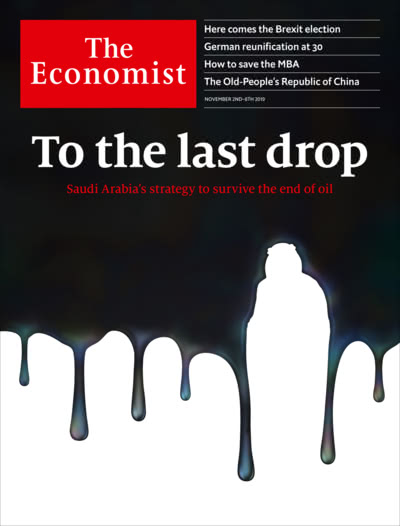
A few weeks ago The Economist ran this cover and two stories on Saudi Aramco, climate change, and the future of the global oil industry:

They claim: “Aramco’s underlying strategy is to be the last oilman standing if the industry shrinks, pointing to the upheavals to come”.

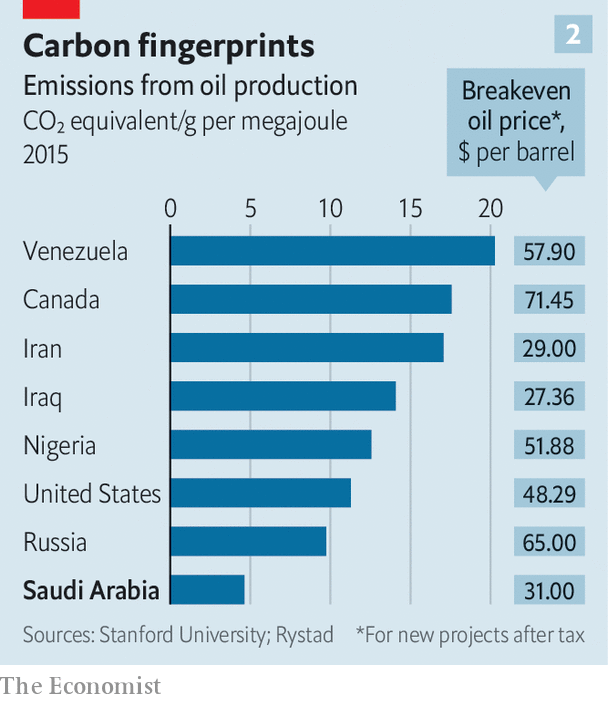
I wrote recently about the non sequiturs often used the defend the Canadian oil industry, notably the claim that Saudi Arabia’s awful human rights record makes it better to extract oil here than there. A chart from The Economist’s longer article further challenges that view:

If we can only use a fraction of the world’s remaining oil without causing catastrophic climate change, it makes sense that we should use the cheapest and cleanest oil. It makes no sense whatsoever to keep investing in the Canadian industry when the capacity already exists globally to extract all the oil the carbon budget will allow.

The IMF on carbon taxes

Carbon taxes have begun to play a strange role in debates on climate change politics. Designed to appeal to conservatives they are now a focus of rage on the political right. At the same time, they are supported by some big fossil fuel companies who see them as a comparatively small cost and a potential source of certainty about future policy.

Recently, the IMF commented:

The Washington-based Fund said the battle against climate change could only be won if the average carbon tax levied by its member states increased from $2 (£1.63) a ton (907kg) to $75 a ton.

The IMF said governments worried about a political backlash against big increases in the cost of heating homes and motoring, and should use the extra revenue raised from the tax to compensate consumers.

“To limit global warming to 2C or less – the level deemed safe by science – large emitting countries need to take ambitious action,” IMF economists said.

“For example, they should introduce a carbon tax set to rise quickly to $75 a ton in 2030. This would mean household electric bills would go up by 43% cumulatively over the next decade on average – more in countries that still rely heavily on coal in electricity generation, less elsewhere. Gasoline would cost 14% more on average.”

Calculations by the IMF’s economists show that a $75-a-ton carbon tax would also lead – once inflation has been taken into account – to an average 214% increase in the cost of coal and a 68% increase in natural gas. For the UK, the increases would be 157% for coal, 51% for natural gas, 43% for electricity and 8% for petrol.

The IMF has something of a reputation for thinking about policy, not politics, and it’s hard to see a carbon tax like this being implemented in any major democratic country.

Trudeau’s false radicalism

Geoff Dembicki has a piece out about how Trudeau’s method is to promise substantive reforms to voters, while privately comforting business with the understanding they won’t really be meaningful:

So on climate, for instance, he was presented as this kind of river-paddling environmental Adonis. He promised that fossil fuel projects wouldn’t go ahead without the permission of communities. But the Liberals create these public spectacles of their bold progressiveness while they quietly assure the corporate elite that their interests will be safeguarded. So at the same time Trudeau was going around the country and convincing people that he was this great climate hope, the Liberal party had for years been assuring big oil and gas interests that there would not be any fundamental change to the status quo.

The Liberal climate plan essentially is a reworking of the business plan of Big Oil and the broader corporate lobby. Most Canadians probably wouldn’t realize this because of the nature of coverage in the mainstream media and the polarized political debate about the carbon tax, but overwhelmingly there is an astonishing consensus among the corporate elite in support of a carbon tax.

The plan is to support a carbon tax and to effectively make it a cover for expanded tarsands production and pipelines. That was a plan hatched by the Business Council of Canada back in 2006, 2007. For 20 years oil companies had resisted any kind of regulation or any kind of carbon tax and fought it seriously. But they started to realize that it would be a kind of concession that they would have to make in order to assure stability and their bottom line not being harmed. The climate bargain that Trudeau went on to strike with Alberta of a carbon tax plus expanded tarsands production was precisely the deal that Big Oil had wanted.

For a long time, Canadians prioritizing climate change have had no effective political option. Under first-past-the-post Green and even NDP votes are often counterproductive protests. I’m wary about criticism of the Liberals increasing the odds of a Conservative win, but I don’t think we should lie either.

Pharma charities and drug co-payments

I hadn’t heard about this weird distortion in the US medical system, where pharmaceutical companies use tax-exempt charities to manipulate the co-payment system used by health insurers for prescription drugs:

Half of America’s 20 largest charities are affiliated with pharmaceutical companies.

Pharmaceutical companies will often claim that helping patients with their co-payments is a way of making costly drugs more accessible. But it has the fortunate consequence of making their customers price-insensitive, because insurance companies will often use high co-payments to nudge their customers into opting for generics over costlier branded drugs: no co-pay, no incentive to save money.

The Securities and Exchange Commission (sec) is also looking more closely at independent charities that are sometimes sponsored by pharmaceutical firms. One independent charity offered co-pay support only for a specific type of “breakthrough pain” for cancer patients, a condition its sponsor had a 40% market share in treating. An sec probe has already settled claims with some pharmaceutical firms, though none has admitted wrongdoing. United Therapeutics has settled the biggest claim, worth $210m, with the Department of Justice. Lundbeck, a Danish drugmaker, and Pfizer have settled smaller claims. “Pfizer knew that the third-party foundation was using Pfizer’s money to cover the co-pays of patients taking Pfizer drugs,” according to Andrew Lelling, a us attorney, “masking the effect of Pfizer’s price increases.” Johnson & Johnson, Astellas, Gilead Sciences, Celgene, Biogen and others face investigations.

America’s health system is convoluted to the point of being surreal, as well as manipulated by the huge influence of the pharmaceutical industry on legislators.