
Stranded assets and regulatory risk

One of the most important economic and political points arising from climate change is uncertainty about how seriously future governments will respond to the problem. If some kind of political change makes governments serious about hitting the 1.5 – 2.0 ˚C temperature targets from the Paris Agreement, it will mean doing everything possible to rapidly reduce emissions, from imposing high carbon prices to mandating the abandonment of especially harmful technologies and practices like burning coal and using exceptionally filthy fuel for international maritime shipping. This is termed “regulatory risk”. Whenever a potential investment project has finances that rely on governments continuing to talk big but do little about climate change, the project risks becoming non-viable after all the costs of development are spent if the government subsequently starts to take climate change seriously.

When it comes to actual fossil fuel reserves, there is a related issue of “stranded assets” – fossil fuel reserves that would be economically viable to extract if they could be sold, but where the climate change and energy policies of governments either directly prohibit their extraction or add other costs like carbon taxes which make the extraction unprofitable. In such a scenario, firms that depended on the value of these reserves to justify their own market value could be in trouble, along with everyone who has invested in them.

A recent article in The Globe and Mail describes how firms are aware of these risks:

[Caisse de dépôt et placement du Québec] The Quebec-based pension fund is part of a growing tide of institutional investors – which includes giants such as Vanguard and BlackRock Inc. – pressing companies for more information on how they will manage the transition to a low-carbon economy. Companies in carbon-heavy industries such as energy and mining face the highest pressure, as investors fear being stuck holding stranded assets: companies who fail to plan for the future and whose valuations will likely plummet as a result.

“It’s a risk that we could be left holding the bag in a Minsky Moment and it could be quite costly,” says Toby Heaps, chief executive and co-founder of Corporate Knights Inc., a Toronto-based organization focused on corporate social responsibility. “I wouldn’t say we need to sound the fire alarm, but certainly it’s time to pause and take a serious look at how we can accelerate our transition to a low-carbon economy.”

The pressure has catapulted climate risk to the top of the agenda in many of Canada’s boardrooms as companies grapple with how to measure, mitigate and disclose potential liabilities. Last year, the board at Suncor Energy Inc. recommended that shareholders approve a proposal put forward by NEI Investments to enhance the company’s climate-related disclosures. Shareholders voted overwhelmingly in favour of the resolution.

There is every reason for advocates of stronger climate change mitigation policies to pressure firms to consider these risks before investing. There are ample examples of how – once a project is built and operating – it becomes politically impossible to shut down, regardless of how much harm it is causing. A classic example is coal-fired power plants in the United States that were built before the Clean Air Act and are thus exempt from the obligation to install scrubbers. Arguably, the entire bitumen sands is a massive example of a terrible idea that has become impossible to discontinue because too much has been invested, too many jobs are now at stake, and governments have become too dependent on royalties and other related revenue.
Targeting pipelines

By the time of the 2015 World Heavy Oil Congress, midstream companies like Kinder Morgan, Enbridge and TransMountain PipeLines had grown used to the calamity that accompanied their pipeline applications. TransCanada’s Keystone XL project had ignited the battle, drawing ferocious protests from ranchers and Indigenous people in Nebraska. This in turn had attracted opposition from regional and then national and global environmental groups, which had long searched in vain for a catalyst to intensify and expand climate change activism. Keystone XL turned oil sands pipelines into an international political issue and a proxy of the first resort for the much broader debate about climate and energy policy. In the process, the pipeline — eventually any pipeline intended to move bitumen to tidewater — became the symbol of the entire fight. It was the line in the sand, the first full and direct conflict between progress in the age of fossil fuel — defined by expanding energy use and industrial megaprojects — and progress in the age of climate change, which sought to balance economic growth and industrial development with sound environmental stewardship and reductions in greenhouse gas emissions.

Turner, Chris. The Patch: The People, Pipelines and Politics of the Oil Sands. Simon & Schuster, 2017. p. 119 (emphasis in original)

Boom psychology

Perhaps every boom is expected to last forever. Every boom contains within it some skewed logic in which the impossible growth and rapidly amassed wealth undergo a transition from fantastically fluid to some simulacrum of a solid state. The careening boom logic becomes the norm. Luck becomes a strain of genius, and opportunism starts to resemble a chess master’s grand strategy. The boom was built on stuff as solid and true as glass and steel, crafted from the technological brilliance and entrepreneurial daring of a generation of the smartest engineers the nation has ever known, its credibility renewed daily at a rate of 2.4 million barrels. With such lofty heights near enough in the Patch’s collective memory, even the deepest troughs can seem like mere hiccups on a journey headed ever upward.

Turner, Chris. The Patch: The People, Pipelines and Politics of the Oil Sands. Simon & Schuster, 2017. p. 107–8

Scale of bitumen sands investment

Midway through the boom’s first wave, in 2006, a Statistics Canada study reported that Alberta was in the midst of “the strongest period of economic growth ever recorded by any Canadian province.” Annual provincial gross domestic product (GDP) and population growth both cleared 10 percent.

When the oil industry’s champions first pitched the federal and provincial governments on more favourable tax and royalty regimes in the mid-1990s, they promised $25 billion in capital expenditure on oil sands projects within 25 years. They hit that mark inside of five years and kept on charging. More than $200 billion was invested in the oil sands from 1999 to 2013. In 2014, the peak year for investment, $34 billion more in capital poured into the Patch. Alberta collected $5.2 billion in royalties from oil sands production the same year.

Turner, Chris. The Patch: The People, Pipelines and Politics of the Oil Sands. Simon & Schuster, 2017. p. 96

The bitumen sands and global decarbonization

Still, even if it was not recognized in many boardrooms in Calgary or anywhere else in the industry, oil’s dominance could no longer be taken for granted. Climate change was not readily managed like the sludge in a single tailings pond or contained like the mess from a single pipeline spill. This was a more profound challenge to the industry’s story of progress — perhaps an existential one. In the years after Shell unveiled its two scenarios, environmental activists began to stand in opposition to one new fossil fuel project after another, and bankers and investors started to ask industry executives tough questions about whether their reserves represented future profits or “stranded assets.” And starting with the proposed Keystone XL project, a major new pipeline that intended to carry Alberta’s bitumen from a storage terminal on the prairie south of Fort McMurray to the Gulf of Mexico, the oil sands became the front line in a larger conflict. In the story of progress being told with climate change at its centre, the world had no choice but to move as quickly as possible toward an economy free of greenhouse gas emissions. For a variety of reasons connected only tangentially to the daily operations of an oil sands site — American political considerations and universal symbolic impact, in particular — the elimination of the Patch’s daily ration of the world’s oil supply came to be seen as the essential first step in this decarbonization process.

Turner, Chris. The Patch: The People, Pipelines and Politics of the Oil Sands. Simon & Schuster, 2017. p. 15–6

Fort McMurray in 2007

The city existed in a perpetual state of growth and agitation. Numbers were murky at the peak of the boom — no one could get a clear count of the “shadow population” living in work camps and other short-term arrangements — but safe to say there were many hundreds like Raheel Joseph arriving each month. Hundreds and hundreds of young people, young men especially, who’d come from somewhere far away because here was a place where the full scale of opportunity a person could grasp all at once was still an open question. And so there were too many people and there was too much money and there was not enough of anything else in Fort McMurray in 2007. A little snow or a single stalled truck, and traffic on Highway 63 was pure gridlocked chaos. You went to Walmart, and no one was stocking shelves — they couldn’t afford the wages to pay someone to do it, and there was no time. They just put the groceries or housewares or work clothes or whatever new stuff made it to the boomtown that week out on pallets, and the pallets would be empty within hours. This was really how things went, day in and day out. Any warm body could find a job, but try to get a table at a restaurant, try to get a coffee at Tim Hortons in less than half an hour, try to find a bed to sleep in.

Turner, Chris. The Patch: The People, Pipelines and Politics of the Oil Sands. Simon & Schuster, 2017. p. 5

Related: Boomtowns and bitumen

The Chiron and humanity at its worst

I’ve written elsewhere about how The Economist doesn’t understand climate change. In their science section and the occasional editorial they stress the need for massive and urgent action, but their thinking is not joined up. Their general editorial stance remains that economic growth is the greatest good, every new fossil fuel discovery is a boon, and that largely business-as-usual politics is either desirable or inevitable.

One passage from a recent special report on France demonstrates the chasm between their enthusiasms and what is necessary for a sustainable world:

The word “factory” does not do justice to Bugatti’s state-of-the-art production site in the shadow of the forest-clad Vosges mountains in eastern France. There is no grease or grime around the assembly line. The floor is a shimmering white gloss. The airy space feels more like a museum of modern art, gleaming eight-litre engines displayed like so many design exhibits. Workers wear white gloves, as if handling treasures. In fact, they are building the world’s fastest supercar.

A Milanese engineer, Ettore Bugatti, founded a car factory in this corner of France in 1909. Germany’s Volkswagen, which later bought the brand, chose Bugatti’s historic French site to develop the Veyron, a car designed to combine elegance and speed. The French factory turned out every one of these luxury record-breaking cars after their launch in 2005. This year Bugatti unveiled a successor, the Chiron, which pushes the limits of physics and sleek design further still. The car reaches 100km (62 miles) an hour in two-and-a-half seconds and has a starting price of €2.4m. Christophe Piochon, head of the French plant, compares the exquisite craftsmanship that goes into the construction of a Bugatti car to haute couture.

This schoolboy hard-on for a product that embodies everything that is putting humanity in peril is both telling and depressing. There’s a pretty strong case that nobody should be allowed to be rich enough to own a €2.4m car. Most people in that position are probably corporate executives, and there is little reason to believe they deserve it. It does not seem that the people who are given such lavish compensation produce that level of value for their employers, and even if they did it doesn’t necessarily follow that they should get to keep it for themselves.

Beyond the issues of economic inequality, there is the fundamental inappropriateness of the technology itself. Car racing is spectacularly pointless in itself, but a race track is essentially the only suitable venue for such a vehicle. Having people driving them around city streets as status symbols demonstrates much about what’s sick in our culture.

Pros and cons of Google’s advanced protection

I see enormous appeal in Google’s new advanced protection system for accounts. It requires a physical token to access your account, adds further screening of attachments, and has a much tougher account recovery process for anybody who legitimately loses access to their own account. It augments the security provided by their two-factor smartphone app by reducing the risk of someone using an attack against your phone as a way to steal the second factor.

Two problems are keeping me from signing up right away. First, it requires that you buy a Bluetooth token as well as a USB token. I much prefer to avoid wireless communications if possible, and I don’t want a delicate device that needs regular battery charging to carry around. The two tokens together cost about $50, and as an extra pain the Bluetooth token seems to be a pair to order via Amazon in Canada. Second, it forces you to access your account through Google’s Chrome browser, which seems unnecessarily restrictive and monopolistic.

Limits to the effectiveness of divestment

There are some comparatively convincing arguments for why fossil fuel divestment can’t do much to limit the severity of climate change, at least in terms of the direct effects from institutions selling their shares.

One important one is that people buying and selling stocks, and the changing value of the stocks, doesn’t directly profit or harm the company involved. A secondary market in shares is necessary to make IPOs possible, but once a company has gone public, it raises the money for big new fossil fuel projects in other ways, such as borrowing from banks.

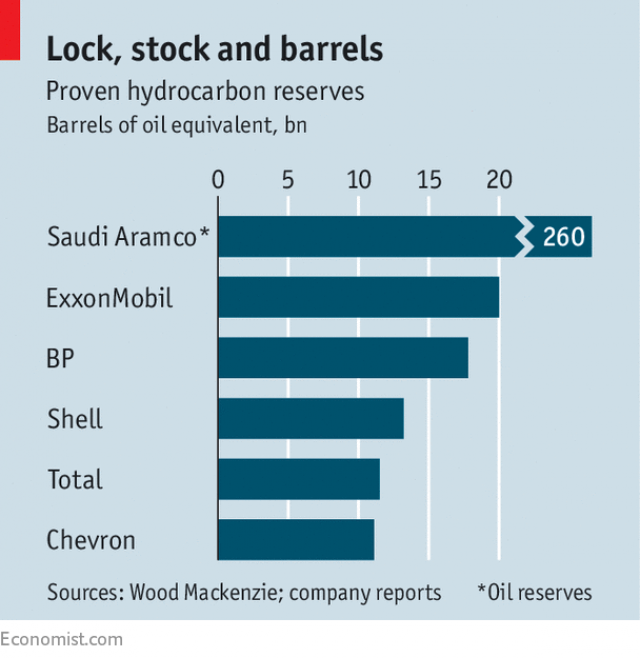
Another is that — while the proven reserves owned by companies like ExxonMobil are vast and can do considerable climate damage — sovereign countries have much larger reserves:

There are responses to these objectives, mainly in terms of how divestment is meant to gradually shift investor sentiment. Divestment is based on a financial as well as a moral case: if we really are going to control climate change, we can’t burn most of the world’s remaining coal, oil, and gas. As such, it makes no sense to develop big new projects, since we can’t even use all the resources in projects that have already been built. If it helps to spread that idea, divestment will have been worthwhile.

It might even help reduce the value of Saudi Aramco itself and the magnitude of its future investments, given that the firm is expected to be partly privatized in the near future.

Civil disobedience as a climate change activism tactic

Friday’s episode of “The Current” discussed the case of Michael Foster who — after warning the pipeline control centre to shut off the pumping stations — turned a valve to shut down the flow of bitumen through the Keystone pipeline in North Dakota. It’s a very self-conscious act of civil disobedience, with Foster sending video to the company in real time showing that the shutdown was imminent and discussing beforehand his expectation that he would be convicted of a crime (transcript / MP3).

Few who take climate change seriously would see this action as unjustified. Canada should have started shutting down the oil sands decades ago and should never have developed them to their current size. There is much debate, however, on the effectiveness of such actions. Their logic depends on influencing external actors: either the general public or the legal system.

Fairly recently my friend Stuart was involved in a non-violent direct action blocking automobile access to Heathrow airport. The objective was essentially “consciousness raising” (he said it was to “stir up the national debate about Heathrow”), that the willingness of activists to put themselves in legal jeopardy would make people accept how terribly unethical our casual use of air travel is.

In the Heathrow case, it’s hard for me to imagine that outcome. Air travellers are stressed and deeply entitled. They feel totally justified in complaining about any inconvenience, and I doubt more than a trivial number would reconsider the broad context of their air travel use when exposed to an action like this.

The situation discussed in the pipeline shutdown case podcast seems to offer a little more hope, largely because of the opportunity to use the legal proceedings as a vehicle for public education. Pipeline companies are already seen as villains by many, and the public and the courts may be more sympathetic to the value of disrupting them than of disrupting the air travel of ‘normal’ people. That said, the courts are a bad mechanism for trying to change climate policy for several reasons: they tend to defer to elected politicians on questions of policy, they can prohibit specific things but rarely order broad outcomes, and rulings requiring broad policy changes are often ignored.

We don’t have good options though. The general public are entitled, selfish, and determined to defend the status quo even when it imposes catastrophe on others. It’s common to say that they are apathetic, but I think that’s a misdiagnosis; it’s less that people have accepted the need to act but are unwilling to do so personally and more that they are constantly acting to support the system that is destroying nature and the prospects of all future human generations. They are unwilling to change their lives or their politics nearly enough or nearly quickly enough to avoid climate catastrophe. No political party in Canada, the U.S., or U.K. has a serious plan to meet the Paris Agreement targets, much less to actually avoid dangerous climate change. And so, in an unprecedented situation and with no good options, activists are trying what’s available and sacrificing their freedom to do so.

One of the most insightful comments about climate change is George Monbiot’s observation that:

[The campaign against climate change] is a campaign not for abundance but for austerity. It is a campaign not for more freedom but for less. Strangest of all, it is a campaign not just against other people, but against ourselves.

No matter how strong the scientific consensus and how undeniable the real-world evidence becomes, nothing so far has convinced people to take action even slightly commensurate with the scale of action required, and people turn all their intellectual and rhetorical skills to justify that inaction (such as by pointing to the other good things they do). Overcoming those psychological responses may be just as important as breaking the power of the fossil fuel industry in a global campaign that can keep us from imposing so much suffering on future generations that we threaten the very ability of human civilization to endure.

Related: