This American Life on patents

A recent episode of the This American Life podcast centres around technology patents, with emphasis on the so-called ‘patent trolls’ who harass legitimate companies using dubious patent claims, in hopes of getting cash settlements.

Designing an ideal patent system is an interesting question from a utilitarian perspective. It seems beneficial to encourage innovation and protect small companies with novel ideas from giant companies that might steal them. At the same time, patents can be used by big companies to bully small ones, and when obvious ideas are given patents it can prevent useful technologies from becoming widely available.

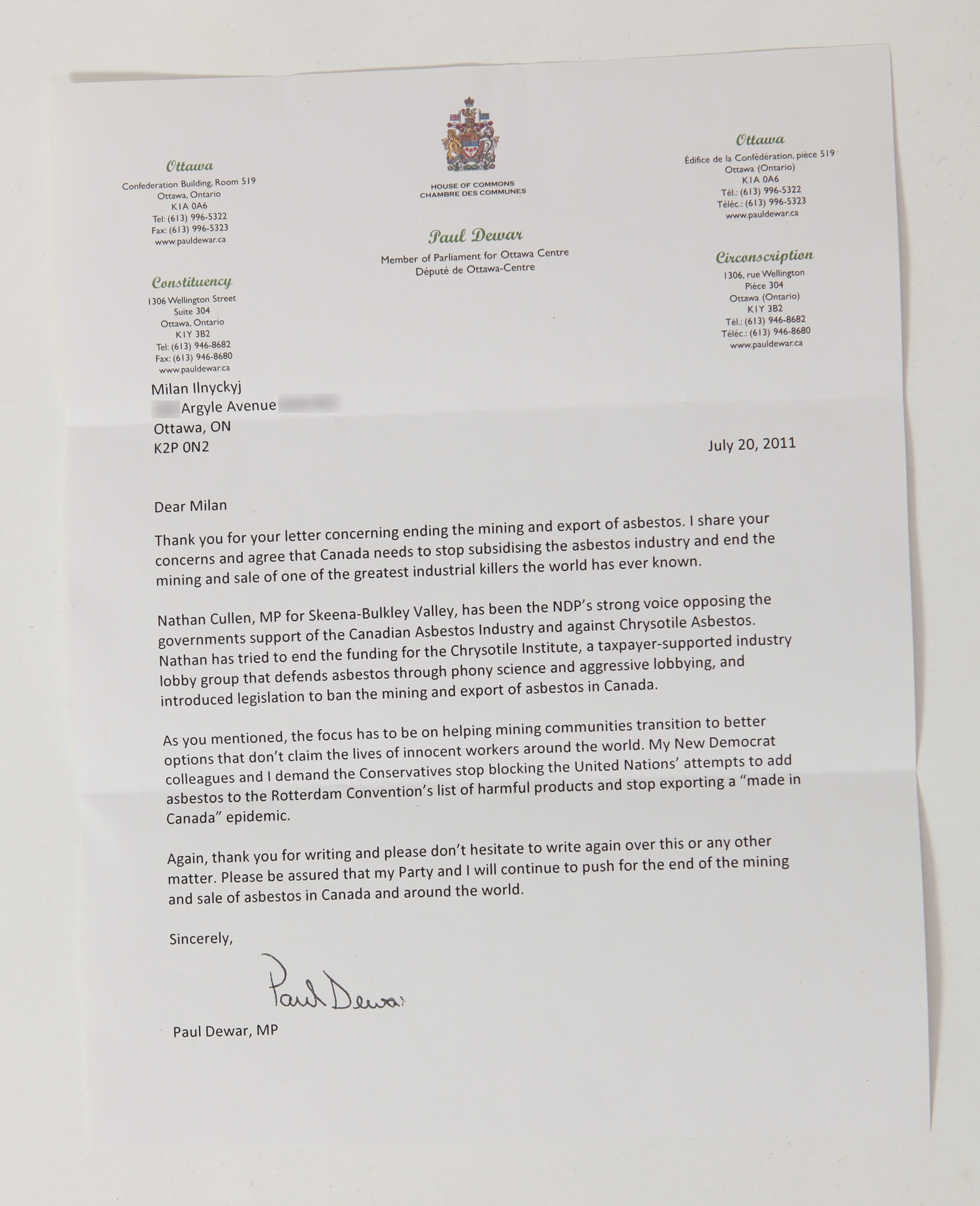
Dewar letter regarding asbestos

Around Canada Day, I wrote a letter to Paul Dewar, my Member of Parliament, about Canada’s export of crysotile asbestos. It seemed classier than holding up a giant “Shame on Canada, Asbestos = Cancer” sign during the Royal Visit.

Today, I got a response setting out his position on the issue:

Any pro-asbestos residents of Ottawa Centre should start bombarding him with strongly worded letters immediately. I am curious what sort of response they would get; hopefully, the same statement of policy with an explanation of why Dewar disagrees with those who favour Canada’s current policy of asbestos support.

It’s good that he has staked his colours to the mast on the issue. Constituents who are concerned about the issue of asbestos should make sure he has voted along these lines the next time the issue arises in the House of Commons. By then, I expect, I will have a new MP (due to me moving).

Asbestos export is an issue I first raised here some time ago.

Should I renew my subscription to The Economist?

Since I was in high school, I have been reading this British news magazine weekly, and not without good reasons. It is essential reading for university debators in Canada. If you don’t keep up to speed on what is written there, you are likely to get blindsided when your opponents bring it up. While their editorial stances are not always entirely convincing, they do defend them with evidence and good arguments. You will never sound entirely stupid while trying to defend their positions.

The Economist is also a magazine that seems to maintain attention in many other quarters. It is the only magazine I have frequently seen circulated in Ottawa offices. The biggest argument in favour of reading it may be that others do, and that by continuing to do so I keep myself appraised of what is happening. As a way of remaining reasonably well informed about happenings in many different spheres of life, all over the world, it may be a uniquely valuable publication.

There are also arguments against renewal. Some have argued that I would be better off spending more time reading other sources of news. Some have argued that I should read less news altogether: most of it is depressing, and most of it I can do absolutely nothing about.

Time is another issue. Your average weekly issue consists of about 100 pages of small, tightly-spaced text. I find that it takes at least five hours to read carefully, and significantly longer when there are lengthy special reports, technology quarterlies, and the like included. I could probably find ways to use that time that would be more useful or pleasant.

The cost is a bit of a consideration, at more than $400 for three more years. That is especially true given ongoing job uncertainty.

There is also the matter of climate change. The Economist does seem to accept the basic science that says that continuing to burn fossil fuels threatens humanity. Some of the time, the seriousness of the problem is reflected in the positions they take. At the same time, they have definitely failed to demand that politicians prioritize climate change over other issues, particularly economic growth. They have also frequently celebrated the discovery and development of fossil fuel reserves. Increasingly, it seems like they must be covert supporters of geoengineering. They realize that climate change needs to be dealt with, and know what would be involved in achieving that outcome by cutting fossil fuel use. They are unwilling to wholeheartedly endorse the rapid abandonment of fossil fuels, so the implicit position is to their accept the climatic consequences or try to eliminate them by technical means.

So, what do people think? To renew or not to renew?

Don’t kill the Webb!

With the last Space Shuttle mission ongoing, people are naturally asking what the future of space exploration is going to be. It seems clear that ambitious plans like a manned mission to Mars are a non-starter in the current fiscal climate. That being said, one of the major reasons why such missions are basically off the table is because they are not very useful. It would be very difficult to get human beings to Mars and then return them alive to Earth, but it wouldn’t teach us much about the universe.

By contrast, the James Webb Space Telescope is designed to be the successor to Hubble: one of the most successful scientific instruments of all time. Much of what we know about the universe has been established, confirmed, or refined using data from that instrument. As such, it is saddening to hear rumours that the Webb telescope may be scrapped fur budgetary reasons, if NASA experiences funding cuts of a certain magnitude.

It seems to me that would be a great shame. While the Webb will cost billions of dollars, it will also actively push forward the boundary of human knowledge and give us a better sense of what the universe is like. Launching it is something that humanity ought to do, even if we are experiencing economically difficult times. Basic science is something that builds upon itself, as new data is collected and new experiments are carried out. It is impossible to know in advance what the consequences of some seemingly obscure bit of cosmology or astronomy or physics will be. For instance, who would have predicted that special relativity would one day permit the precise geographic location of inexpensive receivers, using coordinated time signals from satellites (GPS).

For the sake of the important human undertaking of understanding our universe, we should find the money for the Webb.

Harperland: The Politics of Control

Lawrence Martin’s 275-page account of the political life of Canadian Prime Minister Stephen Harper is useful reading for those who want to more fully understand how Canadian politics reached the arrangement it is now in, as well as those who wish to speculate more effectively about what the years ahead will involve. While Martin’s account is fairly hostile to Harper, the claims included within it are generally quite focused and backed by evidence. It is definitely written in the style of a journalist: opinionated, but with an awareness that everything will be fact checked. The book is packed with illuminating little details, from the way former Liberal Party leader Stephane Dion first arrived to work in Ottawa by bus to how the election-prompting decision to cut per-vote funding to political parties arrived was conveyed by unexpected BlackBerry message.

At times, Martin is sharply critical of Harper and the decisions of the Harper government. For instance, he objects strongly to the treatment of underage terrorist suspect Omar Khadr, the suppression of information on the torture of detainees in Afghanistan, as well as the fiscal record of the Conservative government. Martin argues that on many different policy files, the Harper government is driven by ideology and actively hostile to evidence. These include minimum sentences, drug policy, the long-form census, and others. The Harper government is also portrayed as obsessed with power for its own sake, rather than for the advancement of a well-articulated philosophy, as well as irrationally hostile to their political adversaries and those who disagree on policy grounds. In addition, the Harper government is portrayed as ignoring Canada’s constitutional conventions on matters like the supremacy of parliament, weakening government overall while strengthening the executive.

At many points, the book touches upon climate change and environmental topics. It probably won’t be too illuminating for people who have been following the file, but the details included strengthen the argument that the Harper government has largely seen climate change as a public relations problem to be managed, rather than a real-world issue of any importance to Canadians.

Written by someone who obviously has a great deal of personal experience with the various recent eras of Canadian politics, Harperland may be an especially worthwhile read for younger citizens who dimly remember the Chretien era that took place when they were children and who do not have any personal basis for comparing the recent Conservative governments to those earlier in Canadian history. The book also provides some personal details and character insights on Harper himself and those closely associated with him. It is interesting to read about how despair often precedes the re-emergence of resolution for him after a setback, or to have some examples of his documented vindictive streak provided. Matin quotes Charlie Angus in describing Harper’s “fundamental flaw” as “a mean streak, a level of viciousness that comes out”.

The book contains many references to the interactions between the political and bureaucratic sides of government, particularly on issues like access to information. There are also detailed accounts of the fates of various ministers and high-level advisors.

At times, Martin’s account is rather passionate – particularly concerning the near-emergence of a Liberal-NDP coalition. Particularly when describing this time period, the author seems to be shouting after-the-fact advice to journalists and the opposition. I haven’t been keeping track of his journalistic contributions elsewhere, so it is possible that he is simply re-asserting claims of his own that he feels have been vindicated by future events.

One thing that annoyed me a bit about the book is Martin’s habit of using ‘the West’ as a synonym for ‘Alberta’. It may look that way to someone who sees Ontario and Quebec as the centre of the political universe, but it looks awfully different from British Columbia.

Harperland does praise some successes of the Conservative government. In the ‘achievement log’ he places “the granting of nation status to the Quebecois, the apology to the Native peoples on residential schools, corporate tax reductions, the softwood lumber accord, and the Haitian earthquake rescue effort”. In the end, however, Martin’s verdict is fairly strongly negative:

As a strongman prime minister, [Harper] was beyond compare. He made previous alleged dictators like Jean Chretien look like welterweights. It was no small wonder that Canadians feared what he might do with a majority government. With that kind of power he could establish a hegemony the likes of which Canadians could not imagine.

Martin will have to provide an update in four years or so.

Recent lessons from the NPR Planet Money podcast

Arguments and ideas featured in recent Planet Money podcasts:

It’s a good podcast.

The end of the mail lockout

In the case of Canada Post, the use of back-to-work legislation to end the labour dispute seems inappropriate. Quite likely, it is a violation of the right to collective bargaining that the members of the union possess.

Losing postal service has not been a catastrophe. It definitely wasn’t too problematic before the management-initiated lockout. As such, the only serious disruption to service that has taken place has been the result of a management decision. Canada Post’s workers don’t deserve to be forced back to work through legislation because of that.

Blowout 2100

The overall aim of governments and political parties in North America an Europe at the moment seems to be serving the interests of people who are about 50 and at least fairly well off. Keep stock prices and house prices up, prop up failing banks and car companies, keep pumping fossil fuels, don’t worry about climate change or what future generations will use for energy. After all, the core supporters of the politicians (especially when it comes to all-important campaign cash) will probably be dead by the time the most serious effects of climate change are felt. The same goes for the people in high-level decision-making positions in government and industry today.

It seems that future generations will have good cause to hate us. We have had climate change endlessly explained to us, with multiple convincing lines of evidence to back up the theory. We have been told what we need to do to stop it, but we have chosen to do nothing because we care about our short-term economic welfare more than anything else.

If that is the implicit attitude of the politics of today, it would be helpful if it was made explicit. “Vote for Party X for 30 or 40 more years of relative prosperity. After that, no promises.”

Climate wave crested?

At least for the next few years, it seems likely that the level of public concern about climate change has peaked, and attention will be focused elsewhere. That isn’t justified by the facts, but it seems to be the case, and it is the reality that people pressing for more action need to deal with now.

We have to be intelligent and determined enough to drive the emergence of acceptable climate change policies – ones that protect the planet which we all fundamentally depend upon from casual destruction, because people prefer to have cheaper electricity and transport right now. We need to do that despite how people are worried about other things, how the science is complex and challenging to understand, and how the ideal path forward can only be approximated through risk analysis. We need to try approaches until we find ones that work.

Why keep trying?

The other day, I was looking back over the photos I took at the Fill The Hill climate change event in Ottawa, back in October of 2009. At the time, the event made me optimistic. Here were all these young people concerned about climate change and ready to take personal action in response to it.

When I look at the photos now, the Hill seems a bit thinly populated. Contrast how many people turned out to express their concern about climate change with how many people get excited about a meaningless hockey game or concert and it seems like humanity has cause to worry.

The most important reason to deal with climate change is the ethical obligation we owe to future generations – the obligation to leave them a planet that can support their welfare. When it comes to how people decide on their priorities, however, it seems like such ethical obligations are very low on the list, way below personal financial welfare or convenience.

When I think about how the Amazon rainforest may be doomed because of human greenhouse gas pollution, along with the Great Barrier Reef and countless species, I feel overwhelmed with revulsion about how casually destructive our species is, and how little regard we show for the world which we inhabit and ultimately depend upon completely. We do not have the technical means to build a self-sustaining spacecraft and so the continued life of every human being on the planet depends on the continued operation of all the physical and biological processes that make the Earth habitable. Now – largely because we are fond of cheap energy – we are willfully assaulting those processes as though they are indestructible.

In the face of that, I wonder whether any personal efforts of mine are meaningful. If humanity as a whole is determined to commit suicide, why should I spend my life trying to stop it? The forces pressing for a sane and sustainable strategy seem to be far weaker than the forces that promise instant gratification today, with little consideration for whatever consequences follow.

Normally, this is where I would try to write an uplifting closing about how doing the right thing is appropriate, even when the odds are hopeless and when other people will actually resent you for making the effort. The noble course combines self-sacrifice (reducing your personal impact) with determined political action to try to produce a better outcome. While I still think that is true, and know my conviction will eventually return, it is feeling thoroughly sapped at the moment, partly by the way voters everywhere continue to make their political choices largely on the basis of their own short-term economic self-interest.

Humanity is very clever in a micro sense – when it comes to solving small problems in ways that benefit the solvers quickly and materially. When it comes to macro issues, it seems to be dumb luck and the sheer durability of nature that explain why we haven’t wiped ourselves out already. That isn’t much comfort though. There are limits to how much abuse nature can tolerate, and we have been beating it pretty harshly with a wrench lately (with still-worse abuse promised for the future). Perhaps humanity has no future, and perhaps the thing to do as individuals is choose whatever life seems most tolerable with that possibility acknowledged.