Sleep and slime moulds

Since I spent the last fourteen hours sleeping, I don’t have much of interest to convey right now.

As a consolation, here is a time lapse video of slime moulds and fungus growing. I have always found slime moulds rather fascinating. They start of as single-celled, bacteria-eating organisms resembling amoebas. If two with matching mating types encounter one another, they can form a zygote. That, in turn, becomes a macroscopic organism with many nuclei, but no membranes between cells – an “interconnected network of protoplasmic strands.” Once this has eaten everything nearby, fruiting bodies form that disperse spores. These hatch into single-celled bacteria-eating eukaryotes once again.

One of the more odd and charming sections from the Wikipedia entry on slime moulds is this:

In 2006, researchers at the University of Southampton and the University of Kobe reported that they had built a six-legged robot whose movement was remotely controlled by a Physarum slime mold. The mold directed the robot into a dark corner most similar to its natural habitat.

It is disconcerting to consider that an entity consisting of an amalgamation of amoebas can apparently display something akin to preferences when put in control of a robot (though I think the ‘control’ just consisted of watching how the slime mould moved and copying it). This article has a picture of the robot.

In any case, I am hoping that my period of hibernation will reset my brain. During the last few days, it has sunken into something akin to – but nonetheless more profound than – the normal August lull which permeates Ottawa.

Editing video using still photos

Recently, there was controversy about a doctored photograph showing four Iranian missiles launching, whereas the original apparently showed three and one on the ground. Errol Morris discussed the images on the website of the New York Times.

Photo and video editing are nothing new, but some new software seeks to make the former much easier. It combines video data with that from still photographs in order to accomplish many possible aims. For instance, it could be used to improve the resolution of a whole scene or elements within it. It could also correct for over- and under-exposed regions. Of course, it could also facilitate video manipulation. The skills and software required to edit still images are increasingly available. Combine that with this software and you could empower a slew of new video fraudsters.

It will be interesting to see what kind of countermeasures emerge from organizations concerned about data integrity. One route is forensic – identifying markers of manipulation and tools for uncovering them. Another relies on requiring technologies and techniques for those capturing and submitting video. That could involve the expectation of multiple independent photos and videos produced from different angles using different equipment, or perhaps the widespread deployment of timestamps and cryptographic hashing to strengthen data integrity.

Juno

Juno, a gently comedic and mature-feeling story of teen pregnancy, is really quite a charming film. Other films had so thoroughly ingrained the notion that a teen pregnancy was necessarily utterly disastrous that I spent most of the film waiting for the axe to drop. The fact that it didn’t was a nice deviation from the kind of hysteria that often accompanies the treatment of social issues.

The film is grounded in strong performances by Allison Janney (who I remember from the West Wing) and, of course, Ellen Page, who was previously unknown to me. She manages the Gilmore Girls ‘too charming to be a real teenager’ persona with unusual skill. Indeed, it is the combination of the strong script and Page’s impressive but plausible self-possession that principally make this a film worth seeing.

Wall-E

Emily Horn kissing a statue in the Supreme Court of Canada

The Wall-E trailer did not impress me. It made the film look cute and trite. Nonetheless, I was convinced to see the film by strong recommendations in various news sources and ongoing debates about its environmental messages.

The film is definitely well done: engaging and entertaining, emotive without being sappy. Some of the messages are indisputable: that resilience is a virtue (Wall-E has learned self-repair), that the planet is vulnerable, and that technology can isolate us from natural processes, making us unaware of the impacts we are collectively producing. Others are more dubious: that people ignore their environmental impacts because they are half-hypnotized by machines, rather than because it is convenient to do so, or that a simple imposition of will is sufficient to turn things around. The danger is less that robots will mutiny, and much more that we will be willing to make exceptional ecological sacrifices in order to keep our favourite machines running. It’s not that our creations will defy our will, it’s that we will refuse to temper our desires, whatever the long-term costs associated. Wall-E does make the second point (largely though the vehicle of the floating, near-helpless humans), but it gives a bit too much of a free pass on the first.

It seems fairly likely that this film is destined for the cannon of ‘environmental films for children,’ alongside stalwarts like The Lorax. It deserves the slot, combining old messages about conservation and the sanctity of life with the imagery of contemporary society. It also deserves to be widely seen, by children and adults. That is as much on account of the strong storytelling as anything else – the dialogue is minimal, but it is never the slightest bit tedious. The story is strong, the film is beautifully made, and it generates thought.

On a side note: the various nods to Apple were slightly amusing, rather than tacky. Wall-E’s startup noise will be familiar to anyone who has used a Mac, as is the whole styling of Eve. The original iMac ‘mice’ infesting the garbage heaps in space were also an entertaining touch. Of course, it is a bit ironic that the main object of desire in the film – the robot Eve that Wall-E pines after – is fundamentally modeled upon a much hyped consumer product.

[Update: 8:01am] Emily’s review is here.

The Dark Knight

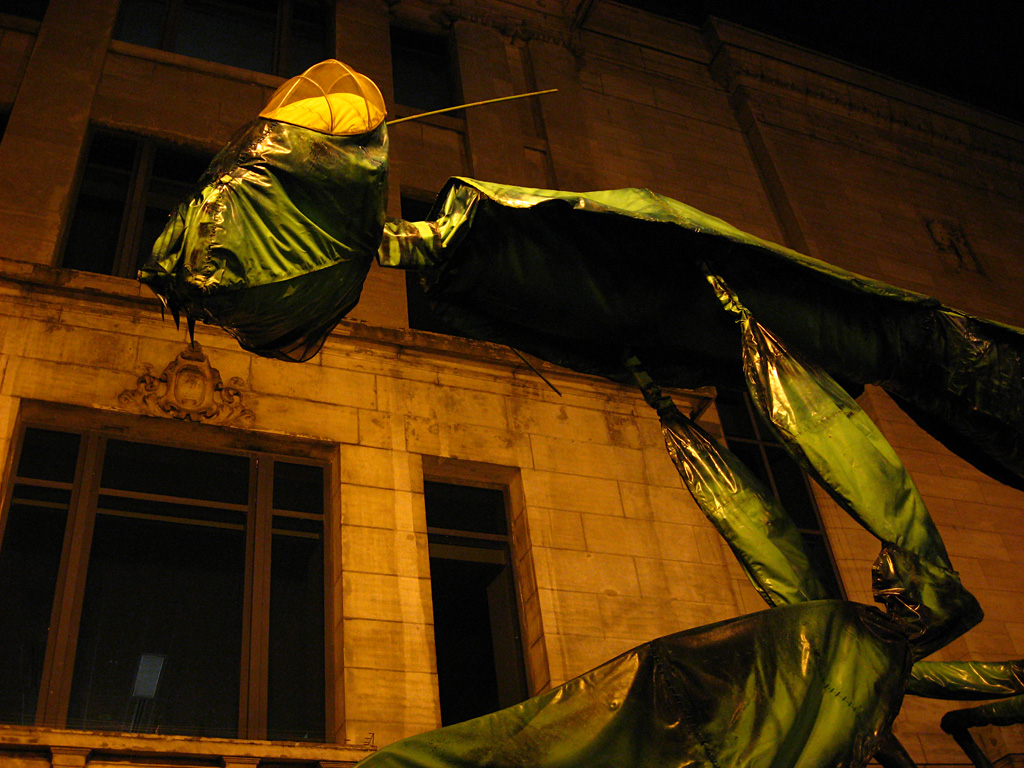
Giant praying mantis, Montreal

Ordinarily, comic book movies are an exercise in the aggressive non-suspension of disbelief, for me. Whether internally criticizing absurd physics or ludicrous plot points, I generally entertain myself more despite them than through them. The Dark Knight was an exception.

I posit two major reasons for this. Firstly, it is a result of the character of the Batman universe. It exists at a larger scale than many fictional or comic universes and, as such, has more freedom to establish its own rules and expectations. It is much more Lord of the Rings than Spiderman, despite greater superficial similarities with the former. Gotham City simply differs enough from our world to make it a clear allegory, rather than reality with implausible supernatural additions and equally implausible smoothing over of plot progression (How do characters put things in place to appear at the middle of chaotic chase scenes? How does the Joker recruit and train people? Why can everyone use unfamiliar equipment instantly? Etc.) It takes a pretty good film to suppress such questions in my mind, and this one manages it notably well.

The second is simply that the acting and presentation are quite compelling. The over-the-top action sequences are less asinine than in many smasher films, and there are some decent character and thematic issues addressed. Probably more importantly, the film has a powerful aesthetic – one that even a fairly reluctant appreciator of alternative universes can respect. Where the later X-Men films felt tacky and emotionally overdone, the gritty and chaotic Batman style remains stubbornly consistent.

Of course, Batman’s moral code remains ludicrous. Simply refraining from actually killing people immediately and with your own hand seems like a bizarre form of self-limitation, when you are perfectly happy to set off massive explosions and otherwise indirectly kill large numbers of people. The film isn’t entirely divorced from point-scoring on contemporary political issues (such as the security value of mass surveillance), but it wears such garments in an accessory fashion, rather than serving as a vehicle for polemic.

On a side note, the film demonstrates the degree to which Hong Kong is itself an alternate universe, at least as viewed from the air. The place looks like Ghost in the Shell made flesh, and provides an almost visceral reminder of the rise of Asia – one that the upcoming Beijing Olympics will doubtless reinforce.


Improv everywhere

The internet creates the possibility of organizing amusing mass pranks. Improv everywhere (who have done some funny things in the past) came up with a clever idea employing twins and subway cars.

Both of my brothers did improv of the more conventional on-the-stage variety. These sorts of surreal social experiments don’t require creative skill on the part of the performers, though they do produce entertaining bafflement among passers-by.

iTunes movie rentals

Ezra Pound quote

Last night, Emily and I tried renting a film through iTunes. I think it’s fair to say that this is another media technology that Apple got right. There are endless problems with systems that promise to let you buy films in the form of downloads. There are limitations on usage, and no guarantees that you can use them on future devices. Renting is quite different. Apple offers a service akin to that of a video store for a comparable price and without the bother of picking up and returning discs. With a bit of equally convenient competition, costs may even fall further.

Indeed, it seems pretty fair to predict that video shops have no future among those customers with computers and broadband access. Eventually, web based services will offer far more films at similar quality and far greater convenience.

Personally, I am rather looking forward to the day when it will be possible to spend $4-5 for two days worth of access to most any film ever made.

A bad new copyright bill

Canada’s proposed new copyright act is unacceptably poor, most importantly because of its treatment of Digital Rights Management (DRM). Under the new law, circumventing any such system – no matter why – is against the law. This means that if the company that sold you a song decides to stop letting you access it, you are out of luck. Under the new law, it would be a crime to copy music from a DRM-protected CD that you bought to an iPod that you own, with an associated fine of $20,000.

The law would also mean that organizations like libraries cannot have any confidence in their future ability to use digital materials today and people with disabilities will not be able to use technology to make protected works more accessible. It would make it a crime for me to use VideoLAN player to watch DVDs I bought in Europe, just because people selling DVDs have decided to use monopolistic regional codes to boost profits. Indeed, it would criminalize the distribution of VideoLAN itself.

It must be remembered that the purpose of copyright law is to serve the public good, not copyright holders. We allow copyrights because they create a legal environment in which it is possible to profit from a good idea. As a result, copyright protections help to ensure that people are furnished with new and high quality music, books, etc. By failing to protect the legitimate needs of consumers, this bill fails to enhance the public interest. As such, it deserves to be opposed and defeated.

Accuracy in films

The Russian Communist Party is protesting the new Indiana Jones film, arguing that teenagers will assume it to be historically accurate and thus become confused about the history of the Cold War. St Petersburg Communist Party chief Sergei Malinkovich has said that: “It’s rubbish… In 1957 the communists did not run with crystal skulls throughout the US.”

Of course, this is all reminiscent of the open letter from Neo-Nazi groups to George Lucas and Steven Spielberg in 1981, asserting that absolutely no Nazis were killed by ghosts that flew out of the Ark of the Covenant. Similarly, they argued in 1989 that the depiction of an officer of the Third Reich being turned into a skeleton after drinking from a false Holy Grail would give a misleading historical impression to the world’s movie-watching youth.

Also in the tradition were the many complaints Baz Luhrmann received about Moulin Rouge: for instance, how much of the pop music portrayed was not written until seventy years or so after the period in question.