The usefulness of being methodical

'Justice' stonework

Whenever I need to wake up early in order to catch a bus or train, I make sure to lay everything out in a clear and sequential manner. That is the most effective way of not forgetting critical items, while also not wasting too much time checking and re-checking things. While, in my case, it is early-morning brain woolliness that makes such clear sequencing valuable, there is evidence that simple lists and straightforward procedures can also serve a useful purpose in situations where complex and demanding tasks are undertaken, sometimes making it too easy to forget a seemingly small but crucial step. Flying airplanes and performing surgery are examples. Indeed, it seems that the pilots might be able to teach some useful techniques to the men and women with the scalpels.

Some recently published research has shown that a simple World Health Organization (WHO) checklist (PDF) is highly valuable for preventing surgical mishaps. The British National Patient Safety Agency found that the use of the checklist (which includes simple items like having the surgical staff confirm the patient, site, and procedure to be performed) can cut deaths by over 40% and complications by over a third. The finding is especially impressive due to the sample size examined: 7,688 patients, 3,733 before the checklist was implemented, and 3,955 afterwards. The patients were located in a diverse collection of countries, including the United States, Canada, the United Kingdom, New Zealand, Jordan, India, the Philippines, and Tanzania. Clearly, surgeons worldwide tend to overlook the same things.

It’s a curious quirk of human nature that someone can be both capable of performing advanced cardiac surgery and capable of forgetting a sponge inside the patient’s body while sewing them up. Hopefully, simple tools like the WHO checklist will help the former to occur more successfully without the danger of the latter. In a less specific context, it is worth remembering the value of simple tools that produce welfare improvements quite disproportional to their cost or difficulty of use.


The Obameter

This strikes me as a rather good idea:

PolitiFact has compiled about 500 promises that Barack Obama made during the campaign and is tracking their progress on our Obameter. We rate their status as No Action, In the Works or Stalled. Once we find action is completed, we rate them Promise Kept, Compromise or Promise Broken.

So far, the site lists seven promises as ‘kept.’ Of course, new events may alter how Obama should and will implement his platform. Also, there is some subjectivity in assessing whether a promise has been kept. Still, it will be interesting to see how his score develops.

Useful free Mac utility: GrandPerspective

For those who need to clear up some hard drive space, figuring out which files are both large and unnecessary can be a challenge in Mac OS X. GrandPerspective is a very helpful free utility. It displays the contents of any folder you like, including your entire drive, as an image where blocks appear for each file proportional to the disk space they occupy. Within minutes of launching it, I discovered that (in an ancient backup from my old PC), I had disc images for three different archaic versions of Linux eating up 700 megabytes each.

In any case, it seems like a useful piece of software for anyone trying to manage the hard drive space on their Mac.

Fossil fuels and industrialization

Emily Horn in duotone

Given our present energy and climate predicament, it is interesting to contemplate how human history would have progressed in the absence of large supplies of coal, oil, and gas. Before efficient steam engines existed, heavy industry depended on mechanical water power to grind flour, saw wood, and so forth. Steam engines and coal helped kick off the path of development that leads to the present world, in which fossil fuels play critical roles as energy sources, inputs for agriculture, and feedstocks for chemical manufacture.

On a planet without fossil fuels, industrialization would probably have made use of mechanical water and wind energy for far longer. It is an open question whether such a society could ever have reached the point of being able to build current-generation renewables, such as electric wind and hydro turbines, solar photovoltaic panels, or concentrating solar arrays. It is possible, then, that only planets with ample and accessible supplies of fossil fuel are compatible with the development of things like spaceflight or computer networks. That could even be one explanation for the Fermi paradox: the question of why the vast observable universe hasn’t yet provided any signs of life outside our solar system.

The challenge now is to move beyond fossil fuel dependency, without losing the beneficial new capabilities that have largely arisen due to the use of those energy sources. Eventually, we need to reach a point where the whole lifecycle of energy production – including construction and dismantling of generation equipment – is accomplished in a zero carbon and sustainable way. We will also need to re-make global agriculture in a way that isn’t dependent on fossil fuels or fertilizers derived from them, as well as find ways to use biomass feedstocks in chemical manufacture. The fossil fuel era must be a one-off transition period in human history; at least, it must prove to be so if human history is to extend much longer.

Studio experimentation II

Following up on my previous table-top efforts, here is a photographic lighting experiment on a human scale. My brother Mica kindly provided the material for the photons to bounce off of.

These all use manual metering for both flash and exposure (none of that ‘through the lens metering’ stuff). Lighting is provided by a 430EX flash, shot through an umbrella, and my white-on-one-side-soft-gold-on-the-other reflector.

As with before, these are original and unmodified files, with no after-the-fact digital alterations applied.

Armchair iceberg tracking

In July 2008, a 27 square kilometer iceberg calved from the Petermann Glacier: between Ellesmere Island and Greenland. Scientists from the CCGS Amundsen placed radio beacons on the iceberg, which has subsequently shifted position and lost some volume. You can actually track the beacon online. The larger piece remains 22 square kilometers in area, and thus may pose a risk to the offshore oil industry in spring of 2009.

Apparently, with an iceberg of this size normal ‘iceberg management’ techniques cannot be employed. You just have to hope it doesn’t run into something.

Building a 35mm camera system

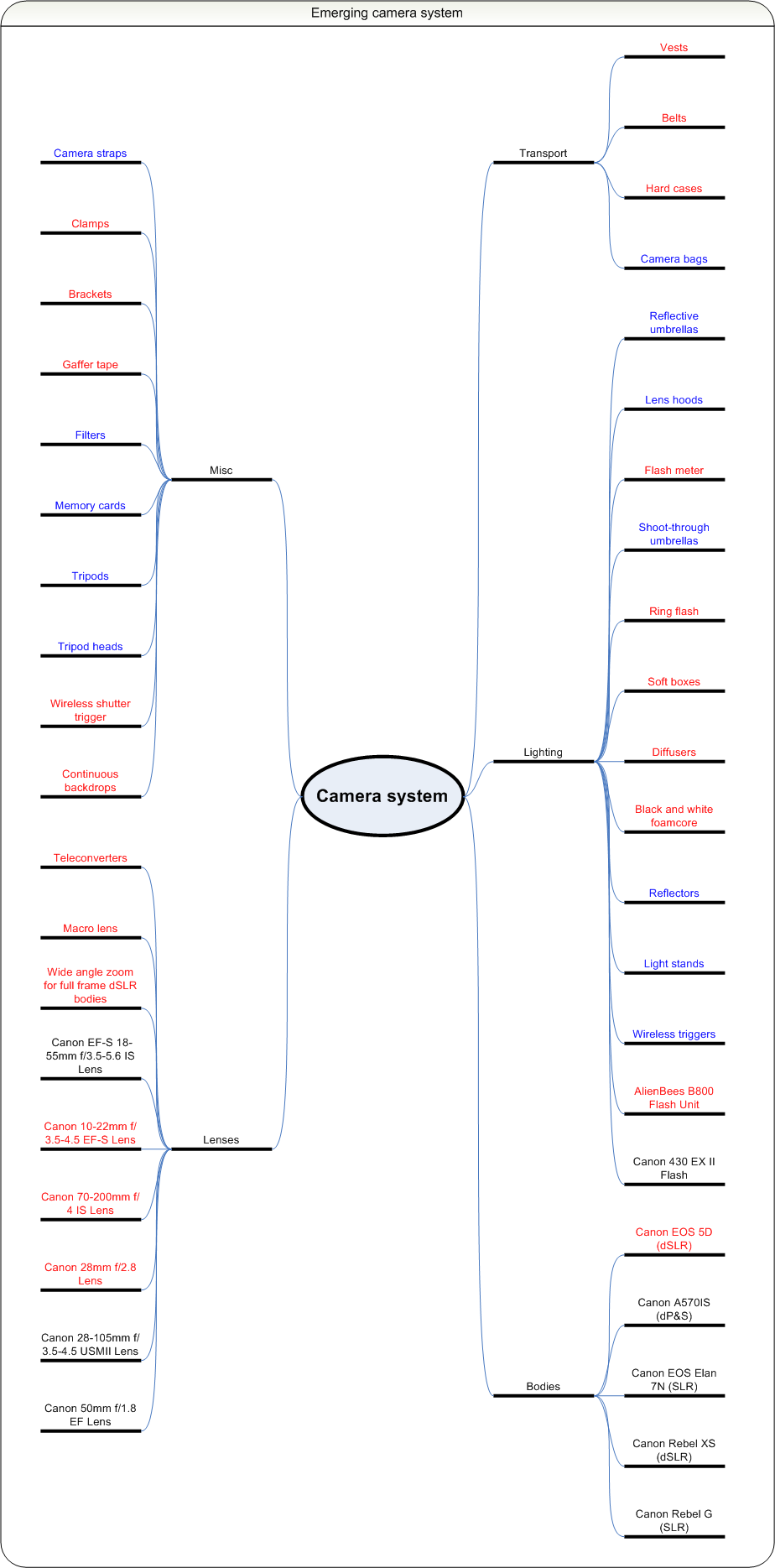
Just for the sake of cataloguing, I made a mind map of a comprehensive small-format camera system. Components in black are things I already have. Those in blue are things that I either eventually want more of, or eventually want better versions of. Things in red, I don’t have at all. Some of the items listed are general (‘lens hoods’) while others are specific, like a particular studio flash unit. Almost certainly, I have overlooked some things.

Clearly, there is a lot of expensive stuff you can use in combination with an SLR or dSLR body, and this listing doesn’t even include chemical or digital darkroom supplies. For those who aren’t wealthy, assembling a good fraction of this stuff is a multi-decadal project.

See also: Lens selection survey

Steve Jobs’ health and the future of Apple

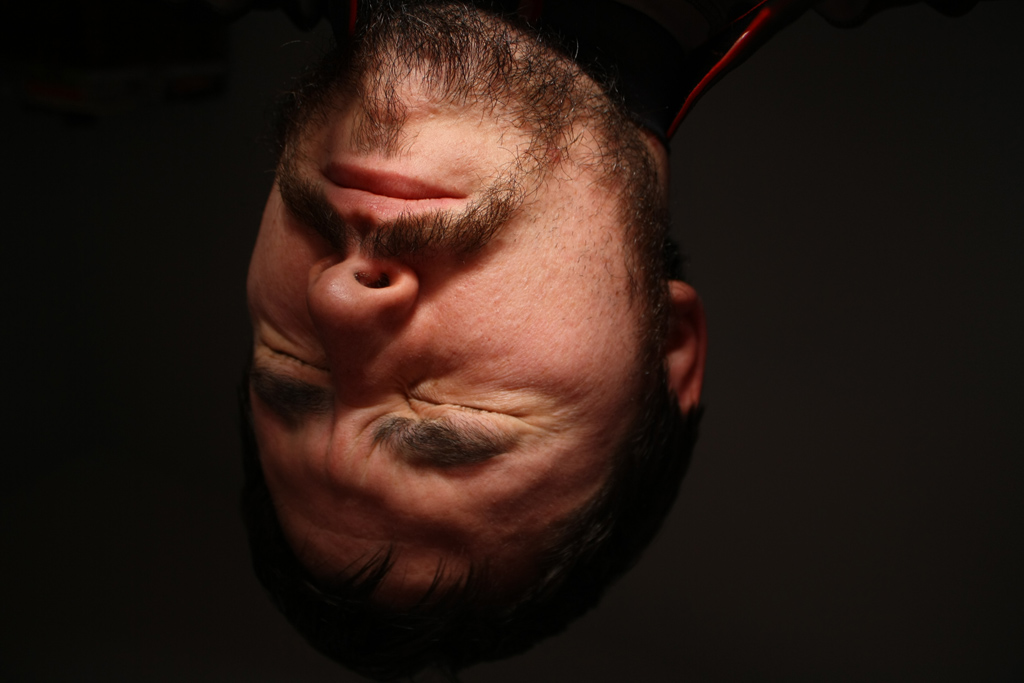
Milan Ilnyckyj, upside down with eyes closed

During the last few days, it has been saddening to read about Steve Jobs’ worsening health problems. Regardless of where you stand on the various Mac-related techie debates, it cannot be denied that the man turned that company around, making it into one of the most innovative and successful ones in the industry. Under his tenure, it has also produced some very high quality products. While some people scoff at the high prices associated (or nitpick about aspects of the products they dislike), it seems fair to say that Apple’s sense of style and sophistication has impacted the whole industry in a positive way. Pixar is also a notable success

Of course, it is foolish for anyone to try and write Mr. Jobs’ professional obituary so soon. He has had one round with serious illness already and returned, to say nothing of his twelve year stint away from Apple. With luck, a bit of time away from the stress and the spotlight will allow him to recover from whatever health issues he is facing. It should also give Apple an opportunity to think more seriously about a succession strategy. As closely tied as the company and Mr. Jobs remain in the public eye, the former must seriously prepare for the time when the latter will no longer be at the helm.

The distance to the horizon

When searching for Napoleon’s fleet in the Mediterranean, Admiral Lord Nelson positioned his own ships in a line, spaced as widely as possible while still allowing them to see one another. As it turns out, there is a fairly basic formula for calculating the distance to the horizon from any particular vantage point. This assumes the planet you are on to be perfectly spherical, but it should provide a decent approximation for slightly-squashed spheres such as the Earth. Obviously, the formula will be thrown off if you are on anything other than perfectly level ground. As such, it is better applied at sea than on land.

Where d = the distance to the horizon
h = the observer’s height above the ground
r= the radius of the planet

d = √ ( h^2 + 2rh )

Nelson’s flagship, the HMS Victory was 62.5m from waterline to the top of the mainmast. As such, someone sitting up there would have been able to see a bit more than 28km.

This formula is useful if you are on a planet with a known diameter and want to know how far away something on the horizon is (the diameter of the Earth is about 6365km). It could also be useful if you are on a planet with an unknown diameter that you want to know. Just drive a stake into the ground and walk away from it until it begins to vanish – then, apply the formula above to solve for the radius. Of course, you will need either sharp eyes or some kind of telescope if the planet you are on has any substantial size.

Incidentally, while they were still operating, the Concordes flew at 17,000m of altitude, allowing people looking out the windows to get a clear view of the curvature of the Earth.