Remember the platypus

The Platypus is a strange and intriguing creature. Some of the odder things about it:

  1. Males can inject venom from spurs on their ankles. The venom will not kill humans, but is extremely painful and heightens overall sensitivity to pain for a period between a few days and several months.
  2. They have ten sex chromosomes, out of a total of 52. Males are ‘XYXYXYXYXY.’
  3. They swim using only their two front legs, though the back two are also webbed.
  4. Only the left ovary of females is functional.
  5. They have no visible ears.
  6. They only use their eyes while above water.
  7. Underwater, they can detect electric fields generated by muscular contractions.
  8. They lose their three teeth before they first leave their mother’s burrow.
  9. They forage for twelve hours a day.
  10. They have a body temperature five degrees lower than most placental mammals.
  11. Females lactate through pores in their skin. Milk pools in grooves located on their abdomens.
  12. The DNA of one female – named Glennie – has now been sequenced by researchers at Oxford.

I recall reading that Australia has three types of animals: the venomous, the bizarre, and sheep. The platypus scores highly on the first two counts.

Privacy and Facebook applications

I have mentioned Facebook and the expectation of privacy before. Now, the blog of the Canadian privacy commissioner is highlighting one of the risks. Because third party applications have access to both the data of those who install them and the friends of those who have them installed, they can be used to surreptitiously collect information from those in the latter group. While this widens the scope of what third party applications can do, it also seriously undermines the much-trumpeted new privacy features in the Facebook platform.

It just goes to reinforce what I said before: you should expect that anything you post on Facebook is (a) accessible to anyone who wants to see it and (b) likely to remain available online indefinitely. The same goes for most information that is published somewhere online, including on servers you operate yourself.

NIN’s The Slip available for download

Following in the footsteps of Radiohead, Nine Inch Nails is giving listeners the option of downloading their latest album for free. Their approach differs from that of Radiohead in two ways: whereas Radiohead asked people to pay whatever they felt was fair, NIN is just sending the files for free. Also, while Radiohead offered their music in the form of DRM-free MP3 files, NIN is offering the choice of “high-quality MP3, FLAC or M4A lossless at CD quality and even higher-than-CD quality 24/96 WAVE.”

Like this blog, the album is available under a Creative Commons attribution non-commercial share alike license.

Immune system biochem

Face on a wall

It seems as though one of the coolest medical products you can make from blood is intravenous immunoglobulin (IVIG). Basically, it consists of antibodies extracted from the plasma of thousands of individual blood donors. It is given to people who have had their own ability to produce antibodies compromised and helps their immune system to attack infections over a period between two weeks and three months.

I remember a children’s television show where white blood cells are represented as the body’s police force. The analogy is fair enough. There are situations where the police force is lazy, so nasty gangs move in. There are situations where nasty gangs simply kill off the police force. Finally, there are situations where the police force goes haywire and starts savaging the population. Autoimmune diseases are the anatomical equivalent of the uncontrolled police force. Apparently, IVIG can help in all three circumstances: as well as in cases of inflammation.

Reading about biochemistry is an excellent way of being reminded just how absurdly complicated life is. I frequently find myself contemplating all the thousands of chemical reactions involved in performing the slightest action – tapping a key, dilating your pupil when a cloud crosses the sun – and being amazed that they can happen so quickly and consistently.

Digital camera noise signatures

I previously mentioned the possibility that jpeg metadata could cause problems with your cropping, revealing sections of photos that you did not want to make public. Another risk that people should be aware of relates to the particular ‘signatures’ of the digital sensors inside cameras:

If you take enough images with your digital camera, they can all be compared together and a unique signature can be determined. This means that even when you think that you are posting a photo anonymously to the internet, you are actually providing clues for the government to better tell who you are. The larger the sample size of images they have, the easier it is them to track down images coming from the same camera. Once they know all the images are coming from the same camera, all they then have to do is find that camera and take a picture to confirm it beyond a reasonable doubt.

The possible implications are considerable. This technique could be used in crime fighting, though also in tracking down human rights campaigners and other enemies of oppressive states. While the linked page lists some techniques for removing the tell-tale signs, there is no guarantee they will work against any particular agency or individual who is trying to link a bunch of photos to one camera or photographer.

The take-home lesson is that anonymity is very hard in a world where so many tools can be used to puncture it.

Some useful patterns in English

Rusty connector

By about 1300 CE, Arabic cryptographers had determined that you can decipher messages in which one letter has been replaced by another letter, number, or symbol by exploiting statistical characteristics of the underlying language. Here are some especially useful patterns in English.

  1. E is by far the most common letter – representing about 1/8th of normal text.
  2. If you list the alphabet from most to least commonly used, it divides into four groups.
  3. The highest frequency group includes: e, t, a, o, n, i, r, s, and h.
  4. The middle frequency group includes: d, l, u, c, and m.
  5. Less common are p, f, y, w, g, b, and v.
  6. The lowest frequency group includes: j, k, q, x, and z.
  7. E associates most widely with other letters: appearing before or after virtually all of them, in different circumstances.
  8. Among combinations of a, i, and o io is the most common combination. Ia is the second most common. Ae is rarest.
  9. 80% of the time, n is preceded by a vowel.
  10. 90% of the time, h appears before vowels.
  11. R tends to appear with vowels; s tends to appear with consonants.
  12. The most common repeated letters are ss, ee, tt, ff, ll, mm and oo.

Naturally, there are thousands more such patterns. Even understanding a few can help in deciphering messages that have had a basic substitution cipher applied.

Here’s one to try out:

LKCLHQBCKDRCPQQBDKAPZULSQUCDK
AZRDTDGPCOTZKQDPQBZQDQZHHLOIP
XLSVDQBZAOCZQICZGLHQDJCQLOCZI
QBDKAPQBZQDKQCOCPQXLSDKXLSOPM
ZOCQDJCSKHLOQSKZQCGXLQQZVZDPO
CGZQDTCGXMLLOGXMOLTDICIHLOVDQ
BRZHCPQLLJZKXLHQBCJRGLPCNSDQC
CZOGXDKQBCCTCKDKA

One hint is that cipher alphabets are not always entirely random. The tools on this page are useful for cracking monoalphabetic substitution ciphers.

Standardizing cell phone chargers

Backhoe

Forgetting my cell phone charger in Toronto has already resulted in a week of weak connectivity. It need not be so. While it must be a gold mine for cell phone shops and manufacturers, the absurd proliferation of charger types is clearly an anti-competitive practice.

A government keen to protect consumers and boost overall economic efficiency would do the following:

  1. Require that all cellular phones be rechargeable using a standard connector.
  2. Ideally, that connector should be mini-USB (second from the left), capable of transferring both power and data.
  3. Require that adapters be sold for all phones made in the past five years, and that the cost of the adapters equal just the cost of shipping and manufacture.

As long as any charger could be plugged into any phone and provide power, firms would be free to compete in designing and building chargers that connect to electrical outlets, car cigarette lighters, or whatever other source of power seems fitting.

The intervention in the market is justified for the same reason as with all standards: it produces societal welfare without adverse effects. It replaces self-serving confusion generated by private firms with an ordered approach that makes sense for everyone. It is not as though there is any major innovation which can occur with cell phone chargers. At root, they are just plastic-wrapped wires that run from a socket to a circuit board. Having fewer types – and making them go obsolete less frequently – would also reduce the usage of energy and materials in manufacturing, as well as the number of (potentially toxic) plastic trinkets populating landfills worldwide. A standard would allow people to share chargers, as well as permit buses and trains to have universal charging stations available.

Something similar could be done for laptop computers. Cell phones and laptops are both ubiquitous elements of modern life and commerce. Just think how many productive hours are needlessly lost because each manufacturer wants to ensure that last year’s charger cannot be sold to someone buying this year’s phone.

Odds guessing results

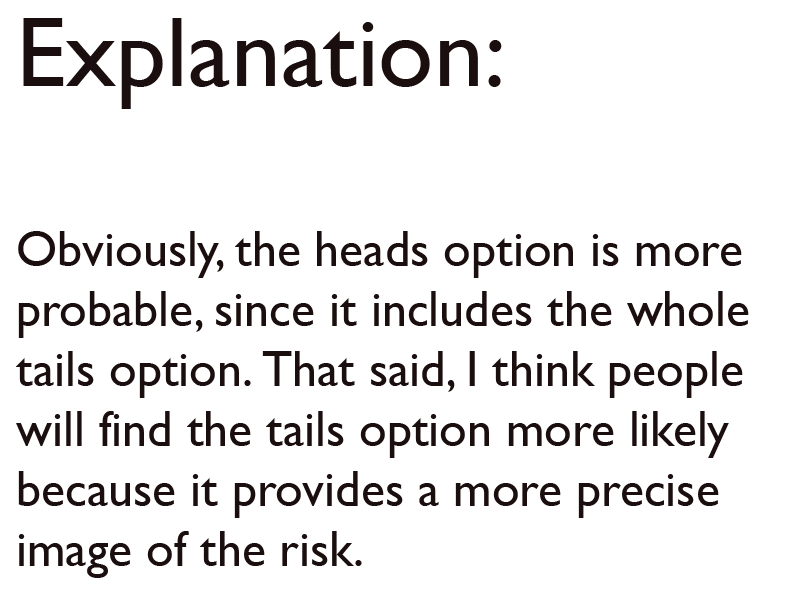
Thanks in a large part to Zoom (of Knitnut.net), I have received 54 valid responses to my odds guessing experiment. As those who read the explanation already know, the point of the experiment was to assess how people assess the relative risks of a vague but more probable outcomes versus a concrete but less likely one. The vague result (1,000 deaths from flooding somewhere in the United States this year) was assigned to ‘heads.’ The precise result (1,000 deaths from Florida hurricane induced flooding) was assigned ‘tails.’

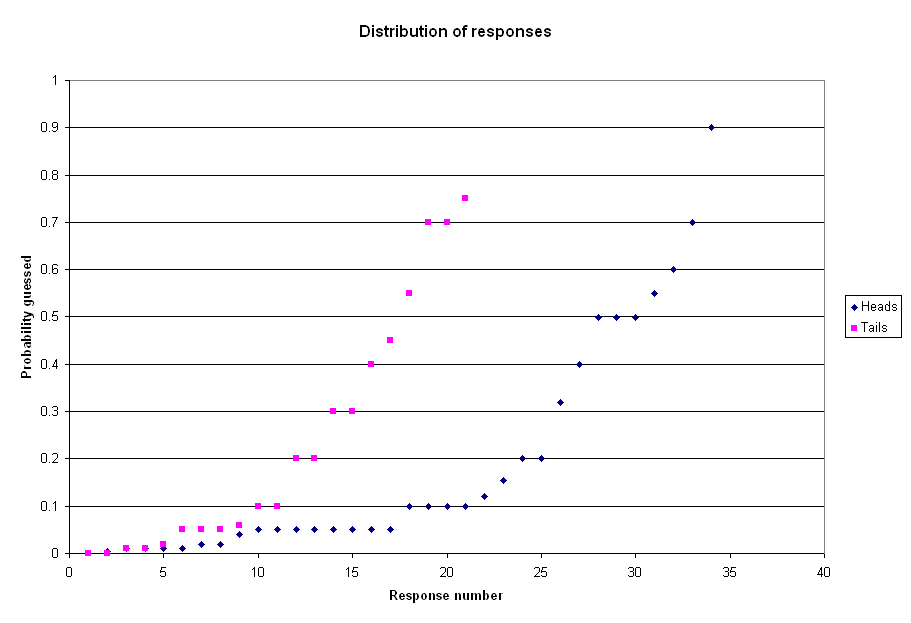
The first result to note is the very wide disparity of answers. Responses for ‘heads’ ranged from 0.005% all the way up to 90%. Responses for ‘tails’ ran from 0% to 75%. Given that there has been no flood in American history that killed 1,000 people, it seems fair to say that most guesses are overestimates. That said, the point of the experiment was to judge the relative responses in the two cases, not the absolute accuracy of the responses. This scatterplot shows the complete set of responses for both questions.

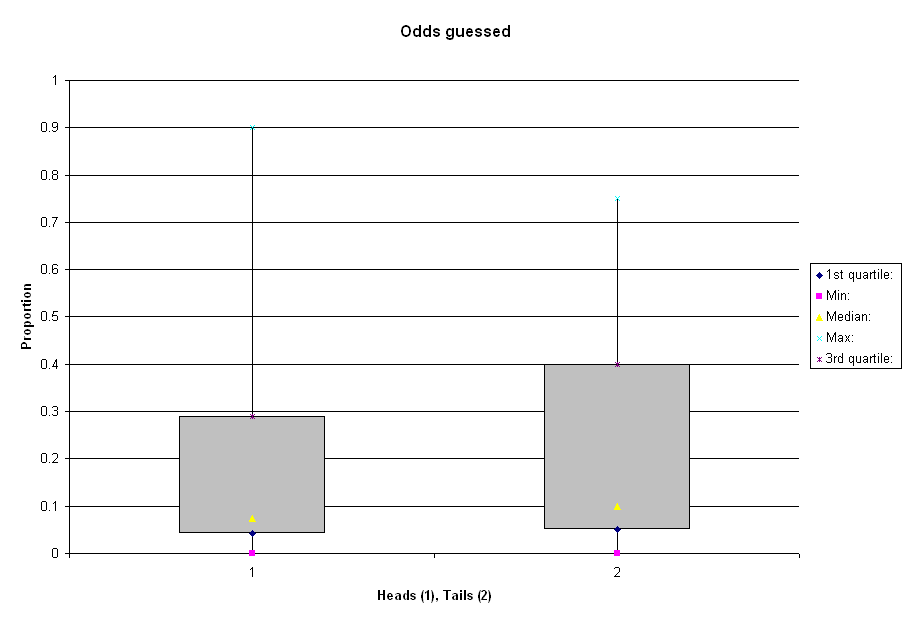
The mean probability estimate for ‘heads’ was 19.3%, while that for ‘tails’ was 23.8%. Because there were a large number of very high and very low guesses, it is probably better to look at descriptive statistics that aren’t influenced by outliers. This boxplot shows the mean, first and third quartile, maximum, and minimum results for each. To understand box plots, imagine that all the people who guessed are made to stand in a line, ranked from highest to lowest guess. Each of the numbers described previously (quartiles, etc) correspond to a position in the line. To find something like the median, you locate the person in the very middle of the line, then take their guess as your number. The advantage of doing this is that it prevents people who guessed very high from dragging the estimate up (as happens with the mean, or average), and doing the same with those who guessed very low.

The yellow triangle is the median. For ‘heads’ the median was 7.5%, compared to 10% for tails. The gray boxes show the range of guesses made by half the sample. At the top is the guess made by the person 3/4 of the way up the line, and at the bottom is the one made by the person 3/4 of the way down the line. As you can see, the bottom half ot the range looks pretty similar. Half of people estimate that the risk of both the ‘heads’ and ‘tails’ outcome is between about 10% and about 0%. What differs most about the two distributions is the upper portion of the grey boxes. Whereas 75% of respondents thought the ‘heads’ option was less than 30% probable, that value was more like 40% for the ‘tails’ option.

A couple of problems exist with this experimental design. Among the 54 ‘coin tosses,’ 63% seem to have come up heads. While it is entirely possible that this is the result of fair throws, I think there is at least some chance that people just chose ‘randomly’ in their heads, in a way that favoured heads over tails. Another problem is that some people might have looked at the comments made by others before guessing, or may even have searched online for information about flooding probabilities.

In conclusion, I would say the experiment provides weak support for my hypothesis. It is undeniably the case that the ‘heads’ option is more likely than the ‘tails’ option, and yet both the mean and median probability assigned to ‘tails’ is higher. There are also significantly more people who assigned ‘tails’ a risk of over 10%.

Those wanting to do some tinkering of their own can download the data in an Excel spreadsheet.

[Update: 28 April 2008] There has been some debate about the point above about the slight heads-bias in the results. I am told that the odds of this outcome are one in 26.3. Whether random chance or a systemic bias better explains that, I will leave to the interpretation of readers. In any event, it only really matters if the ‘heads’ group and ‘tails’ group differed in terms of their natural perception of risk.

The Black Swan

Dirty machinery

Nassim Nicholas Taleb‘s The Black Swan: The Impact of the Highly Improbable is an unusual, excellent book with broad applicability. In particular, those concerned with finance or the use of mathematics in social disciplines (politics, economics, international relations, etc) should strongly consider reading it. They will probably find it uncomfortable – as it demonstrates how their ‘rigorous’ disciplines are built on sand – but they will be wiser people if they can accept that.

Taleb’s main point is that life is dominated by improbable events of huge consequence. This is obscured to us for a number of reasons: not least, because we are able to look back and construct plausible after-the-fact stories about why things turned out the way they did. Because we fail to appreciate how explosively improbable the world is, we leave ourselves far more vulnerable than our predictions suggest. Indeed, the biggest thing Taleb attacks is the very notion that we can make good predictions about the future. ‘Black Swans’ are those improbable events of massive consequence which we are able to rationalize after the fact, though we could not have predicted them before. They can be negative (the sudden collapse of a bank) or positive (the amazing success of an obscure book). They relate to the way in which the world is skewed towards extremes when it comes to things like income or the importance of a publication.

Taleb’s book consists of an odd combination of anecdote, mathematics, scholarly and literary references, personal history, and diatribes. Throughout, one has the impression of engaging in conversation with an unusually fascinating fellow – albeit one who takes special pleasure in cutting down those who disagree with him (the text ignores no opportunity for mocking and insulting economists and financial analysts, in particular).

The lessons Taleb says one should draw from an appreciation of Black Swans are noteworthy and sensible. First, we should maximize our chances of getting lucky and finding a positive Black Swan. In investment terms, that means making lots of small bets on long shots that might really pay off. In life more generally, it basically means trying new things – visiting the restaurant you never normally would, going on the blind date, seizing the opportunity to meet with the big shot publisher to explain your book idea. Second, we should minimize our exposure to negative Black Swans that can wipe us out. That means definitely avoiding standard financial instruments like mutual funds, distrusting any risk assessment based on the bell curve, and appreciating that blue-chip stocks might collapse despite decades of steady growth. His overall financial prescription is to put whatever you are unwilling to lose in US government bonds, while using the rest to make long-shot speculative bets.

It would be very interesting to see Taleb’s ideas applied directly to International Relations (the capital letters mean ‘IR the discipline’ rather than IR the phenomenon) or climate change. Within IR, there are a few dissenters who appreciate just how inappropriate all the statistics and quantitative methods being trotted out really are. They would find Taleb’s book to be confidence-boosting, whereas the number obsessed IR scholars concentrated in the United States would probably respond to it with as much anger as hedge fund managers.

When it comes to climate change, the Black Swan idea seems relevant in several ways. First, it creates a healthy scepticism about projections: whether they are for economic growth, greenhouse gas emission levels, or greenhouse gas reductions associated with certain policies. Secondly, it reveals how fallacious it is to say: “Humanity muddled through so far, therefore we can handle climate change just like any previous crisis.” Thirdly, it sheds light on scenario planning in the face of possible disastrous outcomes with unknown probabilities attached.

It is safe to say that anybody interested in how history is written or how people try to come to grips with an uncertain future will find something of value in this text. At the very least, the colourful asides provide plenty of mental fodder. At the very most, appreciation for Black Swans might significantly alter how you live your life.

Experimenting on model brains

Milan and Paul in a diner

While taking the bus back from Toronto last night, I found myself wondering again about the brain-in-a-computer issue. While there are legitimate doubts about whether it would ever actually be possible to build a model akin to a human brain inside a machine, it is already the case that people are building successively better (but still very poor) approximations. Eventually, the models may become good enough for the following ethical question to arise.

What I wondered about, in particular, was the ethics of experimenting on such a thing. I have heard people mention, from time to time, the possibility of a ‘grandmother neuron’ charged specifically with recognizing your grandmother. The idea seems very unlikely, given that neurons die with regularity and people rarely completely and exclusively forget how to see their grandmothers. That being said, there is lots of experimental evidence that brain injuries can produce interesting results. As a consequence, the unfortunate, brain-damaged victims of car crashes sometimes find themselves to be the focus of intense interest among cognitive and behavioural psychologists.

If we did have a model brain (say a semi-realistic model fly or beetle brain), we could experiment by disabling sections of it to model the effects. By extension, the same could be done with rat, monkey, or human brains. The question then becomes: is there an ethical difference between experimenting on a mathematical model that behaves like a human brain and experimenting on a real human brain? Does that distinction lie in the degree to which the model is comprehensive and accurate? For instance, a good model brain might respond with terror and confusion if experimented upon.

This is yet another way of getting at the whole ethical question of whether people are simply their material selves, or whether there is something metaphysical to them. I maintain extremely strong doubts about the latter possibility, but still feel that there is an ethical distinction between experimenting on crude or partial brain models and experimenting on complete ones or real brains. I am much less sure about whether there is a meaningful ethical distinction between the last two options.