Comprehensive storage

Your average active computer user has more and more data. The first computer I effectively administered had 170 megabytes of hard disk space. Difficult choices had to be made about the relative merits of Doom versus Simcity. Now, just my primary email account has 1500 megabytes of data in it. I have 15 gigabytes worth of photos I have taken (all since 2005) and 20 gigabytes of music.

All this has been made possible by dramatically falling storage prices, combined with the spread of broadband internet. Soon, I expect that this combination will reach its logical conclusion. Right now, people are constrained by the size of their smallest hard drive, as well as by the difficulty of accessing larger remote drives. Eventually, I expect that most people will have a multi-terabyte disk connected to the internet at high speed and securely accessible from virtually any device in the world over the internet. The biggest question is whether this will be an ‘answering machine’ or a ‘voicemail’ solution.

The answering machine option is a big disk purchased by an individual consumer (perhaps a rack of disks, so that cheaper bigger ones can be added to the array as they become available). A company that made three things easy would have a license to print money. The first is integrated ease of use. iTunes music on the big disk should be immediately accessible from a person’s laptop or iPhone, provided they have internet access. The same should be true for saved television shows, photos, etc. The second is effortless backup. It is perfectly feasible to have a disk that is big enough to ensure that the failure of any one component does not lead to any loss of data. The third is security. The big disk should be secure enough against outside attack for use in storing commercially sensitive materials; likewise, the connection between outside devices and the disks should be secure. Probably, this means different levels of access for different sorts of devices, managed through a good user interface.

The voicemail option is to leave all the kit to someone else and just buy a service. Lots of companies are moving towards this model. In many ways, it’s a lot more efficient. Maintaining adequate but not excessive space for a million users is easier than doing the same thing for one; there are also economies of scale, since you can have specialists do all the technical work. The downsides of this model are mostly security related. You need to trust the service provider to keep your data safe. You also need to trust them not to apply arbitrary constraints on how you can use it, as Apple has sometimes done.

I predict that most people will use the second model exclusively, and will pay little or nothing to do so. More technically savvy people will run their own drives, but will probably use external services for (free) unencrypted or (subscription based) encrypted backup. Personally, I can’t wait. External hard drives have the feel of a 1980s solution, rather than one that is aware of the potential of the internet.

Technological options for mitigation

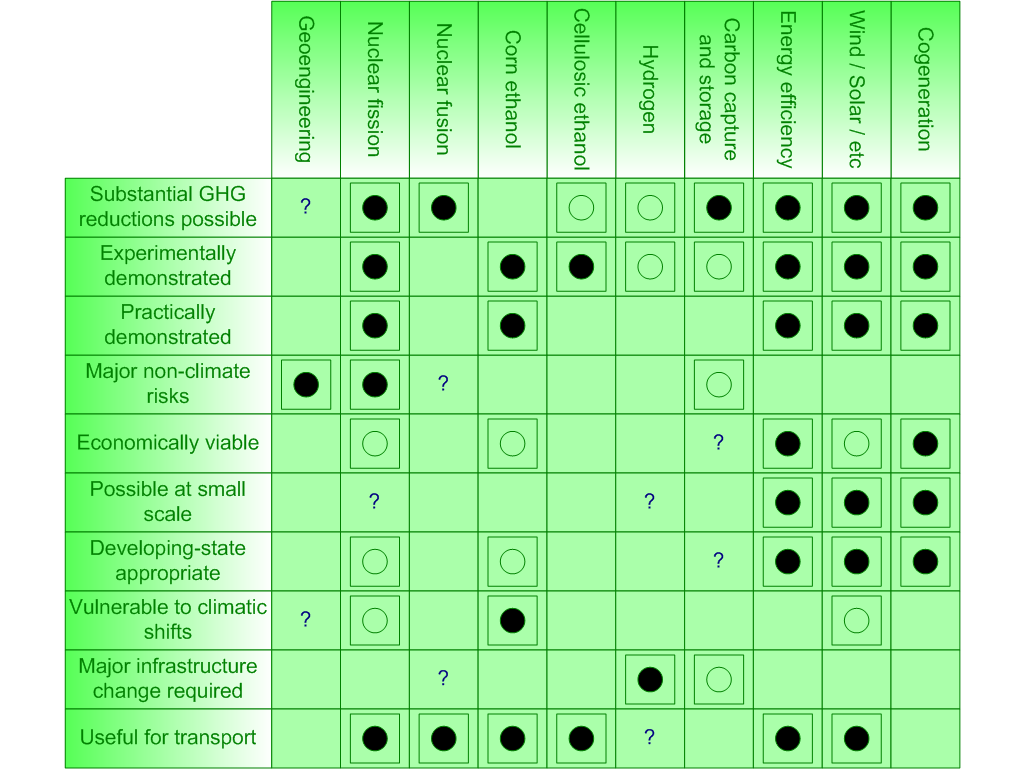
Climate change mitigation technologies

Black circles indicate a definite ‘yes,’ whereas hollow ones denote a partial ‘yes.’ For instance, it isn’t entirely clear whether nuclear fission can ever be economically viable in the absence of government subsidies. Empty squares denote a probable ‘no’ while question marks indicate situations too uncertain to render any judgment upon.

A few of these technologies are so speculative that it is hard to make a decision. That said, this is probably a relatively good summary of the state of the debate at the moment.

Impressions of some DS games

After about a month with a Nintendo DS, I feel capable of commenting on a few of the games, for the benefit of anyone who already has this excellent system or is considering buying one. For about $150, you can get a DS, a plug-in mod chip that lets you run downloaded software, and a micro-SD card to store that software on.

The Legend of Zelda: Phantom Hourglass: I was a big fan of A Link to the Past on the SNES, but never enjoyed any of the 3D Zelda games for other systems. The type of puzzles and combat in Zelda are just better suited to a 2D environment. As such, this game is a welcome return to that tradition. It also makes brilliant use of the distinctive hardware of the DS: almost completely (and very intuitively and engagingly) controlled using the touchscreen. Using the boomerang has never been so much fun. Like all Zelda games, it includes some dungeons too frustrating to finish without a walkthrough guide. Recommended strongly.

New Super Mario Bros. A good 2D platform game, in the spirit of Super Mario 3 and Super Mario World. Yoshi and flying are gone and some new powerups have been added. Basically what you would expect from a Mario game: recommended.

Metroid Prime Hunters: Frustrating to the point of being unplayable. 3D first person shooters just don’t work on this console. Get a SNES emulator and play Super Metroid instead.

Mario Kart DS: Exactly what you would expect from Mario Kart – virtually identical to every version on every platform since the NES. Recommended.

Advance Wars: Dual Strike: Turn-based strategy game with a fairly steep learning curve. While quite addictive, the game can be very frustrating if you haven’t cottoned on to the appropriate way to deal with any particular level. The dialogue is annoying and interminable, the soundtrack is a single track looped indefinitely, but the game is addictive and fun overall. There is also some nice artwork. Recommended.

Worms Open Warfare: Poorly adapted to the DS, based on how Worms is fundamentally horizontal and the DS screens are stacked vertically. The least fun version of Worms I have played on any platform.

Overall, I am really impressed with what the DS delivers for $100. I was initially attracted to the WiFi capability and possible use as a web browser and IM client. While possible, neither of those activities works well on this hardware. The absence of a keyboard makes both too frustrating, though the DS makes a decent RSS reader. Those shortfalls, however, are more than made up for by the high quality of the hardware and game design. Particularly for people with slow computers and no televisions, the DS is a gaming option to consider.

Seeking USB stick crypto

A piece of software that does the following would be very helpful to me:

  1. Creates an encrypted archive on a USB key
  2. Does so using a credible open-source algorithm, such as AES
  3. Ideally, is open source and well scrutinized by competent members of the security community
  4. This archive can be read using software on the key, on either a Mac OS X machine or a Windows XP box
  5. The software that does the encryption and decryption does not require administrator priveleges to run.

Do any such utilities exist? TrueCrypt is cool, but requires an admin account. SanDisk’s CruzerLock is Windows only, and has a really awkward interface. The disk encryption feature of PGP cannot be run off a flash drive. The encrypted disk images created by Mac OS cannot be read using a Windows machine.

The norovirus – way more common than you probably think

Lamplight and sunset

When people say that they are sick with ‘the flu,’ they often mean they have gastroenteritis. Influenza is caused by viruses in the family Orthomyxoviridae and is the stuff of flu vaccines and avian flu worries. Influenza usually often presents with fever, sore throat, muscle pains, severe headache, coughing, weakness and general discomfort. Gastroenteritis is defined as inflammation of the gastrointestinal tract, involving both the stomach and the small intestine. While it can be caused by bacteria including salmonella and E. Coli, gastroenteritis is usually caused by norovirus or rotavirus. In North America, only the common cold (usually caused by a picornavirus or coronavirus) is a more frequently occurring illness.

Norovirus is of particular interest, since it causes about 50% of all food-related cases of gastroenteritis. In total, it causes about 90% of non-bacterial gastroenteritis worldwide. Norovirus is transmitted either directly from person-to-person or through the faecal contamination of food or water. It is highly susceptible to bleach, though more resistant to alcohol and soap. Susceptibility to the virus is genetically linked. About 29% of the population have two recessive copies of the (1,2)fucosyltransferase gene, which means they don’t form a ligand required by the virus to bond. Lucky people. People with at least one dominant copy of the gene only get a brief period of partial immunity after the fight off the virus. Your best bet is to wash your hands often, avoid salads and shellfish cooked in places with poor hygienic standards, and avoid exposing yourself to people who are already infected.

The Shuttle shows you its belly

In order to permit an inspection of the thermal tiles that protect the vehicle from the heat of reentry, the Space Shuttle did a backflip for the cameras while orbiting at abouty 7,700 metres per second. This was done using the dual hypergolic engines of the Orbital Maneuvering System, burning monomethylhydrazine with a nitrogen tetroxide oxidizer. The BBC has a relatively low resolution video of the event.

Technical difficulties

Nothing photographic is my friend these days. The camera I sent back to Canon for repair (because it had a defective battery hatch when I bought it) seems to have come back with a new fault: it eats through batteries in minutes, managing at most five photos before giving out. Some brand new alkaline AAs I put in weren’t sufficient for it to take a single photo. If this doesn’t magically clear up in the next day or so, I suppose I will have to mail it to Canon for another repair.

Compounding the trouble, iPhoto deleted several thousand carefully tagged and sorted images from my library; more than a year’s worth of photography simply vanished. I do have a backup on an external HD (quite current, thanks to the Time Machine feature in Leopard), but I doubt it will be easy to recover them while maintaining the tags and folders.

It’s almost enough to make a person go back to rolls of T-max, binders full of prints, and hours spent in the dark room.

[Update: 11 February 2008] In the end, iPhoto’s little hiccough seems to have cost me every photo I have taken since leaving Vancouver. It was pretty easy to recover the older ones archived by Time Machine. But the photos exclusively on my hard drive just seem to have vanished without explanation. Disk Utility found no problems with the disk or with disk permissions. Once again, the importance of backups is demonstrated.

On the camera front, it seems to be responding well to newly charged Ni-MH cells. Probably, the earlier issue was the result of rechargables losing amps while my camera was off getting repaired, combined with a pack of bad alkalines I purchased.

[Update: 12 February 2008] I was wrong. My camera told me that the batteries were dead after 11 photos. When I put the batteries in the charger, they were ready in the time in took to brush my teeth.

Conclusion: the camera must return to Canon once more, with a slightly more subtle but equally crippling issue to be resolved.

[Update: 10 April 2008] iPhoto failed catastrophically again. Thankfully, I was able to fix it using yesterday’s backup.

Facebook and the expectation of privacy

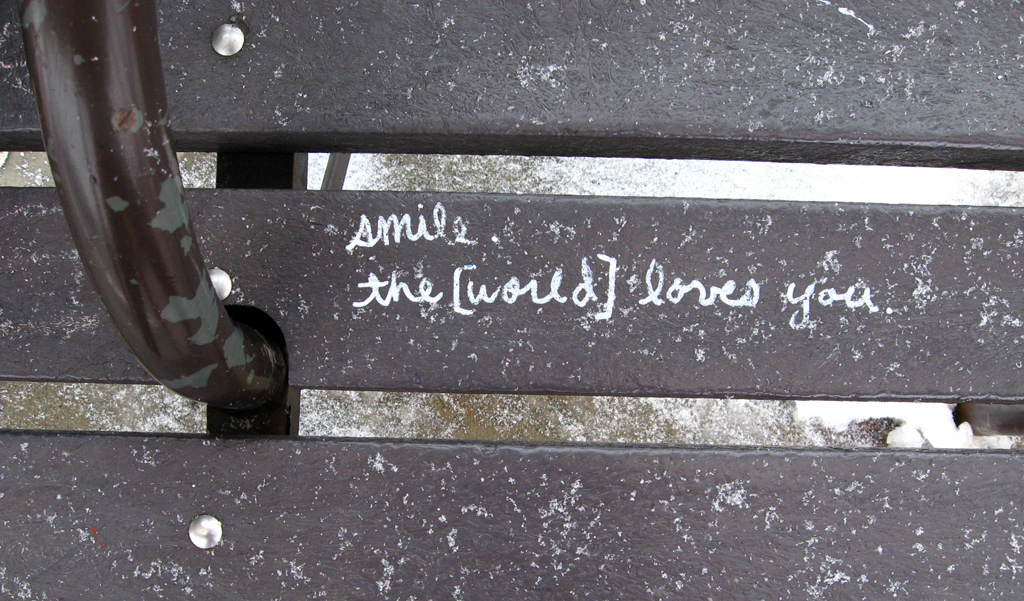
Graffiti on a bench

Another privacy spat has erupted in relation to Facebook, the social networking site. It all began when the site began actively advertising everything you did you all of your friends: every time a photo was updated or a relationship status changed, everyone could see it by default, rather than having to go looking. After that, it emerged that Facebook was selling information to third parties. Now, it seems that the applications people can install are getting access to more of their information than is required for them to operate, allowing the writers of such applications to collect and sell information such as the stated hometown and sexual orientation of anyone using them.

Normally, I am in favour of mechanisms to protect privacy and sympathetic to the fact that technology makes that harder to achieve. Facebook, I think, is different. As with a personal site, everything being posted is being intentionally put into the public domain. Those who think they have privacy on Facebook are being deluded and those who act as though information posted there is private are being foolish. The company should be more open about both facts, but I think they are within their rights to sell the information they are collecting.

The best advice for Facebook users is to keep the information posted trivial, and maintain the awareness that whatever finds its way online is likely to remain in someone’s records forever.

[Update: 12 February 2008] Canada’s Privacy Comissioner has a blog. It might be interesting reading for people concerned with such matters.

Exploratory flowchart

Milan Ilnyckyj’s travels

This graphic summarizes the travel I have done since 2000, with blue arrowed lines for one way trips and black lines for return journeys. Lines with no mode of travel indicated are flights. The chart is not completely comprehensive (it excludes relatively minor trips) and it is somewhat simplified, but it gives a good overall sense.

I hope I am lucky enough to see a similar amount during the next eight years, in spite of air travel guilt.