The awesome power of hardware

Is anyone else surprised by how emulated versions of games originally written for a machine with a 16-bit, 3.58Mhz processor can strain the capabilities of a computer with a 1300Mhz processor? The second machine has 363 more processor cycles per unit time, and a staggering 10,000 times more RAM. Dedicated chips are awesome; hence, the superiority of digital cameras that use hardware interpolation (all Canon cameras, for instance), as opposed to those that use software to interpolate using generic chips.

That said, it cannot really be denied that Super Metroid is the best of the Metroid series, Super Mario World is the best Mario game, and A Link to the Past is the best Zelda. Final Fantasy VII may narrowly beat Chrono Trigger as the best console RPG.

On electronic voting

There is some controversy in The Netherlands right now about electronic voting. A group has gotten hold of a voting machine, discovered that the physical and software security therein is very weak, and otherwise established the possibility that determined individuals could significantly impact election results through electronic tinkering.

The advantages of electronic voting are fairly numerous. Firstly, it could be made to happen more quickly. This may advantage the media more than anyone else, but it may as well be listed. Secondly, electronic devices could be made easier to use for people with physical disabilities and the like. Another advantage the system should have is increasing standardization between voting districts. Skullduggery involving dated or problematic machines in districts likely to vote in a certain way has been noted in a number of recent elections. Also, having an electronic record in addition to a paper one could allow for cross-verification in disputed districts. In cases where the results very starkly do not match, it should be possible to repeat the vote, with greater scrutiny.

The answer to the whole issue is exceptionally simple:

  1. You are presented with a screen where you select from among clearly labeled candidates, with an option to write in a name if that is part of your electoral system.
  2. The vote is then registered electronically, by whatever means, and a piece of paper is printed with the person’s choice of candidate, ideally in large bold letters.
  3. For an election involving multiple choices, each is likewise spelled out clearly. For instance, “I vote NO on Proposition X (flags for orphans).”
  4. The voter then checks the slip to make sure it is correct, before dropping it in a ballot box.
  5. These are treated in the standard fashion: locked, tracked, and observed before counting.
  6. The votes are tallied electronically, with a decent proportion (say, 20%) automatically verified by hand.
  7. If there is any serious discrepancy between the paper and electronic votes, all the paper ballots should be counted. Likewise, if there is a court ordered recount on the basis of other allegations of electoral irregularity.

Electronic systems have vulnerabilities including hacked polling stations; transmission interception and modification; as well as server side attacks where the data is being amalgamated. Paper systems have vulnerabilities relating to physical tampering. Maintaining both systems, as independently as possible, helps to mitigate the risks of each separately and improve the credibility of the process. It is like having both your bank and your credit card company keep separate records of your transactions. If they do not match, you have a good leg to stand on when alleging some kind of wrongdoing.

This system could use relatively simple electronic machines, and may therefore actually cost less in the long run than all paper balloting. Critically, it would maintain an unambiguous paper trail for the verification of people’s voting intentions. Companies that deny the importance of such a trail are either not thinking seriously about the integrity of the voting process or have self interested reasons for holding such a position.

[Update: 14 October 2006] The Economist has a leader on electronic voting machines and the US midterm elections. They assert, in part:

The solutions are not hard to find: a wholesale switch to paper ballots and optical scanners; more training for election officials; and open access to machine software. But it is too late for any of that this time—and that is a scandal.

Quite right.

Oxford from above

Wadham College, Oxford MCR bop

As a recent comment proves, there is at least one thing Microsoft does better than Google: display aerial views of Oxford.

Compare Google Maps, centred on Wadham College, with the Windows Live equivalent: enormously superior.

Here, you can see:

Those pointed out, I should return to the overly loud MCR freshers party, and stop worrying about my ongoing student loan appeal dialogue. People should feel encouraged to list more nice Oxford locations in the comments (with links to Live Local photos).

March of the iPods

Today, iPod the Fifth arrived. They are packed much more compactly now than in earlier days. I suspect Apple is cutting costs in anticipation of having to compete with Microsoft’s Zune player, though, as always, it remains to be seen how successful that product will be. Everyone remembers the spectacular failure of the ‘rokr’ iTunes phone.

As regards iPod the Fifth, I hope it lasts as long as the previous four put together did.

In other news, the heating in our flat has suddenly been turned on. It hit my like a tropical blast as soon as I opened my door. I probably will no longer be sleeping in the woolen toque that Sarah P gave me.

PS. For some reason, iTunes 7.0.1 lacks the option to “only update checked songs” to the iPod. Since I was using that feature to keep a collection of songs small enough for the 20GB version updated, it will now not update at all, because the overall library is too big. I have come up with a crude hack (creating a smart playlist that includes all checked songs and having the iPod only update that), but doing so causes the device to only list that playlist, with none of my other smart or normal listings visible. Trying to add them all (even though they are the same songs as the ‘checked only’ list, causes a ‘not enough space’ error. Any ideas?

Seeking new Oxford bloggers

Oxford is positively laden with newly arriving students. At least some of them must be bloggers. If you are among them, please let a comment with a link back to your site (if you want it added to my listing of Oxford blogs). Likewise, if anyone has found such a fresher blog, please leave a comment that links back to it.

I will not link blogs immediately. Rather, I will wait to see that they:

  1. have at least some real content
  2. have been around for at least a few weeks

Otherwise, maintaining the list would take far too long, and too many items in it would be without much value.

All Oxford bloggers should remember that the fourth OxBloggers gathering is happening on Wednesday of 4th week, November 1st.

PS. Making a link in a blog comment is easy. Just use the following format, replacing the square brackets with pointy ones (the ones that look like this shape ^ turned on either side):

[a href=”http://www.thesiteyouarelinking.com”]the text you want for the link[/a]

That will make a string of blue text that says: “the text you want for the link.” When clicked, it will take the browser to www.thesiteyouarelinking.com. Every bit of the formatting is important, including the quotation marks, so be careful.

Basic problems with biometric security

You have to wonder whether anything other than having watched too many James Bond films feeds the idea that biometrics are a good means of achieving security. Nowadays, Canadians are not allowed to smile when they are having their passport photos taken, in hopes that computers will be able to read the images more easily. Of course, any computer matching system foiled by something as simple as smiling is not exactly likely to be useful for much.

Identification v. authentication

Biometrics can be used in two very distinct ways: as a means of authentication, and as a means of identification. Using a biometric (say, a fingerprint) to authenticate is akin to using a password in combination with a username. The first tells the system who you claim to be, the second attempts to verify that using something you have (like a keycard), something you know (like a password), or something you are (like a fingerprint scan). Using a biometric for identification attempts to determine who you are, within a database of possibilities, using biometric information.

Using a fingerprint scan for identification is much more problematic than using it for authentication. This is a bit like telling people to enter a password and, if it matches any password in the system, allow them into that person’s account. It isn’t quite that bad, because fingerprints are more unique and secure than passwords, but the problem remains that as the size of the database increases, the probability of false matching increases.

For another example, imagine you are trying to identify the victim of a car wreck using dental records. If person X is the registered owner and hasn’t been heard from since the crash, we can use dental records to authenticate that a badly damaged body almost certainly belongs to person X. This is like using biometrics for authentication. Likewise, if we know the driver could be one of three people, we can ascertain with a high degree of certainty which it is, by comparing dental x-rays from the body with records for the three possible matches. The trouble arises when we have no idea who person X is, so we try running the x-rays against the whole collection that we have. Not only is this likely to be resource intensive, it is likely to generate lots of mistakes, for reasons I will detail shortly.

The big database problem in security settings

The problem of a big matching database is especially relevant when you are considering the implementation of wholesale surveillance. Ethical issues aside, imagine a database of the faces of thousands of known terrorists. You could then scan the face of everyone coming into an airport or other public place against that set. Both false positive and false negative matches are potentially problematic. With a false negative, a terrorist in the database could walk through undetected. For any scanning system, some probability (which statisticians call Beta, or the Type II Error Rate) attaches to that outcome. Conversely, there is the possibility of identifying someone not on the list as being one of the listed terrorists: a false positive. The probability of this is Alpha (Type I Error Rate), and it is in setting that threshold that the relative danger of false positives and negatives is established.

A further danger is somewhat akin to ‘mission creep’ – the logic that, since we are already here, we may as well do X in addition to Y, where X is our original purpose. This is a very frequent security issue. For example, think of driver’s licenses. Originally, they were meant to certify to a police officer that someone driving a car is licensed to do so. Some types of people would try to attack that system and make fake credentials. But once having a driver’s license lets you get credit cards, rent expensive equipment, secure other government documents, and the like, a system that existed for one purpose is vulnerable to attacks from people trying to do all sorts of other things. When that broadening of purpose is not anticipated, a serious danger exists that the security applied to the originally task will prove inadequate.

A similar problem exists with potential terrorist matching databases. Once we have a system for finding terrorists, why not throw in the faces of teenage runaways, escaped convicts, people with outstanding warrants, etc, etc? Again, putting ethical issues aside, think about the effect of enlarging the match database on the possibility of false positive results. Now, if we can count on security personnel to behave sensibly when such a result occurs, there may not be too much to worry about. Numerous cases of arbitrary detention, and even the use of lethal force, demonstrate that this is a serious issue indeed.

The problem of rare properties

In closing, I want to address a fallacy that relates to this issue. When applying an imperfect test to a rare case, you are almost always more likely to get a false positive than a legitimate result. It seems counterintuitive, but it makes perfect sense. Consider this example:

I have developed a test for a hypothetical rare disease. Let’s call it Panicky Student Syndrome (PSS). In the whole population of students, one in a million is afflicted. My test has an accuracy of 99.99%. More specifically, the probability that a student has PSS is 99.99%, given that they have tested positive. That means that if the test is administered to a random collection of students, there is a one in 10,000 chance that a particular student will test positive, but will not have PSS. Remember that the odds of actually having PSS are only one in a million. There will be 100 false positives for every real one – a situation that will arise in any circumstance where the probability of the person having that trait (whether having a rare disease or being a terrorist) is low.

Given that the reliability of even very expensive biometrics is far below that of my hypothetical PSS test, the ration of false positives to real ones is likely to be even worse. This is something to consider when governments start coming after fingerprints, iris scans, and the like in the name of increased security.

PS. Those amazed by Bond’s ability to circumvent high-tech seeming security systems using gadgets of his own should watch this MythBusters clip, in which an expensive biometric lock is opened using a licked black and white photocopy of the correct fingerprint.

PPS. I did my first Wikipedia edit today, removing someone’s childish announcement from the bottom of the biometrics entry.

[Update: 3 October 2006] For a more mathematical examination of the disease testing example, using Bayes’ Theorem, look here.

On being an inept and reluctant webmaster

A website I am managing (not this one) is proving exceptionally frustrating. When I disabled the ‘what you see is what you get’ (WYSIWYG) editor in WordPress, I did so because its name was a filthy lie. In truth, what you code, and check, and then check again in every other browser you care to support is what you get. Well, the content management system (CMS) for the other site it like the the WYSIWYG editor writ large: nothing you do actually shows on the site in the way it showed in the editor. Like with the WordPress editor, hundreds of useless tags get added in opening and closing pairs. What’ s more, the CMS has added many layers of complexity to what it, in essence, a very simple site. The only way I have been able to edit tables in one part of the site has been the grab the HTML, edit it using jEdit, then paste it back into the site. This is clearly not the kind of thing you should have to do when you are running an elaborate CMS.

The simplicity of the content, versus the complexity of the management, is tempting me to copy the whole site over to a new CMS that is more comprehensible. Right now, we are using a system called Mambo. In many ways, it is a lot like WordPress. It uses an SQL database to store content, then displays it on dynamically generated pages. I am pretty sure WordPress could actually handle everything this website does, though having it look like a blog would not be acceptable.

Does anybody know of a free CMS that can be hosted using Apache and MySQL that might be easier to work with than Mambo?

Laptop RAM for sale

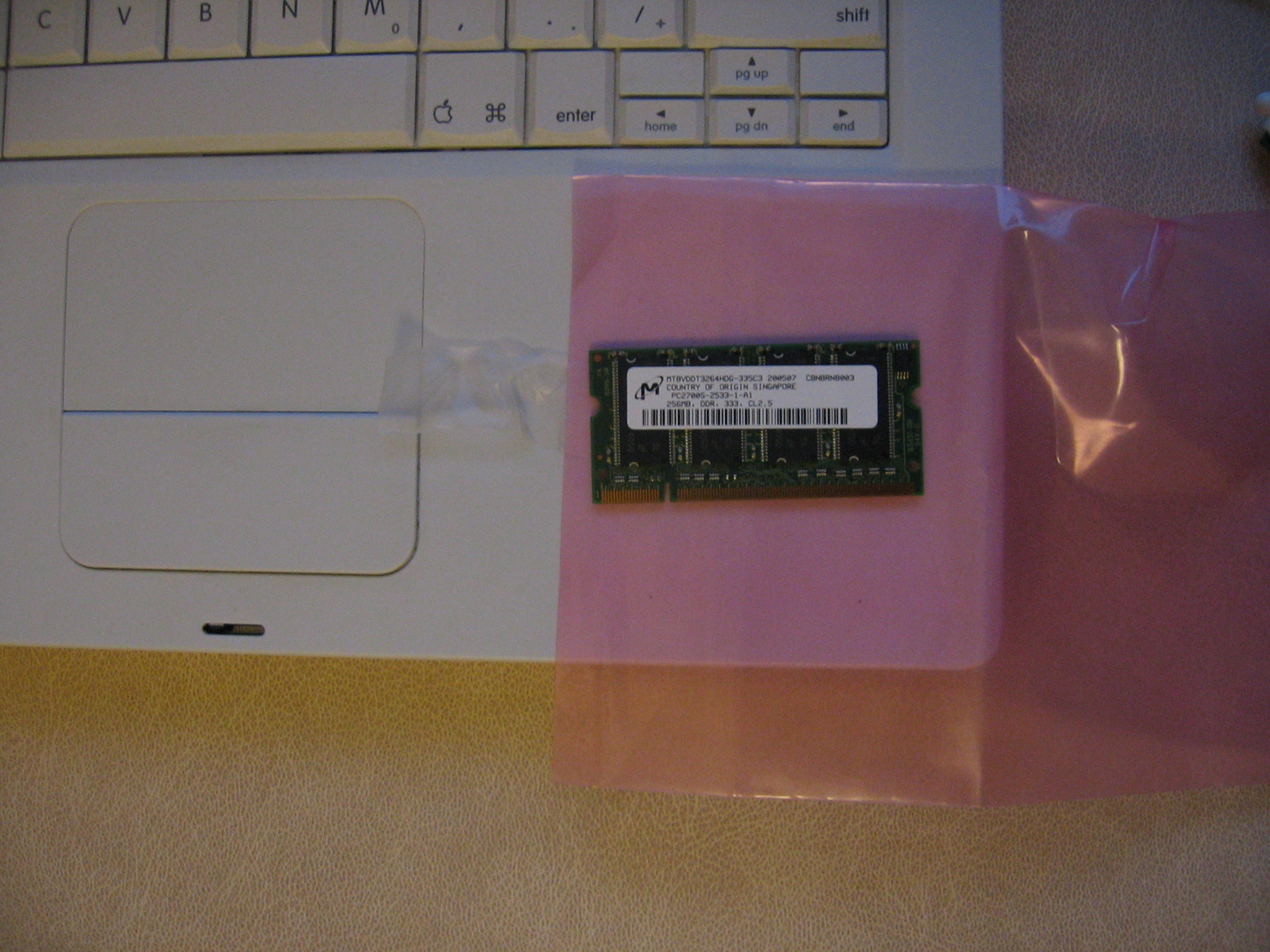
Before it goes up on eBay, I thought I should privately advertise the ability of a 256 meg stick of laptop RAM. I originally bought it directly from Apple, along with my 14″ G4 iBook and have since replaced it with a 1GB stick. It is in perfect working order, and should work with any laptop that takes 200pin PC2700 RAM. This includes all G3 and G4 iBooks and Powerbooks.

Continue reading “Laptop RAM for sale”

State of the iBook

According to iStat Pro, a system monitoring Dashboard widget, the battery in my 14″ G4 iBook only has 31% of the endurance that it shipped with, a bit more than a year ago. No wonder I have been unplugging it from the wall recently only to find less than an hour worth of power available. Of course, the figure it gives is untrue. With somewhere between ten and fifteen minutes remaining, the computer will simply turn off – hopefully in a way that seeks to avert file corruption. Every little click of my hard drive now makes me fearful of losing this vital academic and personal tool. The experience of the succession of iPods has made me wary. Backups as frequent as I can bear to run them seem the best option.

Since it would be at least US$129.00 to replace my iBook battery, I must simply tolerate the lack of stamina until such a time arises (probably once I have tunneled my way out of student debt) to strip this machine of most of its RAM and move to something snazzier.

[Update: 13 October 2008] My original iBook battery has now failed completely. It cannot run the computer for even a fraction of a second, the LED charge display on the bottom of the battery doesn’t work, and the computer often cannot detect that the battery is present.