
Nancy Grace Roman with the Hubble Space Telescope; Mae Jemison and Sally Ride with the Space Shuttle; and Margaret Hamilton with listings of the software she and her MIT team wrote for the Apollo Program
climate change activist and science communicator; photographer; mapmaker — advocate for a stable global climate, reduced nuclear weapon risks, and safe human-AI interaction

If it involves physics, math, computer science, electronics or has general geek cachet, this is the place for it.
Nancy Grace Roman with the Hubble Space Telescope; Mae Jemison and Sally Ride with the Space Shuttle; and Margaret Hamilton with listings of the software she and her MIT team wrote for the Apollo Program
In part because of housing uncertainty — and mindful of George Monbiot’s excellent advice about true freedom arising from low living expenses “If you can live on five thousand pounds a year, you are six times as secure as someone who needs thirty thousand to get by” — I have been avoiding and minimizing taking on new physical possessions.
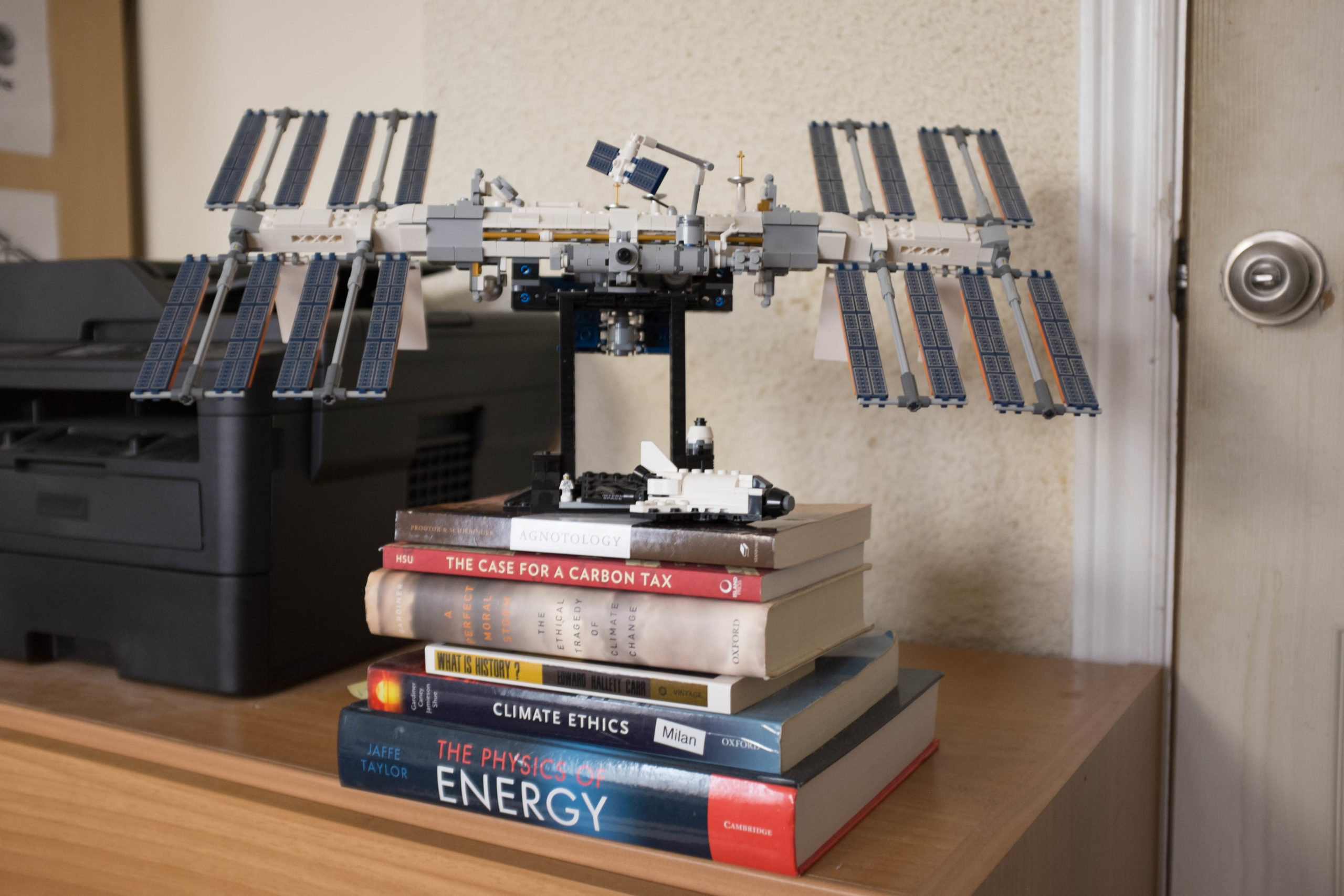
Nonetheless, with my interest in space and the Space Shuttle program specifically, I could not resist ordering Lego’s new Space Shuttle Discovery and Hubble Space Telescope set on the day of its release.
The Hubble is arguably the greatest scientific achievement of the Space Shuttle program and certainly one of the most powerful instruments humanity has ever created for understanding the vastness and history of our universe. The dimensions of the Hubble also did a lot to dictate the final size and configuration of the shuttle (less for the telescope itself, and more for the secret Earth-observing versions operated by the National Reconnaissance Office). Those design decisions, in turn, did much to shape the shuttle’s operational characteristics and history, including the design choices that contributed to the Challenger and Columbia losses.
The set will be fun to put together, and I should be able to find somewhere to display it even if I end up living in a tiny space.
SpaceX’s Starlink satellite constellation promises to provide low-latency high-bandwidth internet to anyone on the planet.
In November or so, the company announced a beta release in Canada. Some northern communities are already being connected, notably Pikangikum in northwestern Ontario with the charitable assistance of FSET Information Technology and Service.
With my brother Mica starting to teach at the Chief Jimmy Bruneau School in Behchoko, about 125 km down the highway from Yellowknife, we both wondered whether the satellite internet package might be useful for them.
So far, I have found three explanations for why Starlink isn’t available in the region yet:
I have reached out to bureaucrats and people in ministers’ offices to try to get authoritative information on what the issue is.
This post — based around this map — shows a station in Kaparuk, Alaska. I sent a message to the map’s creator for verification, since I can’t see how satellites going from pole to pole could cover Alaska but not the Canadian territories. This post shows a Starlink ground station in St. John’s Newfoundland.
If you have any relevant information please contact me. If you are also looking into getting a Starlink connection in northern Canada I don’t have any further information for now but I will provide updates when I do.
Alie Ward’s Ologies postcast about gratitude was a reminder of the benefits of in-person activities and the problems which arise from the incentives of social media firms. Like casinos that profit mostly from people mindlessly putting money into slot machines, platforms like Facebook and Twitter are just designed to keep people on and coming back, no matter whether they become misinformed through the process. In response, I changed my Facebook, Twitter, and Instagram passwords on December 14th and put them on a card at home to look up if I ever specifically decided to check these platforms. I’ve done so a couple of times since and had the strong impression that I haven’t missed anything.
One reason for using these platforms less is how ongoing social media monitoring is dragging out the completion of my dissertation, since there are always developments and new news on divestment. It’s better to get the thing published than to keep dragging it out with new information, so I am no longer actively monitoring social media.
Secondly, during the time surrounding America’s disastrous election (still a disaster, even though Trump lost) I realized that I don’t need endless amateur commentary on what is going on, and that getting it is needlessly emotionally provocative.
I took Twitter off my phone in 2017 but this is much more complete. In particular, it helps break a cycle of checking social media out of habit, seeing links to outside resources, and then getting caught up with reading them before returning to social media.
I am trying to read more books now, and to hike outside.
Informative articles about:
Some time ago I saw this instructive video on computer science and artificial intelligence:
This recent Vanity Fair article touches on some of the same questions, namely how you design a safety shutdown switch that the AI won’t trigger itself and won’t stop you from triggering. It quites Eliezer Yudkowsky:
“How do you encode the goal functions of an A.I. such that it has an Off switch and it wants there to be an Off switch and it won’t try to eliminate the Off switch and it will let you press the Off switch, but it won’t jump ahead and press the Off switch itself? … And if it self-modifies, will it self-modify in such a way as to keep the Off switch? We’re trying to work on that. It’s not easy.”
I certainly don’t have any answers, and in fact find it a bit surprising and counterintuitive that the problem is so hard.
The logic does fairly quickly become straightforward though. Imagine an AI designed to boil a tea kettle unless the emergency stop is pushed. If it is programmed to care more about starting the kettle than paying attention to the shutdown switch, then it will choose to boil water regardless of attempts at shutdown, or even to try to stop a person from using the switch. If it is programmed to value obeying the shutdown switch more then it becomes presented with the temptation to push the switch itself and thus achieve a higher value goal.
In addition to aforementioned rules about internet and computer security (1, 2, 3, 4) it’s worth mentioning that security measures can create their own vulnerabilities.
That’s true in terms of human systems. For instance, granting high-level powers to system administrators creates risks that they will exploit them deliberately or have their credentials stolen, or simply used after being left unguarded.
It’s can also be true for technical means. For instance, people often misunderstand TOR and believe that it makes everything about their web browsing anonymous. Really, it just routes the traffic several times within an encrypted network to disguise the origin before using an exit node to communicate with the target server, potentially with no encryption. Since people may be more likely to use TOR for sensitive or illicit purposes, those exit nodes are likely a target for both freelancers and governments.
Some recent stories have alleged that the virtual private networks (VPNs) which people use to protect themselves from an untrusted local network can create risks as well:
Earlier, people alleged that Facebook was using its Onavo VPN to snoop on users.
I have seen numerous accounts of how — when an artificial intelligence or machine learning system is given a human resource task in the hope it won’t perpetuate human biases — biases in the material used to train the AI lead to it replicating the discrimination. As The Economist recently noted, this can happen even when information on things like the sex and race of applicants isn’t directly provided, since it can be inferred from other features in the data:
Such deficiencies are, at least in theory, straightforward to fix (IBM offered a more representative dataset for anyone to use). Other sources of bias can be trickier to remove. In 2017 Amazon abandoned a recruitment project designed to hunt through CVs to identify suitable candidates when the system was found to be favouring male applicants. The post mortem revealed a circular, self-reinforcing problem. The system had been trained on the CVs of previous successful applicants to the firm. But since the tech workforce is already mostly male, a system trained on historical data will latch onto maleness as a strong predictor of suitability.
Humans can try to forbid such inferences, says Fabrice Ciais, who runs PWC’s machine-learning team in Britain (and Amazon tried to do exactly that). In many cases they are required to: in most rich countries employers cannot hire on the basis of factors such as sex, age or race. But algorithms can outsmart their human masters by using proxy variables to reconstruct the forbidden information, says Mr Ciais. Everything from hobbies to previous jobs to area codes in telephone numbers could contain hints that an applicant is likely to be female, or young, or from an ethnic minority.
In part this is a subset of the black box problem in AI. For example, an AI intended to distinguish dogs from wolves learned to work out which photos had snow in them instead. Since the output from AIs is a set of tuned probabilities, it’s not possible to say what chain of reasoning or source of evidence led them to a conclusion; at the same time, this creates a risk that they will behave in unpredictable and unwanted ways.