A bit overstretched

Between work, the job search, running this site (and BuryCoal), and photography, I am finding myself rather busy these days.

That is the context in which I have been receiving a number of requests to do commercial photographic work. That is exciting and an opportunity to learn new skills. At the same time, it is a possible distraction from activities that are ultimately more important, such as making my own small contribution to the fight against climate change.

As such, I am going to be pretty picky about the projects I undertake. If the work is interesting or serves a group or cause that is worthy of approval, I will consider a potential project more favourably. Otherwise, I will be demanding a rate of pay that corresponds to the scarcity of my free hours.
2010 happenings

Some of my more notable 2010 undertakings and experiences:

  • The end of the Low Carbon Cross Country Trip
  • Two new jobs
  • The transition from beardedness to beardlessness
  • Time with Emily
  • More than 12,000 photos taken
  • Photojournalism and documentary photography course taken
  • Several Montreal and Toronto visits (one wedding included)
  • Collarbone breaking and partial healing
  • Improved health
  • BuryCoal launched
  • Visits from some friends not frequently seen
  • A solid number of books read
  • Several concerts attended
  • Camping with Rosa
  • New York with Kai
  • Multiple Vermont visits, Christmas included
  • Blogging out loud
  • Dozens of cans of kidney beans eaten
  • Many kilometres by Greyhound
  • A departure from my current home, nearly completed

The priority for 2011? Find a job in Toronto and move there.

Testing Google’s OCR

Previously, I briefly mentioned the optical character recognition (OCR) technology within Google Docs. I decided to test it in the relatively challenging circumstance of converting photographs of pages from a book into text:

As you can see, the image to text conversion isn’t perfect. Indeed, it doesn’t work terribly well in the conditions to which I subjected it. Substantial strings of text are missing, and there are many errors.

Probably, the system would work better if the pages had been perfectly flat and evenly illuminated, and if my camera had been perfectly parallel to the page.

War photographer

In my photojournalism class, we watched the 2001 documentary War Photographer, about the work of James Nachtwey. The film showed him working in both conflict zones and zones of acute poverty, including Indonesia, the former Yugoslavia, and Rwanda. It was interesting and well done, and may well have been a balanced portrayal, but the absence of any kind of critical comment on Nachtwey made it feel somewhat like a hagiography.

It may well be the case that Nachtwey is a talented and self-sacrificing man who has helped to increase public concern about various sorts of severe suffering. At the same time, an account based on his own perspective – along with that of his friends, admirers, and co-workers – cannot make that case convincingly. I suppose this is a fundamental problem with autobiographies. Perhaps there should be some sort of third-party certification process where impartial outsiders compare the content of a book or film with all the information they can gather, and then certify or refuse to certify the content. Of course, not many politicians or other public figures would be willing to go through such a screening.

One potent message conveyed by the film is about extreme poverty. Seeing families living right beside dangerous railroad tracks in Indonesia sends a powerful emotional message. Of course, our intellectual response to seeing that varies depending on a constellation of other beliefs. Some people will see that and think: “This shows why economic growth is such a vital phenomenon, when it comes to improving human welfare”. Others will focus more on distributive justice, and say that the issue is less about enriching everyone, and more about transferring wealth from the affluent to the desperately poor.

Evey in The Glebe

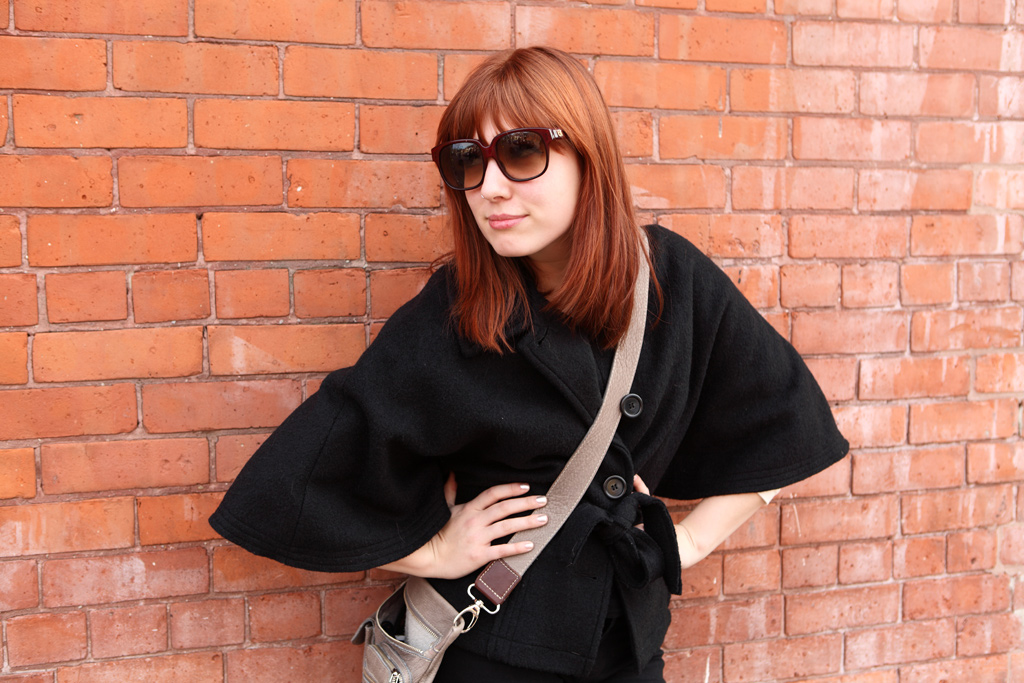
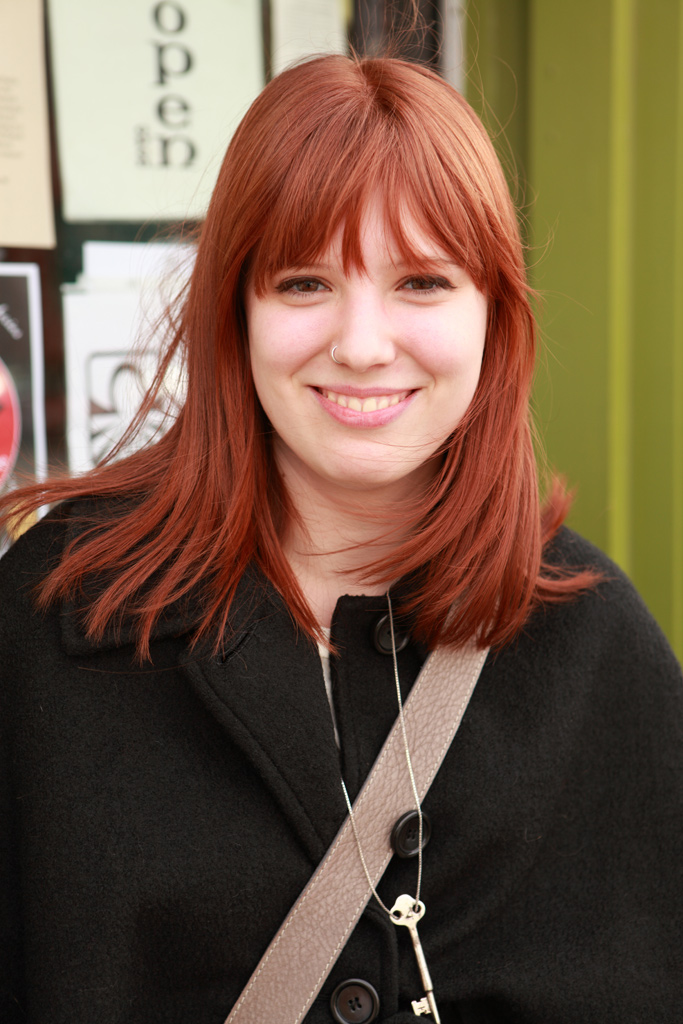
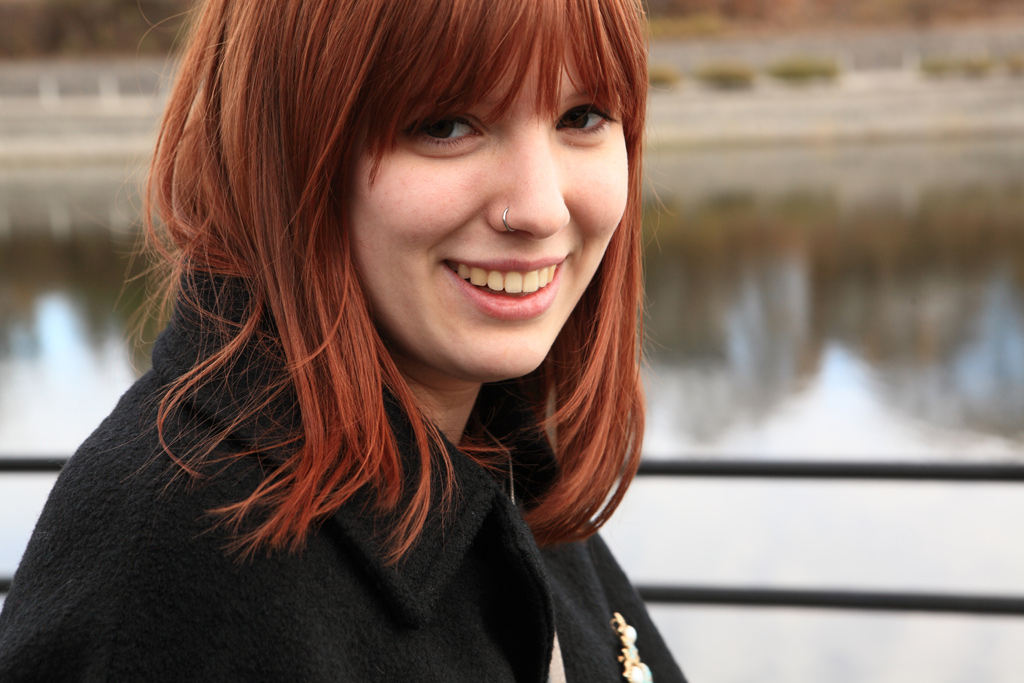
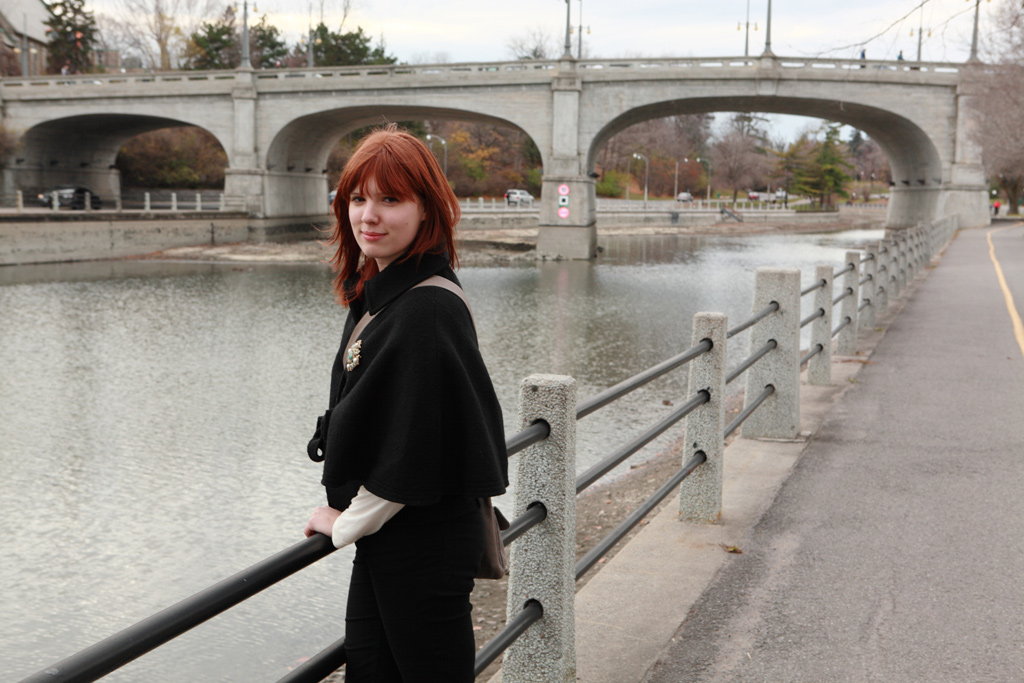
A little while ago, my friend Evey was in town and was good enough to pose for some portraits around The Glebe. She writes a fashion blog called Hey, Good Lookin’.

Remarkably, despite being a native of Ottawa, Evey had never been to the Wild Oat restaurant.

It’s a nice place, with excellent loaves of olive bread available. Just don’t expect to find anywhere to sit during the most popular times of day.

I rather like this cape-like garment, and the thick wool is well-suited to Ottawa’s shortening days.

Octopus Books is an independent shop with an entire section devoted to ‘U.S. Imperialism’. Here, Evey is posing outside.

Proximity to the canal is one of the nice things about The Glebe as a neighbourhood. That, and the presence of Ottawa’s best bagel shop.

The bridge shown here is the same as the one incorporated into the current banner for this site, though I am going to need to find a Toronto bridge to substitute in fairly soon.

When Evey is back in Ottawa around Christmas time, I am hoping we will be able to add to these with some shots in the snow.

Small cameras versus big cameras

When I went to visit Toronto this past weekend, I had to lug a suit bag with me. The idea of bringing along my Canon 5D Mk II digital SLR (dSLR) and associated gear and lenses was too daunting, so I brought along my little Canon A570IS point and shoot (P&S) camera instead.

It has been quite a while since I used a point and shoot, so the experience felt novel to me. Those little cameras certainly have a few things going for them:

  • It can be carried in a pocket and easily held with one hand.
  • Since the camera fits in a pocket, you don’t need to constantly advertise that you are carrying it.
  • It can fit into small spaces, allowing for unusual compositions.
  • Subjects are not intimidated by such a small camera.
  • The tiny shutter is very quiet.
  • The relatively low value of the camera makes you less worried about loss, damage, and theft.
  • There are fewer condensation problems, since the smaller camera and lens have less thermal momentum.
  • The camera takes ubiquitous AA batteries, rather than expensive proprietary cells.
  • The camera can automatically detect faces, and focuses on them.
  • For a small camera, a small tripod is sufficient for long-exposure shots. It is also easier to brace a small camera on most horizontal surfaces.
  • The camera is so light, there are no problems with carrying it around everywhere, for hours.

Of course, there are a few reasons why I missed my 5D. By far the most important is image quality. The sensor in the A570IS is small and produces visibly noisy images at 200 ISO, and ones that are terrible at 400 ISO and up. By contrast, images from the 5D look very decent at 2500 ISO. Because of the superior lenses, shots taken on the 5D also look better in more subtle ways. The 5D also has a more accurate viewfinder; the shot that ends up on your memory card looks much like the one composed through the viewfinder, with minimal cropping and parallax problems.

80% of the time, the ideal option would be something that is about the size and weight of the A570IS but which has the image quality of the 5D Mk II. The rest of the time, the size and weight of the 5D would actually be preferable. In particular, all the dedicated controls spread across the 5D body make it easier to choose the ideal settings for a particular shot quickly.

Alas, for the foreseeable future there will always be the need to choose between convenience and quality.

Tony Fouhse’s photography

Tony Fouhse is an Ottawa photographer doing great work in a range of fields, from commercial advertising to artistic portraits of Ottawa crack cocaine addicts. He has a Flash-based website (sorry, owners of iPads and new MacBook Airs) and a weekly blog.

His work was discussed in the Photojournalism and Documentary Photography I am taking through the School of Photographic Arts: Ottawa. It makes me want to undertake some more involved photographic projects, rather than just taking advantage of what there is to photograph in the general vicinity of my home.

Balancing flash and ambient light

I am taking a photojournalism and documentary photography class through the School of Photographic Arts: Ottawa. The first assignment is balancing flash with ambient light, taking photos of strangers outside at night. It is strongly encouraged to take photos in manual mode, rather than the aperture priority mode I normally use. As such, I am learning to adjust my thought process.

Normally, my thinking when it comes to exposure settings looks something like this:

  1. Will the lighting be changing quickly, not leaving me enough time to change settings? If so, choose a suitable ISO and white balance, set the camera to ‘program’ mode and hope for the best.
  2. If not, choose a combination of ISO and aperture that is suited to the light and the amount of depth of field I want.
  3. Make sure the shutter speeds generated are suitable to the situation, subject, and lens.
  4. Adjust ISO and white balance as necessary.

Switching to manual and balanced flash/ambient light requires choosing an appropriate aperture, then selecting a suitable shutter speed that will underexpose the subject before the addition of E-TTL II metered flash. It’s a workflow that takes some getting used to, but which ought to be helpful in the long run.

Particularly during the dancing at the end, my photos from my cousin Ksenia’s wedding could have used a bit of flash to top up the ambient light.