Pickton should face another trial

PCO building, Ottawa

The decision of the British Columbia Attorney General not to prosecute 20 additional murder charges against Robert Pickton seems like a failure to strike the proper balance between the good use of government resources and the pursuit of justice. It has frequently been pointed out that had his victims been less marginalized members of society their initial disappearances would have been much more thoroughly investigated. Similarly, the failure of the police to appreciate what was occurring and put a stop to it over such a long period of time would have been deemed negligent and unacceptable. By choosing not to prosecute all the murders for which the Crown has evidence, the marginalization of these women is being further entrenched. It is inconceivable that the second trial would not occur if the victims had been wealthy residents of Shaughnessy or the British Properties.

The creation of a detailed public record of what transpired has societal value: both for those who knew the victims and for those who hope to improve the future operation of the police and justice systems. The argument for having a trial is therefore similar to the case I made previously for completing Slobodan Milosevic’s trial after his death. In such cases, the point is not to punish the offender; it is, rather, to make the facts of the situation known, demonstrate places where errors were made, and provide some guidance for future behaviour. On an important but less practical level, a second trial would also be an assertion of the equal human worth of the second group of victims: an especially important message to send given the ways in which the supposed equality of law is not always as meaningful or substantial as it ought to be.

Contraction and convergence

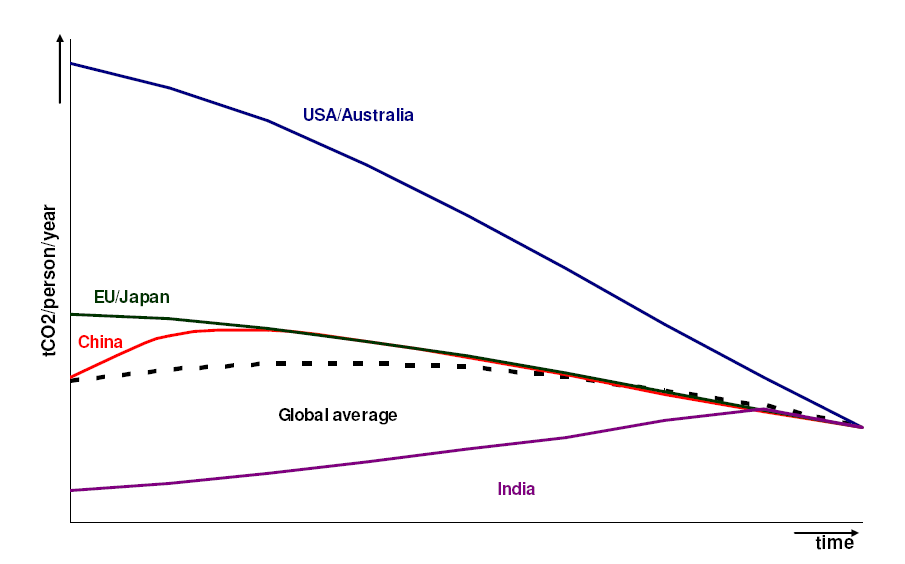
The interim version of the Garnaut Review (mentioned earlier) includes a numberless graph illustrating what the principle of contraction and convergence in per capita greenhouse gas emissions would resemble:

Contraction and convergence graph from the Garnaut Review

A few features are especially notable. The first is the relative trajectories in the opening years. States with very high per capita emissions, like Australia and Canada, would have to reduce emissions sharply right from the outset. Rapidly growing poor states like China would be allowed to grow until per capita emissions are comparable to those in relatively low emission developed states, such as the EU. Gradually, everybody’s per capita emissions become lower and more similar.

This approach becomes a lot more politically feasible when you take these lines to represent emission allocations rather than actual emissions. Developing states would have a choice about how to use the extra space allocated for their development. They could opt to use the allocation for their own emissions, allowing the growth of GHG emitting industry; alternatively, they could sell the allocations to more developed states at a globally established market price. That way, poverty reduction and development goals could be served at the same time as total GHG emissions trend towards a sustainable level. The big advantage of allowing global trading is that it should equalize the international marginal cost of abatement. In simple terms, that means that it will ensure that the emissions that can be avoided at the lowest cost will be addressed first, minimizing the overall cost of mitigation.

The Garnaut Review rightly highlights that it would be incredibly politically difficult to establish such an international regime. At the same time, it is probably also right to say that a general approach that embraces contraction and convergence has the best chance of stabilizing global greenhouse gas emissions at a level that avoids dangerous anthropogenic interference in the climate system, and does so in a way that minimizes total costs and manages the distribution of costs and benefits in an acceptably fair manner.

Ethics among the doomed

Discarded hubcap

There have been a number of arguments here before about how excess can be justified: specifically, how emitting more greenhouse gasses than is sustainable per-capita based on the present human population can be morally justified. A new logical possibility occurred to me today: it is possible that we are already doomed. By that, I mean that pretty much all aspects of life that we consider to be deeply meaningful or important are already destined to be obliterated as a result of past action or inevitable future actions. For instance, the amount of climate change already locked into the climate system as the result of lags and positive feedbacks may be sufficient to make human civilization untenable.

If this is true, it changes the dynamic somewhat. The standard view of climate change is that we are all on a big ship in the middle of the sea, completely isolated from any help, and a serious hull breach has occurred. If most of us work together selflessly, we can plug it and save the ship. There is, however, the logical possibility that the leak is so bad that even the complete commitment of everyone aboard will not stop the rising water, and will not save a single one among us.

If we have crossed that threshold of inevitability, we are released of our obligations to prevent the sinking of the ship. Of course, the extent to which the sinking was preventable or not can only be known after the fact. Either we find ourselves in the position of being saved, on the basis of whatever efforts were made, or we find ourselves in oblivion, in spite of whatever was done to encourage an alternative outcome.

Nicholas Stern video

Emily kindly sent me a link to the video of Sir Nicholas Stern’s presentation in the Examination Schools at Oxford in February of 2007. I was lucky enough to attend in person; I even got to speak with him at the exclusive reception afterwards. My notes are on the wiki. This is your chance to compare a verbatim record of the talk with my notes and thus determine my particular strengths and failings as a note taker.

The talk is well worth watching, not least because Stern is obviously very well informed and quite a capable speaker. His report is fully deserving of its status as the seminal discussion of the economics of climate change.

Garnaut Review interim report

The Stern Review – released in October 2006 by the British Government – is generally considered the most authoritative source on the economics of climate change. Among other things, it concludes that the cost of reducing global emissions is significantly less than the probable costs associated with letting climate change continue on its present course. Now, Australia has released a similar assessment, in the form of the Garnaut Climate Change Review.

Only the interim report is available so far, but it’s likely to make interesting reading for Canadians concerned about climate change. In many ways, the Canadian economy is more similar to that of Australia than it is to that of England. As such, this report may offer some especially useful insights.

P.S. I have some notes from a lecture Stern gave in Oxford.

Robert Gates posturing on missile defence

Everybody has probably heard about how the United States shot down a supposedly dangerous satellite with a ship-based kinetic kill interceptor. Now, US Secretary of Defence Robert Gates is saying that this proves missile defence works. Of course, this is absurd. Satellites follow very predictable orbits. As such, it is pretty easy to hit them with missiles. Commanders won’t have that advantage when trying to shoot down the incoming missiles of their enemies: especially since those missiles will often employ physical or electronic countermeasures.

It is also worthwhile to consider what they would be saying if this test had failed: “Of course, downing an ailing satellite is completely different from missile defence! The fact that this test didn’t succeed in no way suggests that America’s $12.8 billion per year missile program is ineffective, nor that missile defence technologies aren’t worthy of billions more taxpayer dollars.”

It’s a good thing Canada never bought into the idea.

Costly delays at Yucca Mountain

Mosque and power lines

Persistent delays at Yucca Mountain – the Congressionally appointed future home for American nuclear waste – could prove very expensive to taxpayers. Under an agreement between nuclear power utilities and the Department of Energy, firms are charged 1/10th of a cent per kilowatt hour for waste disposal. Yucca Mountain was meant to be open and accepting fuel in 1998.

So far, the delay has cost the American Treasury $342 million in rebates so far, and is projected to cost $11 billion if the facility doesn’t open before 2020. Given the tooth-and-nail resistance from the Nevada government, and the history of lengthy lawsuits in the United States, it’s not impossible that such a delay will occur. Meanwhile, wastes continue to be stored in relatively expensive and high-maintenance cooling ponds and dry storage casks. In the whole mess, consumers lose out twice. The costs for eventual disposal imposed on utilities were passed on to them; as taxpayers, they will also end up paying most of the cost for Yucca Mountain or whatever alternative long-term disposal facility is eventually used.

The situation could be even worse than it seems. Both Clinton and Obama have announced their opposition to the project. Presumably, having one of them win the presidency would return the whole process to the preliminary site selection phase, back where it was thirty years ago. Regardless of one’s position on nuclear power, the need to store the wastes that exist in a safe, economically viable, and long-term way is inescapable. Keeping the waste in a large number of small sites increases both costs and risks.

Canada also lacks a facility for the long-term storage of radioactive wastes.

Wikileaks and whistleblowers

My cousin Tamara and her SO

Wikileaks is a website that allows anonymous whistleblowers to disseminate sensitive or embarrassing documents online. These could be anything from evidence of corruption and bribery in government to corporate wrongdoings to secret military interrogation manuals. While the ability to publish anonymously does have potential for abuse, it is also a valuable public service. There are plenty of barriers that prevent people from becoming whistleblowers, even when there is massive evidence of wrongdoing. Having technological mechanisms to aid the process – and reduce the dangers of retribution – thus serves the public interest. Particularly in places where governments are undermining traditional forms of public and legal oversight, such as in the treatment of terrorist suspects, there is extra value in whatever sources of information remain accessible.

As of today, the site is suffering from a California court decision that required Dynadot – the domain name registry that associates the URL ‘Wikileaks.org’ with an IP address – to “prevent the domain name from resolving to the wikileaks.org Web site or any other Web site or server other than a blank park page until further notice.” This doesn’t make the site inaccessible, since the server can be accessed directly at http://88.80.13.160/, but it will prevent a good number of people from finding it. The ruling arose from proceedings involving Julius Baer – a Swiss bank that leaks have implicated in tax evasion and money laundering in the Cayman Islands. In addition to the DNS restriction, the site is apparently suffering from a denial of service attack, probably orchestrated by one or more organizations the site has embarrassed.

The final result of this will be an interesting development in the ongoing battle to control what kind of information can be distributed online, whether that can be done anonymously or not, and which jurisdictions are most accommodating towards such activities.

Law and morality

Tall ship ice sculpture at Winterlude, Ottawa

There is no fundamental connection between morality and law. Law derives from the combination of rules and the existence of an authority with the ability and will to enforce them, at least most of the time. Morality, by contrast, has to do with situations, the options available to individuals, and the likely consequences of possible actions.

It is possible to imagine cases in which particular actions are moral but not legal (riding in the section of the bus reserved for white people, despite being black in segregationist America or South Africa) as well as actions that are legal but not moral (clearcutting a huge swath of forest after buying a permit from a purely self-interested king). If you accept that it might be morally necessary to lie to a group of Nazi soldiers about where a group of Jewish children are hiding, you accept that it can sometimes be acceptable, or even laudable, to violate the laws that happen to exist in a certain state at a certain time. Simply following the law without evaluating its relation to morality makes a person no better than a secret police officer, mindlessly following orders to round people up to face uncertain fates.

Pragmatism isn’t a morally relevant quality, at least in and of itself. The fact that the state may punish you for breaking the law or failing to act as the law demands doesn’t have any moral force, one way or the other. The relationship between pragmatism, morality, and law is based around the pragmatic evaluation of the consequences of obeying or not obeying the law. Not obeying the law against arson is unlikely to have positive effects; ignoring the law against trespassing, when some important purpose compels the unapproved passage through someone else’s property, is likely to be defensible in many more cases.

Reasons why the law can be moral

In democratic societies, a good case can be made that the law is usually compatible with morality. Partly, this is the result of the democratic process, which includes some relatively good protections against the unjust domination of one group by another.

Sometimes, law is important because it provides clear guidelines and thus produces better overall outcomes. A good example is speed limits. We can agree pretty easily that there should be some limit, though people might disagree on what it is. It is safer and easier to choose a reasonable figure than to let everyone decide individually. Both domestically and internationally, law plays an important coordinating role. It keeps radio stations from interfering the the transponders of aircraft and ensures that one’s laptop can be plugged into any properly functioning electrical outlet in the state.

At a higher level of abstraction, law is important for reconciling divergent moral perspectives: say, one that sees it as unacceptable to portray Mohammed visually and another that has no such qualms. Particularly within a democratic system, law plays a vital role in creating the boundaries within which we can make demands of one another. For instance, I may have no right to demand that you remove a religious symbol from your car or home, but perhaps I can if it is on your desk as a judge or police interrogator. Exactly how this balance is struck is difficult to manage, and it is likely that multiple acceptable options exist. Reaching one of those options, however, depends on engaging with the law, rather than simply accepting the present form at face value.

Reasons to disobey law

There are two major reasons to disobey the law: because it is unjust, or because there is an ongoing emergency.

Refusing to turn up for duty when drafted to serve in an illegal war could be an example of the former. So could sharing a bottle of wine at dinner, while camping in a public park. In each case, an individual evaluation is made about the appropriateness of the existing rule to the present situation. If a compelling case can be made that the rule is harmful or irrelevant, it is sensible for thinking people to disregard it. Civil disobedience goes a bit further, since people go beyond breaking a law to activity and openly demonstrating the breach. This too can be a moral action, if it calls public attention to the injustice of an existing law, or the importance of some competing claim.

Breaking the law in emergencies is relatively uncontroversial. A sixteen-year-old who violates the terms of a learner’s license by driving a dying relative to the hospital is breaking the law in an entirely excusable way. This is recognized in the common law through the defence of necessity. One of the better features of the common law system, it is an overt recognition that law exists to serve the majority of cases, and will fail to produce good results when applied directly in some circumstances.

A duty of evaluation

In the end, the sensible position to take is accepting that in most places, most laws have a sensible reason for existing. That does not, however, absolve individuals of the duty to consider the circumstances in which they find themselves and the appropriateness of acting in one way or another, on the basis of what they reasonably expect the outcome of their actions to be. The alternative is a nation of unthinking robots, following rules that may be well balanced and wise – or arbitrary and viscious – with no more contemplation or personal responsibility than a missile launched by the state at a target that looked unfriendly to the rulers.