The 2008 Beijing Olympics

The Chinese government intends for the 2008 Beijing Olympics to be a kind of coming out party for China’s “peaceful rise.” Certainly, the last few decades have been remarkable: growth has persisted around 10% and hundreds of millions of people have risen out of extreme poverty. At the same time, the Chinese government has much to answer for. Democracy and human rights are both black marks on the Chinese record – both domestically and in terms of their international relations. Because of the unacceptable character of a number of Chinese policies, Canada should boycott the games.

The first set of unacceptable policies are domestic. These include suppression of free speech and the media, as well as the repression of political and apolitical organizations (such as Falun Gong). China also executes more people than any other state, with some allegations going as far as to say that people are being killed so that their organs can be harvested. Ethnic minorities are likewise suppressed in China, with Tibet being a special case. Well corroborated accounts exist of torture by various governmental entities.

Chinese foreign policy is also not in keeping with minimum standards of acceptable conduct. China continually threatens to attack against Taiwan, with hundreds of missiles pointed across the strait. As Paul Collier details, they are also known for adopting ‘no questions’ policies in relation to truly awful regimes, such as the genocidal government of Sudan. China has actively undermined efforts by the international community to put pressure on such governments to cease their human rights violations. International law now clearly recognizes that state sovereignty provides no protection for a government that is committing atrocities. The continuing Chinese insistence on strict non-intervention undermines the degree to which international norms can be manifested, and helps to keep large numbers of people in unacceptable conditions.

The Beijing party is one that deserves to be spoiled, lest China gain international legitimacy on the basis of economic growth rather than acceptable moral and legal conduct. Concerns about things like labour and environmental standards are certainly relevant, as well, but it is the status of the Chinese government as a violator of human rights – and facilitator of their violation by others – that makes them unfit to host the Olympics. Canada coming out and acknowledging this publicly could encourage other states concerned with human rights and international law to carry out boycotts of their own. Through international peer pressure, there is hope that a government as concerned with prestige as the one in Beijing will reconsider some of its least popular policies.

Forestry and fossil fuels

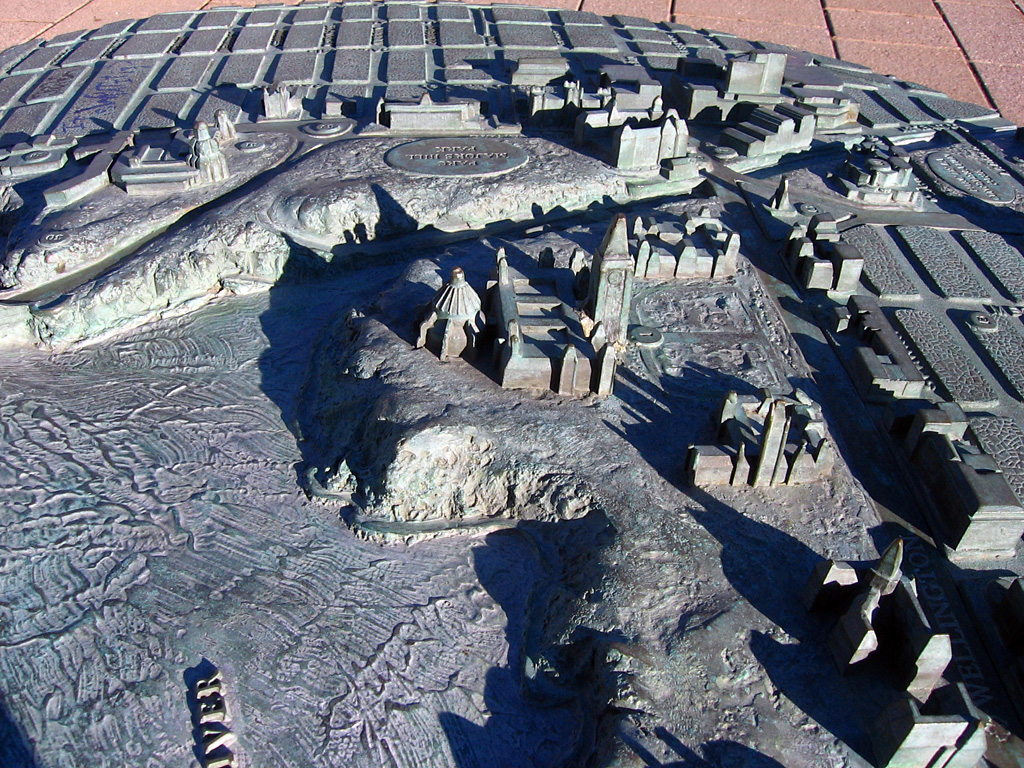
Metal map of Ottawa

One of the most startling distinctions when you look at emissions data from developed and developing states is the relative share of CO2 from fossil fuels and CO2 from land use change and forestry.

In developed countries, 81% of total emissions consist of CO2 produced by the burning of fossil fuels. 19% of emissions are non-CO2 greenhouse gasses, with 11% of that coming from methane and 6% from nitrous oxide. The amount from land use change and forestry barely even registers.

In developing states, by contrast, CO2 from land use change and forestry comprises 33% of total emissions. CO2 from fossil fuels is a more moderate 41%, though it is growing quickly in many countries.

Within the least developed states, land use change and forestry accounts for 62% of total emissions. Largely, this is on account of deforestation. CO2 from fossil fuels produce just 5% of the total.

Part of what this shows is the importance of producing international agreements that take into account the differing emissions profiles of states in different stages of development. Toughening automobile emission standards might make a big difference in Germany, but very little in Chad. By contrast, providing funds to forest rangers in Malaysia or Indonesia might produce big emission reductions.

Source: World Resources Institute. “Navigating the Numbers: Greenhouse Gas Data and International Climate Policy.” 2005.

IPCC 4AR SPM

Yesterday, the Intergovernmental Panel on Climate Change (IPCC) released the Summary for Policymakers (PDF) for the Synthesis Report of the Fourth Assessment Review. That’s what the impenetrable ‘IPCC 4AR SPM’ signifies.

To clarify what that really means, it must be understood that there are a number of levels to the work of the IPCC. Every few years, there is an assessment review meant to evaluate the state of published scientific literature on climate change. The first was in 1990. Subsequent reports have been released in 1995, 2001, and 2007. Each report consists of contributions from three working groups. Each working group writes a report, and each of those reports includes a Summary for Policymakers (SPM). The three working group reports are also combined into a synthesis report, which gets an SPM of its own. That’s what came out yesterday for the Fourth Assessment Review. Each of these reports is negotiated by scientists and approved by the IPCC member states. The SPMs are hashed out by government representatives line by line. That’s what the meeting that just ended in Valencia was about.

The Fourth Assessment Review has examined far more studies than the Third Assessment Review did: 577 compared to 95. Partly on account of that, it marks a big step forward in scientific certainty about the issue. As piles of media coverage stresses, the news isn’t good.

The Bottom Billion

Paul Collier‘s slim and informative volume is true to my recollection of the man from Oxford. The Bottom Billion: Why the Poorest Countries are Failing and What Can Be Done About It is engaging, concise, and powerfully argued. It is also unsparing in its criticism. Collier explains that the ‘developing world’ consists of two groups of states: those experiencing sustained growth and thus seeing their standard of living converging with those in the rich world and those that are ‘stuck’ in poverty, with stagnant growth or absolute decline.

Poverty traps

The ‘stuck’ states – where the world’s poorest billion inhabitants are concentrated – are trapped in one of four ways: by conflict, natural resources, being landlocked with bad neighbours, and by bad governance. States can be trapped in more than one simultaneously and, even when they escape, there are systemic reasons for which they are unusually likely to fall back into one. The discussion of the traps is particularly informative because of how quantitative methods have been used in support of anecdotal arguments.

Not only are ‘bottom billion’ states unusually likely to suffer from conflict, corruption, and similar problems, but some of the most important paths to growth used by states that have already escaped poverty are closed to them. To grow through the export of manufactured goods, you need both low wages and economies of scale. Even if wages in Ghana are lower than those in China, China has the infrastructure and the attention of investors. The presence of export-driven Asian economies makes it harder for ‘bottom billion’ states to get on a path to development.

Solutions

Collier’s proposed solutions include aid, military intervention, changes to domestic and international laws and norms, and changes to trade policy. Much of it is familiar to those who have followed development debates: the problems with agricultural tariffs, the way aid is often used to serve domestic interests rather than poverty reduction, corruption within extractive industries, and the like. His most interesting ideas are the five international ‘charters’ he proposes. These would establish norms of best practice in relation to natural resource revenues, democracy, budget transparency, postconflict situations, and investment. Examining them in detail exceeds what can be written here, but it is fair to say that his suggestions are novel and well argued. He also proposes that ‘bottom billion’ states should see import tariffs in rich states immediately removed for their benefit. This is meant to give them a chance of getting onto the path of manufacture-led growth, despite the current advantages of fast-growing Asian states. His idea that states that meet standards of transparency and democracy should be given international guarantees against being overthrown in coups is also a novel and interesting one.

Position in the development debate

Collier’s book is partly a response to Jeffrey Sachs’ much discussed The End of Poverty: Economic Possibilities for Our Time. Sachs pays much more attention to disease and has more faith in the power of foreign aid, but the two analyses are not really contradictory. Together, they help to define a debate that should be raging within the international development community.

Collier’s treatment is surprisingly comprehensive for such a modest volume, covering everything from coups to domestic capital flight in 200 pages. The approach taken is very quantitatively oriented, backing up assertions through the use of statistical methods that are described but not comprehensively laid out. Those wanting to really evaluate his methodology should read the papers cited in an appendix. Several are linked on his website.

Environmental issues

Environmental issues receive scant attention in this analysis. When mentioned, they are mostly derided as distractions from the real task of poverty reduction. It is fair enough to say that environmental sustainability is less of a priority than alleviating extreme poverty within these states. That said, the environment is one area where his assertion that the poverty in some parts of the world is not the product of the affluence in others is most dubious. It is likely to become even more so in the near future, not least because of water scarcity and climate change.

Climate change receives only a single, peripheral mention. This is probably appropriate. Surely, the effects of climate change will make it harder to escape the traps that Collier describes. That doesn’t really change his analysis of them or the validity of his prescriptions. The best bet for very poor states is to grow to the point where they have a greater capacity to adapt and will be less vulnerable to whatever the future will bring.

‘Nuclear weapons sharing’ in Europe

Gatineau Park trees

One obscure but troubling legacy of the Cold War is the American nuclear weapons that are deployed in Belgium, Italy, and the Netherlands under NATO nuclear weapons sharing agreements. The arsenals consist of 150 B61 gravity bombs held in US custody, apparently for the enduring purpose of deterring a Soviet/Russian tank invasion of Europe. The bombs can be tailored to different yields: with different versions capable of producing explosions with between 0.3 and 340 megatonnes of power. In total, about 3,155 of these bombs were made, with between 1,200 and 1,900 still in service worldwide. A 1994 variant has a hardened casing and can be used as a nuclear bunker buster.

Apparently, these weapons were in place during the negotiation of the 1970 Nuclear Non-Proliferation Treaty and two arguments were privately maintained about why this usage is not in contravention of the treaty. The first was that, since the bombs were under American control, they had not been illegally transferred from a nuclear-weapons state to a non-nuclear weapon state in violation of Article I of the Treaty. The second was that the weapons would not be used “unless and until a decision were made to go to war, at which the treaty would no longer be controlling.”

The latter argument strikes me as exceptionally weak – as does the general rationale for maintaining these weapons. The existing arsenals of American submarine launched missiles, land-based ICBMs, nuclear-equipped bombers, and nuclear cruise missiles would seem sufficient to serve any conceivable purpose for which these bombs might be used. I am also willing to bet that your average Belgian, Italian, or Dutch citizen isn’t too pleased to have the things within their borders.

Solving climate change by stealth

First Nations art in the Museum of Civilization

There is a lot of talk about engaging people in the fight against climate change. In the spirit of prompting thought and discussion, I propose the opposite.

Rather than trying to raise awareness and encourage voluntary changes in behaviour we should simply build a society with stable greenhouse gas emissions and do so in a way that requires little input and effort from almost everyone.

Critically, that society should emerge and exist without the need for most people in it to think about climate change at all. For the most part, it should occur by means of changes that aren’t particularly noticed by those not paying attention. In places where change is noticed, it is because the legal and economic structure of society now requires people to behave differently, without ever asking them to consider more than their own short term interests.

To do this, you need to make two big changes: decarbonize our infrastructure and price carbon.

Decarbonizing infrastructure

When a person plugs their computer or television into the wall, they don’t care whether the power it is drawing came from a dam, from a wind turbine, or from a pulverized coal power plant. Changing the infrastructure changes the emissions without the need to change behaviour. Given how dismal people are at actually carrying out behavioural change (a scant few individuals aside), this is a good thing.

The change in infrastructure needs to go way beyond electrical generation. It must take into account the transportation sector and agriculture; it must alter our land and forest management practices. People can then broadly continue to do what they have been: eat meat, drive SUVs, etc, while producing far fewer emissions in the process. We shouldn’t underestimate the scale of the changes required. Moving from a high-carbon society to a low-carbon one is a Herculean task – especially if you are trying to do it in a way that does not produce major social disruption or highly intrusive changes in lifestyles.

Pricing carbon

There are some who would argue that putting a price on carbon is all your need to do, whether you use a carbon tax or a cap-and-trade system to achieve that aim. Set a high enough price for carbon and the market will change all the infrastructure for us. This is naive both in terms of economics and political science. No democratic government will introduce a carbon price draconian enough to quickly spur the required changes in infrastructure. Governments copy one another and follow the thinking of voters: if other countries are investing in ethanol and voters think it is green, governments will often pile onto the bandwagon, almost regardless of ecological merit. In economic terms, carbon pricing is inadequate because it lacks certainty across time. If one government puts in a $150 per tonne tax, industry may reason that it will be overturned by popular outrage in a short span of time; infrastructure investments will not change.

What pricing does, in combination with infrastructure change, is eliminates the kind of activities that just cannot continue, even when everything that can be decarbonized has been. The biggest example is probably air travel as we know it. There is no way we can change infrastructure and keep people jetting off to sunny Tahiti. As such, pricing will need to make air travel very rare – at least until somebody comes up with a way to do it in a carbon neutral way.

Advantages and issues

The general advantages of this approach are that it relies on people making individual selfish decisions at the margin, rather than trying to make them into altruists through moral suasion. The former is a successful strategy – consider macroeconomic management by central banks or the criminal justice system – the latter is not. People will use emissions-free electricity because it will be what’s available. They will run their cars on emission-free fuels for the same reason. Where emissions cannot be prevented, they will be buried.

The disadvantages of this approach are on two tracks. In the first place, it might be impossible to achieve. There may never be an appropriate combination of power, technical expertise, and will. Without those elements, the infrastructure will not change and carbon will remain an externality. It is also possible that decarbonizing a society like ours is simply technologically impossible. Carbon sequestration may not work, and other zero-emission and low-emission technologies may turn out to be duds. In that case, major lifestyle changes would be required to stabilize greenhouse gas concentrations.

In the second place, this approach is profoundly elitist and technocratic. It treats most citizens as machines that respond to concrete personal incentives rather than their moral reasoning. Unfortunately, ever-increasing emissions in the face of ever-increasing scientific certainty suggests that the former is a better description than the latter, where climate change is concerned.

Australian election upcoming

In nine days, Australia is having a federal election. Based on polls, it seems more likely than not that John Howard – the Conservative Prime Minister – will lose to Kevin Rudd of the Labor Party.

Both Nature and The Economist have commented upon the election in general and the importance of climate change as an issue within it. Up to now, Australia has been one of the least cooperative countries in the world, when it comes to the international regulation of greenhouse gasses. That might change to a considerable extent under Labor leadership.

Disgusting situation in Saudi Arabia

In case anyone needs to be reminded about the awfulness of some world governments, here is a story about a rape victim in Saudi Arabia being sentenced to 200 lashes and six months in jail for being in the car of a non-family member. The seven rapists received sentences ranging from one to five years.

This is the kind of thing that should produce serious and public condemnation from governments that are actually serious about human rights and the rule of law. The combination of theocracy, patriarchy, and vindictiveness that created and enforces these laws has no place in any legitimate society.

On Ethiopia and birth rates

Place de Portage atrium, Gatineau

This week’s issue of The Economist includes a briefing on Ethiopia. In many ways, it reflects the ideas I am reading in Paul Collier’s The Bottom Billion: Why the Poorest Countries are Failing and What Can Be Done About It.. A bad neighbourhood, terrible governance, ethnic conflict, persistent poverty and poor quality of life indicators persist despite western aid and loans from China. It seems probable that Ethiopia is caught in one or more of the poverty ‘traps’ that Jeffrey Sachs, Collier, and others have written about.

What struck me most about the article, however, was the demographics. In order to keep unemployment constant, Ethiopia needs to generate hundreds of thousands of new jobs a year. This is because the average woman in Ethiopia will have seven children in the course of her life. On the basis of such growth, the population could rise from about 75 million now to over 140 million by 2050. While it is possible that such a spectacular rate of population growth is the product of free and voluntary choices, it seems more plausible that it reflects a lack of personal control over reproduction: especially on the part of women. It is both ethical and prudent to redress this balance in favour of women having more control of their reproductive lives.

Statistics suggest that such control is less common in poorer places. This scatter plot shows the relationship between GDP per capita and total fertility rate in 108 countries. The replacement rate of about 2.1 births per woman corresponds to a mean GDP per capita of about $10,000 (though countries with a wide range of incomes can be found with similar TFRs). This data doesn’t necessarily show anything causal. It neither confirms or denies that poverty causes high birth rates or, conversely, that high birth rates cause poverty. Nonetheless, it is suggestive of the fact that women have less control over reproduction in poorer places.

A sustainable world is probably one with a birth rate below the natural rate of replenishment. This is not true indefinitely, but only until the combination of total human population and total human impact upon natural systems can be indefinitely sustained. While people obviously should not be forced to reduce their fecundity by governments, their right to choose whether or not to have children should be upheld and made meaningful through policies such as the legality and availability of contraception. In 1994, the International Conference on Population and Development defined sexual and reproductive health as:

A state of complete physical, mental and social well-being and…not merely the absence of disease or infirmity, in all matters relating to the reproductive system and to its functions and processes. Reproductive health therefore implies that people are able to have a satisfying and safe sex life and that they have the capability to reproduce and the freedom to decide if, when and how often to do so. Implicit in this last condition are the right of men and women to be informed and to have access to safe, effective, affordable and acceptable methods of family planning of their choice, as well as other methods of their choice for regulation of fertility which are not against the law, and the right of access to appropriate health-care services that will enable women to go safely through pregnancy and childbirth and provide couples with the best chance of having a healthy infant.

Sexual politics have always been a terribly contentious area, but that doesn’t mean reasonable people should not be agitating for better recognition and implementation of sexual rights. The United Nations Population Fund has a good website linking to more information on reproductive rights.

Quebec rejects corn ethanol

Having decided in 2005 to authorize a corn-fed ethanol plant in Varennes, the government of Quebec has now officially said that corn ethanol has no future in the province. While the future use of alternative feedstocks is not ruled out, the Quebec Minister for Natural Resources have said that this pilot plant will be the last of its kind. An article in the Montreal Gazette supports the idea that “[b]acking away from ethanol makes sense.”

This is a good thing for a number of reasons. To begin with, ethanol made from corn probably doesn’t have any positive environmental effects. It takes as much oil to grow the corn, make the ethanol, and distribute it as it would have taken to power the ethanol cars in the first place. As such, the effect of using corn ethanol on greenhouse gas emissions is negligible. Furthermore, intensive corn agriculture has problems of its own. Pesticide use peppers the environment with toxins – including persistent organic pollutants. Fertilizer runoff causes the eutrophication of rivers and algae blooms in the sea.

Wherever a sustainable future for transportation energy lies, it is not with ethanol made from corn.