From the National Observer: Young Canadians launch website tracking climate commitments of federal parties
The site itself: Shake Up The Establishment
climate change activist and science communicator; photographer; mapmaker — advocate for a stable global climate, reduced nuclear weapon risks, and safe human-AI interaction

All posts on what Bismarck called “the art of the possible”
From the National Observer: Young Canadians launch website tracking climate commitments of federal parties
The site itself: Shake Up The Establishment
I have always been taught that the idea in Canada, the UK, and other Westminister-style Parliamentary democracies is that Parliament is sovereign and that the prime minister and cabinet must maintain their confidence to rule legitimately.
A recent Economist article on Brexit makes several references to how their fixed-election law ambiguously alters that:
[T]he Fixed-term Parliaments Act of 2011 upturned established conventions on confidence votes within the Commons, leaving confusion among MPs over both how to bring a government down and what happens when one falls. And the quirks of British parliamentary procedure provide various ways in which a sufficiently bloody-minded prime minister might force a “no-deal” Brexit without a majority in Parliament. This has all the makings of a constitutional crisis.
…
The Fixed-term Parliaments Act got rid of the power that prime ministers had previously enjoyed to call an election at any time, thus reassuring the Lib Dems that the Tories would not cut and run as soon as they fancied their chances.
…
The country may thus see a new conflict over where sovereignty lies—the constitutional question which, above all others, Brexit has dragged into the light.
…
Some of the subsequent mess rests on the back of the Fixed-term Parliaments Act of 2011. Before this a prime minister whose flagship legislation was voted down—just once, never mind repeatedly—would have been expected to call an election. If he or she had not, a vote of confidence would have followed which a minority government would have been near certain to lose. The 2011 act replaced this convention with statute which says that a lost confidence vote triggers a two-week period during which any mp can attempt to win the backing of the Commons and form a government to avoid an election. When asked what this would actually look like, the clerk of the House of Commons responds: “I really don’t know—I don’t think anybody knows.”
It seems remarkable that an ordinary piece of legislation can muddy or upend the most important constitutional convention in Westminister democracies — the confidence convention — and that the legislation in turn was to solve a short-term coalition management problem.
The article also discusses another change that got limited consideration but which has important and open-ended effects: “The hurried inception of the Supreme Court was, in the mocking words of its former president, David Neuberger, ‘a last-minute decision over a glass of whisky’.”
One argument routinely used against divestment from fossil fuels is that, as investors, institutions like universities and pension funds might be able to discourage the most wasteful and damaging new fossil fuel investments and encourage fossil fuel corporations to use their resources and expertise to advance decarbonization.
In the U of T divestment brief we explained our doubts about this justification. Nonetheless, it remains an approach that some are trying:
Bruce Duguid of Hermes Investment Management, who worked with bp on behalf of Climate Action 100+, says that disclosure will help investors understand if the billions which bp continues to spend on oil and gas creates too much risk. bp will describe how big new capital projects stack up against the Paris goal of keeping warming “well below” 2°C relative to preindustrial times. Equinor, Norway’s state behemoth, agreed to something similar in April. As with Shell, bp’s resolution does not require it to cut oil and gas output. Greenpeace, a combative ngo, blocked entrances to bp’s headquarters in London ahead of its annual meeting on May 21st.
…
For the time being, though, Shell, bp and ExxonMobil remain members of the American Petroleum Institute, which has sought to ease rules on emissions of methane, a potent greenhouse gas. They also maintain links with the Western States Petroleum Association, which last year fought a carbon tax in Washington state. bp spent over $13m directly to help defeat a ballot initiative in favour of the levy.
…
Others are beginning to question the value of shareholder engagement. The Church of England has said it will divest by 2023 if no advances are made. “Investors’ patience is not limitless,” says Mr Logan. “It’s going to be measured in years, not decades.”
There are many reasons to doubt how meaningful shareholder activism can be, and to ask whether it’s a “shadow solution” that creates the impression that action on climate change will happen, while really justifying the continuation of the status quo. These firms have an enormous financial interest in keeping the fossil fuel reserves they own usable, which in turn means blocking climate change action. Furthermore, neither executives nor shareholders can be expected to meaningfully support a transition to decarbonization which would make these firms irrelevant.
This chart is a nice demonstration of what a pragmatic all-bases-covered campaign against climate change might encourage or at least contemplate pic.twitter.com/D6YONNjebN
— Milan Prazak Ilnyckyj (@sindark) June 6, 2019
Figure from my 2009 blog post, showing why delaying the global peak year for greenhouse gas pollution emissions means having to cut emissions much faster in the 2020s and 2030s to achieve the same temperature target:

Tweeted by Greta Thunberg today:
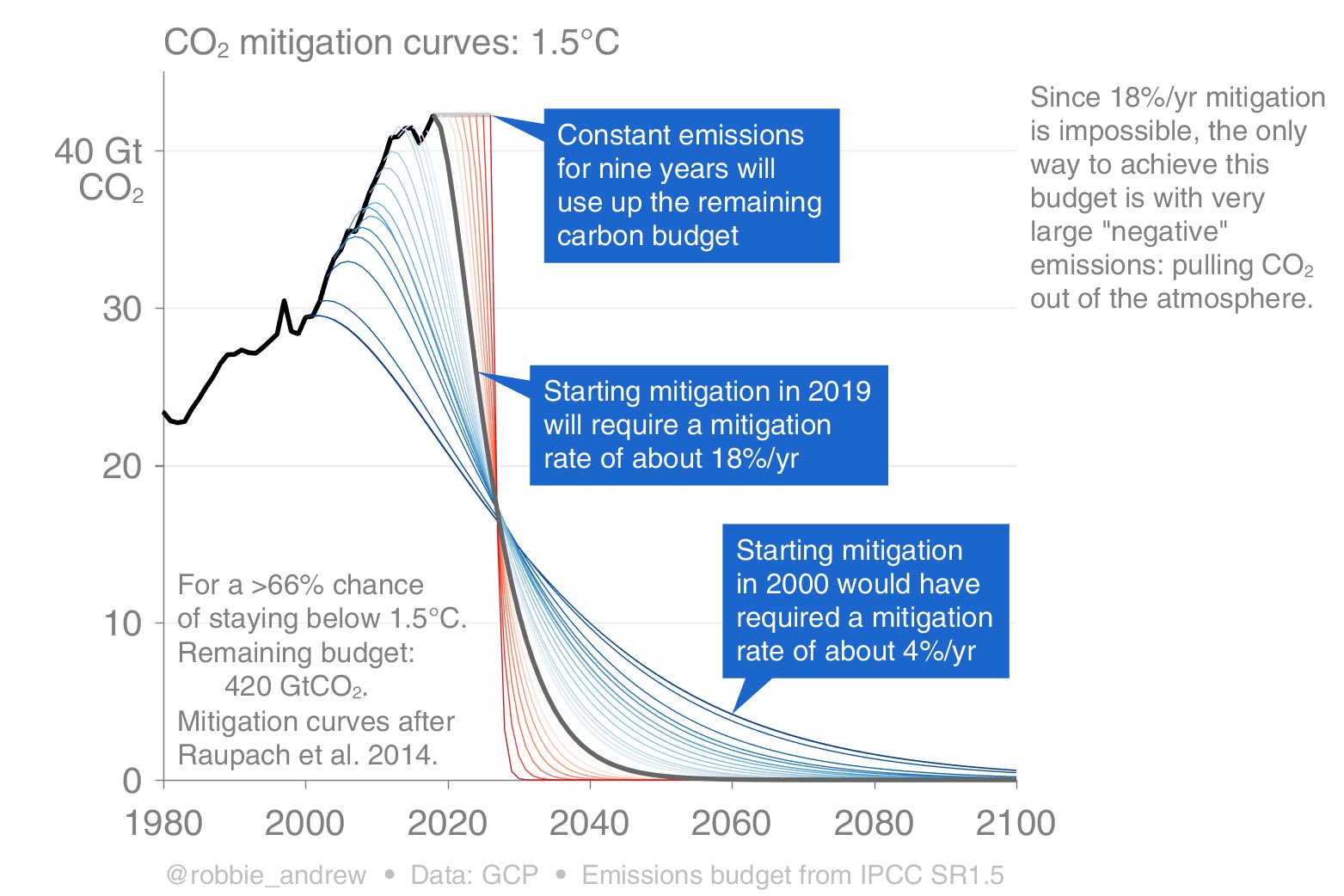
All this delay mutually reinforces the risks of catastrophes. People keep investing in fossil fuels, so they have more to lose from decarbonization. We keep putting off emission cuts, meaning that their eventual rate will need to be much more draconian than if we had started promptly when the risk of catastrophic climate change became well-recognized in the 1990s. We’re committing ourselves to more severe climate change effects, meaning more forced relocation, severe droughts, extreme weather events, and adaptation costs in general measured in both wealth and lives. We’re missing the chance to build global cooperation and overcome the parochial one-country-mindset mentality that makes global environmental problems into collective action problems.
UBC political science professor George Hoberg has a post about today’s court ruling saying B.C. can’t restrict bitumen transport through the proposed Trans Mountain pipeline expansion: The BC pipeline reference case in context
Where have all the activists gone?
The Varsity
By Anna Osterberg
Published: 7:28 pm, 17 May 2019
Yesterday the Massey College Governing Board announced that they have selected Hugh Segal’s successor as the head of Massey College. Their message says: “Massey College is delighted to welcome Nathalie Des Rosiers as its new Principal. She is a distinguished scholar and respected leader who, throughout an impressive career, has shown a deep respect and understanding of the academic community and a profound interest in the development of graduate students and young scholars. She will bring to Massey a fine mixture of intellectual seriousness, curiosity about the world, and a sense of fun and community.”
The college has posted a biography.
In their 2019 Financial System Review the Bank of Canada identifies assessing climate-related risks as an activity they have started to undertake.
The CBC reports: Climate change threatens ‘both the economy and the financial system,’ says Bank of Canada
This week’s Economist is reporting about the growing danger of armed conflict between the United States and Iran:
President Donald Trump’s fixation with undoing “Barack Obama’s signature diplomatic achievement” in the form of the Joint Comprehensive Plan of Action (JCPOA) nuclear deal was worrisome and counterproductive enough, in a world where nuclear weapon proliferation is a growing threat and where proliferation in the Middle East is especially likely if any new nuclear weapon powers emerge.
It’s terrifying to think what a new profusion of nuclear powers in the region could mean. Among other things, I think it would greatly increase the risk of accidental or unauthorized use of nuclear weapons. There were enough US-Soviet close calls in the Cold War, and that was two powers that were far apart, in communication, and well-informed about each other’s capabilities. A nuclear crisis among a larger set of tightly-packed states is a truly fearful prospect.
A conventional American or Israeli attack on Iran is also a fearful prospect, and one that seems almost certain to be less effective at curtailing Iranian nuclear ambitions in the medium term than multilateral diplomacy. Again Trump’s recklessness and the incompetence and ideological drive of his officials like John Bolton is threatening the peace of the world, such as it is holding up these days.