Four Economist articles on climate change

Sorry to post a bunch of links from one source, but this week’s Economist is unusually dense with worthwhile articles about climate change:

There is one on federal legislative efforts in the United States – focusing on the Lieberman Warner bill that has been dominating attention in the Senate. It isn’t as tough as a superior proposal from Bernie Sanders and Barbara Boxer, but it stands a better change of thrashing its way through committee and onto the Senate floor. Of course, even a bill that gets through the Senate would need to be made compatible with a bill passed by the House of Representatives and avoid being vetoed by the President. Even so, the kind of cap-and-trade bills that are appearing in the Senate may well be indicative of the kind of legislation to expect from the next American administration.

American states have traditionally been ‘policy laboratories’ and have often developed environmental policies that were later adopted federally. Examples include rules on automobile emissions and sulphur dioxide emissions which cause acid rain. A second article briefly discusses the Regional Greenhouse Gas Initiative (RGGI): one of the two most important regional initiatives in the US, along with the Western Climate Initiative. Again, this is more a sign of what may be to come than a hugely influential thing unto itself.

A less encouraging trend is demonstrated by an article on the increasing popularity of coal. What is especially distressing is that coal plants are even being built in Europe, which has gone further than anyone else in regulating carbon emissions. Clearly, prices are not yet high enough and regulatory certainty is not yet firm enough to effectively discourage the use of coal for electricity generation. The new plants aren’t even being built in a way that can be easily modified to incorporate carbon capture and storage.

One last story is more tangentially related to climate change: tomorrow’s federal election in Australia will partly turn on voters responses to the positions adopted on climate change by the Labor and Conservative candidates, respectively.

In general, I don’t think The Economist takes the problem of climate change seriously enough. They write good-sounding articles in situations where it is the focus, but often miss it completely or mention it only trivially in articles on energy trends, business, or economic growth. That said, their ever-increasing coverage of the issue is probably representative of its ever higher profile in the planning of the world’s most influential people.

Climate sensitivity and stabilization concentrations

British Columbia provincial crest

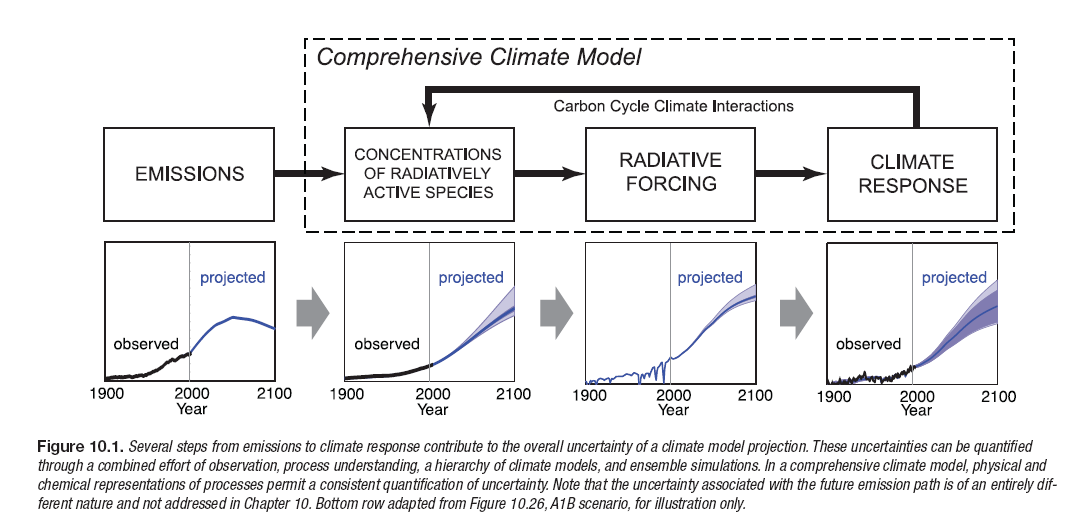
The European Union has a widely quoted objective of avoiding anthropogenic temperature rise of more than 2°C. That is to say, all the greenhouse gasses we have pumped into the atmosphere should, at no point, produce enough radiative forcing to increase mean global temperatures more than 2°C above their levels in 1750.

IPCC Fourth Assessment Report, Working Group I, Chapter 10, Page 753

What is less commonly recognized is how ambitious a goal this is. The difficulty of the goal is closely connected to climate sensitivity: the “equilibrium change in global mean surface temperature following a doubling of the atmospheric (equivalent) CO2 concentration.” According to the Intergovernmental Panel on Climate Change, this is: “likely to be in the range 2 to 4.5°C with a best estimate of about 3°C, and is very unlikely to be less than 1.5°C. Values substantially higher than 4.5°C cannot be excluded, but agreement of models with observations is not as good for those values.”

IPCC Fourth Assessment Report, Synthesis Report, Summary for Policymakers, p.22

Taking their most likely value, 3°C, the implication is that we cannot allow the doubling of global greenhouse gas concentrations. Before the Industrial Revolution, carbon dioxide concentrations were about 280ppm. Today, they are about 380ppm.

Based on the IPCC’s conclusions, stabilizing greenhouse gas levels at 450ppm only produces a 50% chance of staying below 2°C of warming. In order to have a relative high chance of success, levels need to be stabilized below 400ppm. The Stern Review’s economic projections are based around stabilization between 450 and 500ppm. Stabilizing lower could be quite a lot more expensive.

Finally, there is considerable uncertainty about climate sensitivity itself. Largely, this is the consequence of feedback loops within the climate. If feedbacks are so strong that climate sensitivity is greater than 3°C, it is possible that current GHG concentrations are sufficient to breach the 2°C target for total warming. Some people argue that climatic sensitivity is so uncertain that temperature-based targets are useless.

The 2°C target is by no means sufficient to avoid major harmful effects from climate change. Effects listed for that level of warming in the Stern Review include:

  • Failing crop yields in many developing regions
  • Rising number of people at risk from hunger, with half the increase in Africa and West Asia
  • Severe impacts in marginal Sahel region
  • Significant changes in water availability
  • Large fraction of ecosystems unable to maintain current form
  • Rising intensity of storms, forest fires, droughts, flooding, and heat waves
  • Risk of weakening of natural carbon absorption and possible increasing natural methane releases and weakening of the Atlantic Thermohaline Circulation
  • Onset of irreversible melting of the Greenland ice sheet

Just above 2°C, there is “possible onset of collapse of part or all of Amazonian rainforest” – the kind of feedback-inducing effect that could produce runaway climate change.

George Monbiot has also commented on this. The head of the International Energy Agency has said that it is too late for the target to be met (PDF).

Weakening carbon sinks

Some recent figures published in the American Proceedings of the National Academy of Sciences suggest that terrestrial and marine carbon sinks are losing their ability to absorb carbon. In 2000, oceans and plant growth collectively absorbed about 600 of every 1000kg of carbon dioxide released into the atmosphere. In 2006, that had fallen to 540kg. While there is some degree of annual variation in such figures, a persistent downward trend would necessitate even more aggressive cuts in global human emissions.

Atmospheric CO2 concentrations are now about 383ppm, and increasing by nearly 2ppm a year, in line with growth in annual emissions of about 3.3%. Total emissions in 2006 were about 9.9 gigatonnes, compared with 8.4 gigatonnes in 2000. Recall that those figures are just for carbon dioxide; other greenhouse gases, such as methane and nitrous oxide, also contribute to planetary warming.

If terrestrial and marine carbon sinks continue to suffer from a reduced capacity to absorb CO2, the total level of sustainable emissions for the planet may end up being even lower than the 5 gigatonnes that the Stern Review estimates the planet can handle.

Trade and greenhouse gas emissions

Painted face portrait

Countries that are short on land and water import wheat from countries that have lots of both. In a way, you can see this as the small dry country ‘importing’ land and water in the conveniently transportable form of edible grains. The conveyance is an indirect one (you do not pay a ‘water surcharge’ on a bag of flour), but differences in relative factor prices can lead to opportunities for universal gains from trade.

Something similar happens with greenhouse gas emissions, though it takes the form of an externality rather than a priced component of a transaction. When manufacturing or primary commodities takes place in one state and the products of those industries are consumed in another, the total emissions in the exporting countries include some component for which the importing country arguably bears moral responsibility. When a Canadian buys an iPod made from Chinese energy and Sudanese oil, it seems fairest to say that the Canadian is responsible for the associated emissions.

A 2003 OECD study attempted to quantify such transfers using data from 1993 to 1998. For that span of time, the United States effectively imported an average of 263 megatonnes of carbon emissions per year: about 5% of their domestic total. China, by contrast, exported about 360 megatonnes: a figure equivalent to 12% of their GHG production. Canada, with all its forest and hydrocarbon industries, apparently exported about 54 megatonnes: about 11% of our emissions during that period.

Trying to calculate these on an ongoing basis and transfer responsibility from makers to buyers is simply impractical. Thankfully, the establishment of a global price for carbon would achieve the same effect without all the paperwork. It doesn’t matter if the tax is imposed at the point of production or the point of consumption. In the former case, producers would pass the cost to consumers anyhow.

Source: Ahmad, Nadim. “A Framework for Estimating Carbon Dioxide Emissions Embodied in International Trade of Goods.”

Forestry and fossil fuels

Metal map of Ottawa

One of the most startling distinctions when you look at emissions data from developed and developing states is the relative share of CO2 from fossil fuels and CO2 from land use change and forestry.

In developed countries, 81% of total emissions consist of CO2 produced by the burning of fossil fuels. 19% of emissions are non-CO2 greenhouse gasses, with 11% of that coming from methane and 6% from nitrous oxide. The amount from land use change and forestry barely even registers.

In developing states, by contrast, CO2 from land use change and forestry comprises 33% of total emissions. CO2 from fossil fuels is a more moderate 41%, though it is growing quickly in many countries.

Within the least developed states, land use change and forestry accounts for 62% of total emissions. Largely, this is on account of deforestation. CO2 from fossil fuels produce just 5% of the total.

Part of what this shows is the importance of producing international agreements that take into account the differing emissions profiles of states in different stages of development. Toughening automobile emission standards might make a big difference in Germany, but very little in Chad. By contrast, providing funds to forest rangers in Malaysia or Indonesia might produce big emission reductions.

Source: World Resources Institute. “Navigating the Numbers: Greenhouse Gas Data and International Climate Policy.” 2005.

IPCC 4AR SPM

Yesterday, the Intergovernmental Panel on Climate Change (IPCC) released the Summary for Policymakers (PDF) for the Synthesis Report of the Fourth Assessment Review. That’s what the impenetrable ‘IPCC 4AR SPM’ signifies.

To clarify what that really means, it must be understood that there are a number of levels to the work of the IPCC. Every few years, there is an assessment review meant to evaluate the state of published scientific literature on climate change. The first was in 1990. Subsequent reports have been released in 1995, 2001, and 2007. Each report consists of contributions from three working groups. Each working group writes a report, and each of those reports includes a Summary for Policymakers (SPM). The three working group reports are also combined into a synthesis report, which gets an SPM of its own. That’s what came out yesterday for the Fourth Assessment Review. Each of these reports is negotiated by scientists and approved by the IPCC member states. The SPMs are hashed out by government representatives line by line. That’s what the meeting that just ended in Valencia was about.

The Fourth Assessment Review has examined far more studies than the Third Assessment Review did: 577 compared to 95. Partly on account of that, it marks a big step forward in scientific certainty about the issue. As piles of media coverage stresses, the news isn’t good.

Shipping and invasive species

Spiral staircase, Place de Portage, Gatineau

Globalization has been profoundly associated with massive sea freight shipments. Primary commodities flow from states with rich resource endowments to others with processing facilities. Labour intensive goods are shipped from where labour is cheap to where the goods are demanded. In the process of all this activity, a lot of oceanic species have been able to move into waters they would never otherwise have reached. This unintentional human-induced migration has occurred for two major reasons: the construction of canals and the transport of ballast water. This brief discussion will focus on the latter.

Each year, ships carry 3 – 5 billion tonnes of ballast water internationally. The water is taken on in port, once a ship has been loaded. This is necessary to make the ship balanced and stable at sea. The water taken on can easily include hundreds of marine species of which many of which are capable of surviving the journey. If they get expelled in a suitable environment, these creatures can alter ecosystems and crowd out local species. Sea urchins that have arrived in this way have been extinguishing kelp beds off the west coast of North America, destroying sea otter habitat in the process. Zebra mussels are another infamous example of a problematic invasive species.

Efforts to prevent the transmission of species through ballast water take a number of forms:

  1. Ejecting the water taken on in port in the open ocean: most of the species expelled should die, and the new waters taken on should be relatively free of living things
  2. Poisoning the creatures in the ballast water: this can be done with degradable biocides like peracetic acid and hydrogen peroxide
  3. Transferring ballast water to a treatment facility at the arrival port
  4. De-oxygenating the water in ballast tanks: this kills most species, if the deoxygenated conditions are maintained for long enough

None of these approaches is completely effective. Each retains some possibility of unintentionally introducing invasive species. Several also have other environmentally relevant effects.

That said, simply making an active effort to prevent species transmission between ecosystems marks a big change in human thinking. Not long ago, species were often introduced willy-nilly into entirely new environments: for aesthetic, practical, or whimsical reasons. Infamous cases include those of Eugene Schieffelin – the man who introduced starlings to North America because he wanted to continent to contain all the birds mentioned in the works of Shakespeare – and Thomas Austin – the British landowner who introduced rabbits to Australia because he missed hunting them. Wikipedia has a comprehensive list of such introduced species.

Solving climate change by stealth

First Nations art in the Museum of Civilization

There is a lot of talk about engaging people in the fight against climate change. In the spirit of prompting thought and discussion, I propose the opposite.

Rather than trying to raise awareness and encourage voluntary changes in behaviour we should simply build a society with stable greenhouse gas emissions and do so in a way that requires little input and effort from almost everyone.

Critically, that society should emerge and exist without the need for most people in it to think about climate change at all. For the most part, it should occur by means of changes that aren’t particularly noticed by those not paying attention. In places where change is noticed, it is because the legal and economic structure of society now requires people to behave differently, without ever asking them to consider more than their own short term interests.

To do this, you need to make two big changes: decarbonize our infrastructure and price carbon.

Decarbonizing infrastructure

When a person plugs their computer or television into the wall, they don’t care whether the power it is drawing came from a dam, from a wind turbine, or from a pulverized coal power plant. Changing the infrastructure changes the emissions without the need to change behaviour. Given how dismal people are at actually carrying out behavioural change (a scant few individuals aside), this is a good thing.

The change in infrastructure needs to go way beyond electrical generation. It must take into account the transportation sector and agriculture; it must alter our land and forest management practices. People can then broadly continue to do what they have been: eat meat, drive SUVs, etc, while producing far fewer emissions in the process. We shouldn’t underestimate the scale of the changes required. Moving from a high-carbon society to a low-carbon one is a Herculean task – especially if you are trying to do it in a way that does not produce major social disruption or highly intrusive changes in lifestyles.

Pricing carbon

There are some who would argue that putting a price on carbon is all your need to do, whether you use a carbon tax or a cap-and-trade system to achieve that aim. Set a high enough price for carbon and the market will change all the infrastructure for us. This is naive both in terms of economics and political science. No democratic government will introduce a carbon price draconian enough to quickly spur the required changes in infrastructure. Governments copy one another and follow the thinking of voters: if other countries are investing in ethanol and voters think it is green, governments will often pile onto the bandwagon, almost regardless of ecological merit. In economic terms, carbon pricing is inadequate because it lacks certainty across time. If one government puts in a $150 per tonne tax, industry may reason that it will be overturned by popular outrage in a short span of time; infrastructure investments will not change.

What pricing does, in combination with infrastructure change, is eliminates the kind of activities that just cannot continue, even when everything that can be decarbonized has been. The biggest example is probably air travel as we know it. There is no way we can change infrastructure and keep people jetting off to sunny Tahiti. As such, pricing will need to make air travel very rare – at least until somebody comes up with a way to do it in a carbon neutral way.

Advantages and issues

The general advantages of this approach are that it relies on people making individual selfish decisions at the margin, rather than trying to make them into altruists through moral suasion. The former is a successful strategy – consider macroeconomic management by central banks or the criminal justice system – the latter is not. People will use emissions-free electricity because it will be what’s available. They will run their cars on emission-free fuels for the same reason. Where emissions cannot be prevented, they will be buried.

The disadvantages of this approach are on two tracks. In the first place, it might be impossible to achieve. There may never be an appropriate combination of power, technical expertise, and will. Without those elements, the infrastructure will not change and carbon will remain an externality. It is also possible that decarbonizing a society like ours is simply technologically impossible. Carbon sequestration may not work, and other zero-emission and low-emission technologies may turn out to be duds. In that case, major lifestyle changes would be required to stabilize greenhouse gas concentrations.

In the second place, this approach is profoundly elitist and technocratic. It treats most citizens as machines that respond to concrete personal incentives rather than their moral reasoning. Unfortunately, ever-increasing emissions in the face of ever-increasing scientific certainty suggests that the former is a better description than the latter, where climate change is concerned.

On Ethiopia and birth rates

Place de Portage atrium, Gatineau

This week’s issue of The Economist includes a briefing on Ethiopia. In many ways, it reflects the ideas I am reading in Paul Collier’s The Bottom Billion: Why the Poorest Countries are Failing and What Can Be Done About It.. A bad neighbourhood, terrible governance, ethnic conflict, persistent poverty and poor quality of life indicators persist despite western aid and loans from China. It seems probable that Ethiopia is caught in one or more of the poverty ‘traps’ that Jeffrey Sachs, Collier, and others have written about.

What struck me most about the article, however, was the demographics. In order to keep unemployment constant, Ethiopia needs to generate hundreds of thousands of new jobs a year. This is because the average woman in Ethiopia will have seven children in the course of her life. On the basis of such growth, the population could rise from about 75 million now to over 140 million by 2050. While it is possible that such a spectacular rate of population growth is the product of free and voluntary choices, it seems more plausible that it reflects a lack of personal control over reproduction: especially on the part of women. It is both ethical and prudent to redress this balance in favour of women having more control of their reproductive lives.

Statistics suggest that such control is less common in poorer places. This scatter plot shows the relationship between GDP per capita and total fertility rate in 108 countries. The replacement rate of about 2.1 births per woman corresponds to a mean GDP per capita of about $10,000 (though countries with a wide range of incomes can be found with similar TFRs). This data doesn’t necessarily show anything causal. It neither confirms or denies that poverty causes high birth rates or, conversely, that high birth rates cause poverty. Nonetheless, it is suggestive of the fact that women have less control over reproduction in poorer places.

A sustainable world is probably one with a birth rate below the natural rate of replenishment. This is not true indefinitely, but only until the combination of total human population and total human impact upon natural systems can be indefinitely sustained. While people obviously should not be forced to reduce their fecundity by governments, their right to choose whether or not to have children should be upheld and made meaningful through policies such as the legality and availability of contraception. In 1994, the International Conference on Population and Development defined sexual and reproductive health as:

A state of complete physical, mental and social well-being and…not merely the absence of disease or infirmity, in all matters relating to the reproductive system and to its functions and processes. Reproductive health therefore implies that people are able to have a satisfying and safe sex life and that they have the capability to reproduce and the freedom to decide if, when and how often to do so. Implicit in this last condition are the right of men and women to be informed and to have access to safe, effective, affordable and acceptable methods of family planning of their choice, as well as other methods of their choice for regulation of fertility which are not against the law, and the right of access to appropriate health-care services that will enable women to go safely through pregnancy and childbirth and provide couples with the best chance of having a healthy infant.

Sexual politics have always been a terribly contentious area, but that doesn’t mean reasonable people should not be agitating for better recognition and implementation of sexual rights. The United Nations Population Fund has a good website linking to more information on reproductive rights.

Quebec rejects corn ethanol

Having decided in 2005 to authorize a corn-fed ethanol plant in Varennes, the government of Quebec has now officially said that corn ethanol has no future in the province. While the future use of alternative feedstocks is not ruled out, the Quebec Minister for Natural Resources have said that this pilot plant will be the last of its kind. An article in the Montreal Gazette supports the idea that “[b]acking away from ethanol makes sense.”

This is a good thing for a number of reasons. To begin with, ethanol made from corn probably doesn’t have any positive environmental effects. It takes as much oil to grow the corn, make the ethanol, and distribute it as it would have taken to power the ethanol cars in the first place. As such, the effect of using corn ethanol on greenhouse gas emissions is negligible. Furthermore, intensive corn agriculture has problems of its own. Pesticide use peppers the environment with toxins – including persistent organic pollutants. Fertilizer runoff causes the eutrophication of rivers and algae blooms in the sea.

Wherever a sustainable future for transportation energy lies, it is not with ethanol made from corn.