Linear model, a worthwhile aspiration?

If there is one thing my thesis has ended up being about, it is how the linear model of science-based policy-making is wrong. We do not move chronologically through a scientific process – isolated from politics – into a political process based on neutral scientific fact. Additionally, the policies that are adopted always have moral assumptions embedded in them, as well as normative consequences.

One issue that remains is whether our descriptive criticism of the linear model logically extends to it not being something to which we should aspire. Acknowledging that politics affects science doesn’t necessarily mean that we shouldn’t combat that, to such an extent we can. Administrations that have twisted science too far have often ended up looking silly for it (See Litfin). Likewise, while it is clear that various actors use scientific facts and arguments to advance their own agendas, it doesn’t necessarily follow that we should abandon aspirations towards the relatively neutral and balanced presentation of information. By way of comparison, think about adherence to the scientific method. While actual scientific practice doesn’t always follow the ideals of neutrality and objectivity as it should, that doesn’t mean that we should abandon those ideals.

The question, then, is whether the actual processes of science and politics are so far from this ideal that it isn’t even a useful guide for aspirational purposes, or whether we should persist in trying to apply such rationalist approaches.

Solar power and climate change

Cloth pattern, in sumi-e

This is my last full day in Wales. Hopefully, we will have seen a bit of sunshine so far. One of the best things about climbing mountains is the view from the top. Speaking on illumination…

Intuitively, I have long had the sense that solar power makes a great deal of sense as an alternative power source. There are no greenhouse gas emissions, there is no need to operate any massive industrial processes, other than manufacturing panels, and the technology only needs to become incrementally better to be cost-effective against fossil fuels. This map of solar energy, which was used in C.G. Rapley’s presentation, shows the size of solar collectors of the present efficiency that would be needed to satisfy our present electrical needs.

Cost is the first big problem with solar, though it may be a temporary one. According to The Economist:

Decades of research have improved the efficiency of silicon-based solar cells from 6% to an average of 15% today, whereas improvements in manufacturing have reduced the price of modules from about $200 per watt in the 1950s to $2.70 in 2004. Within three to eight years, many in the industry expect the price of solar power to be cost-competitive with electricity from the grid.

Full article (subscription required)

The other big one is load balancing. Because solar output isn’t constant, there is a need to either store power or redistribute it across long distances. Storage across the daily light-dark cycle is of inescapable importance, and the means for doing so are not terribly clear. Batteries are costly and bulky, as well as of a limited lifetime. Solar energy could be used to electrolyze water into hydrogen and oxygen, which could then be fed to fuel cells, but I expect that would increase costs a lot, while reducing efficiency. As with transportation, I think energy storage is a bigger long term problem than energy generation.

Of course, one technology is unlikely to be the solution, in and of itself. There are lots of places where hydro, wind, and geothermal power make sense. There may even be situations where biodiesel is an appropriate choice, despite the inefficiencies of production.

[Update: 3 May 2007] Antonia sent me an interesting BBC article about a solar thermal plant near Seville.

C.G. Rapley on climate change

The Earthwatch Institute lecture tonight was an educational experience, for a whole slew of reasons. I learned a lot about the organization, the talk itself was very well done, and I spoke with some unusually interesting people.

Earthwatch is a slick organization: corporate partnerships, wine receptions before and after talks given at the business school, and a 153-page full-colour glossy book distributed in a ‘treat bag’ to each attendee at the end. This all gives a really interesting glimpse into the world of relationships between private actors. These people aren’t lobbying the state, they are engaging with the scientific and business communities, along with individuals inclined towards certain concerns. Anyone who thinks that regulating carbon emissions is a matter for the leftist fringe should probably meet these people. In the ecosystem of contemporary international actors, they are an unusual species, worthy of further study.

The talk was given by Professor C.G. Rapley, the Director of the British Antarctic Survey. He was well chosen: articulate, funny, and capable of presenting technical material in an engaging and highly effective way. That this is an outset of an international polar year made the choice particularly timely. My transcript of the talk is available on the wiki.

Perhaps the most unusual thing he said – his greatest deviation from the Stern-Gore Axis – was the suggestion that we could (and should) jump-start the demographic transition. This is is transition from high birth and death rates, to massively lowered death rates (due to medicine, agriculture, etc), through massive population growth to the eventual lowering of birth rates and stabilization of the population overall. Rapley alleged that 76m unwanted pregnancies occur each year, worldwide. Giving these people effective contraception and social orders in which they can use it could accomplish a number of good things: he focused on the reduction of future emissions and a reduced push towards urbanization. Of course, the politics of birth control are fiendishly complex, and the possibilities for harm considerable. That said, a world where women have more control over how many children they have would, all other things being equal, be a much better one. Rapley seems to have written more on population for the BBC.

My thanks to all those – both employees of Earthwatch and fellow guests – with whom I spoke at the receptions. Altogether, this evening has reinforced my conception that climate change is the single greatest challenge facing the world today. It has also bolstered my hope that it is something that we can overcome.

One thing not happening this summer

I heard back about the Richard Casement Internship at The Economist today:

Dear Milan Ilnyckyj

Many thanks for your application for the Richard Casement internship, but I’m sorry to have to tell you that you haven’t got it. There were 220 candidates this year, a record number, so I wouldn’t feel too bad about this.

Good luck in the future.

Geoffrey Carr
Science and Technology Editor
The Economist

I was hoping to at least be within the fraction of those who they interviewed, but I expect that would be less than 5% of the total. Even with the pay advertised as ‘a modest stipend,’ I can easily see why 220 people under 25 would apply to write about science for such an interesting publication, headquartered in such interesting cities. Simply in terms of the people you would meet, it would almost certainly be worth doing for free. I hope whoever gets it will make the most of it.

The article I wrote has been posted online, in case anyone wants to read it.

A sign portentous?

If you are in Oxford, go outside right now and have a look at the total lunar eclipse.

On account of the fairly cloudless night, it should be a good show. It should be visible from most of England, Wales, Scotland and Northern Ireland, as well as further afield, and peak between 10.24pm to 11.58pm.

It seems virtually impossible to get a decent photograph of a lunar eclipse on a P&S camera. Even once you have the exposure worked out (about 1/320th of a second at f/5.6 and ISO 50), the lack of major telephoto capabilities means it will always fill too little of the frame to yield a good image. A lens equivalent to 1000mm for 35mm film is what you need to get the moon to approach a full frame.

[Update: 10:49pm] From this vantage, the eclipse has reached totality. Our world is between Apollo and Artemis.

Scientific tourism

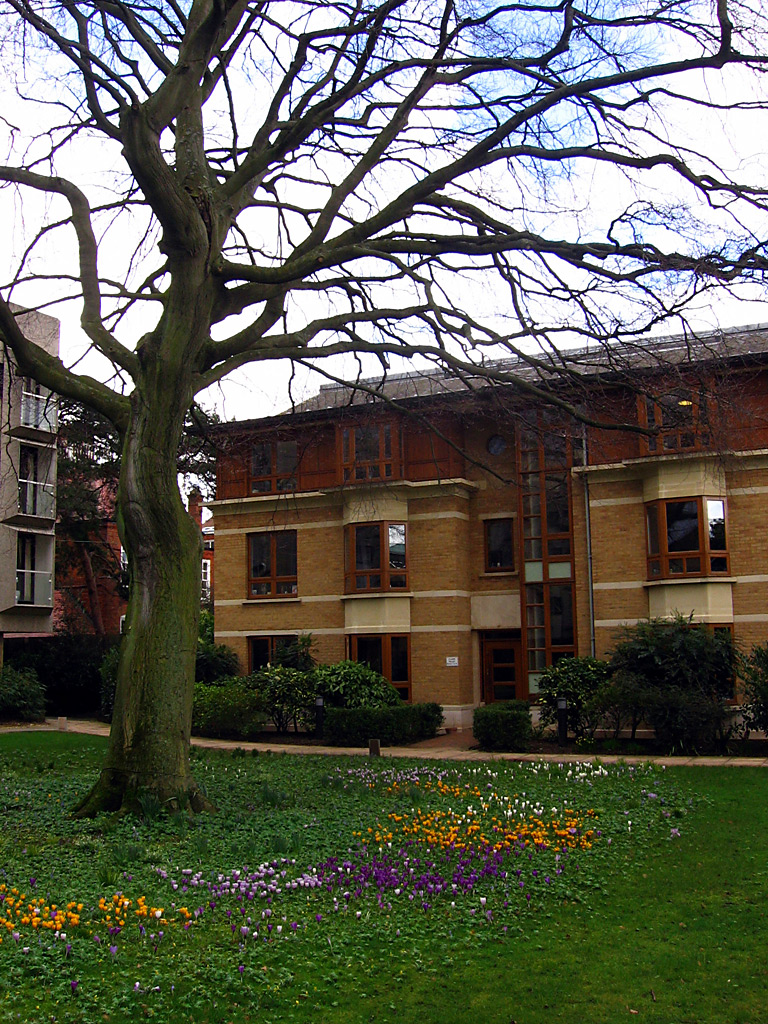
Pembroke College, Oxford

During the last little while, I have become aware of a group called the Earthwatch Institute which has an interesting approach to participating in environmental research and the promotion of sustainability. Since 1971, they have linked more than 80,000 volunteers to more than 2,500 different research projects. The volunteers contribute both financially and through their labour, in exchange for which they get to see some amazing places, meet and work with scientists, and generally gain a better understanding of the world. While you have to wonder how helpful non-specialists could actually be during such a project, it does sound like it would be fascinating.

If you have always envied the people zipping around on helicopters or piloting ships through Antarctic waters, this might be your only opportunity, short of becoming a research scientist. Right now, they are organizing expeditions to Alaskan glaciers, the Amazon river basin, coral reefs in the Bahamas, and a number of other places besides. They seem to cost about $2000-3000, not including travel to the location in question.

For those without scientific training to go on such expeditions may be a bit touristic, but I can see how it could contribute valuable resources to projects – particularly those involving scenic places and photogenic animals.

A disappointing presentation

If it had been an intellectual argument, Professor Timothy Luke‘s presentation on climate change tonight might have been subject to some strong criticism. As it was, it was essentially a smug collection of sniping ad hominem arguments directed at Al Gore, Nicholas Stern, and the concept of liberal environmentalism generally. He made clear that he holds these people in contempt – using a mocking tone of voice while quoting their work – but never really explained why, beyond some vague suggestions that ‘ecopopulism’ would be superior, and how the powerful and the plutocratic are aligned to remain in control. The idea that grassroots organizations will somehow directly access environmental science, then manifest their new preferences through the popular alteration of the political dialog seems rather unlikely. While you can certainly engage in argument with knowledge brokers like Nicholas Stern and Al Gore (starting that argument is much of the point of their work), simply attacking them for being part of existing governmental and economic systems carries little water.

One can hardly expect leaders of politics and industry to abandon their power and the standard economic system. That is especially true when you don’t seem to have any well-formed idea about what the alternative might be. By nor following up his scorn with substance, Professor Luke left us with little value for our time.

Filling the gaps in chapter two

St Anne’s College, Oxford

The conclusion from working on my second chapter is that I have read too much general background material and not enough on my case studies. I am fairly well covered on POPs, since I have done research on them before. Naturally, adding a few more sources would be nice, though there are not really a great many out there. I am also quite well covered on current events relating to climate change, because there has been such a raft of coverage and discussion. While my intention has never been to write a blow-by-blow account of either (how could I possibly do so in 30,000 words?), it is certainly necessary to have a comprehensive understanding of the history, before any important and valid analysis can be done.

As such, I need to fill in my knowledge on recent developments pertaining to POPs, which should not be hugely difficult. Then, I need to shore up my section on the early history of the climate change debate. Aside from the mandatory OUSSG dinner and talk tonight, I suspect this will fill the next 32 hours. Naturally, I am interpreting my promise to Dr. Hurrell of having a second chapter dropped off at Nuffield by Wednesday as having that chapter dropped off, by my own hand, in time for him to read it on Thursday morning.

Framing, selection, and presentation issues

Harris Manchester College, Oxford

One of the major issues that arises when examining the connections between science and policy are the ways information is framed. You can say that the rate of skin cancer caused by a particular phenomenon has increased from one in ten million cases to one in a million cases. You can say that the rate has increased tenfold, or that it has gone up by 1000%. Finally, you could say that an individual’s chances of getting skin cancer from this source have gone up from one tiny figure to a larger, but still tiny seeming, figure. People seem to perceive the risks involved in each presentation differently, and people pushing for one policy or another can manipulate that. This can be especially true when the situations being described are of not comparably rare: having your chances of being killed through domestic violence reduced 1% is a much greater absolute reduction than having your chances of dying in a terrorist attack reduced by 90%.

Graphing

When talking about presentation of information, graphs are an important case. Normally, they are a great boon to understanding. A row of figures means very little to most people, but a graph provides a wealth of comprehensible information. You can see if there is a trend, what direction it is in, and approximately how strong it is. The right sort of graph, properly presented, can immediately illuminate the meaning of a dataset. Likewise, it can provide a compelling argument: at least, between those who disagree more about what is going on than how it would be appropriate to respond to different situations.

People see patterns intuitively, though sometimes they see order in chaos (the man on the moon, images of the Virgin Mary in cheese sandwiches). Even better, they have an automatic grasp of calculus. People who couldn’t tell you a thing about concavity and the second derivative can immediately see when a slope is upwards and growing ever steeper: likewise, one where something is increasing or decreasing, but at a decreasing rate. They can see what trends will level off, and which ones will explode off the scale. My post on global warming damage curves illustrates this.

Naturally, it is possible to use graphs in a manipulative way. You can tweak the scale, use a broken scale, or use a logarithmic scale without making clear what that means. You can position pie charts so that one part or another is emphasized, as well as abuse colour and three dimensional effects. That said, the advantages of graphs clearly outweigh the risks.

It is interesting to note how central a role one graph seems to have played in the debate about CFCs and ozone: the one of the concentration of chlorine in the stratosphere. Since that is what CFCs break down to produce, and that is what causes the breakdown of ozone, the concentration is clearly important. The graph clearly showing that concentrations would continue to rise, even under the original Montreal Protocol, seems to have had a big impact on the two rounds of further tightening. Perhaps the graph used so prominently in Al Gore in An Inconvenient Truth (the trends on display literally dwarfing him) will eventually have a similar effect.

Stats in recent personal experience

My six-month old Etymotic ER6i headphones are being returned to manufacturer tomorrow, because of the problems with the connector I reported earlier. Really not something you expect for such a premium product, but I suppose there are always going to be some defects that arise in a manufacturing process. Of course, being without good noise isolating headphones for the time it will take them to be shipped to the US, repaired or replaced, and returned means that reading in coffee shops is not a possibility. Their advantage over libraries only exists when you are capable of excluding the great majority of outside noise and of drowning the rest in suitable music.

Speaking of trends, I do wonder why so many of my electronics seem to run into problems. I think this is due to a host of selection effects. I (a) have more electronics than most people (b) use them a great deal (c) know how they are meant to work (d) know what sort of warranties they have and for how long (e) treat them so carefully that manufacturers can never claim they were abused (f) maintain a willingness to return defective products, as many times as is necessary and possible under the warranty. Given all that, it is not surprising that my own experience with electronics failing and being replaced under warranty is a lot greater than what you might estimate the background rate of such activity to be.

Two other considerations are also relevant. It is cheaper for manufacturers to rely upon consumers to test whether a particular item is defective, especially since some consumers will lose the item, abuse it, or simply not bother to return it even if defective. Secondly, it is almost always cheaper to simply replace consumer electronics to fix them, because of the economies of scale involved in either activity. From one perspective, it seems wasteful. From another, it seems the more frugal option. A bit of a paradox, really.

[14 March 2007] My replacement Etymotic headphones arrived today. Reading in coffee shops is possible again, and none too soon.


The identification of environmental problems

The identification of an environmental ‘problem’ is not a single crystalline moment of transition, from ignorance to understanding. Rather, it is ambiguous, contingent, and dependent upon the roles and modes of thinking of the actors involved, and values that inform judgments. Rather like Thomas Kuhn’s example about the discovery of oxygen (with different people accessing different aspects of the element’s nature, and understanding it in different contexts), the emergence of what is perceived as a new environmental problem occurs at the confluence of facts, roles, and existing understandings. While one or more causal connections ultimately form the core of how an environmental problem is understood, they are given comprehensibility and salience as the result of factors that are not strictly rational. From the perspective of global environmental politics and international relations, environmental problems are best understood as complexes of facts and judgments: human understandings that are subjective and dynamic, despite how elements of their composition are firmly grounded in the empirical realities of the world.

POPs and climate change

Consider first the case of persistent organic pollutants (POPs). The toxicity of chemicals like dioxins was known well before any of the key events that led to the Stockholm Convention. At the time, the problem of POPs was largely understood as one of local contamination by direct application or short distance dispersal. It took the combination of the observation of these chemicals in an unexpected place, the development of an explanation for how this had transpired, and a set of moral judgments about acceptable and unacceptable human conduct to form the present characterization of the problem. That understanding in turn forms the basis for political action, the generation of international law, and the investigation of techniques and technologies for mitigating the problem as now understood. Even now, the specific chemicals chosen and the particular individuals whose interests are best represented are partly the product of political and bureaucratic factors.

If we accept former American Vice President Al Gore’s history of climate change, the form of problem identification is even more remarkable. He asserts that the discovery of rising atmospheric CO2 concentrations by Roger Revelle in the 1960s, rather than of specific changes to the global climatic system directly, were what prompted the initial concern of some scientists and policy makers. This is akin to how the 1974 paper by Mario Molina and F.S. Rowland established the chemical basis for stratospheric ozone depletion by CFCs which, in turn, actually led to considerable action before their supposition was empirically confirmed. Gore’s characterization of the initial discovery of the climate change problem also offers glimpses into some of the heuristic mechanisms people use to evaluate key information, deciding which arguments, individuals, and organizations are trustworthy and then prioritizing ideas and actions.

Definition and initial implications

For the present moment, environmental ‘problems’ will be defined as being the consequences of unintentional (though not necessarily unanticipated) side effects of human activity in the world. While mining may release heavy metals into the natural environment, this didn’t crystallize in the minds of people as a problem until the harm they caused to human beings and other biological systems proved evident. While the empirical reality of heavy metal buildup may have preceded any human understanding of the issue, it could not really be understood as an environmental problem at that time. It only became so through the confluence of data about the world, a causal understanding between actions and outcomes, and moral judgments about what is right or desirable. Likewise, while lightning storms cause harm both to humans and other biological systems, their apparent status as an integral component of nature, rather than the product of human activities, makes them something other than an environmental problem as here described. Of course, if it were shown, for example, that climate change was increasing the frequency and severity of thunderstorms (a human behaviour causing an unwanted outcome, though a comprehensible causal link) then that additional damage could be understood as an environmental problem in the sense of the term here used.

Worth noting is the possibility of a dilemma between two sets of preferences and understandings: the alleviation of one environmental problem, for instance by regulating the usage of DDT, may reduce the scope to which another problem can be addressed, such as the possibility of increased prevalence of malaria in a warmer world. It is likewise entirely possible that different groups of people could ascribe different value judgments to the same empirical phenomena. For instance, ranchers and conservationists disagree about whether or not it is desirable to have wild wolves in the western United States.

Problem identification, investigation, and the formulation of understandings about the connections between human activity and the natural world do not comprise a linear progression. This is partially the product of how human psychological processes develop and maintain understandings about the world and partly the consequence of the nature of scientific investigation and political and moral deliberation. Existing understandings can be subjected to shocks caused by either new data or new ideas. Changed understandings in one area of inquiry can prompt the identification of possible problems in another. Finally, the processes and characteristics of problem investigation are conditioned by heuristic, political, and bureaucratic factors that will be discussed at greater length below.

Problematizing the origin of environmental problems as human understandings does not simply add complexity to the debate. It generates possibilities for a more rigorous understanding of the relationship between human beings and nature (including perceptions about why the two are so often seen as distinct). It also offers the possibility of dealing with dilemmas like the example above in a more informed and effective manner.