Radio communication

I have long found it surprising, and a bit unsettling, to think how many different overlapping radio signals there are surrounding and traversing us at all times. There are all the AM and FM radio stations, cell phones on different frequencies, communications from satellites, broadcast television, military and police radio frequencies, and miscellanous other signals such as aircraft transponders.

Most of that bandwidth is very inefficiently allocated, as with analog phones. Because frequencies have dedicated purposes that are not always being employed, there is a lot of bandwidth that is allocated but unused at any one time. The clever thing about more advanced systems like Code Division Multiple Access (CDMA) cellular phones is that they can use dynamically allocated frequency, and thus scale bandwidth according to need.

If we could do the same with some the the excellent bandwidth given over to television or military purposes, large scale wireless internet could come about rather more quickly and easily. Wireless internet, such as it exists now (the 802.1x standards) are located in a really undesirable part of the radio spectrum – hence problems with range and interference. As in so many other cases, the stumbling block is more regulatory than technological.

Only 41% of the moon is dark

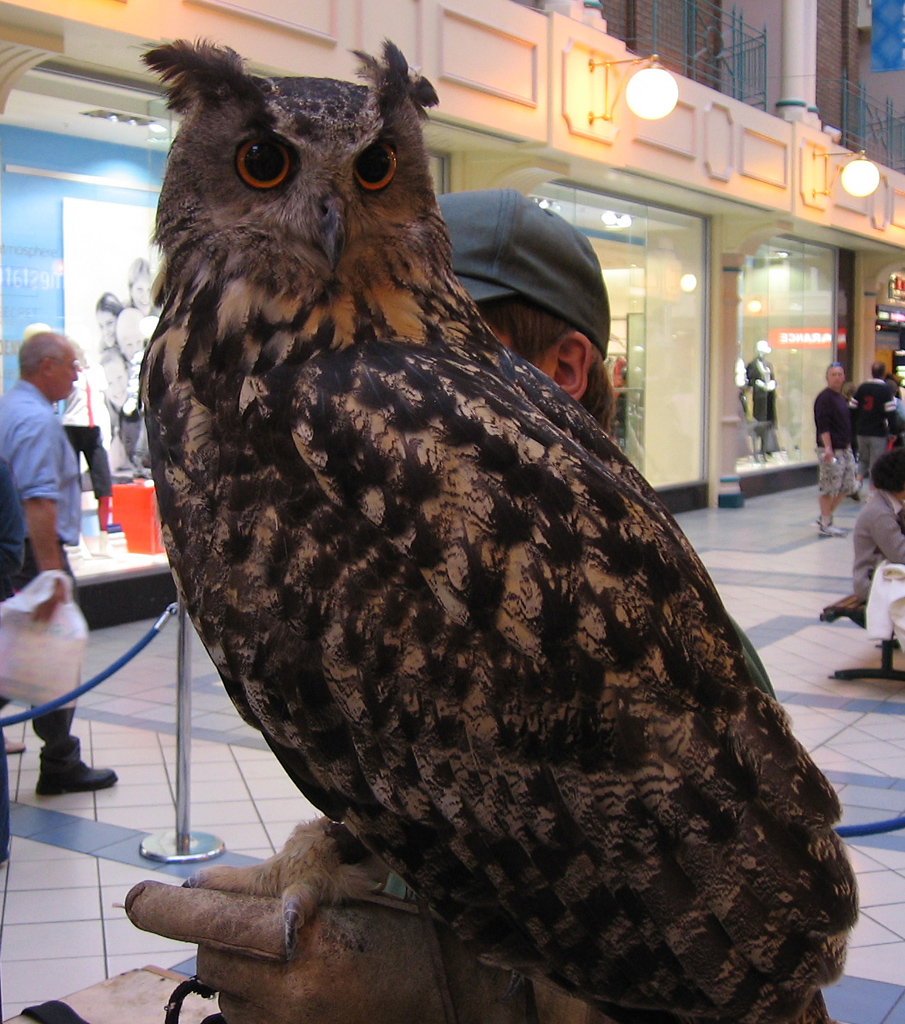
Eagle owl

After having coffee with Louise today, who I was glad to see before my departure, I saw an Eagle Owl being displayed as part of a fundraising drive for the Barn Owl Centre of Gloucestershire. Naturally, the sight of the enormous eyes of this majestic bird made me think about moonlit nights.

If you were to sit on the surface of the sun and look at the earth through a telescope, you would observe it rotating both around the centre of the solar system and around its own axis. The side of the sphere facing you (the side experiencing daylight) would consist of a constantly shifting selection of Earth’s surface as it rotates: with new areas becoming lit in the west as sections in the east fall into shadow. You could watch as the eastern seaboard of North America came into illumination, then passed back into darkness as it spins away to the shadowed side of the planet once again.

By contrast, when you look up from Earth at the moon, the same face is basically presented all the time. Just as one side of the moon is always in view, there is a ‘dark side’ that is always hidden from the vantage point of an observer on Earth. This is because of a phenomenon called tidal locking. The moon rotates on its own axis at just the right rate so that, as it orbits the Earth, the same side is presented. There are, however, minor oscillations in this presentation. This is called libration, which derives from the Latin word meaning ‘to sway.’ You can see an animation of the phenomenon here. It derives both from the fact that the moon’s axis is slightly inclined when compared to its orbit around the Earth and because the moon’s orbit around the Earth is slightly eccentric. Because of the cumulated rocking motion, it is actually possible to see 59% of the moon’s surface from the Earth.

I’ve always wondered how people were able to make celestial observations of such incredible detail and precision in the period prior to modern instruments and measuring systems. It is an enormous tribute to the vigilance and dedication of early astronomers that prior civilizations knew as much about observable astronomical phenomena as they did: knowledge that found application in essential tasks like predicting the chance of the reasons and recurrent episodes of rains or flooding.

On conspiracy theories

Kasbar, Cowley Road, Oxford

Partly prompted by a Penn and Teller episode, and partly by a post written by my friend Tristan, I have been thinking about conspiracy theories today. On what basis can we as individuals accept or refute them? Let’s take some examples that Penn and Teller raise: the reality of the moon landings, the nature of the JFK assassination, and the nature of the September 11th attacks. It should be noted that this is the worst episode of theirs I have ever seen. It relies largely upon arguments based on emotion, backed by the testimony of people to whom Penn and Teller accord expert status, rather than a logical or empirical demonstration of why these theories should be considered false.

Normally, our understanding of such phenomena is mediated through experts. When someone credible makes a statement about the nature of what took place, it provides some evidence for believing it. Penn and Teller amply demonstrate that there are lots of crazy and disreputable people who believe that the moon landing was faked, some strange conspiracy led to the death of JFK, and CIA controlled drones and explosives were used to carry out the September 11th attacks. That said, it hardly disproves those things. Plenty of certifiably insane people believe that the universe is expanding, that humans and viruses have a common biological ancestor, and that any whole number can be generated by adding powers of two (365 = 2^8 + 2^6 + 2^5 + 2^3 +2^2 + 2^0). That doesn’t make any of those things false.

We really have three mechanisms to work with:

  1. Empirical evidence
  2. Logical reasoning
  3. Heuristic methods

As individuals confronted with questions like those above, we almost always use the third. While those with a powerful telescope and the right coordinates could pick out all the junk we left on the moon, most people lack the means. Likewise, those with a rifle, a melon, and some time can learn the physics behind why Kennedy moved the way he did when he was shot, despite Oliver Stone‘s theories to the contrary. Finally, someone with some steel beams, jet fuel, and mathematical and engineering knowledge can model the collapse of the twin towers as induced by heat related weakening of steel to their heart’s content. Normally, however, we must rely upon experts to make these kinds of judgements for us, whether on the basis of sound technique or not.

Logical reasoning is great, but when applied strictly cannot get us very far. Most of what people call ‘logic’ is actually probabalistic reasoning. Strict logic can tell us about things that are necessary and things that are impossible. If every senior member of the American administration is controlled by an alien slug entity, and all alien slug entitites compel their hosts to sing “Irish Eyes are Smiling” once a day, we can logically conclude that all members of the American administration sing “Irish Eyes are Smiling” every day. Likewise, if all bats are bugs, all non-bugs must be non-bats. Entirely logically valid, but not too useful.

A heuristic reasoning device says something along the lines of: “In the more forty years or so since the moon landing, nobody has brought forward credible evidence that they were faked. As such, it is likely that they were not.” Occam’s razor works on the same kind of principle. This is often the best kind of analysis we can manage as individuals, and it is exactly this that makes conspiracy theories so difficult to dislodge. Once you adopt a different logic of probability, for instance one where certain people will stop at nothing to keep the truth hidden, your probabilistic reasoning gets thrown out of whack.

How, then, should we deal with competing testimony from ‘experts’ of various sorts, and with the fallout of our imperfect ability to access and understand the world as individuals? If there was a pat and easy answer to this question, it would be enormously valuable. Alas, there is not, and we are left to try and reach judgments on the basis of our own, imperfect, capabilities.

PS. For the record, I believe that the moon was almost certainly walked upon by humans, that Oswald quite probably shot John F. Kennedy on his own initiative, and that the airplanes listed in the 9/11 report as having crashed where they did actually did so. My reasons for believing these things are almost entirely heuristic.

Back to the moon? But why?

Apparently, Lockheed-Martin got the contract to serve as prime contractor for a return to the moon, and possibly further travel from there to Mars. Now, when I first heard the ‘back to the moon’ proposal, I assumed it was electoral fluff. How can an agency that decided to scrap such a useful piece of scientific equipment as the Hubble Space Telescope possibly be considering the scientifically pointless mission of putting human beings back on the moon?

I believe that humanity will eventually expand outwards into space. It is advisable due to the small but catastrophic risk of asteroid or comet impact, as well as generally in keeping with an agenda of exploration that I find personally inspiring. The first moon landings were an astonishing demonstration of human ingenuity and American technical and economic might. With present technology, manned spaceflight is a symbolic and political endeavour, not a scientific one. That said, returning to the moon serves no purpose, scientific or political. If we could do it in the 1960s, we can do it again now. Even if you accept the argument that a moon base is necessary for a manned mission to Mars, the enormous question remains of why we should take on such an expedition at this time, with this technology, and the present financial circumstances of the United States.

When it comes to space science, people are very expensive and delicate instruments. Robots might not always work (note all the failed Mars landers), but they don’t require all the food, air, space, and temperature and acceleration control that people do. The things we hope to learn about our solar system and the space beyond are almost certainly better investigated by robots, at this time. And the moon is hardly a profitable place to go looking for new scientific insights. A robot sent somewhere interesting – like Europa – would almost certainly advance science more than sending scores of people to that great airless ball that lights up our night sky and causes our tides.

This plan is especially absurd given the magnitude of public debt in the United States right now. The existing level of federal debt is more than $8.5 trillion, more than $28,000 per person, and the federal budget is sharply in deficit. If we could choose to send people to the moon instead of developing one of the two hugely expensive fighter jets now being rolled out (the F-22 and the Joint Strike Fighter, a $256 billion program), I would be all for it. At least, going back to the moon would do relatively little harm (wasted resources aside). Of course, no such trade-off is being offered. This would be spending over and above the sums already being expended on pricey little projects like the JSF, the DDX destroyer (about $4 billion per ship), and the war in Iraq (more than $300 billion, so far). The comparison to military hardware is a sensible one, since manned spaceflight is, to a large extent, just another massive subsidy to the military aerospace industry. Hopefully, the passing of the mid-term elections will put this white elephant to sleep again.

Related items:

Sulfate injection to stop global warming?

Apparently, Paul Crutzen, an environmental scientist who shared a Nobel Prize in 1995 for his work on the role of CFCs in ozone layer depletion, thinks we should correct for global warming by injecting two million tonnes per year of sulphate particles into the upper atmosphere. According to Wikipedia: “sulfates occur as microscopic particles (aerosols) resulting from fossil fuel and biomass combustion. They increase the acidity of the atmosphere and form acid rain.” He predicts that the process of injecting them into the upper atmosphere using balloons or artillery would cost between $25 and $50 billion a year, but would save more by mitigating the effects of global warming.

While I am no environmental scientist, what strikes me as most interesting about this is the ‘technical fix’ mindset that it embodies: a bit like those who decided to stabilize dune formation on parts of the Oregon coast by importing Spanish beach grass, or those who have sought to kill off one accidentally imported pest with an intentionally imported predator. Often, such schemes don’t work at all. When they do, they risk working much too well. Thanks to Spanish beach grass, the Oregon dunes will be a thing of the past in a few decades. The point is simply that, at a stage when we really don’t know the consequences of climate change or their magnitude, it seems awfully bold to predict that such a scheme will both work and do more good than harm.

As is so often the case, the most trenchant criticism of such schemes was expressed humorously on The Simpsons:

SKINNER: Well, I was wrong. The lizards are a godsend.

LISA: But isn’t that a bit short-sighted? What happens when we’re overrun by lizards?

SKINNER: No problem. We simply unleash wave after wave of Chinese needle snakes. They’ll wipe out the lizards.

LISA: But aren’t the snakes even worse?

SKINNER: Yes, but we’re prepared for that. We’ve lined up a fabulous type of gorilla that thrives on snake meat.

LISA: But then we’re stuck with gorillas!

SKINNER: No, that’s the beautiful part. When wintertime rolls around, the gorillas simply freeze to death.

The comparison between atmospheric science and ecology is less dubious than one might think. Both systems are complex and dynamic – they feed back upon themselves in ways which are both powerful and difficult to predict. Furthermore, both atmospheric and ecological systems both affect and are affected by other complex systems with which they are integrated. Consider, for instance, how the construction of the Aswan High Dam (the product of political and economic changes, above all) altered the salinity in the eastern Mediterranean, allowing for the migration of species from the Red Sea.

What would the consequences of blasting artillery shells full of sulfates into the upper atmosphere? Far be it for me to speculate. The intentional modification of atmospheric chemistry and physics is something we have never done as a species, though we have done a lot of unintentional tinkering. What I would venture is that it is likely to have unpredictable effects and that it is a particularly curious way of trying to deal with the problem of global warming.

George Monbiot, who I met at a short conference at the Environmental Change Centre, has his own objections.

Tell me what thy lordly name is on the night’s Plutonian shore

For an interesting example of the connections between science and public policy, look at the recent efforts to re-categorize the planets, a word that derives from the Ancient Greek term for ‘wanderer.’ The International Astronomical Union met in Prague recently to try and do so. Since 1919, they have been the scientific body charged with astronomical naming. At least two competing options were advanced: one was basically to grant planet status to any object in the solar system that has sufficient gravity to have become spherical. This would expand the ranks of planets to twelve, adding Charon – the moon of Pluto – Ceres – a large asteroid – and a distant object called 2003 UB313. (Mythology appreciators may recall that Ceres is the mother of Persephone, who Pluto kidnapped to the underworld and made his queen.)

The alternative, based on different considerations, strips Pluto of its status as a planet. Along with the other objects listed above, barring Charon which is to remain a moon, it will join the ambiguous category of ‘dwarf planet.’ Unsurprisingly, the director of a NASA robotic mission of Pluto is irked by the change. Naturally, funding and attention find themselves tied to terms and definitions that are often arbitrary. Note the scramble to brand all manner of research ‘nanotechnology’ in hopes of capturing the interest, and cash, that is attaching itself to that branch of science. The connection between attention paid to scientific developments and arbitrary phenomenon seems especially important in terms of the way in which the general public is exposed to scientific developments. Remember all the media flurry about the race of ‘hobbit’ proto-humans (Homo floresiensis)? How much less attention would there have been if a certain series of films hadn’t been recently made? Consider also the increased attention paid to climate change in the United States after Hurricane Katrina: an event that it is essentially impossible to definitively attribute to changes in the composition of the atmosphere and attendant climatic shifts.

For all the kerfuffle, there is obviously nothing about the solar system itself that has changed. Why, then, do people care so much? Partly, I suspect it has to do with simple familiarity. Just as it famously discomfited Einstein to be presented with the possibility that the universe is governed by chance at small scales, the idea that the millions of wall-charts in science classrooms everywhere depicting the nine planet solar system are, in some sense, ‘wrong’ may upset others. The solar system, as portrayed in everything from Scientific American to the Magic School Bus series, was a familiar model. That is not, in and of itself, a reason for preserving it. At the same time, I fail to see why this change is being granted such attention.

One other explanation that comes to mind has to do with the way in which many people relate to science: as a set of particular facts in which they have been educated and which they are to remember. All the discussion of having to change mnemonic devices by which the names and sequence of planets are remembered relates to that. Such a stripped-down conception of science doesn’t leave people with much scope for critical inquiry – though such an activity may not be of interest. It is troublesome, I suppose, in an age when it is increasingly vital to have a grasp of scientific ideas and developments in order to be an effective participant in a democratic society. The category into which we file one particular lump of rock orbiting the sun every 250 years doesn’t have such importance.

The way people have been anthropomorphizing the issue strikes me as really odd. People stepping up to ‘defend’ Pluto from cruel astronomers who are ‘demoting’ it suggests that there is some emotional motivation behind the classification. Of course, there is no reason why it is ‘better’ or ‘worse’ for a lump of rock to be one thing or another, in and of itself. It may change of behaviour towards the object in question – think of discussions about whether humans are ‘animals’ or not – but it is quite nonsensical to think of the lump itself having a preference. Owen Gingerich, the head of the committee that came up with the new definition, had a much more comprehensible comment: “We are an expensive science, and if we don’t have public support, we are not going to be able to do our work.” Ah, the politics of science.

Something New Under the Sun

Flowers in a window, London

Happy Birthday Zandara Kennedy

Extensively footnoted and balanced in its claims, John McNeill’s Something New Under the Sun is an engaging and worthwhile study of the environmental history of the twentieth century. It covers atmospheric, hydrospheric, and biospheric concerns – focusing on those human actions and technologies that have had the greatest impact on the world, particularly in terms of those parts of the world human beings rely upon. People concerned with the dynamic that exists between human beings and the natural world would do well to read this volume. As McNeill demonstrates with ample figures and examples, that impact has been dramatic, though not confined to the twentieth century. What has changed most is the rate of change, in almost all environmentally relevant areas.

The drama of some documented changes is incredible. McNeill describes the accidental near-elimination of the American chestnut, the phenomenal global success of rabbits, and the intentional elimination of 99.8% of the world’s blue whales in clear and well-attributed sections. From global atmospheric lead concentrations to the depletion of the Ogallala Aquifer, he also covers a number of huge changes that are not directly biological. I found his discussion of the human modification of the planet’s hydrological systems to be the most interesting, quite probably because it was the least familiar thing he discussed.

Also interesting to note is that, published in 2000, this book utterly dismisses nuclear power as a failed technology. In less than three pages it is cast aside as economically non-sensical (forever dependent on subsidies), inherently hazardous, and without compensating merit. Interesting how quickly things can change. The book looks far more to the past than to the future, making fewer bold predictions about the future consequences of human activity than many volumes of this sort do.

Maybe the greatest lesson of this book is that the old dichotomy between the ‘human’ and the ‘natural’ world is increasingly nonsensical. The construction of the Aswan High Dam has fundamentally altered the chemistry of the Mediterranean at the same time as new crops have altered insect population dynamics worldwide and human health initiatives have changed the biological tableau for bacteria and viruses. To see the human world as riding on top of the natural world, and able to extract some set ‘sustainable’ amount from it, may therefore be unjustified. One world, indeed.

Perseid shower peaks tonight

Lost Lagoon, Vancouver

Taken during a walk with Astrid in late April 2005, this photo shows Lost Lagoon in Vancouver’s Stanley Park. Nearby, to the southeast, is Vancouver’s central urban district. Equally close, to the north and through the park, is the southern end of the Lions Gate Bridge to North Vancouver.

In an announcement particularly relevant to those who live outside of big cities, the Perseid meteor shower will reach its peak of intensity tonight. Generated from dust and fragments from comet Swift-Turtle, the Perseid shower occurs annually. The comet in question was discovered in 1862 and is notable for being the largest object that regularly approaches the earth.

The best time to see the shower is in the hours immediately before dawn, but there should be more than eighty meteors per hour visible to the naked eye for most of the night, for those in reasonably dark places. Because of the way in which the planet rotates, the rate at which the meteors appear is about twice as high right before dawn as it is shortly after sunset. This is because, at that time, the particular part of the planet’s surface where you are is both hidden from the sun and facing in the direction of its the planet’s around the sun. Because of that combination, the most visible collisions with material from the comet will occur.

The shower is called the Perseids because the meteors appear to be coming from the constellation Perseus. Those who are going out to watch may find it worthwhile to familiarize themselves with how the constellation looks and where in the sky it appears.

If anyone has a particularly dramatic experience, I would be glad to hear about it here. I continue to look up with dismay at the thick rain clouds over Oxford.

[Update: 13 August 2006] On account of the constant presence of rain clouds blocking the sky and reflecting back city light, I saw not a single meteor. I hope others did better.

A $500 bet

Let it be noted that the following bet has been placed, for a value of 500 Canadian dollars, at their present value:

I say that in August of 2036, the per-watt price of electricity consumed by the average Canadian consumer will be lower in real terms (accounting for inflation) than it is today. My friend Tristan Laing thinks the cost will be the same or higher. The price in question will be that quoted on the average Canadian’s electricity bill.

He has posted the same declaration on his blog.

[Update: 12 August 2006] I agree with a commenter that the cost per kilowatt-hour will be the easiest metric according to which this wager can be settled. To give a very approximate contemporary value, the cost to consumers for each kilowatt-hour of electricity used in Ontario today is about 5.8 cents. I will come up with a Canadian average soon.