We’re made of cheap stuff

As a child, I visited Vancouver’s Science World on what was probably a monthly basis. I knew most of the stage shows by heart (‘Arcs and sparks’ was the most energetic, complete with exploding pickle), along with the dramatic vocal introduction at the OMNIMAX theatre.

One display I remember well was located in the main atrium area. It was a scale that weighed you and then told you in a robot voice how much it would cost to buy lab-grade versions of all the chemicals that comprise you. It would say: “You contain $1.24 worth of carbon” or “You contain $0.03 worth of iron”. At the end, it said that you had a monetary value of X amount “give or take a few cents”.

In a way, the display illustrates that is remarkable about biology. You can take utterly mundane stuff – air and soil – and turn it into astonishingly complicated chemicals and structures, everything from the complex fragrances of flowers to DNA to the core of an oak tree to a human brain. Botany and plant cultivation are a kind of alchemy precisely because of how they allow the transformation of garden-variety raw materials into complex products. You can have all the materials necessary to make a wombat, but there is really no way to put them together in the right way unless you have a couple of fertile wombats on hand as well.

The same reality intersects with the practice of organ donation. Right now, a mass of a few kilograms located inside my thoracic cavity might be a highly-valuable liver or kidney. Without the benefit of a functioning circulatory and immune system – or, failing that, proper care and refrigeration – it becomes a near-worthless lump of meat in just a few hours. We’re made of cheap stuff; the added value is in the organization.

Lark sleep monitor

For the past couple of months, I have been using a Lark sleep monitor. It’s an accelerometer that you wear on your wrist at night that interfaces with your iPhone. It both works as an alarm clock and as a measuring device that provides data on the length and quality of your sleep. You set when you want to wake up and it wakes you at that time with nearly silent vibration (and a backup sound alarm from the phone).

The device has a few obvious uses. If two people sleep in the same bed but normally wake at different times, the Lark would allow one to more easily wake on time without waking the other. The Lark also lets you collect statistics about yourself, and evaluate how well you sleep in different environments and conditions.

For instance, I slept for an average of 8:41 per night when on vacation at my aunt and uncle’s very quiet house in Bennington, Vermont (with one early morning on December 25th). That compares with an overall average sleep time of 7:45 over the past couple of months.

So far, I have collected data for 86 days. More accurately, I have data for 81 of those days and null values for the five days when I wasn’t able to use the Lark – for instance, because I was taking an overnight Greyhound.

My recent sleep stats

This table shows some simple summary statistics:

Mean Median Standard deviation
Time asleep 7:45 7:56 2:00
Sleep quality 8.5 8.7 0.84
Fell asleep in 0:37 0:30 0:34
Woke up (# of times) 18.9 18 6.39


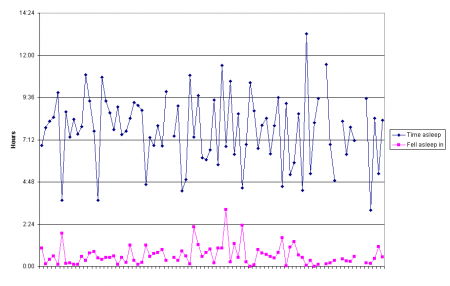
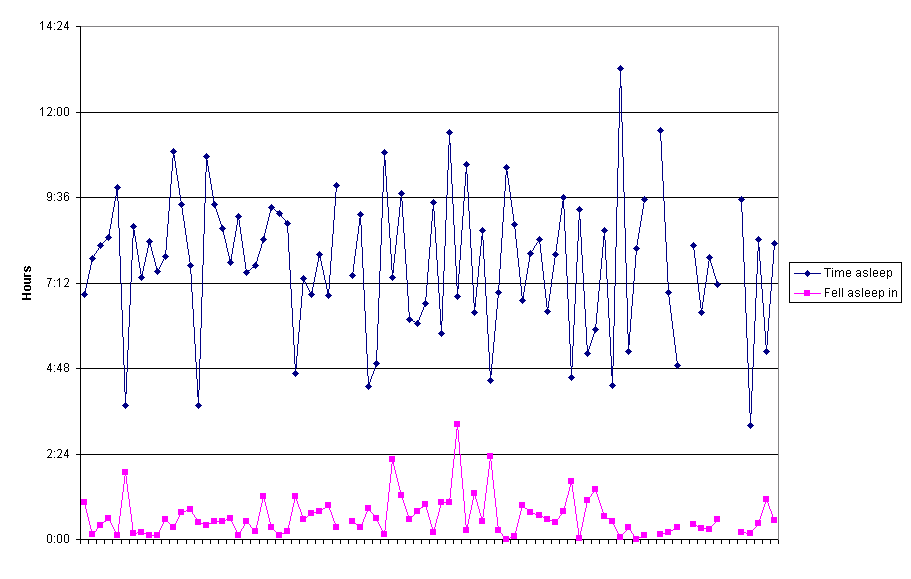
In blue, this time series shows time spent asleep. In pink, it shows how much time was spent falling asleep:
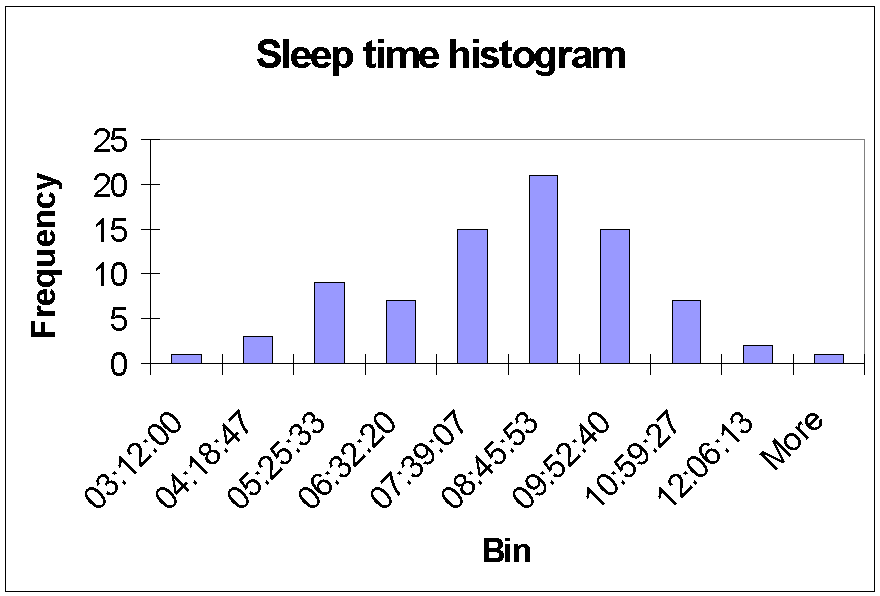
This is a histogram of time spent asleep:
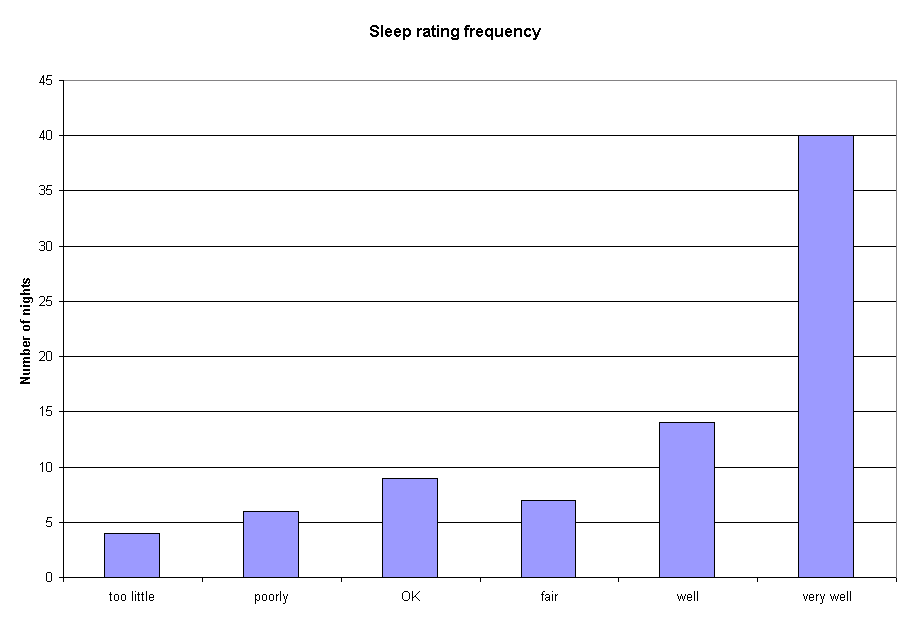
And this shows the frequency of the different qualitative sleep ratings assigned by the Lark software:
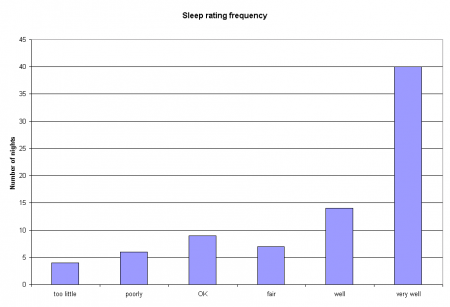
The Lark software informs me that the amount of time it takes me to fall asleep “needs work”, as does the number of times I wake per night. My overall length of sleep and sleep quality it deems “OK”.

The biggest thing that jumps out at me from my own data is the sawtooth pattern of sleep. I tend to alternate between a night with relatively little sleep (about six hours) and a night with relatively much (about nine hours). Given that I usually need to wake up at 6:30am or 6:45am, these correspond to nights when I go to sleep around midnight and others where I collapse around 9:00pm or 10:00pm.

Remember, the Lark distinguishes between time spent falling asleep (the period before the first time of prolonged stillness detected by the Lark) and time spent actually asleep. A night recorded as eight hours of sleep is therefore a night with eight hours of stillness comparable to that of sleep, rather than a night when you spend eight hours in bed. Being able to distinguish those two things may be the most valuable thing about the Lark.

Evaluation of the Lark

Overall, I think the Lark works very well. It has never failed to wake me up, and the iPhone software works well.

One suggestion to all iPhone owners is to put your phone in ‘Airplane mode’ at night. That way, it doesn’t beep or buzz when you get late-night texts and emails. You can still use the Lark in this mode, but you do need to follow a simple procedure:

  1. Set the iPhone to ‘Airplane mode’
  2. Manually turn Bluetooth back on
  3. Connect to the Lark
  4. Set your alarm time in the Lark software
  5. Sleep, and be woken

One useful feature the makers of the Lark could add would be the ability to set pre-programmed alarms for different days of the week. For example, you might set your default Monday-Friday alarm for 6:30am or 7:00am, but your weekend alarm for a more reasonable 9:00am or 10:00am.

One side note: it is easy to transfer the basic sleep data from the Lark into your preferred statistical analysis software. For people who don’t want to do that, the company sells an absurdly overpriced (US$$159!) subscription service that keeps track of your data for you online and provides ‘coaching’.

Googling the Cyborg

In his engaging essay “Googling the Cyborg”, William Gibson effectively argues that the expectation that ‘the cyborg’ will be a human being with an electronic eye and a robot arm is mistaken. The cyborg – he argues – exists in the physical interactions between human beings and machines: “The electrons streaming into a child’s eye from the screen of the wooden television are as physical as anything else. As physical as the neurons subsequently moving along that child’s optic nerve”. (The terminology there is strangely incorrect. Cathode ray tube televisions emit photons, which are produced when the electrons fired from the back of the vacuum tube hit a phosphor screen – and the optic nerve is made of neurons, it isn’t a channel that conveys them. No matter.)

Gibson argues that the cyborg is the “extended communal nervous system” that humanity has grown for itself, with all these sensors and processors and network connections.

He also argues that there is a short-changing that occurs, when we deny that the humans who are behind machines are using them as true extensions of their own being. In the context of remote-controlled rovers on Mars, he says:

Martian jet lag. That’s what you get when you operate one of those little Radio Shack wagon/probes from a comfortable seat back at an airbase in California. Literally. Those operators were the first humans to experience Martian jet lag. In my sense of things, we should know their names: first humans on the Red Planet. Robbed of recognition by that same old school of human literalism.

Gibson, William. Distrust that Particular Flavor. p.251 (hardcover)

I am not sure what should be counted as the first cyborg on Mars. Specifically, did it need to be able to move on human command? Or is moving camera shutters enough to count? In any case, hardly anyone knows the name of the person who was controlling it when it first activated on the Martian surface.

Meteorologists on climate

The other day, I saw a Vancouver Sun article called “Meteorologists split on global warming“.

I was struck in particular by the sub-headline: “Fewer than one in five specialists in the U.S. see human influence as the only driver”.

At first glance, may seem like a garden-variety example of climate change skepticism from experts in fields other than climatology. People who are experts in one area often have misplaced confidence about their expertise in others.

On second reading, the sentence betrays considerable ignorance about the subject of climate. If “19 per cent of U.S. meteorologists saw human influences as the sole driver of climate change in a 2011 survey” then at least 19% of U.S. meteorologists have no idea what they are talking about.

Nobody is arguing that human behaviour – or CO2 emissions exclusively – is the only thing that affects the climate. Look up the concept of ‘radiative forcing‘ and you will quickly learn that scientists have studied many of the causes of climate change in detail. The work of the Intergovernmental Panel on Climate Change (IPCC) has involved consideration of other things. They looked at impacts from changes in ozone, albedo (the reflectiveness of the Earth’s surface), aerosols, linear contrails, and changes in the energy output of the sun. When you look at all of these factors, you see that greenhouse gases are simply the most important cause of change in the climate right now, and we are poised to emit vast additional quantities of them as the world continues to burn fossil fuels.

Gabor Maté on addiction and drug policy

Please listen to this podcast:

Gabor Maté on The Human Face of Addictive Behavior

Maté makes some excellent points about the psychological basis for addiction, as well as the serious problems with our current approach of treating addiction as a crime.

Maté makes a powerful case that criminalization of drug use is ineffective and unethical, and that we could do much more to lessen human misery by pursuing harm reduction approaches.

[Update: 28 Oct 2020] Broken link replaced

The Northern Gateway pipeline

With the commencement of hearings, the political fight over the Enbridge Northern Gateway pipeline is now beginning in earnest. The proposed pipeline would carry bitumen from the oil sands to the Pacific coast for export. It would encourage the development of the oil sands and contribute to the fastest-growing category of emissions of greenhouse gas pollution in Canada. It would increase the total fraction of the world’s fossil fuels that will be burned, affecting how much climate change the world will experience. Having walked away from the Kyoto Protocol – and with no effective mechanism for curbing emissions in place – it is difficult to argue that Canada is doing its part to respond to this serious global problem.

In addition to the climate arguments, there is always some risk of a spill, either along the pipeline or with tankers off the B.C. coast. If what I read in John Vaillant‘s The Golden Spruce is at all accurate, the Hecate Strait is a particularly treacherous waterway. As anyone who has visited the coast of British Columbia knows, it’s also a beautiful and environmentally rich part of the world, both on land and in the sea. It would be a really awful place for another Deepwater Horizon-type disaster.

At present, the hearings on the pipeline are expected to last for 18 months. As we have seen from the Keystone XL pipeline, however, timetables are clearly subject to change as the debate progresses.

Biology and infinite complexity

One distinguishing feature of biology seems to be that it is always possible to examine a process in a greater level of detail, whether it is cellular respiration or blood clotting or evolution.

You can say something simple like “DNA contains genes, which are instructions for making proteins using ribosomes” but there are masses of additional complexity behind the process of protein synthesis, and there is far more that DNA does. For instance, the DNA molecule is both a store of information (base pairs) and a physical machine that does things like replication during mitosis.

A recent abstract from Science highlights some of this:

A Time and a Place for Hox Genes

Patterning of the mammalian body relies on the stepwise transcriptional activation of Hox genes. Noordermeer et al. (p. 222) show that this process involves a dynamic transition in the global architecture of Hox gene clusters, with each gene transitioning, one after the other, from a negative three-dimensional (3D) compartment to an active compartment. This bimodal configuration parallels the distribution of distinct chromatin marks, suggesting the existence of a link between the presence of chromatin domains and the formation of 3D chromosomal structures. This model for Hox gene activation would ensure the proper sequence in the transcriptional activation of Hox genes within each gene cluster.

Unless we eventually develop tools that map out every biological process down to the functioning of individual atoms (which we have basically done for processes like photosynthesis), there will always be more to learn about how living things operate.

The metric system and estimation

Perhaps the best thing about the metric system (more formally, the International System of Units) is the way in which it allows for the easy estimation of many practical problems, and takes advantage of the intuitive connections people can make.

For instance, one millilitre (mL) of volume occupies a space of 1 centimetre (cm) by 1 cm by 1 cm. It is easy to imagine a cube that is 1 cm to a side, so it is easy to imagine what 1 mL of liquid would look like. Similarly, knowing that 1 litre (L) of water (a very familiar quantity of matter) has a mass of 1 kilogram (kg) allows a person to pretty easily consider what the weight of something in kilograms might be. A volume of 1000 L of water weighs one metric tonne, and occupies a space of one cubic metre.

The metric connections extend to other elements of science and everyday life. The metric temperature scale is well suited to a planet where water is exceptionally important. While calories are not strictly a metric unit, they do tie usefully into the common theme of water, with one calorie being the amount of energy required to heat 1 cubic centimetre (equivalent to 1 gram, and to 1 mL) of water by 1˚C. Note that ‘calories’ as expressed in relation to food are usually kilocalories: the amount of energy required to heat 1 L of water by 1˚C.

All very useful!

An alternative Turing Test

During a recent discussion with Tristan, the subject of the Turing Test arose. For those who are unfamiliar, the test is intended as a way to determine if a machine has intelligence. You set it up so that it can converse with a human being – for instance, through a text-based instant message type conversation – and if the person thinks they are talking with another human, it can be taken as evidence that the machine is intelligent.

Setting aside the question of how good an intelligence test this really is (a computer could pretty easily trawl a database of human conversations to produce convincing conversation), it seems like there is another sort of test that would be demonstrative of a different kind of intelligence. Namely, it would be when a machine or a computer program first becomes aware of itself as being a machine or computer program.

It is possible that no machine made by humans will ever develop that level of self awareness. Perhaps it is impossible to replicate whatever trick our brains use to turn flesh into consciousness. If it did happen, however, it seems like it could help to illuminate what self-understanding means, and what sort of mechanisms it requires.