Getting the HPV vaccine

I decided to get vaccinated against human papillomavirus (HPV) with Gardasil. HPV causes genital warts, as well as cervical, anal, penile, and throat cancer. The vaccine covers four of the many strains of the virus – types 6, 11, 16 and 18 – including those that cause most genital warts and cancer cases.

Gardasil is normally prescribed to girls who are young enough that they are presumed to have had no sexual contact with others. Adults are assumed to have been exposed to HPV already. That is probably true in most cases. Still, there is a benefit in getting protection from the four most problematic strains, or at least any of the four that you have not already been exposed to. On that basis, doctors seem quite happy to prescribe the vaccine to adult women and men.

I got the first shot yesterday. There will be another in two months and a third in six months.

The vaccine is expensive, which is the main reason why it is not given to everybody. Still, it seems like a good investment. If enough people get vaccinated, one of the most prevalent sexually transmitted infections could be virtually eliminated and many cancer cases and deaths could be prevented.

Supreme Court supportive of InSite

The Supreme Court of Canada’s unanimous decision to support Vancouver’s safe injection site is very encouraging, particularly in the present political context. Overall, the direction of Canada’s policy toward illegal drugs is depressing and frustrating. We are choosing the emulate the country with the worst drug policy in the developed world – the United States. We are pursuing a hopeless policy of prohibition, while trying to shut down options with a better chance of success, such as those that seek to reduce the harm associated with addiction.

Politicians often choose to cater to the irrational fears and biases of the general population. Judges are a bit freer to consider the ethics and evidence that bear upon a situation. That seems to be what the Supreme Court has done in this case:

During its eight years of operation, Insite has been proven to save lives with no discernible negative impact on the public safety and health objectives of Canada. The effect of denying the services of Insite to the population it serves and the correlative increase in the risk of death and disease to injection drug users is grossly disproportionate to any benefit that Canada might derive from presenting a uniform stance on the possession of narcotics.

Hopefully, this ruling will prompt a broader rethink of how Canada deals with drugs that are currently prohibited.

Related:

Gravity without air resistance

I am glad someone actually went out and did this:

Among other things, it shows how our intuitions are often based on the limited range of conditions experienced by our ancestors on Earth, and thus reflective of only a subset of what is true about the universe generally. We expect air resistance to exist everywhere, despite the airless character of many stellar bodies.

Of course, science fiction authors seem to expect all moons and planets to not only have atmospheres, but have atmospheres that Kirk and company can breathe unaided, but that is a different misplaced assumption.

Climate Reality Project

All day tomorrow, September 14th 2011, Al Gore’s Climate Reality Project will be broadcasting a multinational, multilingual attempt to inform people about climate change and what ought to be done about it.

Hopefully, this will help to recapture the attention of the public and policy-makers. It has drifted a lot in the last few years, partly because those opposed to acting on climate change have been so effective at confusing people and shifting the terms of the public debate in their favour.

This American Life on patents

A recent episode of the This American Life podcast centres around technology patents, with emphasis on the so-called ‘patent trolls’ who harass legitimate companies using dubious patent claims, in hopes of getting cash settlements.

Designing an ideal patent system is an interesting question from a utilitarian perspective. It seems beneficial to encourage innovation and protect small companies with novel ideas from giant companies that might steal them. At the same time, patents can be used by big companies to bully small ones, and when obvious ideas are given patents it can prevent useful technologies from becoming widely available.

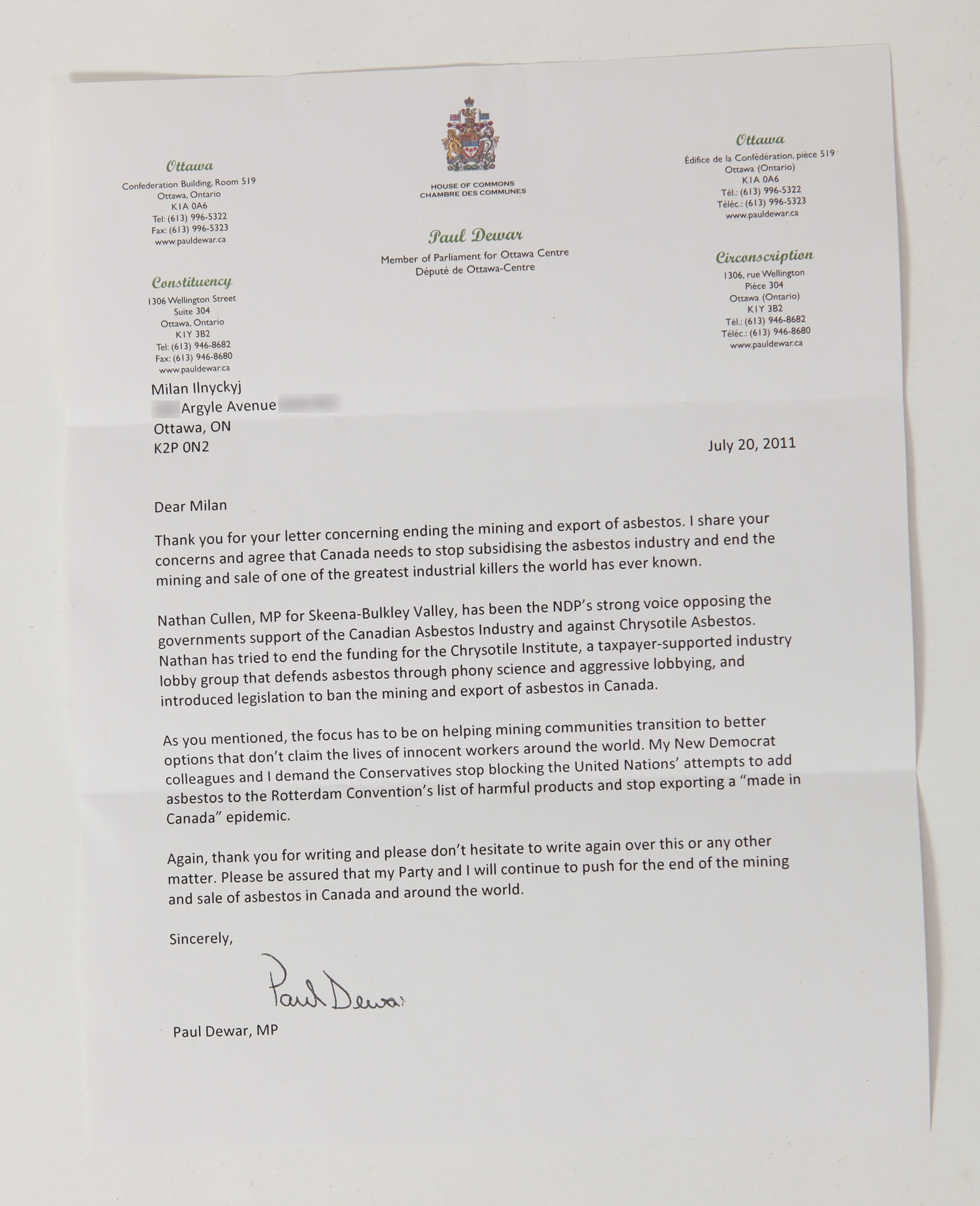
Dewar letter regarding asbestos

Around Canada Day, I wrote a letter to Paul Dewar, my Member of Parliament, about Canada’s export of crysotile asbestos. It seemed classier than holding up a giant “Shame on Canada, Asbestos = Cancer” sign during the Royal Visit.

Today, I got a response setting out his position on the issue:

Any pro-asbestos residents of Ottawa Centre should start bombarding him with strongly worded letters immediately. I am curious what sort of response they would get; hopefully, the same statement of policy with an explanation of why Dewar disagrees with those who favour Canada’s current policy of asbestos support.

It’s good that he has staked his colours to the mast on the issue. Constituents who are concerned about the issue of asbestos should make sure he has voted along these lines the next time the issue arises in the House of Commons. By then, I expect, I will have a new MP (due to me moving).

Asbestos export is an issue I first raised here some time ago.

Key Climate Questions

I have started a new series of blog posts on BuryCoal.com. Entitled “Key Climate Questions”, it will provide information on some of the most important outstanding questions about climate change. The first one is on how long the effects will last. Later posts will address things like whether geoengineering will work, what the regional impacts of climate change may be, the significance of methane from melting permafrost, etc.

Obviously, the aim of the series is not to answer these questions. Rather, it is to flag some of the areas where important scientific work is being done and provide links to information about that research.

Feel free to suggest topics.

Don’t kill the Webb!

With the last Space Shuttle mission ongoing, people are naturally asking what the future of space exploration is going to be. It seems clear that ambitious plans like a manned mission to Mars are a non-starter in the current fiscal climate. That being said, one of the major reasons why such missions are basically off the table is because they are not very useful. It would be very difficult to get human beings to Mars and then return them alive to Earth, but it wouldn’t teach us much about the universe.

By contrast, the James Webb Space Telescope is designed to be the successor to Hubble: one of the most successful scientific instruments of all time. Much of what we know about the universe has been established, confirmed, or refined using data from that instrument. As such, it is saddening to hear rumours that the Webb telescope may be scrapped fur budgetary reasons, if NASA experiences funding cuts of a certain magnitude.

It seems to me that would be a great shame. While the Webb will cost billions of dollars, it will also actively push forward the boundary of human knowledge and give us a better sense of what the universe is like. Launching it is something that humanity ought to do, even if we are experiencing economically difficult times. Basic science is something that builds upon itself, as new data is collected and new experiments are carried out. It is impossible to know in advance what the consequences of some seemingly obscure bit of cosmology or astronomy or physics will be. For instance, who would have predicted that special relativity would one day permit the precise geographic location of inexpensive receivers, using coordinated time signals from satellites (GPS).

For the sake of the important human undertaking of understanding our universe, we should find the money for the Webb.

A Venomous Life: The Autobiography of Straun Sutherland

One of the more entertaining segments in Douglas Adams’ extremely entertaining book Last Chance to See concerns Straun Sutherland, an Australian doctor who counselled Adams on the dangers associated with venomous wildlife in the region Adams was visiting. While definitely entertaining overall, Sutherland’s autobiography could have used more aggressive editing, particularly when it comes to deciding which accounts will be of interest to readers.

In particular, Sutherland devotes far, far too much time to giving his account of various bureaucratic disagreements at the laboratories where he mostly worked. About half the book consists of this. It may have been satisfying for him to lay out his version of events and settle some scores, but aside from the people directly involved in the incidents described, I doubt anyone in the world cared. If I ever write an autobiography, please insist on me removing all such material.

While he speaks at enormous length about bureaucratic squabbles, Sutherland generally only alludes to the more important personal aspects of his life. Dissolving marriages get brushed upon for one sentence, before he moves back to discussing bureaucratic politics at length. Similarly, his references toward the end of the book to his own neurological condition are somewhat unclear.

One frustrating thing about this book is Sutherland’s sometimes-playful-sometimes-maddening fondness for making improbable but possible claims. It may be harmless enough to claim that as a child he made one cinderblock bomb powerful enough to send another cinderblock bomb high enough to be “a little black dot high in the sky” (I suspect any explosion that powerful would have seriously injured or killed the child who initiated it). Similarly, to tell a story about a fellow sailor buying a watch that turned out to be powered by a cockroach attached to the machinery (surely more difficult and costly for a watch counterfeiter than just using a spring or motor). When he talks nonchalantly about a man about an aircraft carrier getting sucked into a jet engine, it isn’t clear if he is giving an honest account in a spectacularly understated way or whether he is telling a very dark sort of joke. In many parts of the book, it is hard to assess the reliability of the narrator, even about serious matters.

That story does connect to one of the more interesting things about the book – the accounts of deaths. It’s not something that happens to anywhere near the same extent in your ordinary autobiography. Characters are introduced and promptly die. Of course, doctors witness the deaths of many more people than members of the population at large. Venom doctors particularly, I expect. The descriptions of death did give me a better sense of what a life as a doctor might be like, and what kind of temperament is suited to it. While the subject matter is often morbid, Sutherland maintains a jovial tone. That is also what made the account of him so entertaining in Adams’ book.

One last quibble is that some of the science and medicine in the book could stand to be a bit more clearly and elaborately explained. Sometimes specialist terms are used as though the reader should already be familiar – which is a bit of a stretch, when the subject matter is venom chemistry or obscure aspects of human or animal anatomy.

The things I enjoyed most about the book are Sutherland’s account of his time in the navy, as well as his descriptions of menial jobs he took while in medical school. There are also some entertaining and enlightening accounts of the practice of medicine in various contexts, from a navy ship to a small community to a research laboratory. Sutherland is quite a character and an entertaining writer. It would have been nice if he had been a touch clearer about when he was being completely serious, and less focused on writing an account of the bureaucratic structure and history of the labs where he worked.