
Hell and High Water

Bridge component

Joseph Romm’s Hell and High Water: Global Warming – the Solution and the Politics – and What We Should Do might be fairly described as an American version of George Monbiot’s Heat. It describes much less intrusive means for responding to the threat of climate change, as well as being more tailored to American politics. It is also less ambitious that Monbiot’s work, since it aims at the stabilization of atmospheric concentrations of greenhouse gasses (GHGs) below 550 parts per million (ppm) rather than 450.

The book is basically divided into two sections: one of which describes the nature and extent of the threat posed by climate change and one talking about solutions. The book is very explicitly focused on what climate change will do to Americans. Romm argues that too much coverage has focused on effects in poor countries, leading Americans to think the impact of climate change on their lives will be minimal.

Romm talks a great deal about how groups opposed to GHG regulation have created and funded a group of irresponsible ‘experts’ trying to convince the general public that major disagreement still exists about the reality and probable impact of climate change. He is very critical of the media, particularly for giving equal attention to the conclusions of a few oil-funded crackpots, compared with those of the enormous majority of scientists and all major scientific assessments.

I have some quibbles with some of Romm’s technological recommendations. I think he is a bit overconfident about the rapidity with which carbon capture and storage and cellulosic ethanol might be deployed. That said, the vast majority of what he says is correct, well defended, and similar to the thinking of others who have considered the questions seriously.

One notable omission from the book is emissions associated with air travel. At no point are they mentioned, either as a problem or an area where policy could yield improvements. As Monbiot effectively highlights, emissions from air travel are among the toughest to address, not least because lots of well-off people who consider themselves environmentalists and support good environmental policies nonetheless want to be able to jet off to South Africa or New Zealand.

Overall, Romm’s book is informative and accessible. He does a good job of bringing the issue home for Americans – de-emphasizing issues like the preservation of nature and international fairness – and emphasizing why they, personally, should be worried. Certainly, the kind of climatic impacts projected by the IPCC for 2030 or so are enough to make any reasonable person extremely nervous. He is right to say that, in a world where GHG concentrations are 650 ppm or more, climate change will be the issue being dealt with by all governments. Equally, he is right to point out that concentrations of that magnitude have a very serious risk of pushing us into a self-reinforcing cycle producing temperature increases of more than 5˚C globally and sea level increases of 25 metres or more. Hell and high water, indeed.

Here come the jellies

What do you get when you combine overfishing with large-scale nutrient runoff from industrial farms into rivers and the sea? Plagues of jellyfish:

The Namibian coast, for instance, used to be “hugely productive in fish,” [UBC fisheries graduate student Lucas Brotz] says, “and now it is entirely dominated by jellyfish. Things appear to be going that way in the Middle East, South Pacific, the Gulf of Mexico and the Mediterranean.”

This is what unlimited fishing with ever-better gear inevitably produces – short term profits for a few years followed by severely degraded ecosystems indefinitely.

Faith and evolution

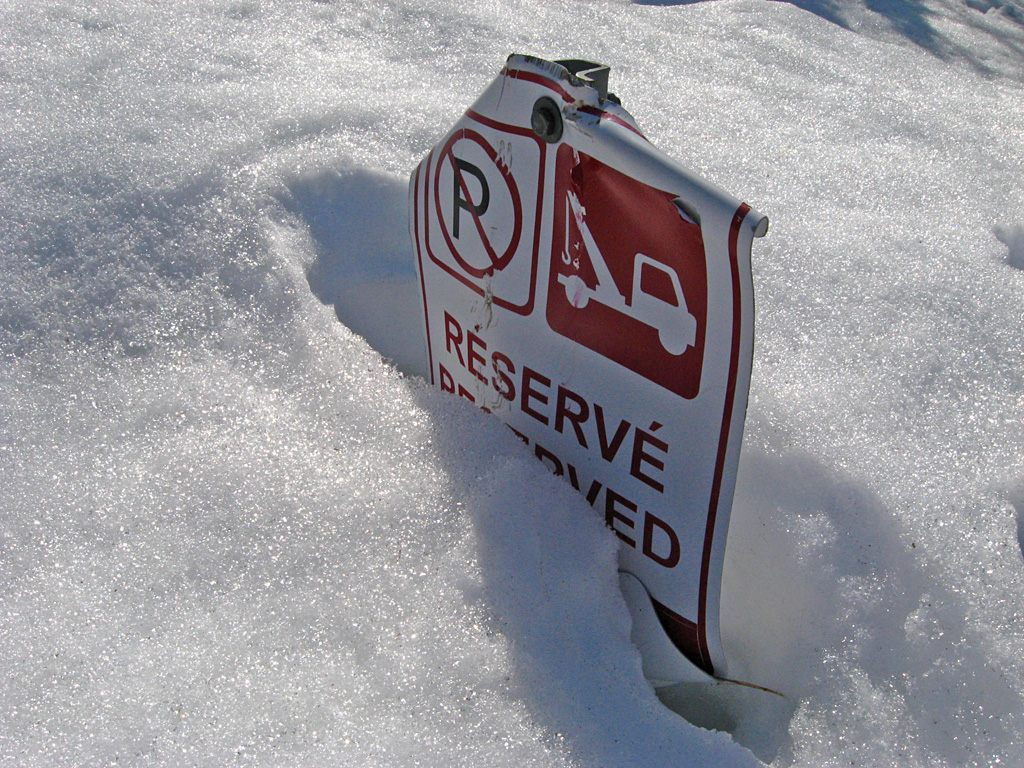
Parking sign buried in snow, Ottawa

An article in a recent issue of The Economist discusses the evolutionary basis for religious belief. The hypothesis being evaluated is that being religious confers some kind of advantage upon those with the trait, explaining the degree to which the trait is widespread. The hypothesis is not an entirely implausible one, and several studies suggesting some degree of validity are listed.

The thing the studies made me wonder was: “If you believed both that being religious would make you more healthy or successful, but you also believed that the religion had no basis in fact, would you practice nonetheless?” This would be akin to adopting Islamic dietary restrictions and fasting requirements because scientists had shown they conferred benefits for cardiovascular health. Such behaviour might achieve the aims that these scientists claim are embedded beneath religious behaviours, but they would clearly deviate from the stated principles of most faiths.

Another possibility acknowledged is that religiosity doesn’t confer direct benefits on individuals. Rather, it just makes them more fertile. There certainly seems to be an inverse correlation between the degree of secularism in a society and birth rates. Genes that promote religious faith may thus be doing so in order to increase the number of offspring who later carry them. The beliefs themselves may lack a basis in fact, but, if they contribute meaningfully to the propagation of selfish genes, part of the near-ubiquity of faith might be explained.

Trouble with aquaculture

Recently, Manitoba banned new hog farms in a wide swathe of the province due to environmental concerns. Now, British Columbia has suspended the issuing of new licenses for salmon farms. The ecological impact of these facilities has been mentioned here before.

Generally, the idea that open-pen aquaculture makes ecological sense for carnivorous species like salmon is fallacious. All it does is displace pressure from fishing activity from wild salmon themselves to the kind of fish they eat. Inevitably, an unconstrained fishery will destroy those stocks as well. Meanwhile, the salmon farms leach lice, excrement, and antibiotics into the waters around them.

The Game Plan

The Game Plan : A solution framework for climate change and energy is a slick, Creative Commons licensed slide presentation covering issues of energy and climate change. It’s like a more numerically focused, more technical, open-source version of An Inconvenient Truth. Clearly, it is aimed at a very different audience. Still, it is interesting and potentially useful as a source of graphics and information.

A seven megabyte PDF version is also available. A PDF of the speaking notes, likewise.

Of frogs and fungus

Ottawa stadium

Batrachochytrium dendrobatidis is devastating communities of amphibians worldwide. Strangely enough, this may partially be because of pregnancy testing. Between the 1930s and 1950s, a curious property of the African clawed frog (Xenopus laevis) was exploited: human chorionic gonadotropin (HCG), which is present in the urine of pregnant women, stimulates egg production in these animals. As a result, commercial trading spread them – and the fungi that afflicted them – around the world.

Which the clawed frogs are affected by the fungus and act as carriers, it doesn’t kill them. Other species are not so fortunate. Now, more than 100 species of amphibian have been infected by the fungus, which colonizes the skin. The spread of the disease varies according to altitude and temperature. In the right conditions, it can kill 85% of the amphibians in an area.

In the case of some species that have been especially badly affected, conservationists have taken the desperate step of removing the last living creatures from the wild:

Rather than letting the animals become extinct, a number of conservationists have started gathering up frogs believed to be doomed — in some areas collecting every last individual of a species — in an effort to enable some to persist in captivity. Some believe it would be worth causing the extinction of a species in the wild if it prevents the species from disappearing altogether.

Some captive breeding programs have been more successful than others, but all are symbols of the unpredictable and destructive impacts of human activities on the natural world, as well as our imperfect ability to counteract them.

Even if the frogs are successfully kept alive in captivity, it is dubious whether they can ever be returned to the wild. In addition to ongoing climatic changes, the simple fact of their removal will fundamentally change the ecosystem in which they lived. Their absence might disrupt the food web, or some other creature might change its location or behaviour to fill the gap. In any event, it is unlikely that many of these frogs will ever be part of a natural breeding population in the wild again.

Carbon capture in Saskatchewan

A $1.4 billion carbon capture (CCS) equipped coal plant is on the drawing board in Saskatchewan. The projected output is 100 megawatts (MW). That works out to a price of $14,000 a kilowatt, compared with about $2000 and $4600 per kilowatt for wind turbines (according to Agriculture and Rural Development Alberta). Of course, unlike the coal plant, the wind turbines wouldn’t require fuel after being installed.

Unless the cost of CCS falls dramatically, it is never going to be able to ride in, horse at a gallop and sword drawn, to rescue the coal sector. The cancelled FutureGen project in the United States was one demonstration of this. Until there is at least one unsubsidized commercial facility out there that is producing electricity from coal and sequestering emmisions – all for less than the price of ‘expensive’ renewable technologies like wind and solar – a fair bit of skepticism about the technology is justified.

Green energy ‘war’

5 on a fence

A new blog written by a former California energy commissioner chooses to discuss the fight against climate change as a ‘war.’ At one level, this reflects the silly American tendency to discuss non-military problems using military language: the War on Drugs, the War on Poverty, etc. At another, the choice reflects the serious disjoint between what most people have publicly accepted about climate change and what the problem really involves.

The public consensus seems to be: climate change is happening and it will have some bad effects. Technology and consumer choices will probably deal with it. Hybrids and fluorescent lights for all! Some of the big issues missed in this viewpoint are:

  • Stabilizing greenhouse gas concentrations is a massive undertaking. It requires deep cuts (50-95%) in emissions from all countries, rich and poor alike.
  • Time is of the essence. Stabilizing at an atmospheric concentration likely to avoid catastrophic impacts probably requires global emissions to peak within the next ten years and fall dramatically within the next forty.
  • Once concentrations are stabilized, continued effort and restraint will be required to maintain that. Human emissions will need to be kept in balance with natural absorption of carbon dioxide forever.
  • Abrupt or runaway climate change could completely undermine the basis for the global economy. Potentially, it could even make the planet uninhabitable for human beings for thousands or millions of years.

Referring to the situation as a war does have some potential benefits. People expect sacrifice and the suspension of normal ways of operating during wartime. The lower quality of light from fluorescent bulbs seems less significant when the future of humanity is at stake; the same goes for bans on short-haul flights or inefficient cars. At the same time, there are huge problems with the war analogy. Wars end. While it is possible that we will eventually have such excellent zero-emission technology that the world’s coal reserves and tropical forests will not tempt us, that seems a distant prospect.

What this underscores is the degree to which climate change is a challenge of an altogether new and different type for humanity. It’s one that our previous ideas about collective action, the ethics of an individual in society, and the cooperation of sovereign entities need to grow to accommodate. While the seriousness and focus sometimes applied to warfare will surely be required, the metaphor probably ultimately distorts more than it clarifies.

Snake oil in science magazines

Climbing wall

One odd tendency I have noticed is the frequency with which popular science magazines contain ads for very dubious products and services: often, precisely the sort you would expect the scientifically knowledgeable to shun. Looking through this month’s Scientific American there are ads for ‘stress erasing’ gizmos, a machine that supposedly makes you fit and muscled on the basis of four minutes of exercise a day, and dubious dietary supplements. I recall that Popular Science regularly featured ads for hypnosis machines and virtual reality helmets supposedly capable of teaching you a new language in hours.

Why do companies selling such things consider the readers of science magazines to be a good target audience? One element is probably that actual scientists don’t read these magazines. The articles they publish are not peer-reviewed and can sometimes be quite low-brow (Scientific American, in particular, seems to have made a big shift towards the Popular Mechanics end of the intellectual spectrum). While the readers are unlikely to be scientists, they are likely to have an acute interest in scientific things, novel ideas, and new technologies. Probably, advertisers are taking advantage of the way in which seeing an ad in a trusted publication already full of novel claims provides it with more legitimacy than it might accrue on its own.

In the broader picture, this is just one reflection of the fundamental problems of authenticity and verification that exist in our society. People can’t decide if climate change is happening, whether taking vitamins is helpful and worth the cost, or whether radiation from cell phones is dangerous. Perhaps more than ever before, people are in a world that is incomprehensible due to the abundance, rather than the absence, of information. Those looking to bring in a few dollars from gullible armchair scientists are taking advantage of that confusion.

Climate blogs

For those wanting more information on climate science and policy than they are getting from here, these are some blogs to consider:

  • Gristmill: Diverse, accessible, and very frequently updated
  • R-Squared Energy Blog: Written by an oil expert, mostly about petroleum and biofuels
  • RealClimate: Usually very detailed and quite technical, raw climatic science
  • ClimateEthics: Infrequent posts, but long and complex ones
  • DeSmogBlog: Fairly similar to Gristmill. Sometimes has very interesting information
  • The Oil Drum: More than you will ever want to know about hydrocarbons

No matter what your appetite for climate information in blog form, those should satisfy it.

Are there any others that people read and would recommend?