The Omnivore’s Dilemma

Shops in Vancouver

Michael Pollan‘s superb book tells the stories of four meals and the processes through which they came to exist. At one extreme is a meal of McDonald’s cheeseburgers, eaten in a moving car; at the other, a cooked wild boar he hunted, accompanied by things grown or gathered. Pollan also considers two types of pastoral food systems: one on a mass scale intended to serve the consumer market for organic foods and a truly pastoral farm centred around grass feeding, healthy animal interactions, and sustainability. His descriptions of the four, and comparisons between them, provide lots of interesting new information, and fodder for political and ethical consideration.

Among these, the industrial food chain and the grass-fed pastoral are the most interesting. Each is a demonstration of human ingenuity, with the former representing the sheer efficiency that can be achieved through aggressive specialization and disregard for animal welfare and environmental effects and the latter demonstrating how people, animals, and plants can interact in a much more ethical and sustainable way, albeit only on a relatively small scale. The account of Polyface Farm – the small-scale pastoral operation run by Joel Salatin – is genuinely touching at times, as well as startling in contrast to the industrial cattle feeding and killing operations Pollan describes. While the book heaps praise on the operation, it also recognizes the limitations inherent: we cannot live in cities like New York and get our food from such establishments, nor can the big stores most people shop at manage to deal with thousands of such small suppliers. Unless you are willing to go back to a pre-urban phase for humanity, the industrial organic chain may be the best that is possible.

Pollan’s book is packed with fascinating information on everything from the chemistry of producing processed foods from corn to some unusual theories he learned from mushroom gatherers. Regardless of your present position on food, reading it will make you better informed and leave you with a lot to contemplate.

Arguably, the book is at its weakest when it comes to ethics. Pollan rightly heaps criticism on factory farms, but seems to pre-judge the overall rightness of eating meat. Some of his arguments against vegetarianism and veganism – such as that more animals are killed in fields growing vegetables than in slaughterhouses – are simply silly. No sensible system of ethics considers it equivalent to kill a grasshopper and to kill a pig. I also think that he places too much emphasis on the relevance of whether an animal anticipates death or not. I don’t see how the inability of animals to “see is coming” makes their deaths qualitatively different from those of human beings.

That said, his arguments are generally coherent and certainly bear consideration. He never explicitly spells out the wrongness of eating industrial meat, though it is clear that his implicit argument is based around the conditions under which the animals live, rather than the fact of killing them. This is a sensible position and he is right to contrast Polyface farm with industrial farms on the basis of how they allow or do not allow animals to express their “characteristic forms of life.” Rather than press his argument to a conclusion, he abandons his consideration in a bout of fantasy: talking about how much better the treatment and slaughter of animals would be if farms and slaughterhouses had glass walls.

I highly recommend this book to almost everyone. Modern life is very effective at concealing the nature and origin of what we are eating. This book helps to pull back the veil to some extent. It is also a reflection of the ever-increasing politicization of food. What you choose to eat is an important signal of your ethical and political views, to be judged accordingly by others. Whatever position you end up taking, it will be better informed and illustrated if you take the time to consider Pollan’s thoughts and experiences.

For my part, the book has convinced me that I should strictly limit or abandon the consumption of eggs. His description of egg operations is especially chilling and supports his assertion that: “What you see when you look is the cruelty – and the blindness to cruelty – required to produce eggs that can be sold for seventy-nine cents a dozen.” Other resolutions stemming from reading this book include to try eating more types of mushrooms, improve my cooking generally, and remember that under no circumstances should one accept an invitation to collect abalone in California.

Meat eating and ignorance

Sails at Canada Place

Here is an ethical argument I have been pondering recently:

  1. Most people, if forced to witness the entire process through which a piece of meat is produced, would choose not to eat the meat.
  2. Some people are never put off by this because it never occurs to them to think about, or they have a notion of where meat comes from that is quite at odds with reality.
  3. Some people are aware of where most of our meat really comes from, but choose to ignore this because they want to eat meat anyhow.
  4. Therefore, meat eating in our society is usually the product of true ignorance or wilful ignorance.

I can only see two responses to this argument: questioning the first point or saying that the conclusion is true but unimportant. You could argue that we find the way in which animals are raised and slaughtered unappealing simply because we aren’t used to it. We don’t generally visit factory farms or abattoirs. We rarely even go to butchers with recognizable animals on display. Arguably, we are simply queasy at an unfamiliar sight, rather than genuinely morally repulsed.

That counter-argument has strength, to a degree. I think it can be applied pretty effectively in the case of a meat production chain that doesn’t require large amount of animal suffering and isn’t worrisomely unhygenic. As I have argued before, however, the industrial meat system is both. I maintain that most people forced to sit in a jury on the question – presented with evidence and arguments on both sides – would conclude that considerable animal suffering occurs in the production of the meat people eat, and that factory farming is profoundly unhygienic from the perspective of the animals, those who eat their meat, and the environment as a whole.

So what about the argument that meat eating is ignorant, but that this doesn’t matter? Perhaps it isn’t wrong to act on the basis of ignorance. While true ignorance seems more defensible than the wilful sort, we cannot automatically assume that it is wrong to act on the basis of misinformation, or even intentionally suppress information we feel will inhibit our actions. Alternatively, a utilitarian might say that the net utility of meat eating is greater than that of vegetarianism or veganism – though that becomes a lot harder to argue if the utility of the animals is considered as well. People dead-set upon arguing the appropriateness of eating meat will be able to find a detour around this argument that suits them well enough for them to dismiss it. For those a bit more open-minded from the outset, I think it creates relatively profound problems.

Canadian emissions by province

Canadian emissions by province

The chart above breaks down Canada’s 1990 and 2005 emissions by province. It shows emissions of all greenhouse gasses, measured in megatonnes of CO2 equivalent. It is interesting both in terms of totals and in terms of rates of change. The only jurisdiction where emissions declined was the Yukon, where they fell from 0.6 to 0.4 Mt CO2e. One obvious fact demonstrated by this chart is that it is possible to address Canadian emissions to a significant extent by focusing on just two provinces, with another three making more modest but still substantial contributions.

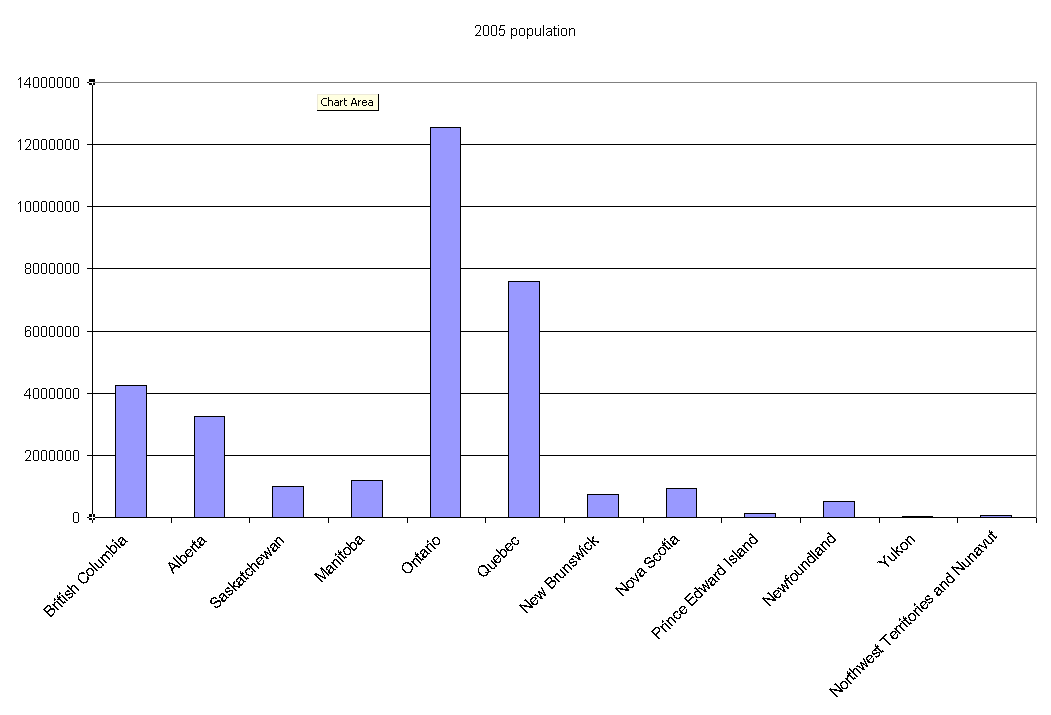
This chart shows the population distribution between the provinces in 2005:

Canadian provinces by population

Of course, it is unfair to directly compare emissions with population. When a driver in Ontario drives using gasoline extracted from the oil sands, Ontario bears some responsibility for those emissions. This is akin to the relationship between emissions and world trade, as discussed before. Even so, there is an obvious disjoint between the level of emissions in Alberta and their share of the Canadian population.

To reach a sustainable level of emissions, it will be necessary for everybody to cut their emissions significantly. That being said, the disaggregation of data can help us to make better choices about where to prioritize. From that perspective, the provincial policies of Ontario and Alberta start to look very important indeed.

Costly cod

Sushi platter

If you want evidence of serious overfishing, look no further than Billingsgate Fish Market in London. Apparently, the price of a kilogram of cod has increased from £6 (C$11.87) four years ago to £30 (C$59.36) today. This is despite how fish is being brought in from ever-father away, concealing the degree to which local waters have been depleted.

Since 2000, cod has been considered an endangered species by the World Wide Fund for Nature. According to one of their reports, the global cod catch has fallen by 70% during the past thirty years and the fish could be commercially extinct as soon as 2020. The WWF report claims that:

[T]he world’s cod fisheries are disappearing fast, with a global catch that has declined from 3.1 million tonnes in 1970 to 950,000 tonnes in 2000. In the North American cod fishery, the catch has declined by 90 per cent since the early 1980s, while in European waters, the catch of the North Sea cod is now just 25 per cent of what it was 15 years ago.

This is consistent with the study in Science by Worm et al. that projected “the global collapse of all taxa currently fished by the mid–21st century.”

Patchwork rules and industry strategy

In many states, a disjoint can be seen between action being taken on climate change at the state or provincial level and inaction at the federal level. Some people argue that such approaches are fundamentally inefficient because they increase uncertainty and the cost of compliance. While this is true in a static sense, it ignores an important element of game theory. Generally, the moment at which it becomes possible to effectively regulate an environmental problem is the moment when industry decides that some form of regulation is inevitable. It then switches its attention from lobbying for total inaction to lobbying for the kind of regulatory regime that suits business best: something as large-scale as possible, with long enough time horizons to guide investment decisions.

This is certainly the pattern that was observed with ozone depletion. Industry went from saying: “There’s no problem” to saying: “There’ a bit of a problem, but it would bankrupt us to fix” to realizing that regulation was inevitable, lobbying for a kind that suited them, and developing superior alternatives to CFCs within a year.

As such, it is entirely possible that grumbling about a “patchwork of regional approaches” signals the approach of an inflection point, beyond which effective regulation and large-scale industry and consumer adaptation occurs.

Killing animals to save them

Nick’s dog Molly

The Inuit Tapiriit of Canada are protesting attempts in the United States to have polar bears designated as an endangered species. They argue that the bears are being killed in sustainable numbers, that a listing in the United States would cut off the supply of hunters, and that such hunting provides vital economic stimulus within their communities. Apparently, the total population of polar bears is estimated at 25,000. Between the summers of 2006 and 2007, 498 bears were killed – 120 of those by commercial hunters who paid about $30,000 for the right to do so. They also hired guides and purchased goods and services within native communities.

The situation raises a number of moral questions. The most obvious is whether it is ethical or prudent to fund conservation efforts through hunting. Unsurprisingly, The Economist says yes, at least for African game. It does make sense to say that ensuring conservation of nature depends on making such conservation in the interests of those who live in the region. After all, they are the only ones with a sustainable capacity for enforcement.

The polar bear may also be a special case. It is estimated that melting sea ice could slash their numbers by two thirds or more by 2050. In response to that, it is possible to argue that saving as many as possible from hunting is justified; it could also be argued that we may as well hunt them, since they are doomed anyhow.

The particular case of polar bears is probably not especially important. Barring dramatic and sudden shifts in the climate policy of most states, it seems unlikely that more than a handful will survive the coming Arctic melt. It is entirely conceivable that all Arctic summer ice will be gone in a few decades and that the bears will only survive in zoos, and possibly by shifting to a new habitat and food supply. The effect those changes will have upon the Inuit are difficult to over-state.

A more general moral question raised by all of this is: “To whom do species belong?” Legally, they belong to the states in which they are found. At the same time, it is part of international law that states are not permitted to take actions that impose ecological costs on other states. Clearly, Brazil or Indonesia burning or cutting down their rainforests has such an effect. The situation is less clear when it is a locally important ecosystem or a single species being considered. Do people in India or France have a right to the existence of polar bears? Is it part of the collective of nature, within which we are all trustees?

It does seem as though there is a certain force to that argument, and a parallel obligation on the part of states not to destroy elements of their natural legacy. Of course, a strong case can be made that allowing hunting to pay for conservation serves rather than violates this principle. Such are the kinds of questions that need to be hashed out within international law and politics as the clash between a notion of state sovereignty predicated on non-interference clashes with the nature of a world as interconnected and full of humans as ours is.

E. Coli and the acid rumen

Fork and spoon on salad

This blog has previously considered the relationship between antibiotic resistant bacteria and factory farming. Recently, I learned about another way in which industrial meat production is breeding microbes that kill humans all the more efficiently. This one has to do with the acidity of our stomachs, one of the ways in which our bodies protect themselves from microorganisms living in the food we eat.

A cow living on a diet of grass has a rumen with a neutral pH. The rumen is the ‘first stomach’ of grass eating animals. Inside, bacteria help to ferment undigestible grass into material the cow’s body can process. Along with these digestive bacteria, many other kinds are present. One sort – Escherichia coli – kills humans by releasing toxins that destroy the kidneys. ‘Normal’ E. Coli, of the sort found in cows since the 1980s, cannot tolerate an acidic environment. As such, our stomachs are pretty good at killing it and thus keeping it from killing us.

A cow in a factory farm does not eat grass. The corn it eats creates an acidic environment in the rumen. This makes the cows ill, while also helping to breed E. Coli that can survive passage through acidic human stomachs. Now, about 40% of feedlot cows have E. Coli in their rumens. Feeding them grass or hay for a few days before slaughtering reduces the number of E. Coli in the animal’s digestive tract by about 80%, but factory farms do not do this. Instead, they try to prevent E. Coli outbreaks through irradiation.

Just another way in which industrial meat farming perverts nature and threatens human health.

[Update: 22 January 2010] Apparently, new research has called this hypothesis about diet and e. coli into question: “different set of findings emerged to indicate that this particular strain did not, in fact, behave like other strains of E. coli found in cattle guts. Most importantly (in terms of consumer safety), scientists showed in a half-dozen studies that grass-fed cows do become colonized with E. coli O157:H7 at rates nearly the same as grain-fed cattle. An Australian study actually found a higher prevalence of O157:H7 in the feces of grass-fed rather than grain-fed cows. The effect postulated (and widely publicized) in the 1998 Science report—that grain-fed, acidic intestines induced the colonization of acid-resistant E. coli—did not apply to the very strain of bacteria that was triggering all the recalls.”

Fissure in the Beaufort ice pack

During the past month, a massive piece of ice has broken off west of Banks Island, in the Canadian Arctic. This picture shows the area in question, while this animation from the US National Oceanic and Atmospheric Administration. The split left open water in the Bering Strait for 45 days. At the same time as the fissure, there was an unusual 45 day period of open water in the Bering Strait.

For a sense of scale, here is a map showing Banks Island in relation to the rest of Canada. While one event of this kind cannot be understood without comparison to what is happening in other areas and what has happened at other times, it is a reminder of the dynamic character of the polar icecap, even in the middle of winter. According to NOAA’s 2007 Arctic Report Card, anomolously high temperatures are yielding “relatively younger, thinner ice cover” which is “intrinsically more susceptible to the effects of atmospheric and oceanic forcing.”

It will be fascinating to see what happens the the icecap next summer: specifically, how the level of ice cover will compare to the shocking minimum in the summer of 2007.

[Correction: 15 January 2008] The open water in the Bering Sea is unrelated to this fissure, though both took place at the same time. Both pieces of information are listed in this report from the Canadian Ice Service.

Oil sands report card

Drew Sexsmith with a mandolin

The Pembina Institute and the World Wildlife Fund of Canada have a new report out on the oil sands. It is available as a four page summary or a 72 page PDF. The report is based on surveys sent to 10 different oil sands operations and focuses on the degree to which they have adopted policies to mitigate their environmental impact.

The report highlights both the greenhouse gas emissions associated with oil sands extraction and processing and the impacts upon fresh water. It also points out how the idea that land is ‘reclaimed’ after extraction is seriously faulty. Apparently, “[d]espite over 40 years of oil sands development, not a single hectare of land has been certified as reclaimed under Government of Alberta guidelines.” The permanent conversion of boreal forests ultimately belonging to the people of Alberta into fields of toxic mud is certainly cause for concern.

The report stresses possibilities for improvement, explaining how running all facilities using the best standards in other existing facilities would cut greenhouse gas emissions by 66%, and reduce volatile organic compound emissions by 47%. Nitrous oxide emissions could be cut by 80%, while sulphur dioxide emissions could be reduced by 47%. Adopting a proposed water efficiency standard would reduce annual water consumption by 60%. These figures are all based on facilities running at maximum capacity, as can probably be assumed with oil around $100 a barrel.

Depressingly, the report highlights that a currently proposed project has even worse standards than existing facilities. In order to mitigate the trend, three recommendations are made to government along with two to industry. The governmental suggestions are:

  1. Government needs to enforce acceptable standards of environmental performance and continuously improve regulations to reflect continuous improvement in companies’ abilities to reduce environmental impacts.
  2. Government needs to report on environmental impacts to public lands.
  3. Government must request segregated information to enable comparison of environmental performance.

The industry recommendations are:

  1. Companies need to implement best available practices and focus on developing and implementing new technologies and processes that lead to step-wise reductions in environmental impacts.
  2. Companies should make project specific oil sands environmental performance information more widely available and in a consistent format.

Overall, this approach may be a productive one. Rather than highlighting the ecological costs of oil sands extraction and demanding that the industry be scaled back, demands for all firms to meet the highest existing standards might be able to mitigate some of the harmful effects without creating as much antagonism. It’s not a comprehensive solution, but it may be a clever form of harm reduction.

Anyone interested in the state of Canada’s environment is encouraged to read at least the short summary.

Canada’s nuclear waste

Hilary McNaughton at Darma’s Kitchen

After being removed from a reactor, nuclear fuel is both too radioactive and too physically hot to be reprocessed or placed in dry storage. As such, it is kept in cooling pools for a period of five to six years. Given the absence of long-term geologic storage facilities, all of Canada’s high level waste is currently in cooling pools or on-site dry cask storage. On a per-capita basis, Canada produces more high level nuclear waste than any other state – a total of 1,300 tonnes in 2001.

Canada currently has eleven nuclear waste storage facilities. Among these, one is in the process of decommissioning and six contain high level waste. Four sites have waste in dry storage casks: Darlington, Bruce, Pickering, Gentilly, and Point Lepreau. Other facilities include spent fuel pools. According to the Canadian Nuclear Safety Commission (CNSC), all Canadian wastes are currently in ‘storage’ defined as: “a short-term management technique that requires human intervention for maintenance and security and allows for recovery of the waste.”

In 2002, a major review of waste disposal options was undertaken by the Nuclear Waste Management Organization (NWMO). Their final report – released in November 2005 – endorsed a system of “Adaptive Phased Management” employing both interim shallow storage and deep geological storage, with the possibility of future recovery of materials. Such recovery would be motivated either by concerns about leakage potential or a desire to process the fuel into something useful. The NWMO is currently engaged in a process of site selection, intended to lead eventually to a National Nuclear Waste Repository.

The nuclear waste problem

From both an environmental and public support standpoint, the generation of nuclear waste is one of the largest drawbacks of nuclear fission as a power source. Just as the emission of greenhouse gasses threatens future generations with harmful ecological outcomes, the production of nuclear wastes at all stages in the fuel cycle presents risks to those alive in the present and to those who will be alive in the future, across a span of time not generally considered by human beings.

Wastes like Plutonium-239 remain highly dangerous for tens of millennia: a span roughly equivalent to the total historical record of human civilizations. Furthermore, while most states using nuclear power have declared an intention of creating geological repositories for wastes, no state has such a facility in operation. The decades-long story of the planned Yucca Mountain repository in the United States demonstrates some of the practical, political, and legal challenges to establishing such facilities in democratic societies.

Dry cask storage is not an acceptable long-term option, as suggested by its CNSC categorization as “a short-term management technique.” When dealing with wastes dangerous for millennia, it cannot be assumed that regular maintenance and inspection will continue. Storage systems must be ‘passively safe:’ able to contain the wastes they store for the full duration of their dangerous lives, without the need for active intervention from human beings. To date, no such facilities exist.