The climate case against Trans Mountain

Writing in The Globe and Mail Thomas Homer-Dixon and Yonatan Strauch have a solid explanation for the incompatibility between the Trans Mountain pipeline and the climate commitments Canada has chosen for itself:

For these [pipeline] opponents, further massive investment in the extraction and export of some of the most carbon-intensive fossil fuel on Earth is nonsensical – idiotic, even. In a dangerously warming world, we should be investing in a clean-energy future, not entrenching Canada more deeply in the economic past.

Continued investment in the oil sands generally, and in the Trans Mountain pipeline specifically, means Canada is doubling down on a no-win bet. We’re betting that the world will fail to meet the reduction targets in the Paris Climate Agreement, thus needing more and more oil, including our expensive and polluting bitumen. We’re betting, in other words, on climate disaster. If, however, the world finally gets its act together and significantly cuts emissions, then Canada will lose much of its investment in the oil sands and the Trans Mountain pipeline expansion, because the first oil to be cut will be higher-cost oil such as ours.

There are more sophisticated analyses of the situation which are necessary, concerning global budgets and international negotiations, but it’s fair and accurate to say that Canada’s progress toward decarbonization depends on not making heavy new investments in fossil fuel infrastructure. If the Trudeau government or any other keeps pushing in that direction, Canada seems likely to end up the poorer while the world will be further imperilled both by the emissions we generate and the diplomatic consequences of putting fossil fuel profits before collective action to avert planetary disaster.

B.C.’s latest move against the Kinder Morgan pipeline

When it comes to stopping unsustainable fossil fuel development, anything that creates investor uncertainty can be useful. By that metric, the British Columbia government’s announcement of a diluted bitumen shipment expansion moratorium while it studies how a diluted bitumen spill would unfold is a small contribution to shifting Canada to an acceptable development pathway.

Still, I wish governments would look squarely at the real problem: the fundamental contradiction between continued fossil fuel exploitation and the climatic stability objectives that states including Canada asserted in the United Nations Framework Convention on Climate Change, the Paris Agreement, and in their own climate announcements. Making it all about local issues may be politics as usual, but it misses the main ethical issues at play.

Canada is still in denial about climate and the bitumen sands

Canada’s bitumen sands continue to be the largest source of growth in Canada’s greenhouse gas pollution, and the biggest barrier to Canada’s fair participation in a global climate change mitigation strategy.

Not only does continued bitumen sands investment perpetuate an industry which undermines Canada’s claim to be serious about Indigenous reconciliation, but giving the industry specially lax environmental treatment would force other sectors to pick up the slack, if that is even possible given the industry’s relentlessly growing pollution.

An article by University of Toronto professor Danny Harvey and Lika Miao now argues that only an oil sands phaseout would allow Canada to meet its (insufficiently ambitious) 2030 emission reduction targets. They see a complete bitumen sands phase out by 2030 as necessary to meet the targets, alongside major action in sectors like energy generation, and emphasize how meeting the more ambitious temperature targets of the Paris Agreement would require much more aggressive action.

All this highlights the chasm between Canadian politics and what would be necessary to curb climate change. Prime Minister Trudeau either doesn’t understand the relationship between fossil fuel use and climatic stability or is choosing to mislead Canadians for political reasons, continuing to assert that Canada’s fossil fuel reserves are usable. That kind of timidity or misdirection serves us all badly, leaving the bulk of Canadians misled into believing that the industry can somehow be compatible with a stable climate.

New big dams in Canada

Some earlier comments discussed the Site C dam project in B.C. Today, B.C.’s NDP government committed to finishing the $10.7 billion project.

Like the Muskrat Falls project in Labrador, this is a multi-billion dollar project facing extensive criticism from environmentalists and Indigenous people.

On the one hand, it is desirable to get as much low carbon generation as possible. On the other, these projects seem to represent continued Indigenous exploitation by Canadian governments (ignoring the standard of free, prior, and informed consent from UNDRIP), and it’s not clear there aren’t lower cost options which are equally desirable from a climate perspective. Loss of glaciers and summer snowpack might also have a catastrophic effect on hydro production.

Stranded assets and regulatory risk

One of the most important economic and political points arising from climate change is uncertainty about how seriously future governments will respond to the problem. If some kind of political change makes governments serious about hitting the 1.5 – 2.0 ˚C temperature targets from the Paris Agreement, it will mean doing everything possible to rapidly reduce emissions, from imposing high carbon prices to mandating the abandonment of especially harmful technologies and practices like burning coal and using exceptionally filthy fuel for international maritime shipping. This is termed “regulatory risk”. Whenever a potential investment project has finances that rely on governments continuing to talk big but do little about climate change, the project risks becoming non-viable after all the costs of development are spent if the government subsequently starts to take climate change seriously.

When it comes to actual fossil fuel reserves, there is a related issue of “stranded assets” – fossil fuel reserves that would be economically viable to extract if they could be sold, but where the climate change and energy policies of governments either directly prohibit their extraction or add other costs like carbon taxes which make the extraction unprofitable. In such a scenario, firms that depended on the value of these reserves to justify their own market value could be in trouble, along with everyone who has invested in them.

A recent article in The Globe and Mail describes how firms are aware of these risks:

[Caisse de dépôt et placement du Québec] The Quebec-based pension fund is part of a growing tide of institutional investors – which includes giants such as Vanguard and BlackRock Inc. – pressing companies for more information on how they will manage the transition to a low-carbon economy. Companies in carbon-heavy industries such as energy and mining face the highest pressure, as investors fear being stuck holding stranded assets: companies who fail to plan for the future and whose valuations will likely plummet as a result.

“It’s a risk that we could be left holding the bag in a Minsky Moment and it could be quite costly,” says Toby Heaps, chief executive and co-founder of Corporate Knights Inc., a Toronto-based organization focused on corporate social responsibility. “I wouldn’t say we need to sound the fire alarm, but certainly it’s time to pause and take a serious look at how we can accelerate our transition to a low-carbon economy.”

The pressure has catapulted climate risk to the top of the agenda in many of Canada’s boardrooms as companies grapple with how to measure, mitigate and disclose potential liabilities. Last year, the board at Suncor Energy Inc. recommended that shareholders approve a proposal put forward by NEI Investments to enhance the company’s climate-related disclosures. Shareholders voted overwhelmingly in favour of the resolution.

There is every reason for advocates of stronger climate change mitigation policies to pressure firms to consider these risks before investing. There are ample examples of how – once a project is built and operating – it becomes politically impossible to shut down, regardless of how much harm it is causing. A classic example is coal-fired power plants in the United States that were built before the Clean Air Act and are thus exempt from the obligation to install scrubbers. Arguably, the entire bitumen sands is a massive example of a terrible idea that has become impossible to discontinue because too much has been invested, too many jobs are now at stake, and governments have become too dependent on royalties and other related revenue.

Trouble between the Volga and Urals

Some kind of nuclear accident, probably “involving nuclear fuel or the production of radioactive material” and not a nuclear reactor, seems to have taken place in Russia: Russia named as likely source of Europe radioactivity spike

Continuing a tradition established by the Chernobyl disaster and the Kyshtym disaster, the information comes from radiation monitors in other countries and has so far been denied by Moscow.

Targeting pipelines

By the time of the 2015 World Heavy Oil Congress, midstream companies like Kinder Morgan, Enbridge and TransMountain PipeLines had grown used to the calamity that accompanied their pipeline applications. TransCanada’s Keystone XL project had ignited the battle, drawing ferocious protests from ranchers and Indigenous people in Nebraska. This in turn had attracted opposition from regional and then national and global environmental groups, which had long searched in vain for a catalyst to intensify and expand climate change activism. Keystone XL turned oil sands pipelines into an international political issue and a proxy of the first resort for the much broader debate about climate and energy policy. In the process, the pipeline — eventually any pipeline intended to move bitumen to tidewater — became the symbol of the entire fight. It was the line in the sand, the first full and direct conflict between progress in the age of fossil fuel — defined by expanding energy use and industrial megaprojects — and progress in the age of climate change, which sought to balance economic growth and industrial development with sound environmental stewardship and reductions in greenhouse gas emissions.

Turner, Chris. The Patch: The People, Pipelines and Politics of the Oil Sands. Simon & Schuster, 2017. p. 119 (emphasis in original)

The bitumen sands and global decarbonization

Still, even if it was not recognized in many boardrooms in Calgary or anywhere else in the industry, oil’s dominance could no longer be taken for granted. Climate change was not readily managed like the sludge in a single tailings pond or contained like the mess from a single pipeline spill. This was a more profound challenge to the industry’s story of progress — perhaps an existential one. In the years after Shell unveiled its two scenarios, environmental activists began to stand in opposition to one new fossil fuel project after another, and bankers and investors started to ask industry executives tough questions about whether their reserves represented future profits or “stranded assets.” And starting with the proposed Keystone XL project, a major new pipeline that intended to carry Alberta’s bitumen from a storage terminal on the prairie south of Fort McMurray to the Gulf of Mexico, the oil sands became the front line in a larger conflict. In the story of progress being told with climate change at its centre, the world had no choice but to move as quickly as possible toward an economy free of greenhouse gas emissions. For a variety of reasons connected only tangentially to the daily operations of an oil sands site — American political considerations and universal symbolic impact, in particular — the elimination of the Patch’s daily ration of the world’s oil supply came to be seen as the essential first step in this decarbonization process.

Turner, Chris. The Patch: The People, Pipelines and Politics of the Oil Sands. Simon & Schuster, 2017. p. 15–6

The Chiron and humanity at its worst

I’ve written elsewhere about how The Economist doesn’t understand climate change. In their science section and the occasional editorial they stress the need for massive and urgent action, but their thinking is not joined up. Their general editorial stance remains that economic growth is the greatest good, every new fossil fuel discovery is a boon, and that largely business-as-usual politics is either desirable or inevitable.

One passage from a recent special report on France demonstrates the chasm between their enthusiasms and what is necessary for a sustainable world:

The word “factory” does not do justice to Bugatti’s state-of-the-art production site in the shadow of the forest-clad Vosges mountains in eastern France. There is no grease or grime around the assembly line. The floor is a shimmering white gloss. The airy space feels more like a museum of modern art, gleaming eight-litre engines displayed like so many design exhibits. Workers wear white gloves, as if handling treasures. In fact, they are building the world’s fastest supercar.

A Milanese engineer, Ettore Bugatti, founded a car factory in this corner of France in 1909. Germany’s Volkswagen, which later bought the brand, chose Bugatti’s historic French site to develop the Veyron, a car designed to combine elegance and speed. The French factory turned out every one of these luxury record-breaking cars after their launch in 2005. This year Bugatti unveiled a successor, the Chiron, which pushes the limits of physics and sleek design further still. The car reaches 100km (62 miles) an hour in two-and-a-half seconds and has a starting price of €2.4m. Christophe Piochon, head of the French plant, compares the exquisite craftsmanship that goes into the construction of a Bugatti car to haute couture.

This schoolboy hard-on for a product that embodies everything that is putting humanity in peril is both telling and depressing. There’s a pretty strong case that nobody should be allowed to be rich enough to own a €2.4m car. Most people in that position are probably corporate executives, and there is little reason to believe they deserve it. It does not seem that the people who are given such lavish compensation produce that level of value for their employers, and even if they did it doesn’t necessarily follow that they should get to keep it for themselves.

Beyond the issues of economic inequality, there is the fundamental inappropriateness of the technology itself. Car racing is spectacularly pointless in itself, but a race track is essentially the only suitable venue for such a vehicle. Having people driving them around city streets as status symbols demonstrates much about what’s sick in our culture.

Limits to the effectiveness of divestment

There are some comparatively convincing arguments for why fossil fuel divestment can’t do much to limit the severity of climate change, at least in terms of the direct effects from institutions selling their shares.

One important one is that people buying and selling stocks, and the changing value of the stocks, doesn’t directly profit or harm the company involved. A secondary market in shares is necessary to make IPOs possible, but once a company has gone public, it raises the money for big new fossil fuel projects in other ways, such as borrowing from banks.

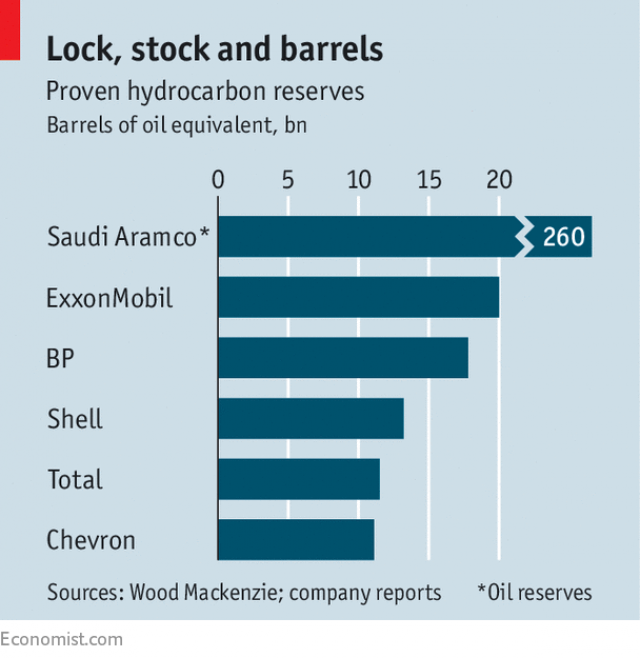
Another is that — while the proven reserves owned by companies like ExxonMobil are vast and can do considerable climate damage — sovereign countries have much larger reserves:

There are responses to these objectives, mainly in terms of how divestment is meant to gradually shift investor sentiment. Divestment is based on a financial as well as a moral case: if we really are going to control climate change, we can’t burn most of the world’s remaining coal, oil, and gas. As such, it makes no sense to develop big new projects, since we can’t even use all the resources in projects that have already been built. If it helps to spread that idea, divestment will have been worthwhile.

It might even help reduce the value of Saudi Aramco itself and the magnitude of its future investments, given that the firm is expected to be partly privatized in the near future.