Oil versus labour

Thought of the day:

One barrel of oil contains about 5.8 million British thermal units (BTUs) of energy (1700 kilowatt-hours). That is roughly equivalent to the energy output of an adult human working 12.5 years worth of 40 hour weeks.

At present, the world uses about 31 billion barrels of oil a year. That is equivalent to the global population (6.7 billion people) working for 58 years.

While the theoretical capacity of renewables is even higher, it is a fair bet that they will take a lot more effort to harness. There aren’t many places where solar panels will spurt out of holes you make in the ground.

Evening spring ride in Ottawa

I just completed my most aesthetically pleasing bike ride for a long time. Residents of Ottawa should consider doing the following:

  1. Begin in the park near 111 Sussex, right around sunset.
  2. Ideally, start on the far side of the series of two white metal bridges spanning the water near there.
  3. About ten minutes after sunset, on a spring evening, begin following the route below.
  4. Ride to 111 Sussex and follow the path that hugs the water beside it. The path in question follows the water’s edge in this picture.
  5. Cross Sussex drive.
  6. Ride along it, past DFAIT headquarters.
  7. Continue past the Saudi embassy.
  8. Follow the curve of the road past the Kuwaiti Embassy and the National Gallery.
  9. Ride into Major’s Hill Park.
  10. Ride to the terrace beside the Chateau Laurier. Follow it to the stairs parallel to the Rideau Canal locks.
  11. Carry your bike up the stairs.
  12. Walk across the bridge towards Parliament.
  13. Carry your bike down the stairs to the path beside the Rideau Canal locks.
  14. Follow the riverside path west as far as you care to go.

The whole route looks gorgeous in the fading evening light, when the sky still offers a bit of competition for the artificial lights.

May Critical Mass

Ottawa Critical Mass

Following Ottawa’s interminable winters, Critical Masses of decent sizes have resumed. While some thin-skinned individuals were scared away by a few low-lying clouds, it was ideal cycling weather: warm and overcast, with no danger of discomfort of any kind.

For the most part, this was a civilized ride. There were a lot of first-time participants, so it was unusually important for people who knew what’s what to direct the mass. There were a couple of insane things done by taxicabs. The mass was heading up along the eastern edge of the Rideau Canal, along a two-lane road. Unwilling to wait a few minutes, to taxicabs decided to gun it the wrong way up the road, beside the mass. The second cab came within a couple of metres of crashing spectacularly into oncoming traffic.

Anyhow, here are some videos from yesterday’s mass:

I look forward to the ride next month.

‘Door prizes’ for cyclists

Bike wheel

The ‘door prize’ is apparently the most common type of accident to injure bike riders in cities. Riding along beside a row of parked cars, someone opens a door on the driver side, leaving too little time for an approaching cyclist to stop. The cyclist thus slams into the door, quite probably injuring themselves. Sometimes, it can be lethal.

Awareness seems like the first mechanism for avoiding such accidents. While it is theoretically possible for cyclists to ride in the middle of lanes, doing so requires extremely thick skin, so as to endure the endless rage of motorists who want to go faster. Cyclists can avoid door prizes by keeping an eye on whether someone is sitting on the driver’s side of a car: as well as for clues like lights being on and engine noise. Well justified concern about the door prize risk makes me do this, though I find that it makes me less situationally aware overall. Having to check one parked car after another leaves less time and mental focus for evaluating other threats, such as cars passing you on the left or making right turns in front of you.

Drivers can be aware that cyclists may be passing them and do more to check for cyclists before opening doors. Glancing at the side-view mirror and back over their shoulder only takes a moment, and will protect the people stepping out of their cars from oncoming vehicles, as well. Doing so is sometimes an explicit legal obligation, as under section 208 of the Manitoba’s Highway Traffic Act:

No person shall,

(a) open the door of a motor vehicle upon a highway without first taking due precautions to ensure that his act will not interfere with the movement of, or endanger, any other person or vehicle; or

(b) leave a door of a motor vehicle upon a highway open on the side of the vehicle available to moving traffic for a period of time longer than is necessary to load or unload passengers

Section 203 of British Columbia’s Motor Vehicle Act is similar, as is section 165 of Ontario’s Highway Traffic Act. Drivers can also partially open doors for a little while, so as to make them more visible to anyone approaching.

Potentially, some kind of automated system could help. I don’t know how much it would cost, but it should be possible to set up a motion sensor that looks backwards on the driver’s side of a car. While it might sometimes be obstructed by vehicles close behind, one would think it would more likely be able to spot cyclists that drivers might have missed. Some kind of light could then give a warning against sudden door-openings, or even prevent doors on that side from being opened.

Arguably, the best solution is to isolate car and bike infrastructure from one another in city centres. I would personally be delighted if most downtown areas were car-free. There would be dramatically more social space, less noise and pollution, and arguably more of a neighbourhood feeling. In the absence of such a transition, perhaps we can aspire to more bike lanes physically separated from car traffic (by a barrier, not a painted line), as there are in the Netherlands and some other European states.

Delicious pike

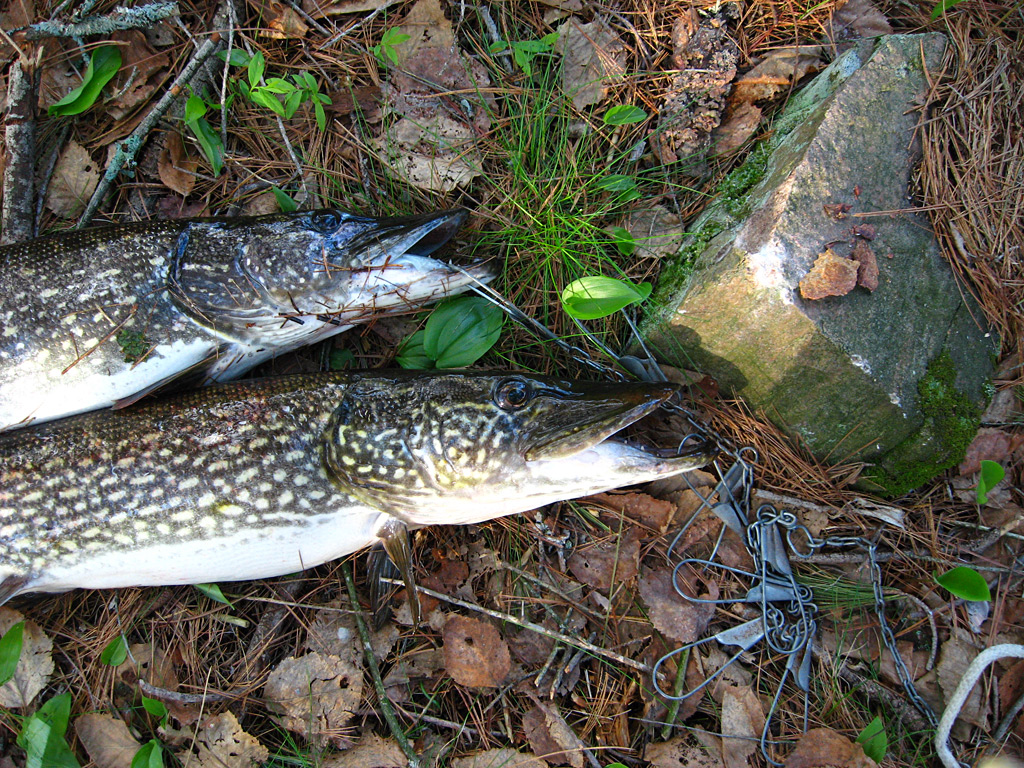
Ontario pike

The Smoky Lake canoe trip provided a delicious opportunity to deviate from my ordinary shunning of meat-eating. There are three major reasons for which I do not normally eat animal flesh: it is generally produced in a way that is not environmentally sustainable, the animals generally live in very poor conditions, and a number of unhygienic practices are endemic in factory farms. I maintain that when most people choose to eat meat, they do so in either honest or wilful ignorance about the consequences of that choice.

Happily, the trip provided an exception to all those objections in the form of lake-caught pike. I saw the lake they came from, the way they were caught and cleaned, and the way they were cooked. Two fish among eleven people probably isn’t causing damage to the ecosystem, particularly since it is a once a year trip. Furthermore, it is fair to say that a pike living in an attractive lake in Ontario is living an existence true to its nature: a statement that surely cannot be made truthfully about most animals people eat.

In any case, our pan fried pike was exceedingly delicious: as the result of its character, freshness, and the fundamentally food-improving qualities of camping. The experience of seeing it delivered from lake to plate has also made me somewhat rethink my view of sports hunters and fishers. While it is certainly true that ecosystems can be damaged by such activities, it is also fair to say that those who especially enjoy such activities might be passionate, knowledgeable, long-term advocates of conservation. It should be further asserted that – environmental considerations aside – those with such skills can make a most satisfying contribution to an expedition outdoors.

Brief Smoky Lake recap

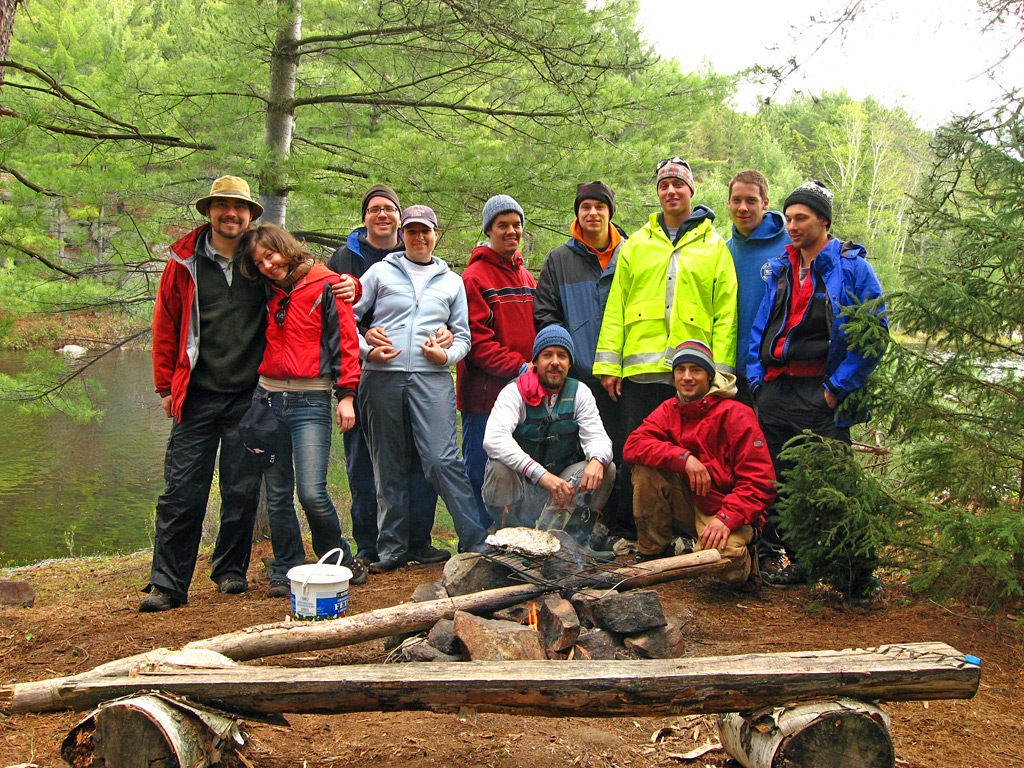
Smoky Lake canoe trip group shot

After four days in the Ontario wilderness, Emily and I are safely back in Ottawa. All told, the trip was successful and a lot of fun. We spent two days traveling and two hanging around our serene camping area, largely while others fished (more on that later). Wildlife sightings were fairly limited – though we did manage to inadvertently terrify a Canada goose and her greenish goslings – though it was nonetheless refreshing to be immersed in nature. While the weekend did include some serious rain, thankfully none of it fell during times when we had to decamp or travel. The smell of campfire smoke will doubtless linger on our clothes and selves for some time yet.

Getting out into the wilderness was certainly a most welcome break from city life. Similarly, the time spent in Toronto was a nice break from relatively parochial Ottawa.

For the visually inclined, some photos are on Facebook.

Gone paddling

This weekend, Emily and I will be canoeing on Kawigamog, Noganosh, and Lost Lakes – near Sudbury. It should be a good opportunity to explore the Ontario wilderness, in the general area of Algonquin Park.

This will be my first big canoe trip since the second Bowron Lakes expedition in August 2004. Canoe-camping is an especially enjoyable sort. You can bring lots of gear, which means more comfort and better food. You also cover quite a bit of ground, which allows for variety and real expeditions.

We should get back to Ottawa on Tuesday.

Ducks are distractions

The continuing furor over the 500 ducks that died in a toxic oil sands tailing pond seems like an excellent demonstration of the capacity of people to utterly miss the point. Oil sands extraction has converted a vaste swathe of boreal forest into toxic wasteland, speckled with tailings ponds up to 15 square kilometres. The Pembina Institute has asserted that: “Despite over 40 years of oil sands development, not a single hectare of land has been certified as reclaimed under Government of Alberta guidelines.” In addition to that, there is the water use and the greenhouse gas emissions.

To look at this and have your attention dominated by a few unlucky birds seems like the height of myopia.

The option of a week in the woods

Bridge support beams

For some reason, it is intensely satisfying to live in a way that satisfies these two conditions:

  1. Being able to walk from your home into a wooded area where you have some hope of going a week without seeing anyone else.
  2. Having the gear and experience required to actually do so.

Vancouver easily matches the first criterion. Crossing the first row of North Shore mountains lets you into an area of proper wilderness. Oxford does relatively poorly on the first criterion, though there is still an appreciable amount of wild space about, especially given the high population density of the UK.

Ottawa, I know less about. My experience with outdoor clubs here have been disappointing so far, and personal expeditions have largely been confined to cycling. Hopefully, this summer will involve some camping and exploration in Gatineau Park, if not father afield.