
[Update: 14 October 2006] Entry redacted
Category: Writing
Anything on the process or results of writing as an activity and a passion
A small request for those commenting
I would be much obliged if, when commenting, you would call yourself something other than ‘Anonymous.’ Anything at all that distinguishes you from other commenter who don’t want to leave names, aliases, or initials would be wonderful. At present, threads with multiple commenters, all called ‘Anonymous’, are likely to become rather difficult to understand.
With regards to the need to provide an email address, this is to help prevent spam comments. Using your real email address, will over, time reduce the probability of your comment getting eaten as spam. That said, I do have the ability to see which email addresses people have listed. If you really don’t want me to know who you are, you can always use something like “nottelling@history.ox.ac.uk” or whatever strikes your fancy. Doing so will somewhat increase the probability of your comment being marked as spam, but if you aren’t doing anything else dodgy – like linking to virus laden websites – you should be fine regardless. The system is also clever enough to learn, over time, that comments from a particular computer are safe.
I very much enjoy getting comments and engaging in discussion here. Along with other roles, the blog is a device through which I hope to refine ideas and positions, on the basis of intelligent criticism. As such, all substantive contributions are appreciated.
As always, any technical problems with the blog should be reported on the bug thread.
Summer days

With nine days left before I go to Dublin, I am pondering how the time can best be spent, and what sort of spurs I might use to ensure that most of it is used productively. At the very least, I should finish the latest tranche of work for Dr. Hurrell, as well as the bits of thesis reading I am in the process of completing already. More ambitiously, it would be nice to finally finish with the eternal fish paper. I need to de-scale and clean it: removing more than 20% of the total words, while rebalancing a few things. Working with it is much like trying to handle a piece of machinery in the dark that was once very familiar to you, but now continuously surprises you a bit with things that are not where you remember them being, sections with purposes that elude your comprehension, and a general loss of intuitive understanding.
As I am sure more seasoned veterans of the grad school experience could have told me in advance, life is rather less productive overall when it isn’t particularly structured. The absence of the need to discuss readings at particular times tends to make them languish on your shelves. Likewise, the absence of any deadline for the completion of research or papers tends to leave the ideas lingering in dusty corners of the hard drive or the brain. This is the basic reason why the protagonist of Good Will Hunting is wrong to chastise people for spending money on graduate education when they could just use the local library for free. The problem isn’t fundamentally one of information access, but rather of human motivation.
Today, I also wrote a batch of messages to people who I have, at one time or another, had substantial contact with, but with whom I now exchange very little information. Such people have at least temporarily become as constellations in my personal firmament. Indeed, I very often find myself imagining their response to a particular project and idea, then altering my own positions and actions on the basis of their simulated contribution. Exchanging a letter with them every month or so is probably an excellent accompaniment for that process; it will, at the very least, keep them from drifting too far off themselves, as I keep writing lines for them to speak.
PS. Mica has a new music video up. People are encouraged to discuss it on his blog. In many ways, it is unlike anything he has made before.
PPS. While my digital camera is off in dust rehab, I am operating off the stock of photos I have taken previously. Apologies if they are not particularly topical, current, or interesting.
Strange and annoying WordPress bug
I am abandoning the What You See is What You Get (WYSIWYG) editor that is built into WordPress (they call it the ‘visual rich editor’). It has the extremely nasty habit of randomly inserting literally hundreds of [em] tags and [/em] tags into pages with complex formatting, such as my academic C.V. Usually, it closes every tag that it randomly opens, so the formatting isn’t visibly affected. As soon as you try to change some small thing, however, everything goes insane. Going back through and fixing all of these mangled pages is a big pain.
WordPress also has serious trouble dealing with [p] tags and line breaks.
I hope the cause behind this was identified in the recent bug hunt and will not trouble people after the next major release.
Spelling, grammar, and public writing

Talking to people about some of the essay editing I have been doing, in various capacities, I find that there are two general positions when it comes to grammatical and typographical errors. Most people fit pretty squarely into one or the other group, and a fair amount of animosity seems to fly between the two. Normally, my impulse is to call for restraint in in the prosecution of such campaigns. In this case, however, I think the argument in favour of the second position is quite clear-cut.
The first group feels that the important thing is just making clear what you mean. Misspelling a proper name, using the wrong homonym (its v. it’s), and similar errors are not of great consequence, because anyone can tell what you meant. I have some sympathy for this view, particularly because it can lay some claim to being anti-exclusionary. English is a weird language and it is hard to learn. A lot can be said for tolerating those who are in the process of doing so. The internet and other venues are richer for their contributions, and it is unreasonable to expect perfect use of language from those who are still getting used to it. Indeed, I would be extremely hard pressed to write a perfect post or comment in French.
At the same time, those who are capable of writing proper English have little excuse not to do so, whether online or in a different context. The second group – to which I belong – sees writing properly as a duty the writer owes to their audience. To just throw unedited text at people is disrespectful, because it shows that you don’t care enough about them to present them with something polished. I am not talking here about Joyce or e.e. cummings bending the rules – that is the privilege of anyone who knows them well enough to toy with them. A style deliberately different from standard English is not comparable to carelessly written English. I am talking about those people who can’t be bothered to check their spelling and read over what they wrote to make sure it accords with the basic conventions of English grammar. With built-in spellchecking and nearly effortless editing fundamental to modern word processing, there is really no excuse.
A secondary benefit is that taking the time to re-read what you’ve composed lets you better make sure that you aren’t about to put something malformed or uninformed into a public place, where it may embarrass you to many people, and where it may be hard to remove.
On walking into lamp posts
In one of their less well considered comments, The Economist said the following this week, when discussing the upcoming European Galileo Positioning System, which is to exist in parallel to America’s Global Positioning System (GPS):
GPS is accurate to within about 15 feet (5m); fine for navigating a car but too imprecise for pedestrians.
Thankfully, at least some pedestrians seem to have natural navigation systems that operate at such ranges with no satellite data whatsoever. It’s a trick even children seem capable of pulling off.
PS. Incidentally, the Galileo Positioning System seems like a pretty easy thing to implement:
Time – Galileo’s position
01:00:00 – Under the Church of Santo Croce, Florence (dead)
01:00:01 – Under the Church of Santo Croce, Florence (dead)
…
On editing: a noble task and profession
The academic stages of my life have involved a huge amount of editing. I have read countless essays written by friends, papers submitted to journals, chapters destined for books, scholarship essays, and the like. It seems to me that there are three major types of editing that occur: low level, high level, and contextual.
Low level editing is what I have been doing for the last three hours: the careful reading of someone’s written work, with the major aim of identifying minor errors of spelling and grammar. The remit frequently extends to include the identification of sentences that are particularly unclear or otherwise problematic. Low level editing is distinguished by the fact that large amounts of knowledge about the topic of the work being edited are rarely required. Knowing terms of art can be an asset (those who do not often misunderstand how they are to be used), but I am essentially capable of giving a low level edit to anything written in the social sciences or the humanities.
A high level edit is much more intellectual. Alongside language, argument is evaluated. Contradictory evidence might be brought up; logical flaws might be highlighted. A high level edit usually incorporates a low level edit, but need not do so. A high level edit is rarely effective or comprehensible to the person whose work is being edited without one or more conversations. While a low level edit might get you thanked in a block of names in the acknowledgements section of a book, enough high level edits might get a book dedicated to you. Indeed, I am personally extremely grateful to people who have done high level edits of things I have written over the years: particularly Kate Dillon, Meghan Mathieson, Tristan Laing and Ian Townsend-Gault. Virtually everything important that I’ve written in the last five years has passed an inspection from at least one of them.
Contextual editing is the kind I have done least. It is the process of adapting a written work to fit into a particular place: whether a journal, a book, or somewhere else with specific requirements for length and content. I’ve done a lot of that on the fish paper – as well as when I worked for the international relations and history journals at UBC. Contextual editing has the virtue that it generally takes the quality of text and argument in the original piece as settled. It has the pitfall that it is generally an arduous process of sorting, summary, and re-jigging that is rather less rewarding than either of the other sort of edits.
Anyone who has ever been irked to see a tense or pluralization error in the middle of a huge academic tome might pause to consider the amount of error checking that goes into such things. The essential fact is that the brain that wrote a sentence is often badly placed to pick out any flaws within it; they have long-since been papered over in the mind of the author. With regard to errors in books, I have certainly noticed a great many such things myself. These days, I am likely to angrily correct them with a four-colour pen. I tip my hat to all the friends, spouses, significant others, teachers, and supervisors who have reduced the number of times it takes place. You are true heroes of the intellectual process.
Fish paper publication upcoming
I may be delerious because it’s 6:30am, but this seems pretty unambiguous:
I really enjoyed the piece you wrote on EU policies regarding fishery sustainability off the coast of West Africa. I’d like to work with you to prepare your piece for publication in [the MIT Internatinal Review].
You mentioned on your cover letter that you would be willing to “re-focus it in the most appropriate direction and summarize other sections.” This will probably comprise the bulk of our work together, as your piece was very well written to begin with.
An excellent bit of news by which to start the day. I am off to London.
Thesis development
Talking with Dr. Hurrell about the thesis this evening was rather illuminating. By grappling with the longer set of comments made on my research design essay, we were able to isolate a number of interwoven questions, within the territory staked out for the project. All relate to science and global environmental policy-making, but they approach the topic from different directions and would involve different specific approaches and styles and standards of proof.
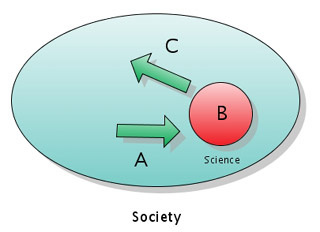
The first set deal with the role of ‘science’ as a collection of practices and ideals. If you imagine society as a big oval, science is a little circle embedded inside it. Society as a whole has a certain understanding of science (A). That might include aspects like objectivity, or engaging in certain kinds of behaviour. These understandings establish some of what science and scientists are able to do. Within the discipline itself, there is discussion about the nature of science (B), what makes particular scientific work good or bad, etc. This establishes the bounds of science, as seen from the inside, and establishes standards of practice and rules of inclusion and exclusion. Then, there is the understanding of society by scientists (C). That understanding exists at the same time as awareness about the nature of the material world, but also includes an understanding of politics, economics, and power in general. The outward-looking scientific perspective involves questions like if and how scientists should engage in advocacy, what kind of information they choose to present to society,
The next set of relationships exist between scientists and policy-makers. From the perspective of policy-makers, scientists can:
- Raise new issues
- Provide information on little-known issues
- Develop comprehensive understandings about things in the world
- Evaluate the impact policies will have
- Provide support for particular decisions
- Act in a way that challenges decisions
For a policy-maker, a scientist can be empowering in a number of ways. They can provide paths into and through tricky stretches of expert knowledge. They can offer predictions with various degrees of certainty, ranging from (say) “if you put this block of sodium in your pool, you will get a dramatic explosion” to “if we cut down X hectares of rainforest, Y amount of carbon dioxide will be introduced into the atmosphere.”
The big question, then, is which of these dynamics to study. Again and again, I find the matter of how scientists understand their legitimate policy role to be among the most interesting. This becomes especially true in areas of high uncertainty. The link from “I know what will happen if that buffoon jumps into the pool strapped to that block of sodium” to trying to stop the action is more clear than the one between understanding the atmospheric effects of deforestation and lobbying to curb the latter. Using Stockholm as a ‘strong case’ and Kyoto as a ‘weak case’ of science leading to policy, the general idea would be to examine how scientists engaged with both policy processes, how they saw their role, and what standards of legitimacy they held it to. This approach focuses very much on the scientists, but nonetheless has political saliency. Whether it could be a valid research project is a slightly different matter.
The first big question, then, is whether to go policy-maker centric or scientist centric. I suspect my work would be more distinctive if I took the latter route. I suspect part of the reason why the examiners didn’t like my RDE was because they expected it to take the former route, then were confronted with a bunch of seemingly irrelevant information pertaining to the latter.
I will have a better idea about all of this once I have read another half-dozen books: particularly Haas on epistemic communities. Above all, I can sense from the energy of my discussions with Dr. Hurrell that there are important questions lurking in this terrain, and that it will be possible to tackle a few of them in an interesting and original way.
The Salmon of Doubt
One more promising bit of academic news, from the MIT International Review:
Your paper is indeed still being considered (congratulations!), having made it through a particularly rigorous selection process. You will receive a more formal note to this effect in the forthcoming days.
This is, of course, the eternal fish paper, still passing through journal selection processes on its way to eternity. So much time has now passed since I wrote that paper that it feels like a familiar alien life-form that has been observing me continuously, but which I can only properly recognize when it glances at me in a certain way. Needless to say, this is an odd relationship to have with a piece of your own work.
I am very cautiously optimistic. If the paper gets through to publication, it will be my first published work in a journal not run by the University of British Columbia.