On luxury notebooks

Encouraged by the approval of friends like Emily and Tarun, as well as the endorsement on Tony’s blog, I bought a Moleskine notebook today. I am quite ambivalent with regards to the symbolism of the things: they try to cultivate artistic chic, but through their absurd price, coupled with ready availability, they can easily be seen as absurdly pompous. This might be called ‘Powerbook syndrome:’ only very marginally better than iBooks, yet nearly twice the price.

I was able to justify spending eight quid on a 120-page notebook only because it is an eighteen month weekly calendar. As such, it is worth spending more for something that will not fall apart or lead to you cursing it daily for a year and a half. It is a better alternative to telling people: “Yes, Thursday might be good. Just email me and I will check in Outlook that I don’t already have something sorted out.”

The choice was between developing a memory for appointment-type details and getting some kind of day-planner. The redeeming qualities of spending money on something long-lived should be a useful antidote to accusations of notebook snobbery. As for the question of whether Moleskine notebooks are really all they’re cracked up to be, I will get back to you.

On caffeine

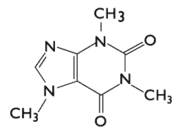
Caffeine moleculeCaffeine – a molecule I first discovered as an important and psychoactive component of Coca Cola – is a drug with which I’ve had a great deal of experience over the last twelve years or so. By 7th grade, the last year of elementary school, I had already started to enjoy mochas and chocolate covered coffee beans. When I was in 12th grade, the last year of high school, I began consuming large amounts of Earl Gray tea, in aid of paper writing and exam prep. During my first year at UBC, I started drinking coffee. At first, it was a matter of alternating between coffee itself and something sweet and delicious, like Ponderosa Cake. By my fourth year, I was drinking more than 1L a day of black coffee: passing from French press to mug to bloodstream in accompaniment to the reading of The Economist.

Unfortunately, coffee doesn’t seem to work quite right in Oxford. My theory is that it’s a function of the dissolved mineral content in the water, which is dramatically higher than that in Vancouver.

As I understand it, caffeine has a relatively straightforward method of operation. After entering the body through the stomach and small intestine, it enters the bloodstream and then binds to adenosine receptors on the surface of cells without activating them. This eventually induces higher levels of epinephrine release, and hence physiological effects such as increased alertness. Much more extensive information is on Wikipedia.

From delicious chocolate covered coffee beans used to aid wakefulness during the LIFEboat flotillas to dozens of iced cappuccinos at Tim Horton’s with Fernando while planning the NASCA trip, I’ve probably consumed nearly one kilogram of pure caffeine during the last decade or so. After the two remaining weeks of this term – and thus this academic year – have come to a close, my tight embrace with the molecule will probably loosen a bit.

Third Oxford Bloggers’ Gathering Wednesday

To all those who run a blog in Oxford:

I encourage you to attend the third informal quarterly gathering of Oxford bloggers, to take place this Wednesday (May 31st) at 8:00pm at The Bear.

This was announced previously, but I am trying to encourage a good turnout. In the past, these gatherings have been good fun: with enjoyably conversation and a surprising amount of affinity between those connected by only this one activity.

Oxford bloggers who want to earn my thanks might consider posting something about this themselves, so as to broaden the scope of who might attend. Feel free to direct any questions towards me.

Draft RDE complete

Two hours before my self-imposed deadline (to be brutally enforced by Claire), I finished a solid first draft of my research design essay, including two appendices. Weighing in at about 5000 words, sans appendices, it is right in the middle of the range from minimum to maximum length, leaving me some space to correct errors that my two much appreciated peer-editors point out before Sunday.

Many thanks to Meghan and Claire for throwing themselves in front of that bullet.

If you feel left out for not getting a copy, download one here (PDF). Please leave me comments ranging from “this word is spelled incorrectly” to “the entire methodological construction of this project is hopeless, for the following intelligent and well-articulated reasons.” The linked PDF doesn’t include the appendices because they are separate Word files and I don’t have software to merge PDF files with me. They really shouldn’t be necessary, anyhow.

[Update: 27 May 2006] I have a slightly revised version up, based on my own editing. Still waiting for comprehensive responses from external readers.

Draft research design paper introduction

Preamble

‘Policy making’ can be understood as the application of judgment to problems, on the part of those empowered to make choices that will affect the matters in question. Global environmental policy making, in particular, involves heightened difficulties related to the process of acting upon the world. Firstly, with regards to such large and complex matters as climate change and the management of ecosystems, our understanding of the objective nature of the world is uncertain. This applies both to the functioning of the natural world in the absence of specific human prompts and to the impact that choices made by human beings and organizations will have within the context of natural processes. On the one hand, for instance, we have an imperfect understanding of the functioning of food webs in the absence of human involvement. On the other, we have an incomplete understanding of the effects of pesticide use on those processes.

The major vehicle through which questions about the nature of the world and the consequences of human action are accessed is science. ‘Science’ exists as a collection of methodologies, epistemic communities, and ideals. While the role of science as an entity involved in policy making may seem initially straightforward, complexities arise rapidly. Crucially, these involve the balance between making judgments about ontological questions under circumstances of uncertainly and the balance of making judgments between alternative courses of action. On one hand, for example, scientists can assess the distribution of fallout from atmospheric nuclear tests conducted above islands in the Pacific; on the other, groups of concerned scientists can call for the discontinuation of such tests.

The perceived appropriateness of each of those roles, on the part of scientists, is reflective of the credibility of scientists as individuals and members of communities and organizations, as well as the political understandings that exist about the relationship between expert knowledge and power. All viable environmental policies must be created in light of existing and emerging expert knowledge, but the question of arbitration between descriptive and prescriptive claims is one that raises fundamental issues about how science and policy do, can, and should relate.

The question

This thesis will examine the relationship between science and global environmental policy making on two conceptually separable but intertwined levels. It will so so firstly on the practical level of how environmental science and scientists have been involved in the development of laws and institutions and secondly at the more theoretical level of the understood relationship between the actual communities and idealized roles of scientists and policy makers. While the general answers for each level will be generated through different methodological means, it can be hoped that the insights generated will be mutually reinforcing.

In order to engage with the practical questions of how science has affected policy making, this thesis will examine two case studies: the 2001 Stockholm Convention on Persistent Organic Pollutants and the 1997 Kyoto Protocol to the United Nations Framework Convention on Climate Change. The first can be seen as an example of a mechanism where a scientific understanding emerged of the issue in question and a reasonably effective legal regime for its mitigation emerged. The second example demonstrates a situation in which, for reasons which shall be examined, a similar progression from issue identification to effective policy action has not taken place. The contrast between the cases will hopefully allow for the isolation of important variables, on the basis of the comparative study of preparatory documentation and the first-hand impressions of the participants.

The theoretical component of this thesis will use the controversy surrounding the publication of Bjorn Lomborg’s The Skeptical Environmentalist in 2001 as a starting point for addressing the internal debate within the scientific and policy communities about the role that science and scientists should play in the making of decisions that entail both potentially enormous costs and equally serious risks. The theoretical discussion will also involve the examination of the secondary literature on the philosophy of science, as well as the relationship of science and policy in related fields: such as global health and development studies.

The thesis will consider the competing hypotheses that the general understanding of science as a descriptive adjunct to the prescriptive policy making process is broadly valid, that is is overly simplistic given the multifaceted nature of the epistemic communities involved, and that it might be a fundamentally inappropriate way of representing a corpus of thinking, institutions, and individuals which is actually incapable of operating without concealed normative maneuverings. These possibilities will be assessed through consideration of the examples listed above, as well as the analysis of primary and secondary documentation.

See also: Research design essay planning (15 May 2006)

In Memoriam

Karen FurstrandOne year ago, my friend Karen died in a car crash, in Vancouver. I found out the next morning from a newspaper headline, while I was waiting at a bus stop with a packet of photos I had taken of her in and around the Nitobe Gardens at UBC. It all strikes me as having happened a very long time ago: from our last brief conversation to walking twenty kilometres home, along the dark sea front, after her candle light vigil.

A year’s contemplation of life and death have yielded little more certainty about how to feel and respond.

As such a personable and enthusiastic individual, I do not doubt that Karen Furstrand is well and broadly remembered. I hope that those good recollections will temper the grief of friends and family as they think back upon her. In particular, my best wishes and condolences go out to her brother Ian, sister Sonia, and parents Erik and Celia.

Man of letters

Since I got my fountain pen and pad of brown, lined, recycled paper, I’ve written about thirty letters: ranging from a few short paragraphs to one of several hundred pages. There was a time, about eight years ago, when I wrote a great many handwritten letters: probably more than a hundred in all. In one of the more cruel things ever done to me, a few years ago the recipient demanded to return or destroy them, en masse. I certainly didn’t want them returned, but I really hope they haven’t been destroyed for want of attic space. They were written during an incredibly embryonic time and, idiotic as they doubtless are in the greater part, I think of them as a partially externalized version of myself as I was and wanted to be. I want them out there as a challenge to the blurring of memory in response to time and new events.

Since then, I’ve been both too ashamed of my atrocious handwriting to write many things by hand. I have also been concerned about having information out there of which I have no record to back up recollections that inevitably become hazy with time. The greatest force that has changed my mind recently is the sheer and impossible volume of computer generated text: whether blog, email, or printed letter. In the face of such a flood of information, it is increasingly hard to get anyone (including myself) to pay attention. As a consummate record-keeper, I do have virtually every scrap of electronic information ever sent to me archived and searchable. Even so, I am far more likely to re-read the few letters I have received since arriving here (the rest being safely entombed with photographic negatives back in North Vancouver).

I’ve just finished writing a letter of the sort that you hope will become a bulwark between a past mistake and all the future. As always, there is no certainty that a few flimsy pages can prove so solid, but I shall hope and see.

Further thesis planning

The thesis discussion with Dr. Hurrell has further convinced me that I am on a good track. We also sorted out an agreeable pattern for this term’s work this evening: two essays for the core seminar, two papers specifically for him, the research design essay, and a third essay for him to be written during the subsequent break, if necessary. Based on my standard of 3000 word papers, that will mean 21,000 words of writing for this term, in total. (Not counting dozens of blog posts, of course)

While discussing the thesis topic, we edged closer to a real question. The idea, at this point, is to choose two examples of international environmental agreements, then investigate the role that science and scientific communities played in their formulation. Two possible examples at the Stockholm Convention – wherein the coordination of science and policy can be said to have gone fairly well – and the Kyoto Protocol – where the relationship is muddier and the policy outcome less effective. The methodology would centre around looking at the preparatory materials and history of both conventions, as well as interviewing participants. On the theoretical side, I would examine writing on the connections between science and policy in this and other areas, as well as as much philosophy of science as I can push through my limited mental faculties.

The above, expanded and fused with a preliminary survey of the literature, will form the body of the 6000 word research design essay I submit at the end of this month.

A farewell to spheres of tungsten carbide

When I saw fountain pens on sale for the price of a pint at Smiths, I decided it was time to try and improve the elegance of my correspondence. It was with some success that I made my initial foray into the world of non-ballpoint pens: writing a thank-you note to Sarah’s parents and a short letter to Meghan. My printing is more geared towards being able to copy extensive notes during a lecture than producing perfectly formed letters, but it would be nice to be able to do the latter, when the necessity arises.

One unexpected aspect of fountain pen use if that it feels better to write. No pressure is required in order to deposit ink, so there is a feeling that the pen is just gliding across paper. While you might expect that to lead to many errors, even my earliest experiments are at least as legible, on average, as my ballpoint printing. Taken up with the novelty of a new type of writing instrument, as well as the familiarity of writing to friends, I wrote short letters to Viktoria Prokhorova, Meaghan Beattie, and Kate Dillon. There is something exceptionally satisfying both about writing and receiving handwritten letters. Regardless of the level of care or energy you put into an email, it doesn’t usually manage to have the same significance.

Cognitive calculus

Speaking with Lindi tonight, I was reminded of an idea that I wanted to briefly describe. Basically, it’s that it can be useful to think about self-expression in terms of time ratios. That is to say, the ratio between the amount of time it takes for someone to take in your thoughts, as a function of how useful they find those thoughts to be.

If, in a seminar of fifteen, you can make a comment that takes one minute, the effective cost to the group is fifteen minutes. As such, it had better be worth at least fifteen minutes of thinking time, based on the value of thinking time for members of that group. A comment that nobody would have come up with on their own is especially valuable precisely because it represents such an efficient use of time.

Something similar is true of blogging. If I can spend an hour to produce something that is worth two minutes to thirty people, I will have at least broken even. In practice, I will probably have done better because I will have achieved other objectives: most notably the clarification of my own thought.

The value of the time ratio idea is primarily in helping you to avoid exposing people to pointless or irrelevant information. The self-selection involved in reading or not reading a blog is somewhat liberating in that capacity (compared to a seminar comment you have little choice but to listen to), but I should still aim to maintain a net cognitive surplus.