Photographing birds in Ontario and Quebec

I enjoy photographing birds, and been having increasing luck doing so with my new 70-200mm lens. I think it might be a good project to collect images of birds that congregate around Ottawa, Toronto, and Montreal, use them as photos of the day, and identify their species.

It can be a project a bit like collecting the Oxford colleges, though it is obviously much more open-ended.

A few I have shot with the new lens:

  1. Species unknown – near the Rideau Canal locks
  2. Rock Pigeons (Columba livia) – on Somerset
  3. Species unknown – Kensington Market area, Toronto
  4. Species unknown, possibly a House Sparrow (Passer domesticus) – Victoria University, Toronto

Can anyone put a name to the unknowns above? I will try to come up with some new bird photos during the next week or so.

P.S. Has anyone tried the Canon 1.4X or 2.0X teleconverters? Does either work with the f/4 70-200mm zoom (I remember the box saying the lens is compatible with them). Do the focusing and metering systems still work properly, despite the lost 1-2 f-stops?

Cloud cover and climate change

Musician at Raw Sugar Cafe

According to research published back in April, the biggest climate changes in the 21st century may occur more due to changes in high altitude cloud cover, in response to increased temperatures from rising greenhouse gas concentrations, rather than due to the initial temperature increases themselves: Global warming due to increasing absorbed solar radiation, published in Geophysical Research Letters.

Reduced cloud cover would reduce the amount of sunlight that gets reflected back into space, rather than striking the surface of the Earth. As such, it would produce further warming. Based on evaluation of simulations used in preparing the Fourth Assessment Report of the IPCC, this effect may be of greater magnitude than the initial warming due to increased absorption of outgoing long-wave radiation by greenhouse gasses.

While the result certainly cannot be considered definitive now, it underscores the importance of improving climate models and incorporating the key feedback effects into them. Only when that has been done can more precise estimates of the climatic sensitivity of the planet be produced, as well as more accurate regional projections.

Playing with Wolfram Alpha

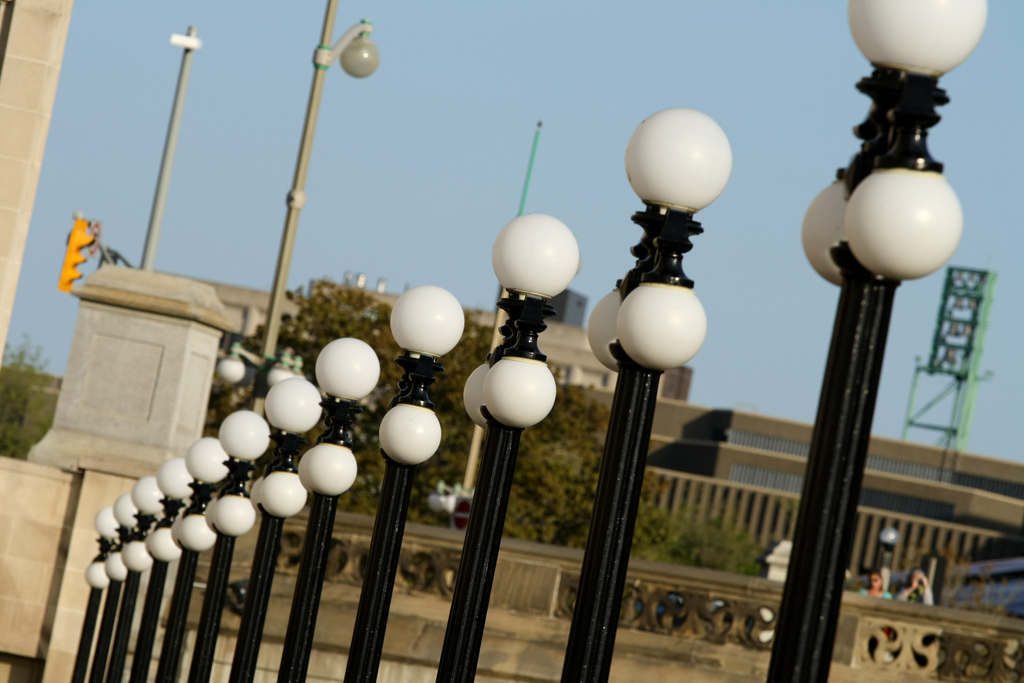
Ottawa street lights

Wolfram Alpha is based on a rather neat idea: making a website that can actually deal with information in an intelligent way, rather than simply search for words of things in existing pages. Put in ‘1 kg gold‘ and it will tell you that it would form a sphere 2.313cm in diameter, a cube 3.73cm to a side, and cost US$32,520. Put in ‘running 10 km/h 60 minutes 6’0″ 185lbs age 25 male‘ and it will estimate the number of calories expended. It doesn’t know about cycling yet, unfortunately. It doesn’t seem to be able to do calculations on greenhouse gas emissions yet, either, though it will tell you that mixtures of air and methane in which the methane is between 5% and 15% of the total will explode if exposed to a temperature of 595˚C. It also knows that Apple has 35,100 employees and a current P/E ratio of 23.1. It can search for base pair sequences within the human genome.

The biggest limitation of the site is phrasing things in a way it interprets properly. Indeed, most of the searches I try produce only the message: “Wolfram|Alpha isn’t sure what to do with your input.” For the time being, Wolfram Alpha is less of an open-ended vehicle for computations and data access, and more a set of discretely made tools for existing tasks. If you know which tools exist and how to format input for them, it works well. If you are trying to get it to do something its designers didn’t anticipate, it probably won’t work.

In short, Wolfram Alpha is a fun thing for statistics nerds to play around with, and could be genuinely useful for research. The best way to appreciate its current capabilities is to watch this introductory screencast.

The AECL and new nuclear plants in Ontario

It seems that the province of Ontario is leaning towards having Atomic Energy of Canada Limited (AECL) build their new nuclear reactors, provided the federal government provides some additional support. The recent history of the company isn’t very impressive, given their failure to get two comparatively simple isotope reactors to work, and giving the contract to a Canadian company makes it even more likely that Canadian taxpayers and ratepayers will end up subsidizing them.

Perhaps it would be wiser to give the contract to a French, American, or Japanese firm, and let their citizens help pay for our gigawatts. It seems plausible that using a design that is being implemented elsewhere will have price benefits: both in terms of economies of scale and in terms of learning from the experience of those who began building them earlier. AECL’s Advanced CANDU reactor has not yet been fully designed, and probably never will be unless it wins the competition in Ontario, besting France’s AREVA and Westinghouse, from the US.

New research on the meridional overturning circulation

Bird in a bush

Recent research undertaken by the Woods Hole Oceanographic Institution and Duke University suggests that ocean currents work differently from how they were previously considered to, with implications for climate change. Using a combination of two years worth of observations from underwater sensors and computer models, they determined that “much of the southward flow of cold water from the Labrador Sea moves not along the deep western boundary current, but along a previously unknown path in the interior of the North Atlantic.” If the results of this study are accurate, it could mean that previous attempts to model the climate system incorporated inappropriate behaviour for this current. As a result, they could have generated less accurate projections of how warming due to greenhouse gas concentrations will affect different parts of the climate system.

More information about the study is available in Nature: Interior pathways of the North Atlantic meridional overturning circulation. For those lacking time or access to Nature, here is the abstract:

To understand how our global climate will change in response to natural and anthropogenic forcing, it is essential to determine how quickly and by what pathways climate change signals are transported throughout the global ocean, a vast reservoir for heat and carbon dioxide. Labrador Sea Water (LSW), formed by open ocean convection in the subpolar North Atlantic, is a particularly sensitive indicator of climate change on interannual to decadal timescales. Hydrographic observations made anywhere along the western boundary of the North Atlantic reveal a core of LSW at intermediate depths advected southward within the Deep Western Boundary Current (DWBC). These observations have led to the widely held view that the DWBC is the dominant pathway for the export of LSW from its formation site in the northern North Atlantic towards the Equator. Here we show that most of the recently ventilated LSW entering the subtropics follows interior, not DWBC, pathways. The interior pathways are revealed by trajectories of subsurface RAFOS floats released during the period 2003–2005 that recorded once-daily temperature, pressure and acoustically determined position for two years, and by model-simulated ‘e-floats’ released in the subpolar DWBC. The evidence points to a few specific locations around the Grand Banks where LSW is most often injected into the interior. These results have implications for deep ocean ventilation and suggest that the interior subtropical gyre should not be ignored when considering the Atlantic meridional overturning circulation.

Improving our understanding of ocean currents should help to improve the accuracy of predictions from general circulation climate change models, and may be helpful in producing regionally specific projections of climate change impacts.

Downloading from YouTube and Megavideo

There are lots of sites out there that present videos in a non-downloadable way, wrapped in flash video players. For instance, there are Megavideo and YouTube. For those running Safari, there is an easy way to download these videos:

  1. On the page with the video, click ‘Window’ and the ‘Activity.’
  2. Scroll through the list until you find something plausibly large (at least a few megabytes)
  3. Select that item and copy it, either with the hotkey or from ‘Edit > Copy.’
  4. Click ‘Window’ and ‘Downloads’
  5. Paste the item, with either the menu or the hotkey.
  6. The file will download to your desktop.
  7. Add the extension .flv to the file
  8. They can be played in video players like VideoLAN.

The same trick can be used to grab other forms of embedded media from all sorts of websites, and it’s much easier than digging around in search of temporary internet files.

Changing Images of Man

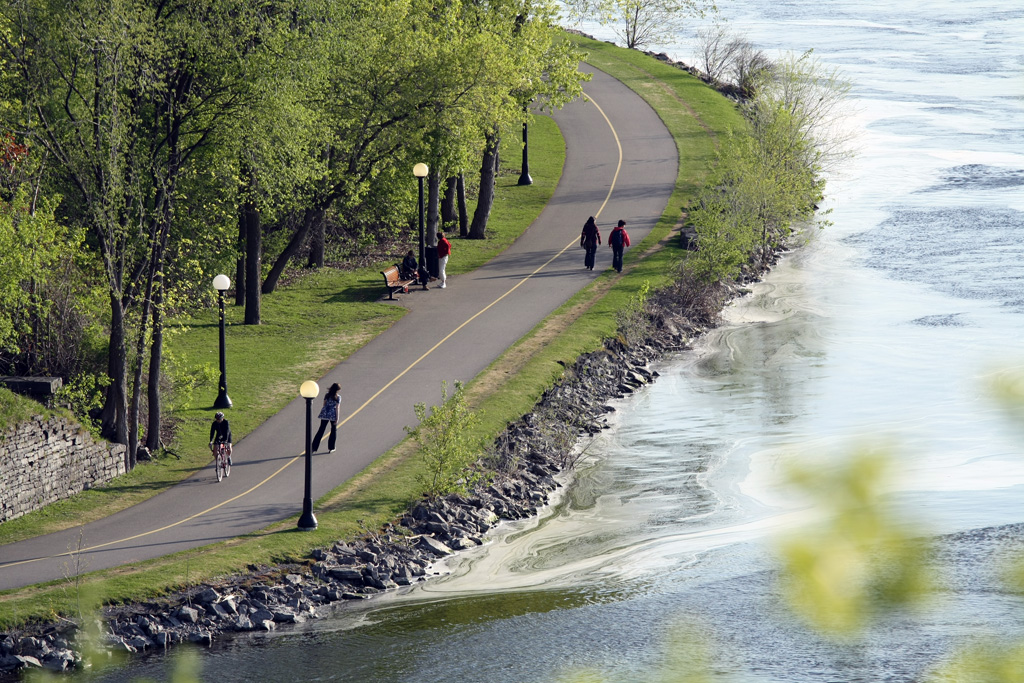
Ottawa River Pathway

First published in 1974, and available for free online, Changing Images of Man is a kind of philosophical reflection on science and how human beings understand themselves. While it does touch on some interesting ideas, the degree to which it is fundamentally lacking in rigour or discipline means that it is also choked with nonsense, impenetrable jargon, and pointless speculation. In short, it does not have the feel of a text whose ideas have been borne out by subsequent history. Rather, it is more like a monument to a kind of faddishness that has long since become dated, though elements endure in the more superstitious aspects of contemporary culture.

Much of the book concerns environmental issues: specifically, how human civilization can cease to be such a destructive force, and how ecology is affecting science in general. Neither discussion is very satisfying. The former discussion focuses on a kind of caricatured extension of the Beatles going to India to lean yoga and discover themselves. While significant transformations in human behaviours and self-understanding may well be necessary to generate a sustainable society, the perspective on those changes offered in this work doesn’t seem either plausible or compelling to me. The latter discussion exaggerates the degree to which the study of complex dynamic systems challenges the practice of science: while they are certainly more challenging to study scientifically than systems that are more easily broken down and understood in terms of constituents, science is nonetheless proving increasingly capable of dealing with complex systems like climate and ecosystems, and is doing so without the kind of radical extension and modification endorsed by this book.

Much of the book is no more comprehensible than a random string of pompous-sounding words strung together in a grammatical way. It seems telling that the chapter on ‘feasibility’ is the least accessible and comprehensible of the lot. The report perceives a crisis in science that I don’t think existed at the time it was written, and I do not think has emerged since. Complex phenomenon are being grappled with using enhanced versions of conventional techniques, while UFOs and psychic phenomena have been effectively rejected as quackery, due to the absence of any good evidence for their existence. Basically, Changing Images of Man is an exhortation to abandon rigorous thought in favour of a kind of wooly inclusiveness, exceedingly open to ideas that are too vague to really engage with. The book has a naive counterculture tone, overly willing to reject what is old and unthinkingly embrace novel concepts that register with a 1960s/1970s mindset. While the questions it considers are generally good and important ones, the answers provided are vague, preachy, and largely useless.


Climate deniers deciding science funding in Canada

Pink and purple tulips

In yet another demonstration of the ongoing tensions between conservative political parties and science, Prime Minister Stephen Harper has appointed a couple of climate change deniers to federal science funding bodies. One has claimed that “the climate-change issue is somewhat sensational and definitely exaggerated.” The appointments seem likely to worsen the quality of scientific work being done in Canada, putting us further behind the rest of the developed world, when it comes to comprehending and appreciating the characteristics of the world in which we live, and in which important political choices must be made.

This is reminiscent of the appointment of a man seriously invested in the oil sands to the ‘Clean Energy Dialogue’ ongoing with the US. The Conservatives claim that they accept the science of climate change, but they cannot really take it to heart because of the degree to which it fundamentally conflicts with a laissez faire approach to economic regulation.

All we can hope for is for climate change denial to eventually become so patently ridiculous to the electorate that parties that continue to dabble in it seem to be arguing the equivalent of the Earth being flat and orbited by the sun. That may be the only time at which conservative parties have the impetus they need to reform their ideas to be compatible with what we now understand to be the state of the world.