Encrypting personal communication

Statue outside the National Archives

Personal use of encrypted communication is yet another example of so-called ‘network effects.’ (These have been mentioned previously: 1, 2, 3.) The basic idea is that the more widespread certain technologies become, the more useful they are to everyone using them. The most commonly cited examples are telephones and fax machines; back when only a few people had them, they had limited utility. You would need alternative channels of communication and you would waste time deciding which one to use and exchanging instructions about that with other parties. Once telephones became ubiquitous, each one was a lot more powerful and convenient. The same can be said for email addresses.

Good free software exists that allows the encryption of emails at a level where it would challenge major organizations to read them. While this may not protect an individual message that falls under scrutiny, it changes the dynamic of the whole system. It is no longer possible to filter every email passing along a fibre-optic cable for certain keywords, for instance. You would need to crack every one of them first.

Making the transition to the routine use of encryption, however, requires more effort than the adoption of telephones or email. While those technologies were more convenient than their predecessors, encryption adds a layer of difficulty to communication. You need to have the required software, key pairs generated, and passphrases. It is possible to make mistakes and encrypt things such that you can never access them again.

As such, there is a double barrier to the adoption of widespread communication encryption: people must deal with the added difficulties involved in communicating in this way and with the problem that hardly anyone uses such systems now. If there is nobody out there with whom you can exchange PGP encrypted messages, you aren’t too likely to bother with acquiring and using the software. It is entirely possible that those two constraints will prevent widespread adoption for the foreseeable future.

One nice exception to this rule is Skype. Users may not know it, but calls made over Skype are transmitted in encryption form, very considerably increasing the difficulty of intercepting them. The fact that users do not know this is happening greatly increases the level of usage (you cannot avoid using it). While such systems may well not be as secure as explicit encryption efforts undertaken by senders and recipients, they may be a useful way to increase overall adoption of privacy technology. Such ‘invisible encryption’ could also be usefully incorporated into stores of personal data, such as the contents of GMail accounts.

PS. For anyone who decides to give PGP a try, my public key is available here.

Parliament light show

On Parliament Hill, they put on a giant multimedia show twice a night. It is called Canada: the Spirit of a Country and it is both preachy and prescriptive. To anyone even slightly wary of government dictating values from on high, it seems a bit disturbing. It definitely seems absurd and over-done.

I hadn’t properly seen it before yesterday, when Emily and I happened across it. While the virtues it expresses are generally admirable, the delivery is incredibly Orwellian. Between psychedelic bursts of light projected across the front of Parliament, it plays videos and expounds in both official languages on the virtues of diversity and cultural exchange, peacekeeping, and the like. It’s like an over-the-top ‘Part of our Heritage’ commercial, though it seems a lot more disturbing. While the message may be an innocuous one, the propaganda approach is off-putting and the overenthusiastic promotion of Canada seems very much like a case of too much effort.

If you ignore the words, the light show itself is quite dramatic, though also profoundly discordant. It is very odd to see huge spinning abstract purple shapes projected all across Parliament, suddenly replaced with a pattern that looks like the razzle dazzle ships of World War I.

Standing within 50m of the war memorial, one might hope that we have moved beyond nationalism. At an aesthetic level, one might at least hope that we have moved beyond the kind of crude, half-deluded, and self-serving nationalism that the light show seems to represent.

Tricky bits of language

Frieze in Parliament

Living in Ottawa frequently involves encountering people speaking French. While I have been reasonably fluent at times, most of my felicity has been sapped by lack of use. There are many areas of grammar, syntax, and vocabulary that make me feel uncertain and amateur.

In English, there are relatively few such areas. Only two really stand out as perpetually confusing for me:

  1. I can never remember the proper use the subjunctive. I have never understood it, correctly structured phrases employing it still sound incorrect, and the Wikipedia entry is bewildering. As such, I avoid using the subjunctive altogether. I am in good company, at least. Somerset Maugham is reputed to have said: “The subjunctive mood is in its death throes, and the best thing to do is to put it out of its misery as soon as possible.”
  2. The other is the interaction of apostrophes and the letter ‘s’ in situations where words end in ‘s’ naturally. It gets no more confusing than when you have a word that always ends in ‘s,’ is being made plural, and is a possessive. For instance: “The different species’ characteristics can be easily distinguished.” I always feel inclined to say (and write) spee-sea-ze-ze-ze.

Without a doubt, I have looked up the proper usage of each of these dozens of times. The explanation is just very reluctant to stay in my brain. Not even reading Lynn Truss’ Eats, Shoots & Leaves has provided any lasting understanding.

Light reading – the Harry Potter finale

Having read the first six Harry Potter books, it seemed only natural to read The Deathly Hallows as well. Without spoiling anything for people who plan to read it, but have not done so yet, I can say that the conclusion mirrored the overall mediocrity of the series – much more notable as a pop culture phenomenon than as books many people are likely to read in twenty years. The most notable contribution they made was probably to encourage children to read. Hopefully, they will go on to read more substantial fantasy series’ such as those of C.S. Lewis, Tolkien, or Philip Pullman.

You have to wonder what Rowling is going to do with herself from now on. Millions of people are likely to read whatever she comes up with next – if she chooses to keep writing – but it’s anyone’s guess whether the next creation will enjoy anything like the widespread and enduring attention the seven Potter books have.

Those trying to maintain ignorance of the book’s contents should not read any further.

Continue reading “Light reading – the Harry Potter finale”

Real time ocean monitoring

Emily Horn in front of Parliament

The Neptune project, being led by the University of Victoria, is quite a considerable undertaking. The first stage of the plan is to make an 800km loop of fibre-optic and electrical cable and use it to connect five living room sized automated underwater data collection systems called ‘nodes.’ These will track fish stocks and undersea earthquakes, while collecting other kinds of data on an ongoing basis. This will be the first cabled ocean observatory with multiple nodes.

Ultimately, the system will expand to include 3000km of powered fibre-optic cable connecting a larger number of nodes, all capable of returning data in real time. Compared with systematic collection of data (go to a spot at set intervals and check what is happening) or sporadic collection (just use whatever data becomes available from whenever people happen to be in a place), real time data allows for different sorts of analysis and more comprehensive evaluations. The nodes will contain instruments including temperature meters, conductivity meters, pressure gauges, acoustic dopplers and hydrophones, current meters, wave sensors, electrometers, seismometers, cameras, nutrient monitors, sample storage containers, and autonomous robots.

The system should offer some useful data on migratory fisheries and whale movements, as well as the ominous rumblings of the Juan de Fuca plate, extending from British Columbia down to Oregon. It will also contribute to a more systematic understanding of ocean geology and ecology in general.

Managing peak power demand

111 Sussex, Ottawa

Readers may recall an earlier discussion about how moderating peak electricity demand serves climate change mitigation objectives. One mechanism presently operating towards this end is the PeakSAVER program, run by Toronto Hydro. According to WWF Canada:

Research commissioned by the Independent Electricity System Operator (IESO) in 2003 found that peak-shaving programs could reduce peak demand by ten per cent, equivalent to the output of three of Ontario’s four remaining coal plants, and that a mere one per cent reduction in peak demand would have saved Ontario consumers $170 million in the previous year.

The PeakSAVER program allows Toronto Hydro to remotely turn down thousands of air conditioners and water heaters across the city. This is done within set limits, preventing air from exceeding certain temperatures and hot water from falling below them.

Another upshot of such programs is that they could be used to help overcome the limitations of renewable power. At times when the sun is shining and the wind is blowing, electricity could flow unimpeded. At times where supply exceeds demand, non-essential usage could be throttled back, or variable pricing could be used to induce consumer action.

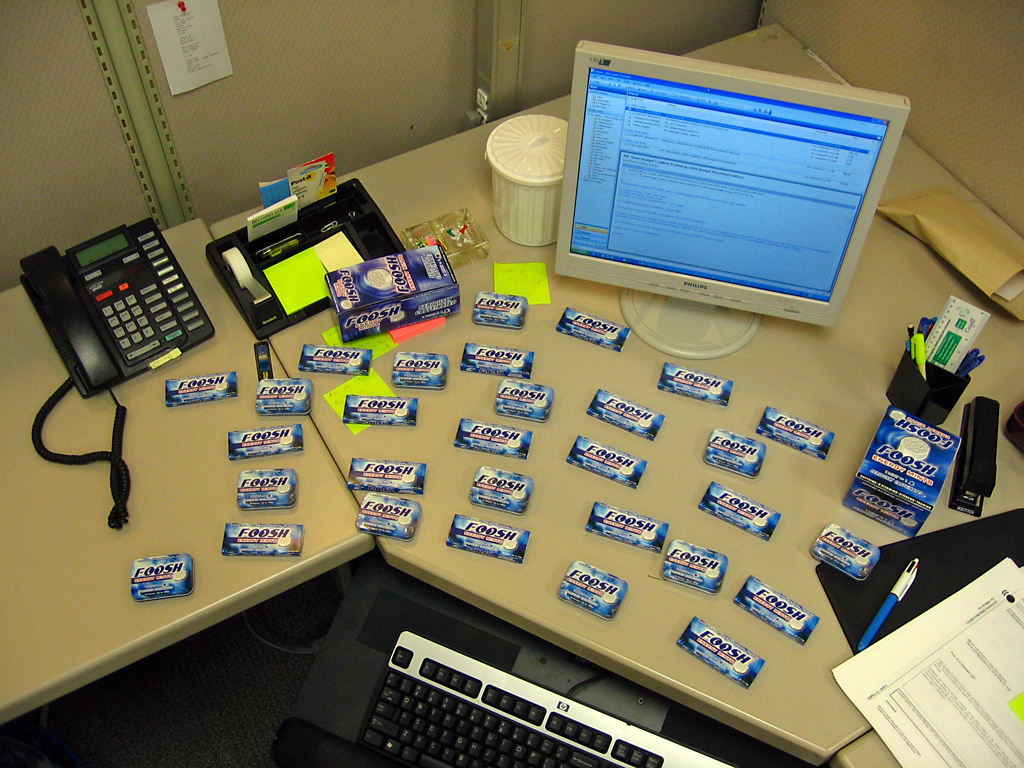
Festooned with Foosh mints

Foosh mints

Thanks to a package that arrived today, I have 30 packages of Foosh mints in my cubicle. That represents 28.8g of pure caffeine and twice the number of mints shown in this photo from Oxford.

Mostly, the choice to purchase so many reflects the expense and annoyance of having them shipped from the US. Partly, it reflects the manic desire to accumulate large collections of desirable things that seems to be a prominent feature in human history.

Films and fish stocks

According to Shifting Baselines, it seems that Charles Clover’s excellent book “The End of the Line” is being made into a documentary film.

That was the book that inspired me to go meet Dr. Daniel Pauly at the UBC Fisheries Centre, as well as go on to write the article that was recently published in the MIT International Review.

Hopefully, the release of the film will raise the profile of the issue a bit. As morally dubious as the factory farming of land animals is, it does not endanger the survival of these species. That is not true of the modern industrialized fishing industry. The collapse of fisheries in the Mediterranean and North Atlantic is just a sign of what is to come to all fisheries worldwide unless aggressive conservation measures are put in place and enforced.

The inaccessibility of rail

There seem to be a lot of rail fans who read this blog. Like me, they would probably lament how the main train station in Ottawa was moved from downtown to a site 5km out of town that is only easily reached by highway. Admittedly, this happened in 1966, but it only came to my attention recently.

Definitely one of the most annoying aspects of inter-city public transit is how the stations tend to be located in inaccessible and often dangerous parts of town. Of course, with real estate prices being where they are – and with the ever more entrenched dominance of the automobile – that seems unlikely to change soon.