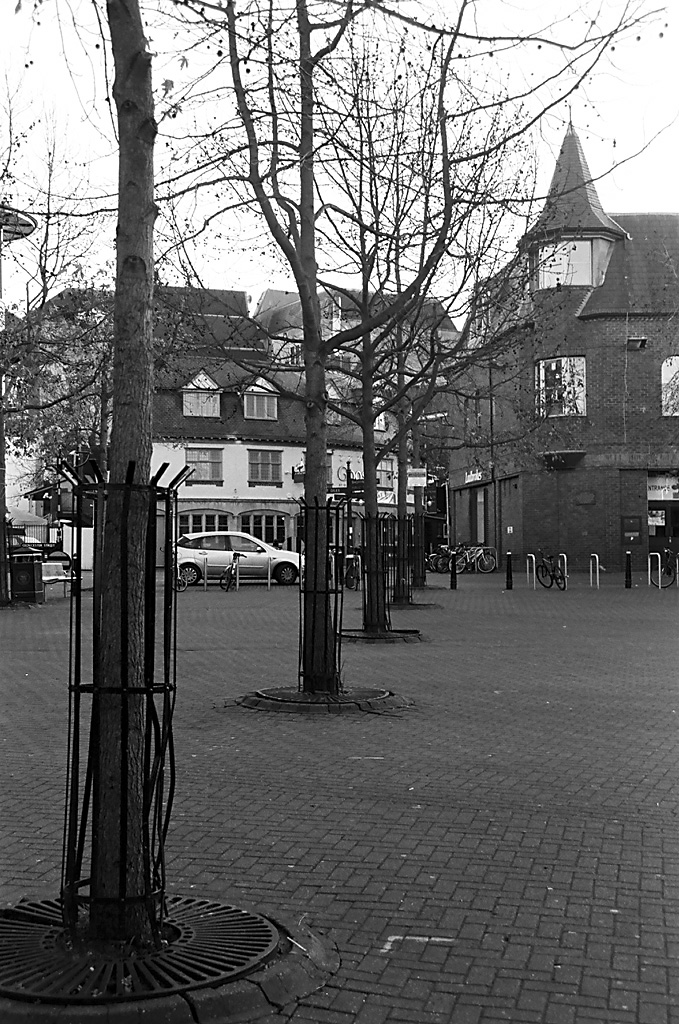
Time, and our imperfect orbit

In keeping with the dictates of thesis writing, and the sage comments of those who suggest that blog entries are not the best use of time, I resolve the following: posts on this blog between now and the completion of a draft thesis shall be limited to no more than one substantive and one narrative post per day, the latter to generally include a photograph. Posts that pertain directly to the substantive content of the thesis, as designated by the M.Phil Thesis category, are exempt from these restrictions.

An article in Harper’s that I first took up because of its hyperbolic title – “Clash of the Time Lords: Who will own the measure of our days?” – is actually a really interesting demonstration of how human beings try to make the world fit within our understanding.

In particular, the article hinges on the fact that the second has two distinct definitions. The first is based on astronomical phenomena: 1/86,400th of a day, that being 1/365.25th of the time it takes for the Earth to orbit the sun. The second is based on the extremely precise oscillation of cesium atoms, the measuring stick used in atomic clocks. Specifically, it is 9,192,631,770 oscillations. The trouble arises from how those two are not the same; the Earth does not sweep through its orbit with perfect precision. Rather, it wobbles, hits things, and slows down. As such, astronomical time ‘slows down’ as compared with atomic time.

Right now, this is corrected for using occasional leap seconds. Every time the Earth has lagged behind atomic time by one second, one second is added to the reckoning of atomic clocks. Since our orbit continues to slow, leap seconds need to be inserted with ever greater frequency. This is good for astronomers, since it lets them continue to aim their telescopes in the same way as before. What is more controversial is whether this is a sensible system overall.

From a galactic or universal perspective, it doesn’t seem too reasonable. Ultimately, it is a throwback to the era when it was believed that the Earth occupies some metaphysically special place in the universe. When we concede that it is just one of uncountable numbers of things zipping about under the influence of gravity and other forces, the idea that time should be altered to correct for the peculiarities of its orbit becomes a difficult one to maintain, for any reasons aside from the practical ones of astronomers. Consider, for instance, the question of whether it would be appropriate to subtract a period of time if a comet or asteroid impact cause the orbit of the Earth to speed up.

That said, there are a good number of practical reasons to consider fiddling with time to match our orbit. The disjoint between calendar time and astronomical time is the reason for the piecemeal and difficult shift the world has made from the Julian to Gregorian calendars. Indeed, the point was to return key astronomical events, like the equinoxes, to the points in the calendar where they ‘should’ be. That shift famously required the negation of eleven days. For those who followed the decree of Pope Gregory XIII, they were October 5-14th, 1582. People in the UK and US didn’t switch systems until later, erasing September 3-13th, 1752. As such, the measure of time differed be eleven days across the English channel. When the US and UK did make the switch, the passage of calendar time was re-aligned with the experience of astronomical time.

Over thousands of years, allowing atomic time to rule, and diverge to an ever greater extent from astronomical time, would shift the seasons into ever different positions within the calendar. Very slowly, sunrise and sunset times would get out of sync with the times of day when they previously happened: likewise, the solstices and equinoxes. Already, the GPS satellites, which rely critically on super precise time, are 14 seconds ahead of UTC (Coordinated Universal Time). This is because they have not been counting leap seconds. Time in Unix computer systems also ignores leap seconds. As more leap seconds are added to UTC, that gap will grow.

Perhaps this is the most obvious solution: acknowledge the split and come up with two separate accountings of time: one that just counts the oscillations of those cesium atoms and thus the actual number of atomically defined seconds that pass, and another that corrects those figures for the peculiarities of our passage through space. Most people would probably only bother with the latter, but having the former as a kind of absolute record of how much time has passed since event X strikes me as more honest.

PS. Slightly related to the above is this excellent comic about dinosaurs planning to steal the prototype kilogram (the actual hunk of platinumiridium that defines the unit of mass).

Fewer than 100 days left for the thesis

House in Jericho

Week two of Hilary begins tomorrow. That means thirteen more weeks until the thesis is due. There will also be two more significant research papers that need to be written, in the next seven weeks. Collectively, that will be about 36,000 researched, written, and edited words.

This week, I should probably concentrate on secondary sources directly related to the scientific basis for Stockholm and Kyoto.

Thirteen Days

I watched Kai’s copy of Thirteen Days tonight. As a historical re-enactment of the Cuban Missile Crisis, it is apparently quite accurate. A lot of the dialogue was taken straight from tapes made of the meetings. Though, from what I have read, our historical understanding of the crisis keeps changing as new evidence becomes available. One can only speculate how much of what has happened in world politics more recently will be improperly understood, unless such archives are eventually opened.

The tension between the military and civilian portions of government is a particularly interesting aspect of the film. The kind of autonomy granted to military forces – as required for strategic reasons – is profoundly worrisome, in a world where ever more states have ever more nuclear weapons. That’s what makes the crisis such a chilling incident: the disjoint between intentions and certain action, the possibility of error and catastrophe.

Genetically modifying photosynthesis

Dark path in Merton College

The European perspective on the genetic modification of foods generally seems like an unrelentingly negative one. While the dangers inherent to tinkering with nature are real and should be discussed, there are nonetheless a lot of appealing uses for the technology.

One significant example has to do with photosynthesis: the process whereby plants produce sugars from carbon dioxide and sunlight, generating oxygen as a by-product. Some plants use enzymes to turn CO2 into sugars composed of three carbon atoms (these are called C3 plants) while others have an enzyme (PEP Carboxylase) that allows them to produce four carbon sugars (C4 plants). The latter variety are much better at turning solar energy into sugars at temperatures above 25 degrees Celsius. The evolution of the C4 process has apparently taken place more than fifty times, in nineteen families of plant. Helping a few more important plants make the transition seems like it could be very beneficial.

C4 plants can be up to 50% more efficient than C3 ones in hot climates, while also using less water and nitrogen. Maize, a C4 plant, can yield a harvest of 12 tonnes per acre, while rice, a C3 plant, does no better than eight. If we could genetically modify rice to be a G4 plant, we could simultaneously increase crop yields, reduce the water and fertilizer needs of farmers in hot areas, and produce crops that would be less vulnerable to global warming. While there could certainly be some nasty unintended consequence of doing so, that does not seem like sufficient cause not to try.

The idea that the foods we eat now are ‘natural’ is not one that meshes very well with the fact that they have been ceaselessly modified, over thousands of years, through selective breeding. While there may be special dangers involved in mixing genes in the lab rather than out in the fields, there are also special opportunities, like the one listed above. It will be interesting to see if someone manages to pull it off.

Meat, methane, and global warming

Apparently, there is quite a substantial connection between the global meat industry and global warming. A report from the Food and Agriculture Organization concludes that the livestock industry generates 18% of all greenhouse gas (GHG) emissions. The figure includes feed production, the raising of animals themselves, as well as the transport and refrigeration of meat. Collectively, that is a larger share than all transport: cars, planes, etc. That quantity is both highly significant, and disproportionate to how livestock represents only 1.5% of global GDP. The report also describes the contribution of the meat industry to land degradation, water scarcity, and diminishing biodiversity. A summary of the report is also available.

Largely because of farming animals for meat, global concentrations of methane have more than doubled since the pre-industrial period. While those concentrations are still much lower than those of carbon dioxide, methane has 21 times more effect per unit volume. This seems unlikely to slow down any time soon, since global meat consumption has increased five-fold since 1950, and the rising GDP of many populous countries seems destined to perpetuate that trend.

Perhaps public figures hoping to show that they are serious about global warming should embrace vegetarianism or veganism instead of hybrid cars. While it is good that Canada’s Food Guide to Healthy Eating has been changed to list “Meat and Alternatives” as one of the four food groups, perhaps they should be more aggressively promoting a meat-free lifestyle; it is almost certainly healthier, and makes ethical and environmental sense as well.

This sort of reading often makes me feel that I should take the full leap to becoming vegan. That said, almost all the best things I eat involve milk or eggs. Giving up beef and tuna (with rare sashimi exceptions) was difficult enough. Giving up cheese is practically unthinkable.

Climate change game

The BBC has made a free online game, in which you try to manage European policies during the next century so as to deal with climate change, all while maintaining political popularity. It is quite difficult, and perhaps not overly realistic. Dealing with energy is extremely easy (I could never even come close to selling my surplus), whereas food and water require constant management. In reality, I would expect markets to deal with food and water problems fairly easily (especially if the latter were priced intelligently), whereas large scale energy issues require government leadership. More information about the game is here.

Perhaps the greatest flaw of the game is how it deals with the popularity of initiatives. The way in which public opinion is modeled seems badly off-kilter. One would not expect to be able to get a screen at the end that says all of the following:

  • Well done!
  • Europe emitted a very low level of carbon emissions, which is likely to result in global temperatures increasing by 1.4-2.5 degrees Celsius.
  • You left the economy in ruins. Hyper-inflation and joblessness are endemic across Europe. People are starving and crime and lawlessness have taken hold.
  • You were generally liked and seemed to consider public opinion on almost all the decisions you took.

I am not sure what this ‘victory’ screen says about the BBC’s opinion on European voters, but the combination strikes me as supremely implausible. The willingness of the other world leaders to accept binding targets is also rather greater than one would expect.

Mountains on the horizon?

Provided I win one of two ballots, I will be going hiking either in the Lake District or Snowdonia before the term is out. This is with the same excellent student group that arranged the trip to Scotland in July (photos).

I will know how my bid fared by Tuesday. On the off chance that neither was successful, perhaps I will go to Morocco during the Easter break, after all, though probably not by hitchhiking. While the thesis is daunting, there are simply too many excellent travel opportunities here for me to stay cooped up in the few square kilometres of Oxford.

Uncertainty and morality

Gloucester Green

Speaking with Professor Henry Shue today about some of the normative issues that arise from science based policymaking, uncertainty was an area of particular interest. Specifically, when policy makers are required to make decisions under conditions of uncertainty, what special moral obligations arise as the result. An example of such uncertainty is the magnitude of harm likely to result from climate change.

To me, it seems that two types of duties arise fundamentally from such uncertainty. The first is an investigative duty. This falls upon policy makers directly, in the form of obligations to develop a reasonable understanding of the issues at hand, and it manifests itself through delegation to experts who can conduct more rigorous and comprehensive research. Within this obligation, there are specific rules of procedure embedded: for instance, a willingness to keep an open mind. Without such an approach, evidence will simply be discounted (Kuhn’s SoSR is helping me to refine my thinking about these procedural rules). A more contentious component of this obligation has to do with resources. It seems like more should be devoted to problems that: (a) have a greater potential impact and (b) have a greater effect upon the constituents to whom the policy maker is responsible. The second criterion there has both a moral basis (because of the nature of representative legitimacy) and a practical basis (because it would be a waste of time for the Inuit Circumpolar Conference to focus their resources on desertification in Africa).

The second type of duty is to take preventative action and/or action to mitigate the damage that will be done by what has become inevitable. Deciding how much to allocate in total, as well as how to subdivide it, is tricky both for practical and moral reasons. Both prevention and mitigation have distributive consequences; they also involve arbitration between competing rights. Do people, for instance, have the right to live in areas more likely to flood, due to climate change, or do they just have the right to live in comparable conditions anywhere? Who has the duty to provide the material requirements of satisfying such rights? When it comes to climate change, the idea that people have a right to that which they have simply owned or done for a long time is problematic, not least because many such ‘legacy’ activities contribute to the problem at hand.

While I certainly cannot provide answers to any of these questions here, I can hopefully do so in the thesis. Indeed, the three big areas of moral discussion that keep cropping up are: (a) dealing with uncertainty (b) social roles and (c) the nature of ‘technical’ solutions to environmental problems. All three offer the chance to delve into some of the moral complexities concealed within the idea of science-driven policy.

Note to self: look up Trevor Pinch and Sheila Jasanoff, within the ‘Science, Technology, and Society’ school of research in the United States.

Who art thou?

While more than 100 people a day consistently visit this site, less than a dozen leave comments regularly. A lot of the remainder seem to be people who search for something specific, either find it here or do not, and then depart. One recent query of the first sort: “how many chapters mphil thesis?” And one of the latter: “photo of two turkeys.” Discounting such visits, there still seem to be some silent readers out there.

I would be really curious to know a bit about those who read consistently. You don’t need to say who you are, but I would love to know where you are from and why you read this blog. Knowing that would give me a greater ability to write on subjects people care about (say, sandwich economics) and less on topics of lesser interest. I have never sought a mass audience, but I would like to please the audience I have.

People who have been silent thus far are especially encouraged to leave a note.