Stirling engines in space

During the course of several past discussions on energy efficiency, the issue of Stirling engines has arisen. These machines convert temperature gradients into usable kinetic energy which can be used to drive machinery or generate electricity. According to an article in this month’s Scientific American, they have found a new use. NASA is phasing out the radioisotope thermoelectric generators (RTGs) that have been used to power some space missions in favour of the older and non-radioactive technology.

RTGs work by using plutonium 238 decay to heat a thermocouple, which then produces usable current. The Stirling based system still uses plutonium decay for energy, but uses the heat more efficiently. The plutonium-Stirling combination is about 25% efficient at converting heat to electricity, compared to 6-7% for a conventional RTG. A prototype constructed by Lockheed Martin uses two Stirling engines to drive a generator and produce 100 watts of power. The unit that does so is about 1m long and 30cm wide, weighing 20kg – half as much as an RTG.

Extrapolating from space technology to more mundane uses is generally hazardous – for instance, satellites have solar panels with 35% efficiency, but they cost millions of dollars. That said, the technology does demonstrate that Stirling engines have a role to play in increasing efficiency in some circumstances.

Costly delays at Yucca Mountain

Mosque and power lines

Persistent delays at Yucca Mountain – the Congressionally appointed future home for American nuclear waste – could prove very expensive to taxpayers. Under an agreement between nuclear power utilities and the Department of Energy, firms are charged 1/10th of a cent per kilowatt hour for waste disposal. Yucca Mountain was meant to be open and accepting fuel in 1998.

So far, the delay has cost the American Treasury $342 million in rebates so far, and is projected to cost $11 billion if the facility doesn’t open before 2020. Given the tooth-and-nail resistance from the Nevada government, and the history of lengthy lawsuits in the United States, it’s not impossible that such a delay will occur. Meanwhile, wastes continue to be stored in relatively expensive and high-maintenance cooling ponds and dry storage casks. In the whole mess, consumers lose out twice. The costs for eventual disposal imposed on utilities were passed on to them; as taxpayers, they will also end up paying most of the cost for Yucca Mountain or whatever alternative long-term disposal facility is eventually used.

The situation could be even worse than it seems. Both Clinton and Obama have announced their opposition to the project. Presumably, having one of them win the presidency would return the whole process to the preliminary site selection phase, back where it was thirty years ago. Regardless of one’s position on nuclear power, the need to store the wastes that exist in a safe, economically viable, and long-term way is inescapable. Keeping the waste in a large number of small sites increases both costs and risks.

Canada also lacks a facility for the long-term storage of radioactive wastes.

Colour-shifting cephalopods

As discussed in comments previously, one of the coolest thing about octopodes and cuttlefish is their ability to camouflage themselves and otherwise control the pigmentation of their skin. An article from today’s New York Times discusses the phenomenon. The creatures certainly have some neat tricks:

Dr. Hanlon has watched octopuses perform what he calls the Moving Rock Trick. They assume the shape of a rock and move in plain sight across the sea floor. But they move no faster than the ripples of light around them, so they never seem to move.

The article also describes forms of visual deception used against other cuttlefish. Apparently, there are situations where a male cuttlefish “disguises its skin to look female, he can sneak up to the guarded female and mate. The sneaky male’s disguise may be so good that the other male may try to guard him as part of his harem.” An impressive and cunning trick, for any species.

Wikileaks and whistleblowers

My cousin Tamara and her SO

Wikileaks is a website that allows anonymous whistleblowers to disseminate sensitive or embarrassing documents online. These could be anything from evidence of corruption and bribery in government to corporate wrongdoings to secret military interrogation manuals. While the ability to publish anonymously does have potential for abuse, it is also a valuable public service. There are plenty of barriers that prevent people from becoming whistleblowers, even when there is massive evidence of wrongdoing. Having technological mechanisms to aid the process – and reduce the dangers of retribution – thus serves the public interest. Particularly in places where governments are undermining traditional forms of public and legal oversight, such as in the treatment of terrorist suspects, there is extra value in whatever sources of information remain accessible.

As of today, the site is suffering from a California court decision that required Dynadot – the domain name registry that associates the URL ‘Wikileaks.org’ with an IP address – to “prevent the domain name from resolving to the wikileaks.org Web site or any other Web site or server other than a blank park page until further notice.” This doesn’t make the site inaccessible, since the server can be accessed directly at http://88.80.13.160/, but it will prevent a good number of people from finding it. The ruling arose from proceedings involving Julius Baer – a Swiss bank that leaks have implicated in tax evasion and money laundering in the Cayman Islands. In addition to the DNS restriction, the site is apparently suffering from a denial of service attack, probably orchestrated by one or more organizations the site has embarrassed.

The final result of this will be an interesting development in the ongoing battle to control what kind of information can be distributed online, whether that can be done anonymously or not, and which jurisdictions are most accommodating towards such activities.

Richard Casement internship

The Economist’s Richard Casement internship is seeking applicants once again. The winner will spend three months this coming summer in London, writing about science and technology. They are most keen on people with a scientific background who are inclined to try their hand at journalism. The work environment would probably be incredibly stimulating, and the intern would likely make a lot of useful contacts. Partly because of that, they get a lot of applicants. Despite how the job offers only a “small stipend,” they got 220 applicants for the position last year.

I am not applying this year, though I encourage others to do so. The article I wrote last year, about the importance of hash functions, can be accessed online.

Crystals for improved CO2 separation

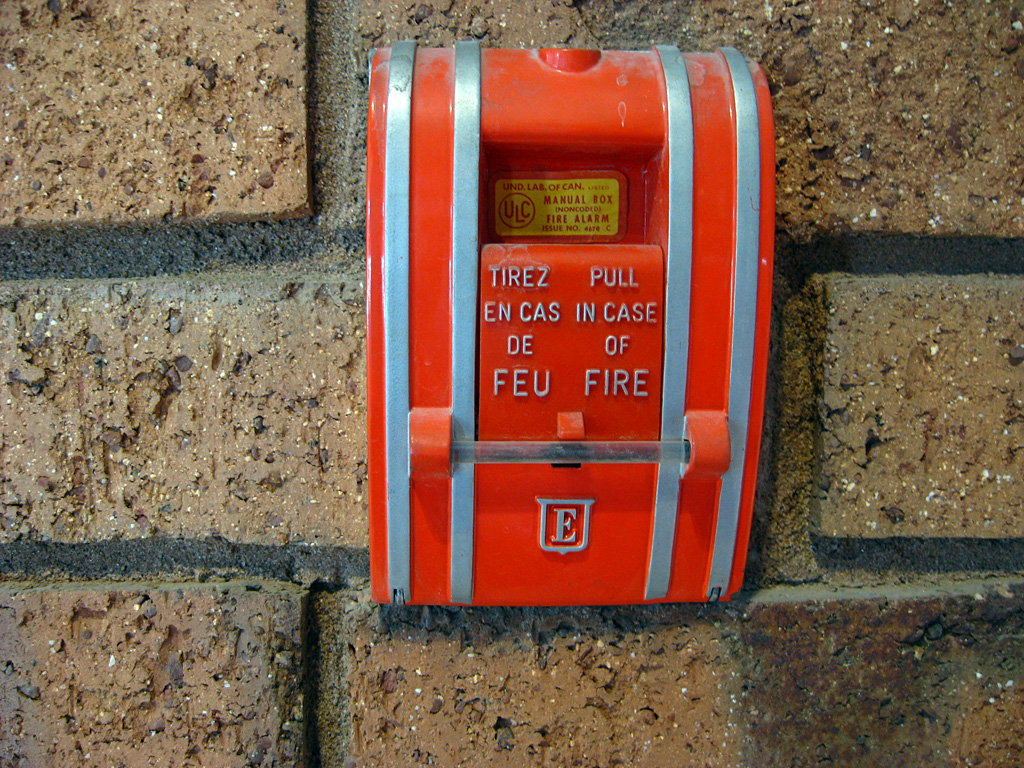
Fire alarm pull switch

One should always be cautious about noisy announcements regarding climate related technologies. The mainstream media is all-too-willing to repeat them without much investigation or consideration. That said, there is every likelihood that concern about climate change (and increasingly stringent regulations) will produce dramatic breakthroughs in climate relevant technologies. One area in which that could occur is in relation to carbon capture and storage. At present, this is quite an energy intensive process, largely because of the difficulty of separating CO2 from the other flue gasses being produced by a power plant or factory. Some new research suggests that zeolitic imidazolate frameworks could do this much more efficiently than the amine scrubbers currently being tested.

The authors suggest that these crystals could be and inexpensive and durable way to isolate CO2 for sequestration. Their central conclusions about the materials sound promising:

Members of a selection of these ZIFs (termed ZIF-68, ZIF-69, and ZIF-70) have high thermal stability (up to 390°C) and chemical stability in refluxing organic and aqueous media. Their frameworks have high porosity (with surface areas up to 1970 square meters per gram), and they exhibit unusual selectivity for CO2 capture from CO2/CO mixtures and extraordinary capacity for storing CO2: 1 liter of ZIF-69 can hold ~83 liters of CO2 at 273 kelvin under ambient pressure.

If so, they could help reduce the costs associated with installing and operating CCS equipment – a particular boon given the likelihood that coal use will remain a feature of many economies and some processes – like concrete manufacture – are extremely hard to decarbonize.

Comprehensive storage

Your average active computer user has more and more data. The first computer I effectively administered had 170 megabytes of hard disk space. Difficult choices had to be made about the relative merits of Doom versus Simcity. Now, just my primary email account has 1500 megabytes of data in it. I have 15 gigabytes worth of photos I have taken (all since 2005) and 20 gigabytes of music.

All this has been made possible by dramatically falling storage prices, combined with the spread of broadband internet. Soon, I expect that this combination will reach its logical conclusion. Right now, people are constrained by the size of their smallest hard drive, as well as by the difficulty of accessing larger remote drives. Eventually, I expect that most people will have a multi-terabyte disk connected to the internet at high speed and securely accessible from virtually any device in the world over the internet. The biggest question is whether this will be an ‘answering machine’ or a ‘voicemail’ solution.

The answering machine option is a big disk purchased by an individual consumer (perhaps a rack of disks, so that cheaper bigger ones can be added to the array as they become available). A company that made three things easy would have a license to print money. The first is integrated ease of use. iTunes music on the big disk should be immediately accessible from a person’s laptop or iPhone, provided they have internet access. The same should be true for saved television shows, photos, etc. The second is effortless backup. It is perfectly feasible to have a disk that is big enough to ensure that the failure of any one component does not lead to any loss of data. The third is security. The big disk should be secure enough against outside attack for use in storing commercially sensitive materials; likewise, the connection between outside devices and the disks should be secure. Probably, this means different levels of access for different sorts of devices, managed through a good user interface.

The voicemail option is to leave all the kit to someone else and just buy a service. Lots of companies are moving towards this model. In many ways, it’s a lot more efficient. Maintaining adequate but not excessive space for a million users is easier than doing the same thing for one; there are also economies of scale, since you can have specialists do all the technical work. The downsides of this model are mostly security related. You need to trust the service provider to keep your data safe. You also need to trust them not to apply arbitrary constraints on how you can use it, as Apple has sometimes done.

I predict that most people will use the second model exclusively, and will pay little or nothing to do so. More technically savvy people will run their own drives, but will probably use external services for (free) unencrypted or (subscription based) encrypted backup. Personally, I can’t wait. External hard drives have the feel of a 1980s solution, rather than one that is aware of the potential of the internet.

Technological options for mitigation

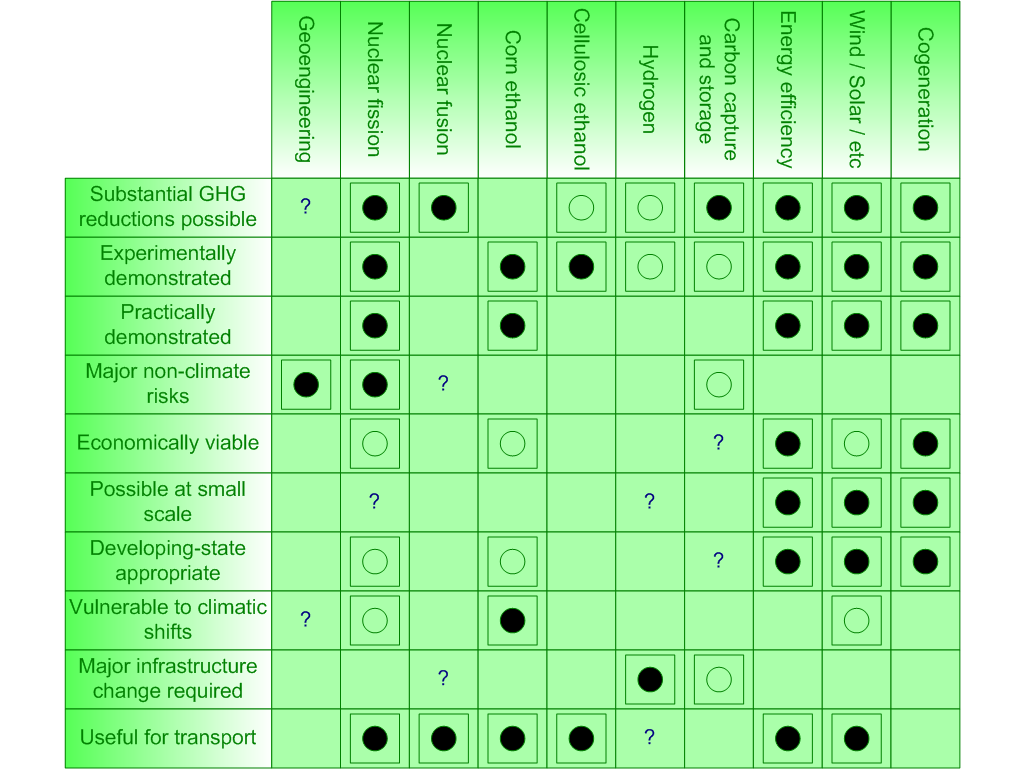
Climate change mitigation technologies

Black circles indicate a definite ‘yes,’ whereas hollow ones denote a partial ‘yes.’ For instance, it isn’t entirely clear whether nuclear fission can ever be economically viable in the absence of government subsidies. Empty squares denote a probable ‘no’ while question marks indicate situations too uncertain to render any judgment upon.

A few of these technologies are so speculative that it is hard to make a decision. That said, this is probably a relatively good summary of the state of the debate at the moment.

Impressions of some DS games

After about a month with a Nintendo DS, I feel capable of commenting on a few of the games, for the benefit of anyone who already has this excellent system or is considering buying one. For about $150, you can get a DS, a plug-in mod chip that lets you run downloaded software, and a micro-SD card to store that software on.

The Legend of Zelda: Phantom Hourglass: I was a big fan of A Link to the Past on the SNES, but never enjoyed any of the 3D Zelda games for other systems. The type of puzzles and combat in Zelda are just better suited to a 2D environment. As such, this game is a welcome return to that tradition. It also makes brilliant use of the distinctive hardware of the DS: almost completely (and very intuitively and engagingly) controlled using the touchscreen. Using the boomerang has never been so much fun. Like all Zelda games, it includes some dungeons too frustrating to finish without a walkthrough guide. Recommended strongly.

New Super Mario Bros. A good 2D platform game, in the spirit of Super Mario 3 and Super Mario World. Yoshi and flying are gone and some new powerups have been added. Basically what you would expect from a Mario game: recommended.

Metroid Prime Hunters: Frustrating to the point of being unplayable. 3D first person shooters just don’t work on this console. Get a SNES emulator and play Super Metroid instead.

Mario Kart DS: Exactly what you would expect from Mario Kart – virtually identical to every version on every platform since the NES. Recommended.

Advance Wars: Dual Strike: Turn-based strategy game with a fairly steep learning curve. While quite addictive, the game can be very frustrating if you haven’t cottoned on to the appropriate way to deal with any particular level. The dialogue is annoying and interminable, the soundtrack is a single track looped indefinitely, but the game is addictive and fun overall. There is also some nice artwork. Recommended.

Worms Open Warfare: Poorly adapted to the DS, based on how Worms is fundamentally horizontal and the DS screens are stacked vertically. The least fun version of Worms I have played on any platform.

Overall, I am really impressed with what the DS delivers for $100. I was initially attracted to the WiFi capability and possible use as a web browser and IM client. While possible, neither of those activities works well on this hardware. The absence of a keyboard makes both too frustrating, though the DS makes a decent RSS reader. Those shortfalls, however, are more than made up for by the high quality of the hardware and game design. Particularly for people with slow computers and no televisions, the DS is a gaming option to consider.

Law and morality

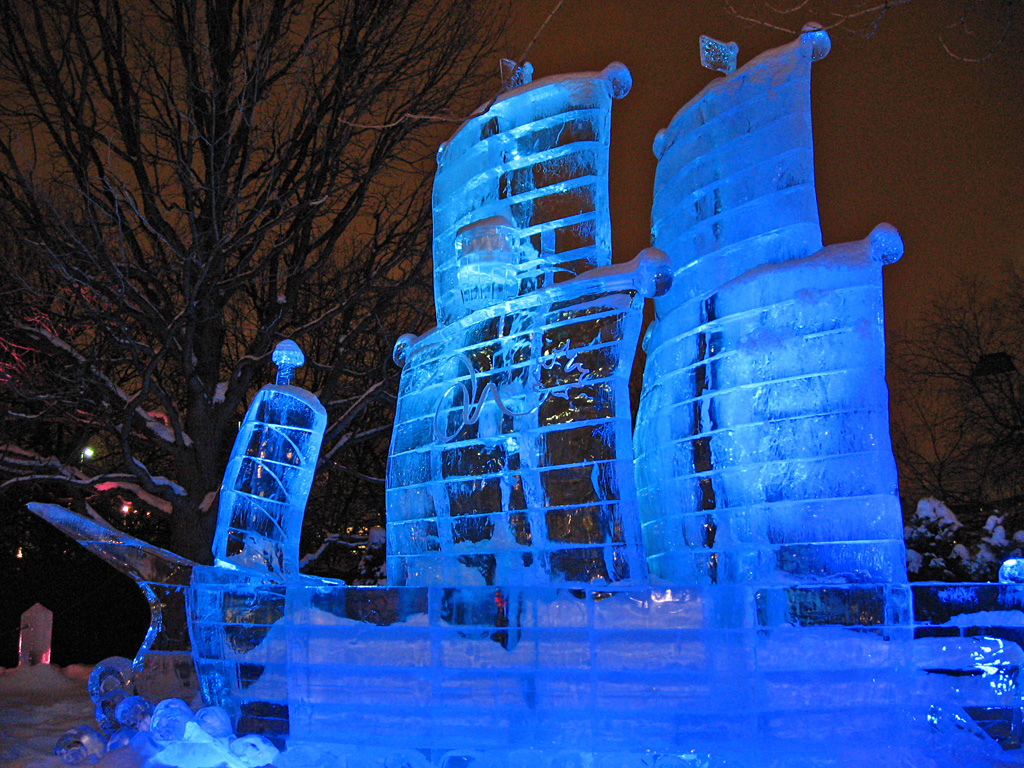
Tall ship ice sculpture at Winterlude, Ottawa

There is no fundamental connection between morality and law. Law derives from the combination of rules and the existence of an authority with the ability and will to enforce them, at least most of the time. Morality, by contrast, has to do with situations, the options available to individuals, and the likely consequences of possible actions.

It is possible to imagine cases in which particular actions are moral but not legal (riding in the section of the bus reserved for white people, despite being black in segregationist America or South Africa) as well as actions that are legal but not moral (clearcutting a huge swath of forest after buying a permit from a purely self-interested king). If you accept that it might be morally necessary to lie to a group of Nazi soldiers about where a group of Jewish children are hiding, you accept that it can sometimes be acceptable, or even laudable, to violate the laws that happen to exist in a certain state at a certain time. Simply following the law without evaluating its relation to morality makes a person no better than a secret police officer, mindlessly following orders to round people up to face uncertain fates.

Pragmatism isn’t a morally relevant quality, at least in and of itself. The fact that the state may punish you for breaking the law or failing to act as the law demands doesn’t have any moral force, one way or the other. The relationship between pragmatism, morality, and law is based around the pragmatic evaluation of the consequences of obeying or not obeying the law. Not obeying the law against arson is unlikely to have positive effects; ignoring the law against trespassing, when some important purpose compels the unapproved passage through someone else’s property, is likely to be defensible in many more cases.

Reasons why the law can be moral

In democratic societies, a good case can be made that the law is usually compatible with morality. Partly, this is the result of the democratic process, which includes some relatively good protections against the unjust domination of one group by another.

Sometimes, law is important because it provides clear guidelines and thus produces better overall outcomes. A good example is speed limits. We can agree pretty easily that there should be some limit, though people might disagree on what it is. It is safer and easier to choose a reasonable figure than to let everyone decide individually. Both domestically and internationally, law plays an important coordinating role. It keeps radio stations from interfering the the transponders of aircraft and ensures that one’s laptop can be plugged into any properly functioning electrical outlet in the state.

At a higher level of abstraction, law is important for reconciling divergent moral perspectives: say, one that sees it as unacceptable to portray Mohammed visually and another that has no such qualms. Particularly within a democratic system, law plays a vital role in creating the boundaries within which we can make demands of one another. For instance, I may have no right to demand that you remove a religious symbol from your car or home, but perhaps I can if it is on your desk as a judge or police interrogator. Exactly how this balance is struck is difficult to manage, and it is likely that multiple acceptable options exist. Reaching one of those options, however, depends on engaging with the law, rather than simply accepting the present form at face value.

Reasons to disobey law

There are two major reasons to disobey the law: because it is unjust, or because there is an ongoing emergency.

Refusing to turn up for duty when drafted to serve in an illegal war could be an example of the former. So could sharing a bottle of wine at dinner, while camping in a public park. In each case, an individual evaluation is made about the appropriateness of the existing rule to the present situation. If a compelling case can be made that the rule is harmful or irrelevant, it is sensible for thinking people to disregard it. Civil disobedience goes a bit further, since people go beyond breaking a law to activity and openly demonstrating the breach. This too can be a moral action, if it calls public attention to the injustice of an existing law, or the importance of some competing claim.

Breaking the law in emergencies is relatively uncontroversial. A sixteen-year-old who violates the terms of a learner’s license by driving a dying relative to the hospital is breaking the law in an entirely excusable way. This is recognized in the common law through the defence of necessity. One of the better features of the common law system, it is an overt recognition that law exists to serve the majority of cases, and will fail to produce good results when applied directly in some circumstances.

A duty of evaluation

In the end, the sensible position to take is accepting that in most places, most laws have a sensible reason for existing. That does not, however, absolve individuals of the duty to consider the circumstances in which they find themselves and the appropriateness of acting in one way or another, on the basis of what they reasonably expect the outcome of their actions to be. The alternative is a nation of unthinking robots, following rules that may be well balanced and wise – or arbitrary and viscious – with no more contemplation or personal responsibility than a missile launched by the state at a target that looked unfriendly to the rulers.