Positive externalities and the environment

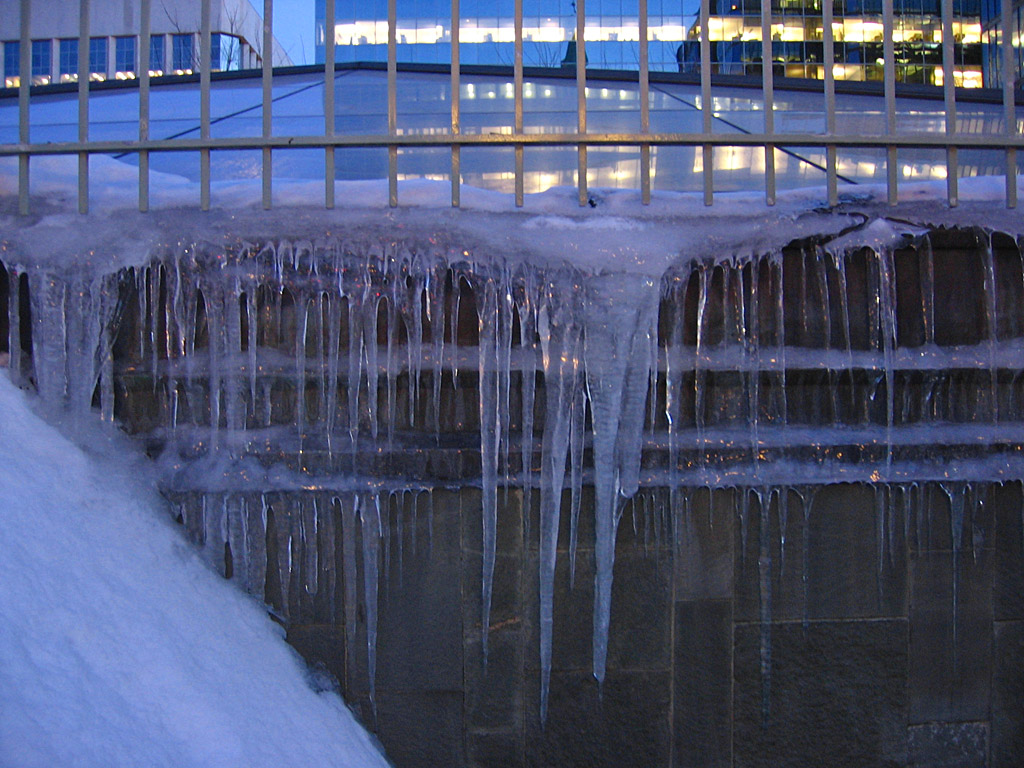
Icicles in Ottawa

When you see “environment” and “externality” in the same sentence, it is a safe bet that the issue being discussed is negative externalities associated with production or consumption. These are certainly critical, but they are not the only area in which environmental thought and economic theory on externalities intersect. The positive externalities associated with new technologies also bear consideration. When a firm or individual invents something that provides major overall benefits, many of those will accrue to other people. This is good from the perspective of those able to benefit from the new technologies, but it is theoretically bad for innovation overall. If I suspect that most of the gains for my new engine, battery, or vaccine technology will accrue to other people, I will not devote as much of my time and resources to developing such innovations as I would if I believed I would personally get all the benefits.

As with intellectual property rights in general, the issue of balance here is a critical and difficult one. We want to encourage people to design and build better solar cells, wind turbines, and power plants. They could arguably be best encouraged to do so by giving them extensive property rights over what they come up with: lengthy patents and the right to collect royalties from all users. That said, such a restrictive system could sharply limit distribution. Once we have a good technology, we want to see it widely deployed – including in places where people have urgent sustenance needs and cannot be fairly called upon to pay heavy royalty fees.

One established way to square this circle is with prizes. The X-Prize assisted the development of (highly greenhouse gas intensive) private space technology. Prizes may also be used successfully to encourage the development of vaccines and treatments for poor world diseases like malaria. Richard Branson has created a prize for straight-out-of-the-air carbon capture. A few big prizes for things like lowering the cost and efficiency of renewable power sources might help to overcome institutional hesitation within innovative firms, as well as get some clever people tinkering in their garages.

The existence of positive externalities associated with new technology also provides strong justification for other governmental interventions: including direct government research and governmental support for private and academic efforts. Internalizing the full costs of pollution is exceedingly important if we aim to achieve environmental protection within a free market system; internalizing the benefits of innovation may also help to bring that about.

For a much more detailed discussion, see: Jaffee, Adam et al. “A tale of two market failures: Technology and environmental policy.” Ecological Economics. Volume 54, Issues 2-3, 1 August 2005, Pages 164-174.


My dislike of taxis

I need to be deep in Gatineau relatively early tomorrow morning for a training session. Given that I do not want to walk ten kilometres through unfamiliar terrain and the first bus that goes to this place arrives after the session begins, it seems I have no choice but to take a cab – something I generally only do in situations where it is essentially unavoidable.

I dislike almost everything about taxis: the fact that they are cars, the ‘back of a police car’ feeling of riding in one, the fact they that so sharply privilege convenience over efficiency or cost, and the barbershop awkwardness of having to share a vehicle with a stranger from whom you are buying a necessary service that makes you anxious and unhappy.

At least I will be able to take the bus home in the evening.

Another climatic threat: jökulhlaups

Canada’s Parliament with Christmas lights

In some parts of the world, large lakes are bounded by natural dams made of glacial ice. When the ice melts, the resulting surges of water are comparable in effect to the failure of human-made dams. Merzbacher Lake, in Kyrgyzstan, has completely emptied 39 times, following such events. An article in Geophysical Research Letters describes that lake in greater detail.

Significant past examples of such glacial lake outbursts occurred in Iceland, Alaska, Canada, and Bhutan. While relatively few areas are threatened by such events, they are demonstrative of the kind of change that is ongoing in the cryosphere.

Tsho Rolpa, a glacial lake in Nepal, seems to be due for such an event. It is 4580m above sea level and dammed by 150m of ice. The melting of the Trakarding Glacier is feeding the growth of the lake, which will eventually breach the ice wall in a highly dramatic manner. Local communities have been building raised watchtowers and shoring up embankments. Tsho Rolpa is one of 2,323 glacial lakes in the Nepalese Himalayas.

The eradication of smallpox

On this day in 1979, the World Health Organization certified that smallpox had been eliminated from the wild. It was probably the only intentional extinction in human history, and it was a considerable boon to the human race. The disease is an atrocious one, and it took a heavy toll across history. Notably, it caused much of the death associated with the arrival of Europeans in North America.

The extinction raises a number of questions. One is whether it will ever be repeated. We came close with polio. Very few people would mourn the elimination of tuberculosis, malaria, or AIDS. Worldwide eradication requires global coordination – something very hard to bring about when territories exist outside the control of any state. Think of the tribal areas bordering Pakistan and Afghanistan.

Another issue has to do with smallpox itself. It was horrifically destructive to the First Nations because they lacked any of the immunity conferred by prior exposure. Now, the whole world is in essentially the same boat. An intentional or accidental release of the weaponized smallpox produced by many states could thus cause of devastating global pandemic. It rather makes one wish we had never turned it into a weapon in the first place.

Boomtowns and bitumen

Haida sculpture

Since 1999, the population of Fort McMurray has nearly doubled. Primarily, this is on account of the oil sands: unconventional petroleum reserves whose exploitation is being driven by high prices and geopolitics. The demand for labour is dramatically increasing its price, both directly and indirectly. Apparently, inexperienced truck drivers can expect to make $100,000 per year. Shell has also just opened a 2,500 unit housing complex for its oil sands employees, part of their $12 billion in local infrastructure spending.

With oil around $90 a barrel and the atmosphere still being treated as a carbon dump, this is not terribly surprising. That said, such projects are certain to develop increasing momentum of their own. Once they bring enough jobs and money, they are hard for a provincial government to not support – especially if many of the environmental costs are being borne by people outside the province or by future generations. Internalizing environmental externalities through taxation or regulation becomes progressively more difficult as the incentive of certain parties to preserve the status quo increases. Such asymmetries are likely to give oil sands development a harmful legacy in terms of general policy development, in addition to its climate change effect and local environmental impacts.

Materialism

The terms ‘materialism’ and ‘materialist’ seem to be popularly misunderstood. As such, it bears mentioning that there are two wildly different interpretations of what these terms mean.

Perhaps the more common interpretation is based around a desire for material possessions. In this view, a ‘materialist’ is someone who continually wants to own more things.

A much more interesting definition holds that being a ‘materialist’ means that you believe everything in the universe is made of comprehensible materials, interacting with each other on the basis of laws we can understand. This viewpoint definitely raises important questions in philosophy – and potentially lethal ones in theology – it is also much more worthy of consideration than the fact that neighbour X might want a bigger car than neighbour Y.

Meat and antibiotics

Portraits in Ottawa

Quite a while ago, I wrote about connections between human disease and the factory farming of animals. Recently, some new observational data has supported the link between the two. In the Netherlands, a new form of the superbug MRSA has emerged. It is strongly resistant to treatment with tetracycline antibiotics: a variety heavily used on livestock. The animals need the drugs because they are kept in such appalling conditions (unhygienic and constrained) that they would get infections too easily otherwise.

Xander Huijsdens and Albert de Neeling found that 39% of pigs and 81% of pig farms in the Netherlands were hosts to the potentially lethal antibiotic resistant bacteria. People who came into contact with pigs were 12 times more likely to contract this form of MRSA than members of the ordinary population; those who come into contact with cattle are 20 times more susceptible. The strain has since been found in Denmark, France, and Singapore. A study conducted by the University of Guelph found the strain in 25% of local pigs and 20% of pig farmers.

Maintaining the effectiveness of antibiotics for the treatment of people is highly important for human welfare. Antibiotics are one of the major reasons why modern medicine is valuable: they help people die dramatically less often after childbirth and surgery than was the case before their development. They have also helped to make diseases that would formerly have been probable death sentences treatable. The fact that we are allowing farms to deplete their value so that they can produce meat more cheaply (by forcing more animals closer together in less clean conditions) seems profoundly unwise. In Pennsylvania, legislators have even banned farmers who produce hormone and antibiotic milk from saying so on their packaging – on the grounds that it would make consumers unduly worried about the other milk on offer.

200 million pieces of Pi

Pi – the ratio of the circumference of a circle to its diameter – is an irrational number, meaning its decimal expansion never ends or repeats. As such, it could never be written out in full. If Pi is also a normal number, roughly meaning that the value of an arbitrary digit is random, an interesting property arises. Specifically, that every possible string of digits will be located in it somewhere. Given that any text can be perfectly converted into a number and any image or sound can be very well approximated by a number, this means that every possible written document, painting, photograph, symphony, and lecture can conceivably be located somewhere within that endless string of digits.

Quite a while ago, I had the idea that you could refer to any information in terms of a ‘Pi address’ – where to look within Pi to find the desired data. It would work for anything from the newest Tori Amos album to the first edition of the Oxford English Dictionary. The biggest problem is that the address would, in most cases, require more storage space than the actual data.

This website proves the point by letting you search the first 200 million digits of Pi for any string you want. My birthday begins at digit 196,469,286; my office phone number begins at digit 124,573,291. Because it is mathematically possible to calculate Pi from any arbitrary decimal place, it isn’t necessary to find all the prior digits to convert those back into the numbers they represent. That said, for large pieces of data (like the book and album mentioned), the Pi address would almost certainly be a lot longer than a data file containing the entire work. Pi addresses may not be a good way to refer to information, though they do provide a relatively dramatic perspective on the nature of infinity.

Passionate Minds

Billboard advertising nuclear power

I started Passionate Minds: The Great Love Affair of the Enlightenment, Featuring the Scientist Émilie du Châtelet, the Poet Voltaire, Sword Fights, Book Burnings, Assorted Kings, Seditious Verse, and the Birth of the Modern World with high hopes. It promised science, literature, and history in an accessible package. That promise is only partially realized. While the book does reveal some of the most remarkable (and the most flawed) characteristics of both Voltaire and du Châtelet, it sometimes makes claims that stretch the evidence provided. Often, the book simply asserts things rather than seeking to prove them.

Bodanis’ central thesis – that Émilie du Châtelet has been given insufficient historical attention – is fairly robust. Clearly, hers was an extraordinary life: born into nobility, but driven towards science and the sometimes hapless literary life of Voltaire instead of occupying a more traditional position in the Court. At times, the book demonstrates startling contrasts between the way of life at the time and the present. This is especially true of the marriages: purely political and economic unions in which years of habitation with a prominent lover were apparently not too exceptional. When a court rival attacks Voltaire through a lawsuit, her husband comes to his defence – despite how Voltaire has been living with his wife for years and they are a highly prominent couple.

In the end, the book would have been better if it had focused less on intrigue and more on what significant scientific contributions du Châtelet actually made. Saying that “[m]ore technical aspects of her work played a great role in energizing the French school of theoretical physics, associated with Lagrande and Laplace” isn’t a very convincing way of showing historical importance. Likewise, the assertion that “[t]he use of the square of the speed of light, c2, in Einstein’s most famous equation, E=mc2 is directly traceable to her work” is never adequately argued.

The book does an excellent job of describing how atrocious the medicine of the time was, contributing to du Châtelet’s own relatively early death in childbirth. It also relates some fascinating historical episodes in an engaging way: for instance, the rigged lottery through which Voltaire made his fortune.

A book about du Châtelet written by someone with more of a focus on studying and explaining science would be a better tribute to the woman than this interesting yet flawed volume.