Socially dedicated days

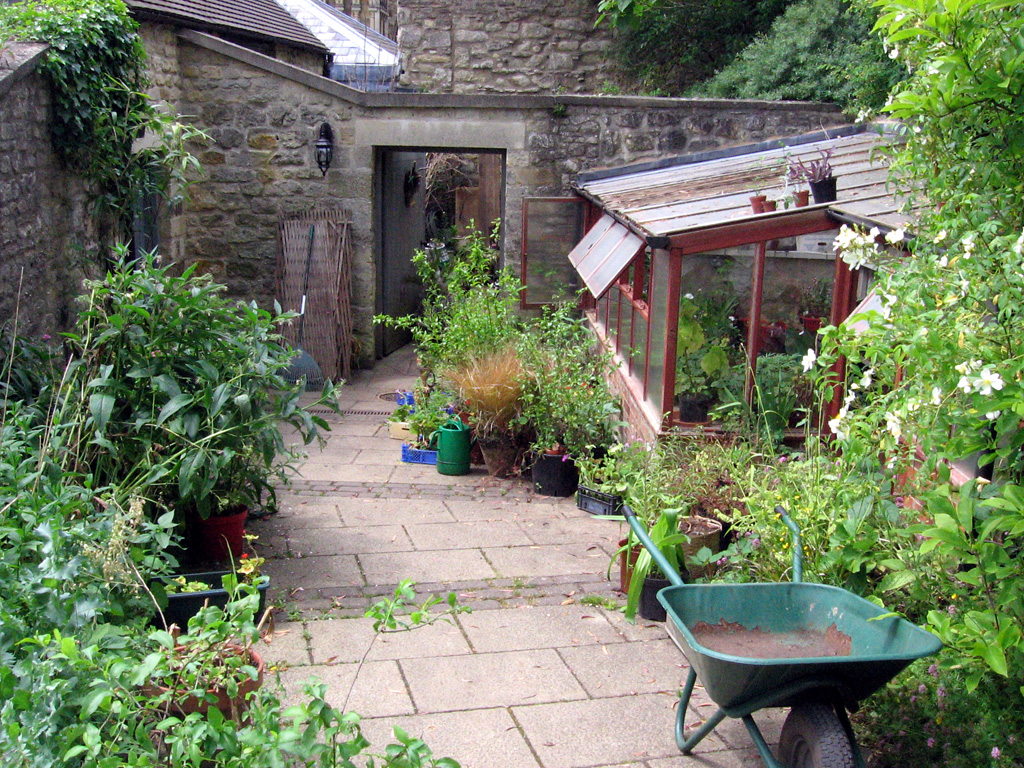
Corpus Christi Gardens

With so many friends on the cusp of zipping off in all directions, I’ve been doing my best to spend time with people this week. Thus far, it is going even better than might have been anticipated – despite limited academic progress. There will be plenty of time for papers after the exodus, after all.

For a few hours this morning, I was giving a tour of Oxford to Diarmuid Torney: a young man who will be part of next year’s M.Phil in IR class. It was especially gratifying to have the chance to impart a few useful bits of information in a way I wish had been done for me. Essential sandwich shops, pubs, libraries, and individuals were pointed out.

Tonight, there is an end-of-year party for the M.Phil group, followed by the annual lecture for the Global Economic Governance Program. Tomorrow evening, there is a garden party in Wadham. I wish my bike was operable for transport between them, but the seat remains resolutely stolen.

I really need to find people who want to accompany me on my putative European trips; ticket prices are rising quickly.

[Update] Lest I contribute to any confusion, my belief that the IR party was tonight was the product of a bad piece of intel. Sorry. There are also no WMD in the Manor Road Building.

(CR: Somno) Continue reading “Socially dedicated days”

Work cut out for me

As of this afternoon, at least I can say that I have decided on the topics for my last three papers of this year. Together, they should be about 9000 words and based on me reading at least six books, plus articles and individual chapters.

  1. What impact did the ending of the overseas colonial empires have on the nature and conduct of international relations? Have subsequent wars been consequences of decolonisation?
  2. What are the causes of the Arab-Israeli conflict and why has it proved so resistant to resolution?
  3. How has the international trade regime come to encompass ‘beyond the border’ issues – such as human rights and the environment? What does this imply for developed and developing countries?

At present, Dr. Hurrell seems more focused on preparing for a trip and a grant proposal than on pressing me to finish these. That’s both a blessing, because it takes pressure off during the time that will be my last chance to see many friends this year, and a curse, because it draws out this term into what would otherwise be the summer.

A few properly tottering stacks of books around the room should be a good source of motivation.

A mystery

In my mail this morning, I found a roll of Fuji Velvia 100, a voucher for processing, and an invoice for about eleven quid. It’s all from a place called 7dayshop.com, in Guernsey. From the slip, it’s unclear whether the invoice is a bill that demands payment or simply a receipt for payment made.

I am as sure as sure can be that I didn’t order any such thing. I have stopped shooting film entirely in the UK and, if I were to start, I would almost certainly use T-Max or HD400. It seems at least possible that someone sent this as a gift. If so, please let me know before I call them curiously and accuse them of sending unsolicited transparency film. Likewise, if so, thanks for sending me such an excellent variety of film.

Thanks for your help.

[Update: 4:04pm] The mystery is solved; see comments.

In which Milan’s dislike of team sports is discussed

World Cup watching

For what I think was the first time in my life, I watched a portion of a televised soccer (football) match tonight: Poland versus Germany, as seen in the Saint Antony’s Bar. As a North American, I associate soccer with dreary mornings where children from ages of about ten to maybe seventeen or eighteen play while parents look on. My own soccer experiences were absolutely miserable – even worse than baseball, which I really despised. My experiences with coaches were all mutually hostile, while the ones with fellow players ranged from hostile to genuinely abusive. Soccer was as bad as the Cub Scouts. This has contributed to my general underlying conviction that team athletes are goons. It’s a conviction well reinforced by my spate of unfortunate incidents involving hockey playing roommates.

My natural response to being an obvious outsider in the team sports environment was to defy the lot of them, rather than try to conform. Of course, that is exactly the strategy that will maximize mutual hatred and cement a lifetime of resentment and barely suppressed anger about the whole experience. While I am absolutely certain most people playing team sports are decent people, I have the same kind of fear of them as I have of dogs, after being bitten several times as a paperboy.

Watching the match was interesting far more on sociological than athletic grounds. There was a small but noisome cadre of Poland fans, surrounded by many more people cheering (very softly) for Germany. By the time of the German victory at the end, they had become overt enough to make me pretty nervous. Since I find the whole concept of sport to be vaguely distasteful and unsettling, I suppose that’s not surprising. Even so, I suspect I will see bits of at least a few more matches before the World Cup has ended. I did manage to learn to enjoy Olympic hockey – at least when Canada was playing – so perhaps I am not entirely hopeless.

PS. With two days left in the semi-final of the video contest, please keep voting for Mica. Of course, once he gets to the final, I will be kicking up the publicity a bit.

First eBay sale

I’ve joined the ranks of those who have at least listed an item on eBay. In this case, it’s the Sony headphones that I want to sell in order to get money for a snazzier pair. These are brand new and in the original packaging.

I may have set the minimum bid a bit high, but you can’t set a reserve price under £50 and I’m really not willing to sell these for less than £15 after spending almost £25 on them. In any case, we will see how this experiment in commerce goes.

[Update: 21 June 2006] With exactly 12 seconds left in the auction, someone placed a bid. Looks like I am offloading these headphones for £15 plus the cost of shipping.

The economics of it all:

Price initially paid on Amazon: £25.66 C$53.01

Payment received from eBay: £15.00 C$30.99
Shipping fee from eBay: £2.00 C$4.13

eBay listing fee: £1.29 C$2.68
PayPal currency fee: £0.86 C$1.77
Cost of packaging: £0.49 C$1.01
Cost of shipping: £0.68 C$1.40
Net eBay income: £13.68 C$28.26

Amazon cost – eBay income: -£11.98 -C$24.75

In the end, choosing to buy these headphones cost me about twenty-five bucks for three months’ usage. Let’s hope the ones I choose to replace them with last much longer.

Not quite the Guggenheim

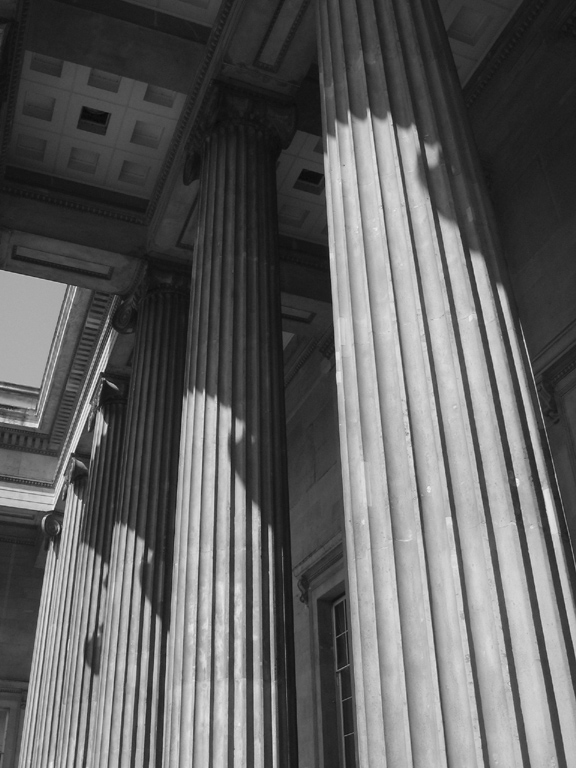
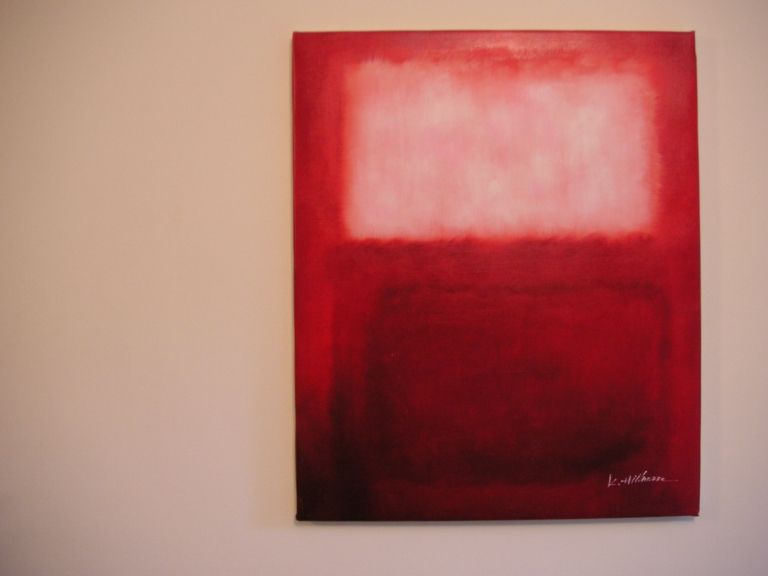
Columns outside the British MuseumYesterday, before the Strategic Studies dinner, I made my second ever purchase of original art of the ‘hang on the wall variety.’ It’s a moderately good imitation Rothko oil on canvas painting, which I bought for less than ten quid from someone leaving the country. Friends from Vancouver might remember the pastel on paper head that was my first such purchase. I bought him from Kate’s friend Neal Rockwell in Victoria for $10 about seven years ago. It accompanied me through living in Totem Park and Fairview Crescent: always glaring outwards with these shocking eyes that I nonetheless found fascinating enough to never regret buying the thing or having it around. I felt a real affinity with that haunted figure.

By comparison, this 50x60cm rectangle of differing reds with a white rectangle near the top is much less interesting. While it definitely beats the blank – and somewhat battered – wall that it is now covering, Antonia and I both noticed upon hanging it that it somewhat resembles a video iPod in proportions: with the upper white rectangle corresponding to the screen. Probably, it will take me a while to reach a comprehensive and final judgment. Like music, I can tell immediately if there is the possibility that I will really like it, but it takes me at least a week to determine if I actually do.

Morality of Kosovo-style wars

This afternoon, I saw Henry Shue give a talk for the Changing Character of War Program on ethics and the targeting of civilian infrastructure – such as power plants – during wartime. While I am sure he put a lot of thought into it, it was not ultimately convincing. Largely overlooked were a number of key factors.

His basic argument was that states can behave morally by leaving enough infrastructure, such as electrical power, to maintain the basic needs of the civilian population. If the state starts with twenty power plants – and it takes three to run basic hospital services, water treatment, and the like – you can morally bomb seventeen, but not eighteen, of them. Even if the enemy state then uses that remaining capacity for military purposes, the moral responsibility of the first state to not imperil large numbers of civilians will be upheld.

The first problem with this is that the re-tasking of such capacity to military purposes is very predictable. In the US, Canada, and UK there was extensive rationing during the second world war. While it didn’t put anyone into a state of desperate privation, that is reflective of the fact that it wasn’t necessary to make such cuts. I am sure people died in the Soviet Union because resources were directed towards the war effort instead. If a state knows that the capacity they leave will be thus re-tasked, how is that morally different from destroying it, from the perspective of protecting civilians? How responsible are states for immoral actions taken by others, but prompted by their own actions and predictable in occurrence? Human security isn’t meant to be about whether the attacking state is blameless or not; it is meant to be about maintaining the lives and human rights of people in general. As a teleological objective, it’s hard to see how such a simple deontological moral axiom holds.

Also, there is the question of what the moral difference is between a civilian noncombatant and someone who has been forcefully drafted. Why is blowing up an apartment block worse than blowing up a barracks full of teenage conscripts? Likewise, there is the matter of how the purposes for which things like power plants are being used can be determined.

Dr. Shue’s analysis did raise and try to address many of these questions, but did not do so in a comprehensive or forceful way. I suspect a more complete answer would require the rejection of some of the rationalist assumptions that underlay his whole analysis. He assumed, for instance, that citizens could choose freely to support their government or not. Likewise, he didn’t give any special consideration to the psychologies of warfare: an element that would need to be included in a normative theory with real-world applicability.

The degree to which such questions are really engaging makes me feel as though I should take his normative theory optional paper next year. It might lead to some excellent discussions.

PS. The talk also reminded me of one of the reasons I thought the Spider Man films were so bad. At one point, Spidey is offered the choice between saving his love interest or a whole tram full of civilians: a real moral dilemma. Instead of having to actually give him such a difficult moral choice – akin to choices made by powerful people and organizations all the time – the filmmakers allow him to use his super powers to save both. Such cop outs, when it comes to grappling with ethical questions, serve no good purpose.

From academic discourse to fistcuffsmanship

Wadham College Gardens

Tonight’s supervision went really well. Dr. Hurrell seemed unusually positive about my essay, and the conversation was engaging and useful. Afterwards, I spent a few hours with a group of Wadham students. At first, we were in Wadham’s Ho Chi Hinh Quad, before moving to the King’s Arms. There, some disagreement seemed to nearly lead to a brawl, so I cycled home. With a seminar at 11:00am tomorrow, it seemed wise.

I still owe Dr. Hurrell three papers, but I can console myself with the knowledge of seeing Antonia at OUSSG tomorrow, then having dinner with Claire on Wednesday, meeting lunch with Bilyana on Thursday, and possibly meeting Roz on Thursday night. It’s great to be seeing so many friends before they leave for the summer: Claire to New York, Roz to Rome, etc. The Wadham Library also got a book that is fairly essential to my thesis today; it is already secured in my backpack.

That clothe The Weald and reach the sky

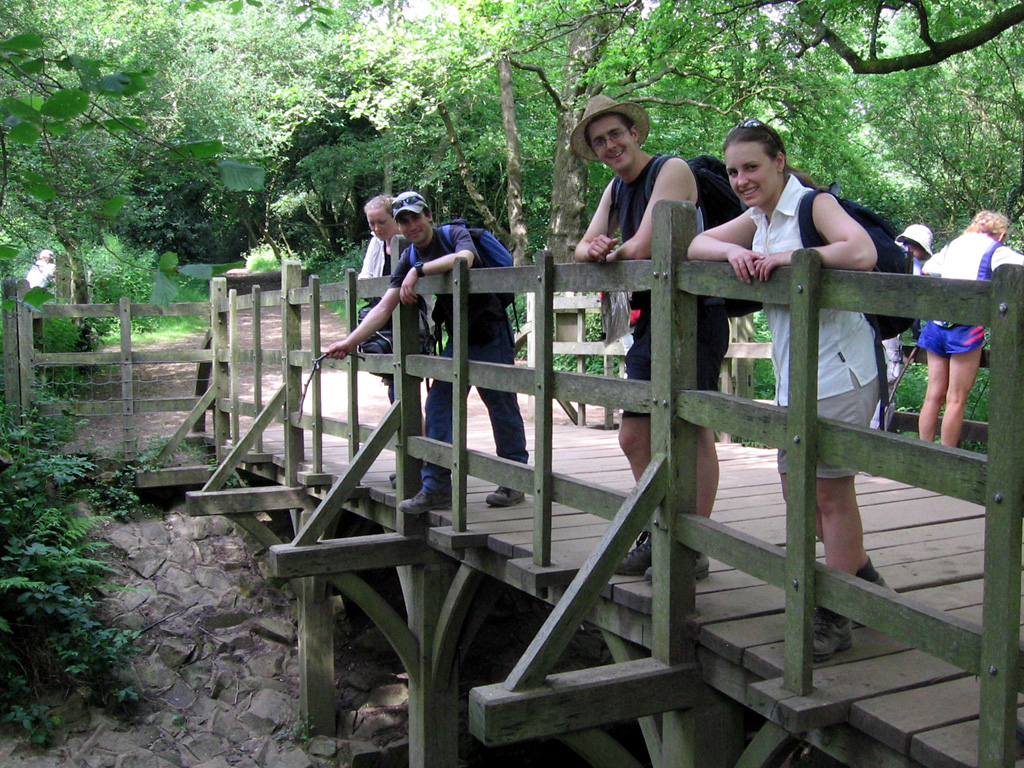
Pooh Sticks Bridge

Like so much else, the walking trip in The Weald was primarily a good mechanism for meeting new people. All told, fourteen people were part of the expedition. Something about rambling seems to attract people of a scientific or technical bent. I had long conversations during the five hour walk about mettalurgy, the GPS system, the manufacture of large organic molecules for pharmaceuticals, computer programming, fisheries, and the HIV fighting potential of a certain molecule that comes from sea fans. It was definitely a group of people I’d like to spend more time with. One even lent me the new Milan Kundera novel: Immortality.

The walk took place in and around the inspiration for A.A. Milne’s 100 Acre Wood, of Winnie the Pooh fame – though the terrain dates back to the establishment of a hunting park following the Norman Conquest. Marked features were low verdant hills, and idyllic stands of deciduous trees around small creeks. Throughout the hike (and the 2.5 hour minibus trips both ways), the sun was intense enough to make me fear that I will rosy tomorrow, despite the use of sunscreen and my wide-brimmed canoeing hat. I have an obvious watch tan.

Particularly appealing is the prospect of doing a trip to the Lake District with this group. I’ve been told that it’s an essential place to see, and to do so with such an obviously qualified and interesting sect is a welcome thing to contemplate. There is much about fit young scientists that appeals to me. Likewise, places of natural beauty that includes mountains.

After three days of devoted walking in the hot sun, followed by little sleep, my muscles are all clenched up and aching. I may allow myself to sleep in a bit tomorrow, before scrambling to come up with an excuse for Dr. Hurrell, explaining why I don’t have a paper for him. Given that we still have an undiscussed one to cover, he shouldn’t be too harsh on me.

PS. While walking to and from the rendezvous for the hike, I gave my first listen-through to Fox Confessor Brings the Flood. Some of the songs I can already tell are superb.

PPS. Being way too busy to read emails or blog posts is a novel and not entirely unwelcome experience. I feel like I’ve had a miniature vacation, right in the middle of an Oxford term.

London Gallery Tour

Antonia outside the Tate Modern

The primary focus of my trip to London with Antonia was art galleries. We saw sculpture in Canada House, off Trafalgar Square. We saw paintings in the National Gallery, National Portrait Gallery, and Tate Modern; also, photography in the National Theatre and additional sculpture in other places. Seeing art with a clever and interested fellow observer is wonderful for offsetting the overwhelming character of a place like any of the museums listed above. When that other person is also well versed in historical and mythological iconography, it is even more welcome. When you have dozens of original Dalis, Kandinskys, and Picassos strewn about, it can be hard to maintain focus.

Developing focus in the first place is hard when you need to wake up at 5:45am. As a reward, we were at the British Museum just in time for its opening. Right now, there is a fascinating temporary exhibit on Arabic calligraphy and artwork. Some of the material included is really superb; I especially enjoyed some of the examples where Asiatic kinds of calligraphy and Arabic lettering had been forged into elegant hybrids. Before leaving the British Museum, we also took a guided tour of the Islamic World section, as well as wandering on our own through the North American, Central American (where many of the sculptures have superb facial expression), and ancient British Isles areas. As always, the central atrium – installed sometime before my first visit in 2001 – is a striking piece of artwork in its own right, much like the turbine room in the Tate Modern. I love the elation and sense of safety I feel when enclosed in huge open-air geometric spaces.

Atrium of the British Museum

After walking through Soho and Chinatown, Antonia and I arrived in Trafalgar Square. After a perfunctory security check, we were allowed into Canada House, though sadly not invited to the wine reception that was being prepared. Instead, I got around to finally registering as a Canadian national living in the UK and we had a look at some of the Canadian stone sculpture that was on display.

Words and shapes

I really should dig through all the collected brochures to attach names to these descriptions, but I have neither the time nor the energy just now. Perhaps in future sittings.

Also at Trafalgar Square (aside from a version of Nelson’s column covered with scaffolding for repair, with the scaffolding decorated with sea life as a warning about global warming) are the National Gallery and National Portrait Gallery. At the first, we saw a terrifically frightening dragon that I am hoping Antonia will identify in a comment. All efforts at photography there were quite effectively thwarted. As has generally been the case, the National Portrait Gallery was an illustration of how few British authors, politicians, and public figures I have heard of. They lack a portrait of Douglas Adams: an oversight that really must be rectified.

The London Eye

Between that and the next art viewing (at the National Theatre), we met with two sets of Antonia’s friends – the first a friend from ancient schooldays and the second the kind gentleman who put a roof over my head for the unplanned overnight stay. At the National Theatre, we saw an exhibition of the top photojournalistic images of the year. Some were extremely good – particularly a portrait of Kofi Annan that makes superb use of contrast, composition, and dynamic range. Many were exceptionally gruesome, as I suspect is not unusual for such compositions.

Delicious pizza

After pizza-walking-sleep-wake-shower, the next day proceeded to the Tate Modern via a picnic. From National Theatre to Antonia’s friend Jong’s house was one long arc with the Gherkin as the central point. The return trip to the Tate Modern was essentially the converse. Since the recent major re-hang, I don’t entirely have my bearings in that fascinating place. As such, every return visit has the feel of rediscovery to it, much as I lament the fact that Hepworth’s Pelagos has been relocated to Cornwall. There, we met another friend of Antonia’s who is on the Tate staff related to planning and executing activities for children and families. A great way to be initiated into such a wonderful collection of art, no doubt.

My thanks to Antonia for the company that was the highlight of the trip, and to Jong who was kind enough to accompany us for a long while, and house us as well.

I would write more, but I need to get to sleep. It’s another 6:00am reveille tomorrow.