Arctic sea ice, in the midst of re-freezing

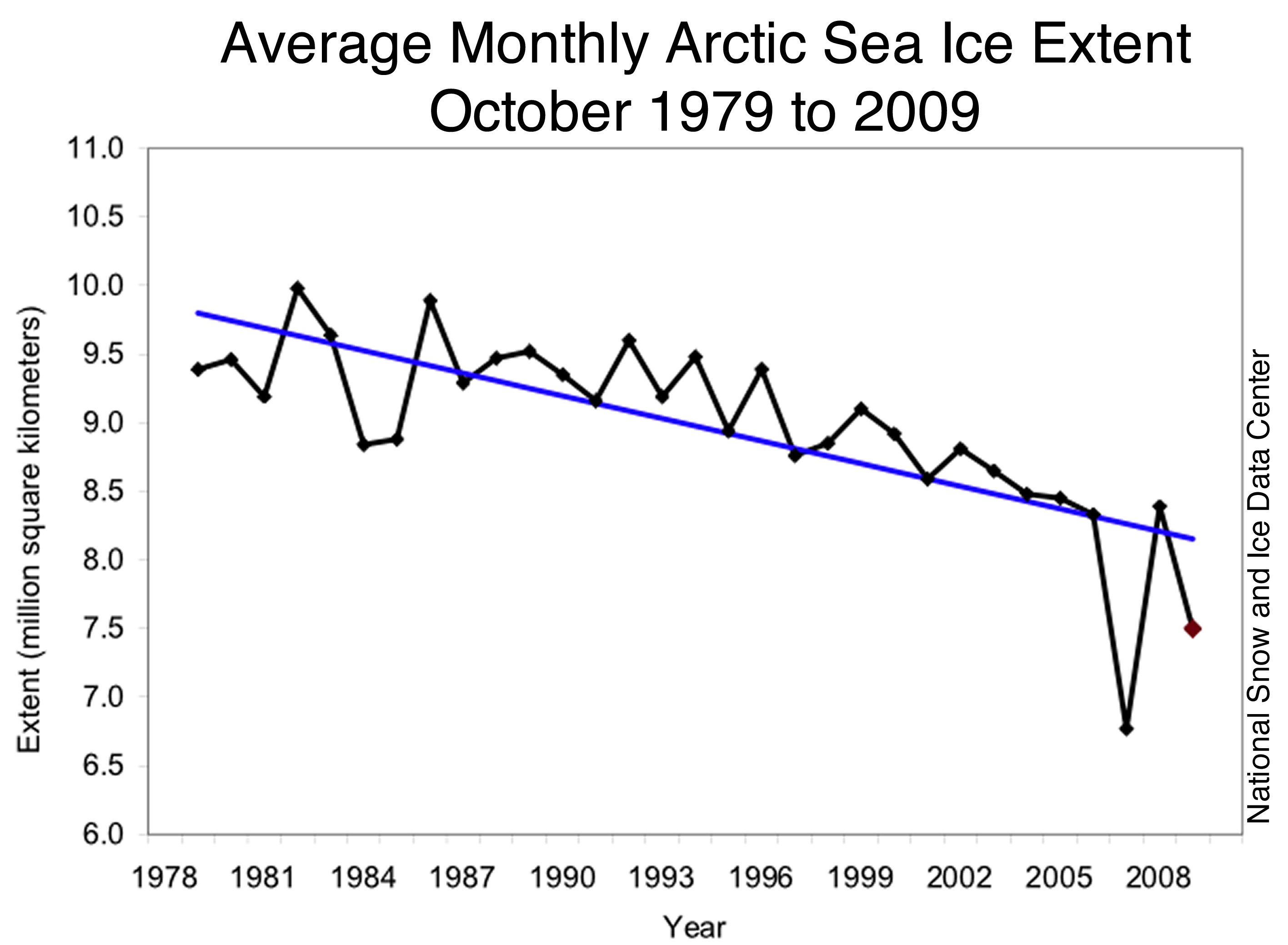
While 2007 retains the record for the lowest observed mimumum summer Arctic sea ice extent, the level right now is the lowest ever observed for this time of year:

Arctic sea ice extent, 9 November 2009

The US National Snow and Ice Data Centre explains the situation with reference to strong winds: “the growth rate slowed for a time in early October, coinciding with strong winds from the south over central Siberia. The winds helped prevent ice from forming along the Siberian coast. At the end of the month, extensive areas of open water regions were still present in the northernmost North Atlantic, and north of Alaska. The ice edge was north of both Svalbard and Franz Josef Land.”

The year-on-year trend, going back more than 30 years, shows that fall ice has been progressively less extensive. Note that, at Canada’s northernmost permanent settlement nautical polar night conditions exist from late November to mid-January. During this time, “no trace of light can be seen anywhere but the sky is not completely dark at midday.” Further north, where the middle of the Arctic icecap is, this period of darkness extends even longer.

Fighting oil sands emissions by burning natural gas?

According to Morgan Downey’s Oil 101, it actually takes more energy to produce a barrel of synthetic crude oil from the oil sands than the barrel of crude contains. Most of that extra energy comes from natural gas. It is worth paying that energy cost because crude oil is a valuable product that can be turned into gasoline, kerosene, etc, whereas unprocessed bitumen laden sand has no value. Note that even more energy is required to run the refineries that turn synthetic crude into usable fuels.

As a result of this, the economic viability of the oil sands depends on natural gas remaining cheap enough for synthetic crude to compete. As such, it is arguably the case the promoting natural gas as a fuel for vehicles and electricity generation is a smart climatic move. It is a relatively clean fuel in those applications, and using it in that way might keep a larger share of it from being used to upgrade bitumen – thus leaving the carbon contained therein safely buried.

In Scenario A (cheap gas), a lot of Canada’s northern natural gas goes towards liquefying and upgrading bitumen, thus liberating the carbon it contains into the atmosphere, both during upgrading and refining processes and when the resultant fuels are burned.

In Scenario B (expensive gas), the natural gas is used for higher-value purposes like electricity generation, and more of the carbon in the bitumen never ends up in the atmosphere. Other forms of environmental damage associated with the oil sands – including air and water pollution, habitat destruction, etc – are also lessened.

Can Canada meet the Conservative GHG targets?

Small red apples

The Globe and Mail is full of coverage of a ‘landmark’ new report, considering whether and how Canada could meet the stated greenhouse gas reductions of the current government (20% below 2006 levels by 2020, 60-70% below by 2050). The report was paid for by the Toronto Dominion Bank and compiled by the Pembina Institute and David Suzuki Foundation. Economic modelling was done by M.K. Jaccard and Associates Inc, Canada’s ubiquitous non-governmental providers of projections on climate plans.

The report includes estimates of what the GDP cost of meeting the government’s targets would be, for each province. Overall, the cost is estimated at 1.5% of GDP in 2020. Alberta would be the most affected, with an economy 8.5% smaller than it would be in a scenario with new restrictions on emissions. Saskatchewan is projected at -2.8% and B.C at -2.5%. Ontario would actually be 0.9% richer with regulation, while Quebec would be 0.3% poorer. Given the risks associated with climate change, such an investment seems appropriate. That is especially true when you recognize that we will inevitably have to abandon fossil fuels anyhow.

Of course, much depends on the precise methodology used to compile the report. It isn’t clear how the government’s Regulatory Framework would actually operate in practice – for instance, which compliance options firms would choose to employ, and how much of an effect that would have. The plan also assumes that carbon capture and storage (CCS) will rapidly emerge as an effective and affordable technology, though it isn’t quite as dependent on that outcome as Alberta’s even more worrisome climate plan. In an editorial by Jeffrey Simpson, he claims that:

The government must know its policies will fail. But if the Conservatives expect people can be fooled or will tune out because they don’t care or the issue’s too complicated, why not?

Another editorial argues that the targets were set without a plan for achieving them established. Very disappointingly, it then goes on to argue that since meeting Canada’s targets would involve “unacceptable damage to Canada’s economy and national unity,” the targets should be further loosened. What this ignores is the critical issue of dealing with climate change. If Canada and the world fail to adopt effective mitigation policies, the alternative isn’t going to be unity and prosperity amidst ever-higher greenhouse gas concentrations and temperatures. The future of Canadian and global prosperity depends on maintaining a climate that is compatible with human prosperity. Furthermore, it seems absurd to say that growth of 8.5% below business-as-usual is a terrifically awful thing to inflict on Alberta. That’s the kind of impact that might arise as the result of some modest global economic blip or disruption in fossil fuel markets. Only in this case, the cost would be borne in order to help Canada make a credible start on the critical path to a low-carbon economy.

The ethics of letting Alberta and the oil sands off the hook are also highly dubious. People don’t have the fundamental right to keep doing what they have been, even when it becomes overwhelmingly obvious that their actions are harming others. Aside from those suffering now from the air and water pollution associated with rampant oil sands development, there is the key issue of the defenceless and innocent members of future generations who will suffer as the result of these emissions. Indeed, extracting and burning just 10% of the oil sands resource would release 15 billion tonnes of carbon into the atmosphere, a quantity sufficient to have a significant temperature effect in and of itself. In addition, continued failure to act on the part of Canada makes it less likely that a strong international agreement will emerge. Given the importance of reaching such an agreement soon, and setting the world on the path to decarbonization, more foot-dragging from Canada is shameful and inappropriate.

Among others, I have long argued that the targets lacked a credible plan for implementation. The government seems to be banking on the fact that they won’t be around in 2020 or 2050 to be held to account. As such, nearer term targets – such as those in the 10:10 campaign – could be usefully adopted in Canada. Anything else leaves too much of a gap between promises and mechanisms of accountability.

The full report is available online (PDF).

Flu vaccine ethics

Electrical meters

An article in today’s Globe and Mail argues that it is selfish for people to refuse the H1N1 flu vaccine, given the risks it creates for other people. The argument is a pretty strong one. The chances of suffering serious side effects from the vaccine are very low, the illness is a serious one, and people who could get vaccinated choosing not to do so does very plausibly cause harm to others.

Firstly, people hospitalized with preventable swine flu will occupy beds and the attention of medical staff, to the detriment of other patients. There is also a chance they will make medical personnel sick. Refusing to get vaccinated also threatens those who are immunosuppressed.

Medical ethics is often a challenging field in which to reach conclusions about what behaviours are admirable, which are dubious, and which should be prohibited. There is often a trade-off between individual autonomy, individual risk and reward, and collective risk and reward. In this case, I think those who choose not to get the vaccine as mis-applying their autonomy. That is on account of a faulty perception about the risks and rewards they face. That said, I am wary of saying that people other than primary care providers should be mandated to take the vaccine. If anything, that might produce a more harmful backlash in the long term. That said, I think it is fair to say that people who choose not to get the vaccine probably aren’t acting very intelligently or empathetically.

[Update: 18 November 2009] I got the vaccine tonight – the first evening when it was available for non-priority groups in Ottawa.

Fill the Hill 2009 video

Today’s climate change rally on Parliament Hill was a great success, with a huge number of people showing up despite the nasty weather. The speakers were strong, and the mood in the crowd was very positive. It’s great that people have rallied around such a challenging target, with the 350 campaign. Let’s hope that this movement can grow to the point where policies to end deforestation and the use of fossil fuels become mainstream and effective, around the world. That’s the only way we will be able to avoid dangerous climate change.

I don’t have my brother Mica’s talent for editing video. If someone wants access to the unedited files, please let me know and I will provide them. Perhaps they can be incorporated into a more sophisticated product, with music and such.

Fill the Hill – October 24th

Various environmental groups are supporting a major event on Parliament Hill next Saturday, October 24th. The event begins at noon, with a big photo stunt happening at 2:00pm. 3,559 such events are scheduled around the world, in 161 different countries. Groups involved in this non-partisan event include Oxfam Canada, the Canadian Federation of Students, 350.org, and KYOTOplus.

With the Copenhagen climate change negotiations less than 70 days away, this is a good opportunity to demonstrate that you are concerned about the issue, and hope that Canadian politicians will do more to address it. So far, Canada’s record is very poor. Our emissions are way above where we pledged to be through the Kyoto Protocol. Furthermore, while we do have climate targets for 2020 and 2050, we do not yet have a viable plan for meeting them. Changing that will require showing Canadian politicians that citizens aren’t satisfied with the meagre efforts put forward so far.

Beyond attending the event itself, if anyone wants to help with postering and general awareness raising, they can contact me and I will put them in touch with some of the organizers.

[Update: 18 October 2009] A postcard for the event is available.

[Update: 19 October 2009] Here are some posters in English and French.

[Update: 26 September 2009] I have put my photos and videos from the event online.

Edgy campaign from the Young Greens

Narrow red leaves

The Young Greens of Canada recently launched a new website emblazoned with the slogan “[Y]our parents f*cked up the planet – [I]t’s time to do something about it. [L]ive green, vote green.” Obviously, it is intended to provoke controversy, and it is arguably a tactical mistake. That being said, it is certainly factually true. The ancestors of those now alive helped to expand the fossil-fuel-driven society that is the fundamental cause of climate change. Most of them did so in ignorance of what the consequences would be, but that is no longer a legitimate possibility for those now alive. Faulty arguments from deniers aside, we all now know that climate change is real, dangerous, and caused by us. We have to stop. That being said, it would be more correct to say “our parents” or “all our parents” and to mention that, so far, we are all doing the same thing.

We certainly need a diversity in media campaigns to address climate change and, even if some people object to this one, I think there is some cause for raising the issue of responsibility. We need to move from a mindset where we pat ourselves on the back for walking to the grocery store or using a compact fluorescent light to one where we recognize the harm our emissions will cause to other people and take major steps to reduce them (while also demanding change in the economic and political structures within which we live).

Canada’s political system forces the Greens to engage from the outside. Whether you think this communication strategy will alienate more than it educates or not, that is clearly what the Young Greens are trying to accomplish here.

Promoting responsible mining

Previously, I described the phenomenon where mining companies leave behind messes that would eliminate their profits if they were obliged to clean them up. Often, however, these liabilities end up being borne by taxpayers in general, who either fund the cleanup or live with the consequences of the contamination.

Now, a private members bill proposes sanctions on Canadian mining companies that violate good governance and environmental standards abroad. Bill C-300 was proposed by Liberal MP John McKay, and has already passed through second reading in the House of Commons.

Extractive industries, including mining, certainly have a checkered history of international operations. While there are certainly examples of projects that take into account governance and environmental concerns, legal reforms that make these more typical are welcome.

Patio heaters

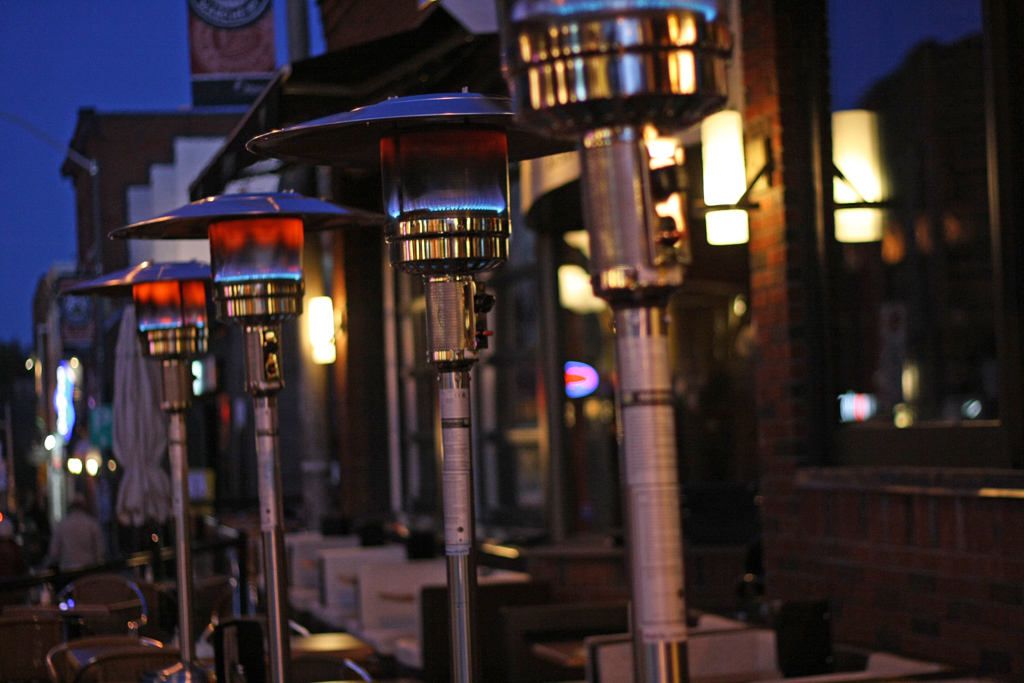
Patio heaters, Ottawa

The photo above illustrates part of why Canada has greenhouse gas emissions of about 24 tonnes of CO2 equivalent per person per year (about three times as much as Sweden). It also shows the extent to which we take the easy energy embedded in fossil fuels for granted: gas powered heaters, running in Ottawa in October, to warm a patio with nobody on it.

I doubt renewable energy will ever become cheap enough for this kind of excess to make sense.