Embassy artwork

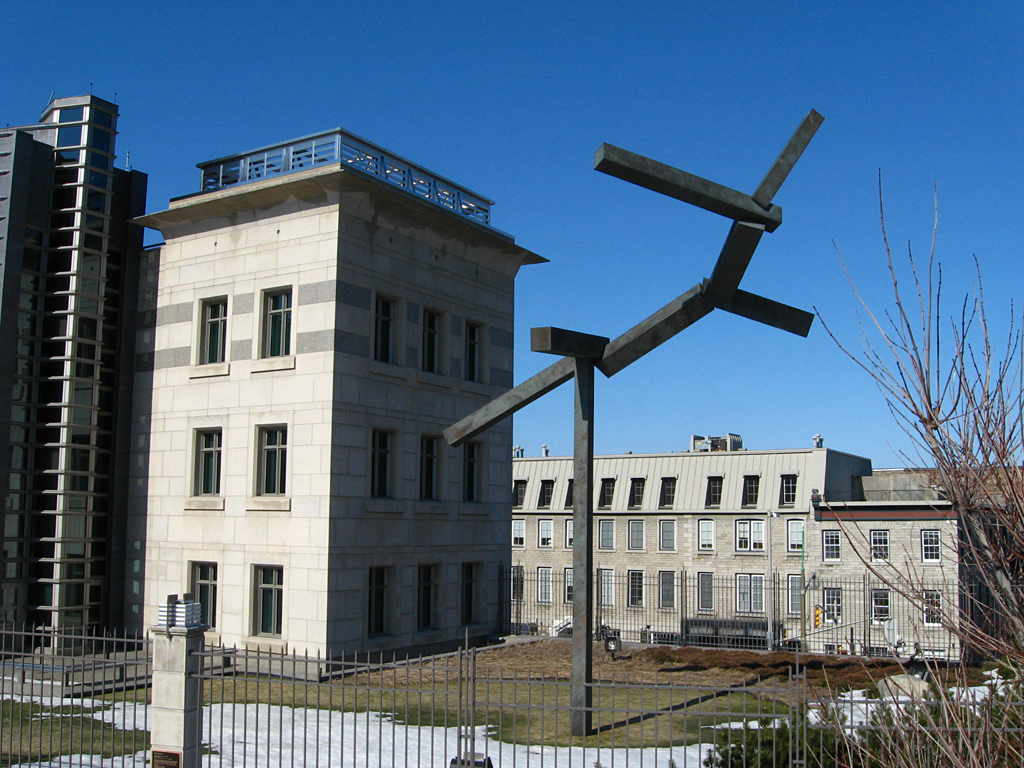
Ugly statue outside the American Embassy, Ottawa

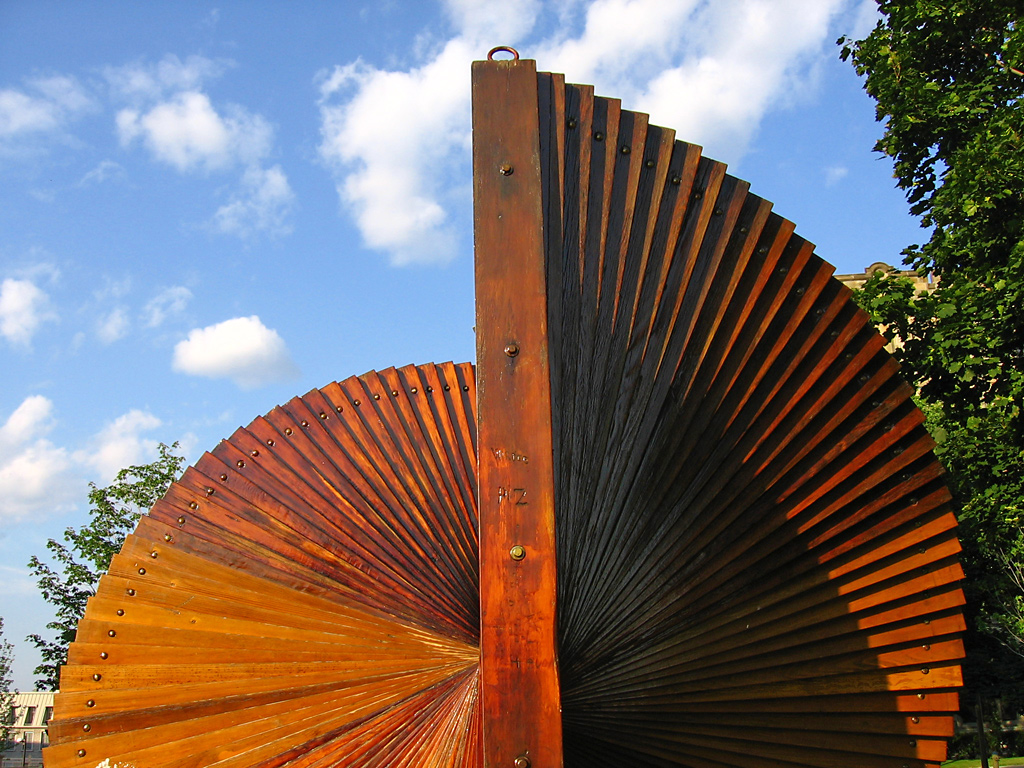
The city of Ottawa is quite well provisioned with public art. Some pieces, like the wooden spiral in the park near the mint, are quite charming. The piece above, located in the US embassy compound, is probably the worst of the lot.

As you can see, the sculpture looks a bit like a balloon animal where the balloons have been replaced by black steel beams and the angles have been randomly altered by twenty or thirty degrees. Sitting within a perimeter fence that never contains a visible human, the statue also symbolizes how faceless and harsh the whole compound is.

While concerns about security are obviously of enormous importance for an American diplomatic facility, nothing about them seems fundamentally at odds with good taste. A less ghastly bit of art, and an embassy that somehow demonstrates that the United States is a nation full of people basically just like Canadians rather than an imposing neo-military facade, might be a start along that road.

P.S. In the spirit of fairness, it should be noted that the British High Commission is equally externally unpopulated and far more lacking in architectural virtue.

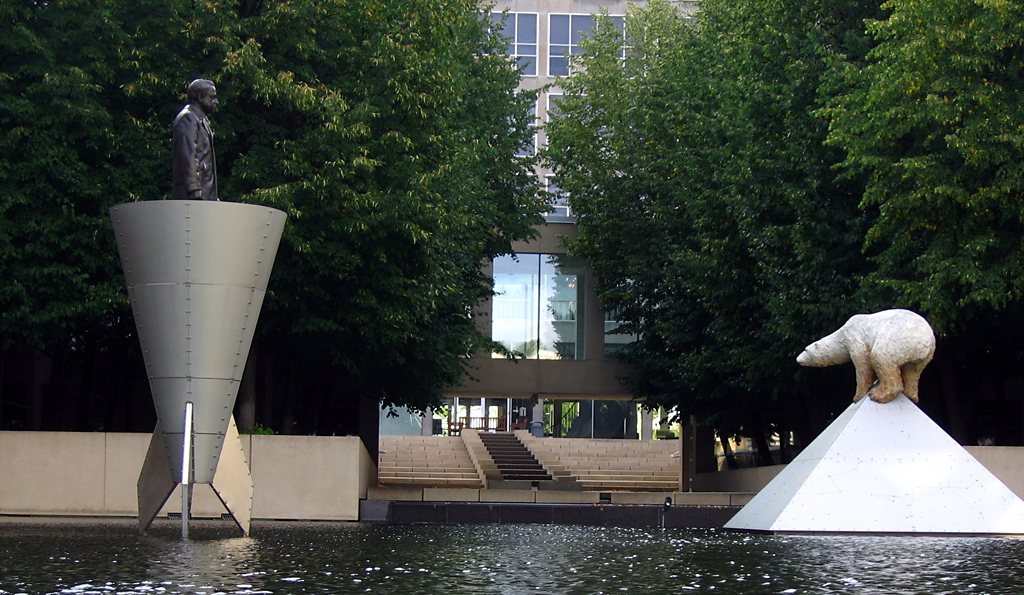
P.P.S Two other statues notably for their oddness and lack of aesthetic appeal are the strange rocket ship / polar bear statue at the building formerly intended to become city hall and the giant evil spider outside the National Gallery.
Beetle-kill and carbon dioxide

Positive feedbacks are one of the most worrisome aspects of climate change. Viscious spirals could make controlling the problem far more difficult and, if we wait too long to act, potentially impossible to deal with. A new article in Nature suggests that the pine beetle epidemic in British Columbia has turned the forests there into net carbon emitters:

In the team’s model, a pine forest untouched by beetles but with a normal amount of logging is a slight carbon sink, sucking up more carbon (as carbon dioxide) than it loses (either as carbon dioxide or as timber). The only exception to this is when forest fires convert the forest to a net source, as they did in 2003. The beetles have an even bigger effect — in their worst year releasing 50% more carbon than the 2003 fires — and act over longer time scales, with additional logging making things even worse.

According to Werner Kurz, Natural Resources Canada’s senior research scientist, the total emissions associated with the outbreak will be about 990 megatonnes by 2020 – about 1.5 years worth of total Canadian emissions at present levels.

Eventually, the pine beetles will find themselves in the position of having nothing left to eat and the epidemic will taper off. What is nevertheless suggested by this situation is the possibility that climate change can lead to degraded ecosystems which hold less carbon dioxide, thus further contributing to climate change.

Your rights as a Canadian photographer

Bullies within private security and police forces are increasingly keen to harass people taking photographs in public places. As such, being aware of the laws relating to photography in your jurisdiction is quite worthwhile. The standard ‘I am not a lawyer / this does not constitute legal advice’ warning applies.

Things you cannot do:

  • Misrepresent someone in a slanderous way through photography or captions accompanying photographs.
  • Photograph people in their homes, or in spaces where they have a ‘reasonable expectation of privacy,’ such as public bathrooms.
  • Trespass, especially at night.
  • Take photos “that could be considered national secrets, interfere with a large number of Canadian’s lives, impair or threaten the Canadian Forces, national security or intelligence.”

Things you can do:

  • Take photos for non-commercial use in nearly any public space.
  • Photograph and publish photos of anyone, aside from young offenders, who are “newsworthy, doing newsworthy things, or are public figures or celebrities.”
  • “It is not against copyright law to take a photo of any architectural work, for example, a building, or a permanent piece of public art.”

The document linked above has a lot more detail, including statutes specific to provinces. It also has some good tips on what to do if you are confronted about taking photographs. As always, remaining calm and polite – but clear and firm about what it is within your rights to do – is the best approach. Deleting your photos in response to a confrontation is probably not a great idea because (a) it reinforces the idea that those confronting you have the right to make you do this (b) when they almost certainly do not (the exemption is the national security case) and (c) you will be destroying evidence that the photos you were taking were legal.

Two Toronto discoveries

My weekend in Toronto yielded knowledge of two new interesting places:

The first is a Louisiana Cajun restaurant called Southern Accent. It is located at 595 Markham Street, near the Honest Ed discount store. Their serving staff are very friendly and accommodating, the decor is pleasantly unusual, and the food is novel and tasty.

The second is an excellent used book store called A Good Read. It is located at 341 Roncesvalles Avenue. It is a boutique-style shop, rather than an encyclopaedic warehouse like Chapters, and it seems to be stocked almost exclusively with the kind of books you would feel lucky to find in a normal used book shop. I picked up a massive tome on the history of cryptography that I mean to work through over the course of many lunch hours.

Twelve days to taxes

Only twelve days remain before taxes need to be filed. Sure, one could print all the myriad forms required, fill them out by hand, and send them off with a big red lipstick kiss to the Canada Revenue Agency. Alternatively, you can use their very accessible NETFILE system to do it all electronically. All you need are documents detailing your various earnings and tax deductions.

You need to have an epass before you can file online, and you won’t be able to use it until they send you a code in the mail. As such, those wanting to file online and on time should request one immediately, if they haven’t already done so.

The data file you submit to NETFILE needs to be prepared using some kind of software. One option is to use the H&R Block online service. It costs $20 a person and produces a .tax file that you can upload to NETFILE yourself. Alternatively, the H&R Block page will let you print off a physical return to mail in.

If you want to save $20, you can prepare a NETFILE return using free software. A friend of mine recommends Taxman: a free piece of Windows-only software. It is not quite as elegant as the H&R Block interface, but $20 might justify a bit of finicky dealing, as well as the need for fellow Macheads to find a Windows machine to use for a while. The Taxman site also includes a game plan for filing taxes.

P.S. Given how mobile people reading this blog seem to be, it is worth mentioning that if you moved in order to be closer to a school or employer, you are eligible for tax benefits. In the future, make sure you hang on to receipts for related expenses. Even meals you eat during the time you are traveling are eligable.

Mintz on carbon taxes

Jack Mintz, who is apparently one of Canada’s leading economists, came out in support of a carbon tax today. Specifically, he suggested that federal taxes on gasoline be expanded to include the taxation of other carbon-generating fuels. This sort of upstream tax on fuels can complement a cap-and-trade regulatory scheme for large emitters by covering sectors of the economy too small to be efficiently addressed through the latter approach. Mintz does not have a reputation as a green champion, making his endorsement all the more suggestive of a general trend towards accepting carbon taxes as one good approach for addressing the massive problem of climate change.

Whereas the carbon tax recently created in British Columbia begins with prices of $10 a tonne, eventually rising to $30, Mintz proposes a federal tax of about $42 a tonne. One of the major issues raised concerns inter-provincial transfers from high emission provinces like Alberta and Ontario to lower emitting provinces like Quebec. That being said, there are many ways in which carbon taxes can be designed. They can be set up so as to not increase the overall tax burden, on account of taxes being reduced elsewhere. They can also be designed so that revenues collected in one province must also be recycled or invested there.

With luck, people will start to realize the opportunities inherent in replacing conventional taxes with carbon taxes. Doing so will offer a strong financial incentive to invest in greater efficiency, cleaner fuels, and more sustainable practices generally.

Hurricanes and climate change action

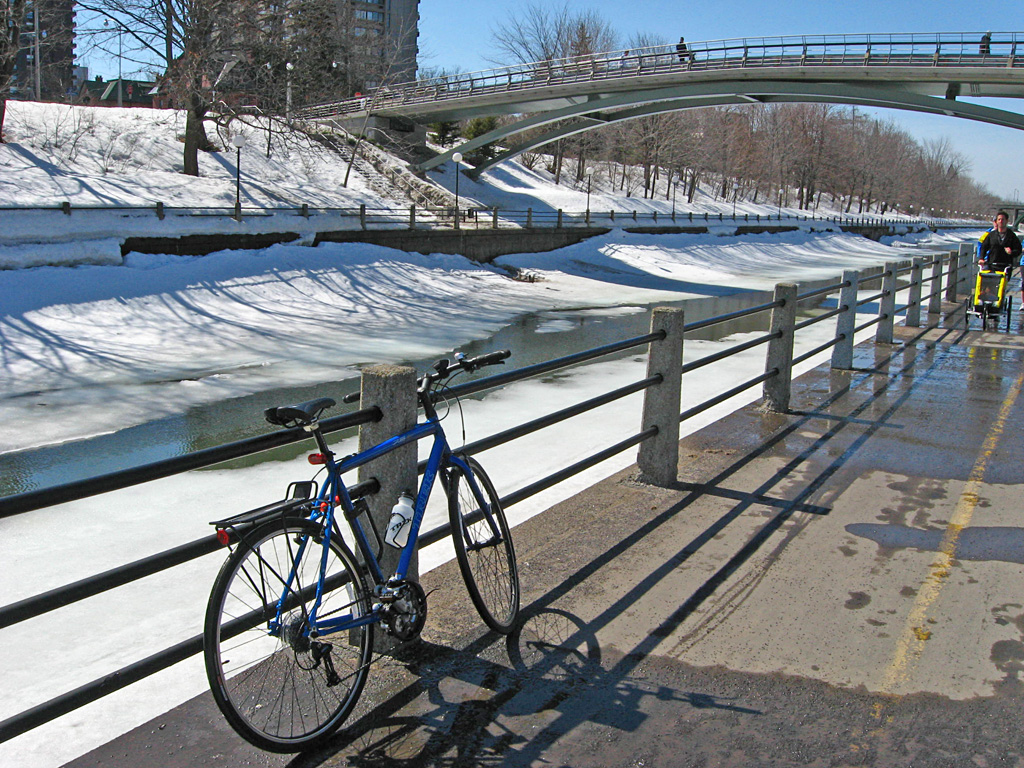
Bike beside the Rideau Canal in spring

At several points in the past, I have mentioned the possibility that the majority of people will not be willing to accept serious action on climate change until at least one big, unambiguously climate related disaster has taken place. The same point is made in Joseph Romm’s book but, whereas I have speculated that it could be vanishing icecaps or large-scale climate induced human migration in Asia, he seems to think that Atlantic hurricanes striking the United States may make the difference.

There is good reason to find this plausible. The strength and frequency of hurricanes both have a lot to do with sea surface temperature (SST). While it isn’t feasible to attribute the occurrence or harmfulness of a particular storm to climate change, it is relatively easy to show a correlation between rising global temperature, rising SST, and more severe hurricanes. Simulations conducted by the U.S. National Oceanic and Atmospheric Administration Geophysical Fluid Dynamics Laboratory led to them concluding that “the strongest hurricanes in the present climate may be upstaged by even more intense hurricanes over the next century as the earth’s climate is warmed by increasing levels of greenhouse gases in the atmosphere.” Within decades, rising SSTs could make the kind of extraordinary hurricane seasons that have proliferated since 2000 the low end of the new scale.

This matters partly because a hurricane-climate change connection would affect Americans directly and very visibly. Insurance prices would rise further, at the same time as more areas became uninsurable and serious questions arose about whether to rebuild at all in some places. The cost trade-offs between insurance, protective measures like higher levees, and storm risk would be thrown into sharp relief. The perceived damages associated with climate change would also shift from being associated with people outside of North America at some distant point in the future to being both physically and temporally immediate.

Obviously, it would be better if serious measures to combat climate change (eliminating non-CCS coal, pushing hard on energy efficiency, building dramatically more renewable capacity, etc) could come about simply as the result of a reasoned assessment of the IPCC’s scientific conclusions and projected associated costs. If, however, it is going to take disasters before people and politicians are ready to embrace real change, we should hope that they will come early, carry a relatively small cost in human lives, and not exacerbate the problem of climate change in and of themselves, as fires and ice loss do.

Airsick

This short video on climate change, produced by Toronto Star photographer Lucas Oleniuk, is very elegant. It doesn’t have a great deal of substantive content, but it includes a lot of striking visual images. Rather than being shot continuously, it consists of 20,000 black and white still images.

The video, and some of the claims made in it, are being discussed on Metafilter.

Carbon capture in Saskatchewan

A $1.4 billion carbon capture (CCS) equipped coal plant is on the drawing board in Saskatchewan. The projected output is 100 megawatts (MW). That works out to a price of $14,000 a kilowatt, compared with about $2000 and $4600 per kilowatt for wind turbines (according to Agriculture and Rural Development Alberta). Of course, unlike the coal plant, the wind turbines wouldn’t require fuel after being installed.

Unless the cost of CCS falls dramatically, it is never going to be able to ride in, horse at a gallop and sword drawn, to rescue the coal sector. The cancelled FutureGen project in the United States was one demonstration of this. Until there is at least one unsubsidized commercial facility out there that is producing electricity from coal and sequestering emmisions – all for less than the price of ‘expensive’ renewable technologies like wind and solar – a fair bit of skepticism about the technology is justified.

Who wants to go up Grouse?

I am amused and pleased to have played a role in organizing a hiking trip in Vancouver involving Emily; my friend, former classmate, and former flatmate Kai; his friend Verena; and my father. Vicarious social mountain climbing – the last resort of we flatland dwellers.

Actually, the whole thing was great fun, even from 4,808km away.

[Update: 28 Mar 2008] Emily has a post on this.