Killing animals to save them

Nick’s dog Molly

The Inuit Tapiriit of Canada are protesting attempts in the United States to have polar bears designated as an endangered species. They argue that the bears are being killed in sustainable numbers, that a listing in the United States would cut off the supply of hunters, and that such hunting provides vital economic stimulus within their communities. Apparently, the total population of polar bears is estimated at 25,000. Between the summers of 2006 and 2007, 498 bears were killed – 120 of those by commercial hunters who paid about $30,000 for the right to do so. They also hired guides and purchased goods and services within native communities.

The situation raises a number of moral questions. The most obvious is whether it is ethical or prudent to fund conservation efforts through hunting. Unsurprisingly, The Economist says yes, at least for African game. It does make sense to say that ensuring conservation of nature depends on making such conservation in the interests of those who live in the region. After all, they are the only ones with a sustainable capacity for enforcement.

The polar bear may also be a special case. It is estimated that melting sea ice could slash their numbers by two thirds or more by 2050. In response to that, it is possible to argue that saving as many as possible from hunting is justified; it could also be argued that we may as well hunt them, since they are doomed anyhow.

The particular case of polar bears is probably not especially important. Barring dramatic and sudden shifts in the climate policy of most states, it seems unlikely that more than a handful will survive the coming Arctic melt. It is entirely conceivable that all Arctic summer ice will be gone in a few decades and that the bears will only survive in zoos, and possibly by shifting to a new habitat and food supply. The effect those changes will have upon the Inuit are difficult to over-state.

A more general moral question raised by all of this is: “To whom do species belong?” Legally, they belong to the states in which they are found. At the same time, it is part of international law that states are not permitted to take actions that impose ecological costs on other states. Clearly, Brazil or Indonesia burning or cutting down their rainforests has such an effect. The situation is less clear when it is a locally important ecosystem or a single species being considered. Do people in India or France have a right to the existence of polar bears? Is it part of the collective of nature, within which we are all trustees?

It does seem as though there is a certain force to that argument, and a parallel obligation on the part of states not to destroy elements of their natural legacy. Of course, a strong case can be made that allowing hunting to pay for conservation serves rather than violates this principle. Such are the kinds of questions that need to be hashed out within international law and politics as the clash between a notion of state sovereignty predicated on non-interference clashes with the nature of a world as interconnected and full of humans as ours is.


Fissure in the Beaufort ice pack

During the past month, a massive piece of ice has broken off west of Banks Island, in the Canadian Arctic. This picture shows the area in question, while this animation from the US National Oceanic and Atmospheric Administration. The split left open water in the Bering Strait for 45 days. At the same time as the fissure, there was an unusual 45 day period of open water in the Bering Strait.

For a sense of scale, here is a map showing Banks Island in relation to the rest of Canada. While one event of this kind cannot be understood without comparison to what is happening in other areas and what has happened at other times, it is a reminder of the dynamic character of the polar icecap, even in the middle of winter. According to NOAA’s 2007 Arctic Report Card, anomolously high temperatures are yielding “relatively younger, thinner ice cover” which is “intrinsically more susceptible to the effects of atmospheric and oceanic forcing.”

It will be fascinating to see what happens the the icecap next summer: specifically, how the level of ice cover will compare to the shocking minimum in the summer of 2007.

[Correction: 15 January 2008] The open water in the Bering Sea is unrelated to this fissure, though both took place at the same time. Both pieces of information are listed in this report from the Canadian Ice Service.

Oil sands report card

Drew Sexsmith with a mandolin

The Pembina Institute and the World Wildlife Fund of Canada have a new report out on the oil sands. It is available as a four page summary or a 72 page PDF. The report is based on surveys sent to 10 different oil sands operations and focuses on the degree to which they have adopted policies to mitigate their environmental impact.

The report highlights both the greenhouse gas emissions associated with oil sands extraction and processing and the impacts upon fresh water. It also points out how the idea that land is ‘reclaimed’ after extraction is seriously faulty. Apparently, “[d]espite over 40 years of oil sands development, not a single hectare of land has been certified as reclaimed under Government of Alberta guidelines.” The permanent conversion of boreal forests ultimately belonging to the people of Alberta into fields of toxic mud is certainly cause for concern.

The report stresses possibilities for improvement, explaining how running all facilities using the best standards in other existing facilities would cut greenhouse gas emissions by 66%, and reduce volatile organic compound emissions by 47%. Nitrous oxide emissions could be cut by 80%, while sulphur dioxide emissions could be reduced by 47%. Adopting a proposed water efficiency standard would reduce annual water consumption by 60%. These figures are all based on facilities running at maximum capacity, as can probably be assumed with oil around $100 a barrel.

Depressingly, the report highlights that a currently proposed project has even worse standards than existing facilities. In order to mitigate the trend, three recommendations are made to government along with two to industry. The governmental suggestions are:

  1. Government needs to enforce acceptable standards of environmental performance and continuously improve regulations to reflect continuous improvement in companies’ abilities to reduce environmental impacts.
  2. Government needs to report on environmental impacts to public lands.
  3. Government must request segregated information to enable comparison of environmental performance.

The industry recommendations are:

  1. Companies need to implement best available practices and focus on developing and implementing new technologies and processes that lead to step-wise reductions in environmental impacts.
  2. Companies should make project specific oil sands environmental performance information more widely available and in a consistent format.

Overall, this approach may be a productive one. Rather than highlighting the ecological costs of oil sands extraction and demanding that the industry be scaled back, demands for all firms to meet the highest existing standards might be able to mitigate some of the harmful effects without creating as much antagonism. It’s not a comprehensive solution, but it may be a clever form of harm reduction.

Anyone interested in the state of Canada’s environment is encouraged to read at least the short summary.

Canada’s nuclear waste

Hilary McNaughton at Darma’s Kitchen

After being removed from a reactor, nuclear fuel is both too radioactive and too physically hot to be reprocessed or placed in dry storage. As such, it is kept in cooling pools for a period of five to six years. Given the absence of long-term geologic storage facilities, all of Canada’s high level waste is currently in cooling pools or on-site dry cask storage. On a per-capita basis, Canada produces more high level nuclear waste than any other state – a total of 1,300 tonnes in 2001.

Canada currently has eleven nuclear waste storage facilities. Among these, one is in the process of decommissioning and six contain high level waste. Four sites have waste in dry storage casks: Darlington, Bruce, Pickering, Gentilly, and Point Lepreau. Other facilities include spent fuel pools. According to the Canadian Nuclear Safety Commission (CNSC), all Canadian wastes are currently in ‘storage’ defined as: “a short-term management technique that requires human intervention for maintenance and security and allows for recovery of the waste.”

In 2002, a major review of waste disposal options was undertaken by the Nuclear Waste Management Organization (NWMO). Their final report – released in November 2005 – endorsed a system of “Adaptive Phased Management” employing both interim shallow storage and deep geological storage, with the possibility of future recovery of materials. Such recovery would be motivated either by concerns about leakage potential or a desire to process the fuel into something useful. The NWMO is currently engaged in a process of site selection, intended to lead eventually to a National Nuclear Waste Repository.

The nuclear waste problem

From both an environmental and public support standpoint, the generation of nuclear waste is one of the largest drawbacks of nuclear fission as a power source. Just as the emission of greenhouse gasses threatens future generations with harmful ecological outcomes, the production of nuclear wastes at all stages in the fuel cycle presents risks to those alive in the present and to those who will be alive in the future, across a span of time not generally considered by human beings.

Wastes like Plutonium-239 remain highly dangerous for tens of millennia: a span roughly equivalent to the total historical record of human civilizations. Furthermore, while most states using nuclear power have declared an intention of creating geological repositories for wastes, no state has such a facility in operation. The decades-long story of the planned Yucca Mountain repository in the United States demonstrates some of the practical, political, and legal challenges to establishing such facilities in democratic societies.

Dry cask storage is not an acceptable long-term option, as suggested by its CNSC categorization as “a short-term management technique.” When dealing with wastes dangerous for millennia, it cannot be assumed that regular maintenance and inspection will continue. Storage systems must be ‘passively safe:’ able to contain the wastes they store for the full duration of their dangerous lives, without the need for active intervention from human beings. To date, no such facilities exist.

The implied right to pollute

In today’s news, there is some talk about the new report from the National Round Table on the Environment and the Economy. Much of it has surrounded the possibility of a carbon tax as a vehicle for assisting the with reduction of Canadian greenhouse gas emissions. One comment from the CBC struck me as especially wrong-headed. In relation to a carbon tax, a person being interviewed said that it “would specifically impact western oil producers who might have to carry the brunt of such attacks.”

The fallacy here is that western oil producers have the right to emit as many greenhouse gasses as they like, for free. If your neighbour was running a pulp mill in his back yard, allowing toxic chemicals to ooze throughout the neighbourhood, nobody would call it an ‘attack’ when he was made to stop. Arguments implying that industry or private individuals have the right to impose ecological harms upon others need to be challenged in terms of fairness and ethics. Otherwise, they obscure the true character of the situation and help to perpetuate the status quo.

Airborne and streaking eastward

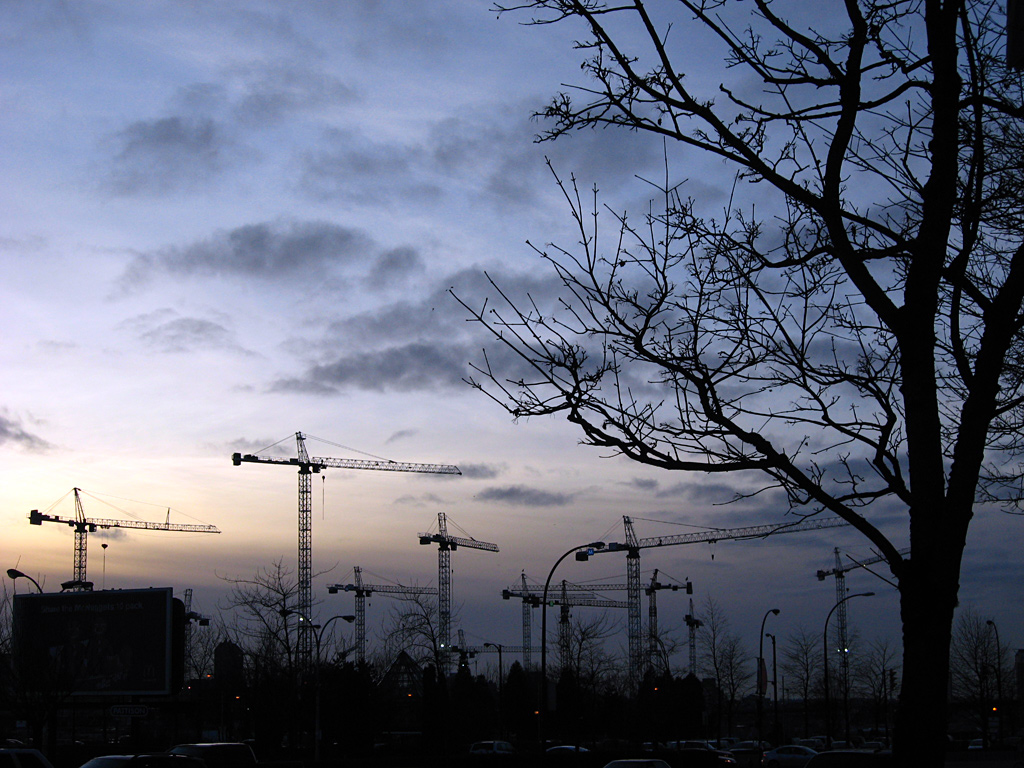
Cranes in Vancouver

I should now be in the air on my way back to Ottawa. Many thanks to all the people who helped to make my holiday in Vancouver so entertaining and personally meaningful. It has been a reminder of how important friends and family really are, and it has left me thinking with renewed energy about possible means of returning to British Columbia on a more permanent basis in the medium to long term.

For now, I need to get back on top of work projects and tardily finish my December book for the reading agreement with Emily.

Conditional support for our troops

Ottawa commuters in the snow

Walking through the Rideau Centre yesterday, I came upon a cart selling t-shirts with various slogans on them. Beside the silly Che Guevara stuff was one shirt that caught my attention. In white letters on a red background it said “Support our Troops.” Under that were both a maple leaf and the flag of the United Nations.

It struck me as admirably post-nationalistic. We recognize the sacrifices made by members of the armed forces, but also that their conduct needs to be bounded by international law. While the sentiment is admirable, it sits uncomfortably with the reality of how ignorant most Canadians seem to be about what we are doing in Afghanistan. People really think we are mostly building bridges and distributing big bags of rice. The reality of the all-out war in which we are committed is very different.

That is not necessarily to say that we shouldn’t be fighting the Taliban along with our NATO allies; it is simply to highlight that Canadian governments manipulate the perception of Canada as a ‘peacekeeping nation’ to keep people from looking too closely at what our armed forces really do. The degree to which many people seem happy to continue to believe in the peacekeeping myth just because it makes them feel good is also problematic.

Milan’s Ottawa

Last winter, I made a map of the parts of Oxford in which I would be likely to find myself over the course of a week.

Here is my approximate Ottawa map:

Map of the parts of Ottawa where Milan Ilnyckyj spends time

It is basically defined by three corridors, leading from my home to work, the grocery store, and the Rideau Centre. During the summer, it would certainly have a few more tendrils. That said, it is a safe estimate that 50% of my time is spent within the tiny (unmarked) rectangles of my cubicle and bedroom.

Defending bike lanes over the web

MyBikeLane is an interesting concept in distributed social law enforcement. The idea is that people take photos of cars parked in bike lanes and then upload those to the site along with details on when and where the incident occurred. Since they can be sorted by license plate, the worst offenders can be easily identified. New York has by far the most active community, followed by Toronto.

Since I carry a digital camera at all times anyhow, I will keep my eyes peeled for possible contributions once I resume biking. For now, my small hybrid tires and the recollection of my nasty Halloween fall are keeping my bike in the basement.

I learned about the site from this interesting blog.

A few thoughts on climate justice

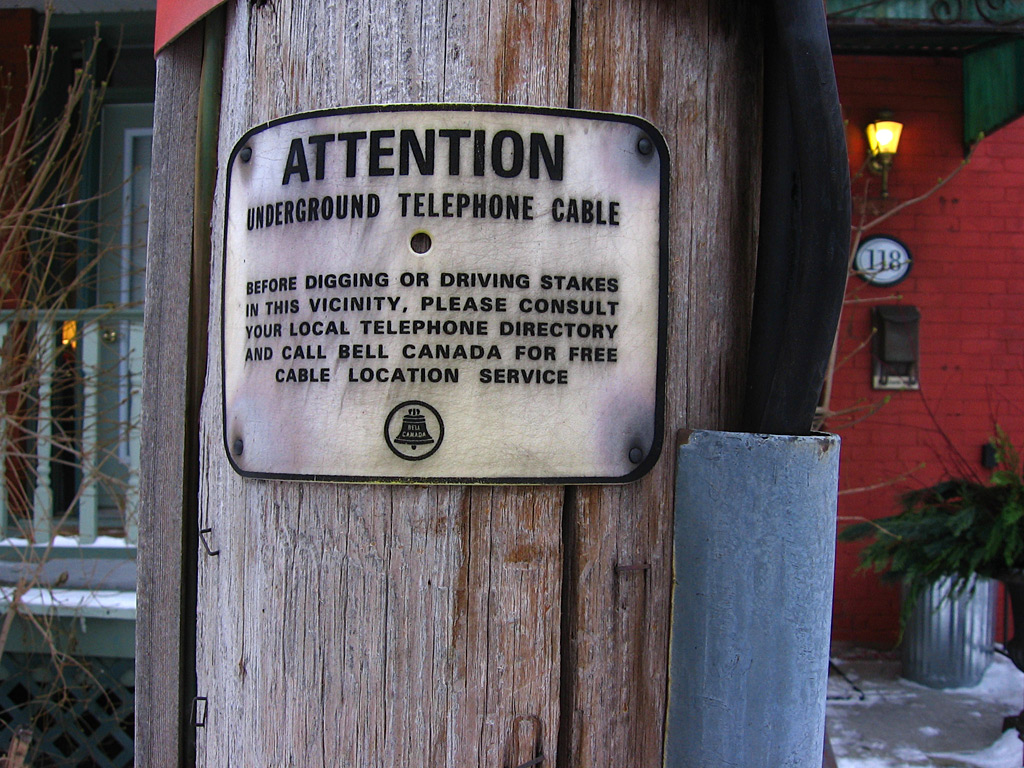
Bell Canada warning sign

A couple of articles at Slate.com address the issue of ‘climate justice.’ This is, in essence, the question of how much mitigation different states are obliged to undertake, as well as what sort of other international transfers should take place in response to climate change. The issue is a tricky one for many reasons – most importantly because anthropogenic greenhouse gas emissions constitute a unique experiment that can only be conducted once. If we choose the wrong collection of policies, all future generations may face a profoundly different world from the one we inherited.

If we accept Stern’s estimate of a five gigatonne level for sustainable global emissions, that works out to about 760kg of carbon dioxide equivalent per person on Earth. Releasing just 36kg of methane would use up an entire year’s allotment, as would just 2.5kg of nitrous oxide. One cow produces about 150kg of methane per year. Right now, Canada’s per-capita emissions are about 24,300kg, when you take into account land use change. American emissions are about 22,900kg while those of India and China are about 1,800kg and 3,900 respectively. Because of deforestation, Belize emits a startling 93,900kg of CO2e per person.

The questions of fairness raised by the situation are profound:

  1. Should states with shrinking populations be rewarded with higher per capita emissions allowances?
  2. Should states with rising populations likewise be punished?
  3. Should developing states be allowed to temporarily overshoot their fair present allotment, as developed states did in the past?
  4. To what extent should rich states pay for emissions reductions in poor ones?
  5. To what extent should rich states pay for climate change adaptation in the developing world?

It may well be that such questions are presently unanswerable, by virtue of the fact that answers that conform with basic notions of ethics clash fundamentally with the realities of economic and political power. We can only hope that those realities will shift before irreversible harmful change occurs. Remember, cutting from 24,600kg to 760kg per person just halts the increase in the atmospheric concentration of CO2. The level of change that will arise from any particular concentration remains uncertain.

Another vital consideration is how any system of international cooperation requires a relatively stable international system. While it is sometimes difficult to imagine countries like China and the United States voluntarily reducing emissions to the levels climatic stability requires on the basis of a negotiated international agreement, it is virtually impossible to imagine it in a world dominated by conflict or mass disruption. It is tragically plausible that the effects of climate change could destroy any chance of addressing it cooperatively, over the span of the next thirty to seventy years.