Rejecting Canada’s new copyright act

As a student, I was constantly being called upon to support various causes, through means ranging from making donations to attending rallies. Usually, such activities have a very indirect effect; sometimes, they cannot be reasonably expected to have any effect at all. Not so, recent protest activities around Canada’s new copyright act: a draconian piece of legislation that would have criminalized all sorts of things that people have legitimate rights to do, such as copying a CD they own onto an iPod they own.

Defending the fair use of intellectual property has become a rallying point for those who don’t want to see the best fruits of the information revolution destroyed by corporate greed or ham-fisted lawmaking in the vein of the much-derided American Digital Millennium Copyright Act. At their most controversial, such acts criminalize even talking about ways to circumvent copyright-enforcement technology, even when such technology is being mistakenly applied to non-copyrighted sources: such as those covered by the excellent Creative Commons initiative or those where fair use is permissive for consumers. Watching a DVD you own using a non-approved operating system (like Linux) could become a criminal offence.

For now, the protests seem to have been successful. Of course, the temptation for anyone trying to pass a controversial law is to hold off until attention dissipates, then pass it when relatively few people are watching. Hopefully, that will not prove the ultimate consequence of this welcome tactical victory for consumer rights.

Related prior posts:

Feel free to link other related matter in comments.

Climate and the boreal forest

According to data submitted by Global Forest Watch Canada to the International Boreal Conservation Campaign (IBCC), Canada’s boreal forest contains 186 gigatonnes of carbon dioxide equivalent. That is equal to about 27 years worth of present global emissions. Permafrost – which is rich in methane – makes up about 25% of the world’s land area and about 50% of Canada.

Significant permafrost melting would release gasses that would accelerate the warming trend. Making boreal areas into parks and avoiding deforestation there isn’t a terribly effective mechanism for keeping the bulk of these greenhouse gasses in the soil. The trees themselves are increasingly threatened by pine beetles, as warm winters permit their continued spread. Maintaining the soils as a carbon sink essentially requires that they remain cold – an increasingly distant prospect as emissions continue to grow and other carbon sinks become saturated.

Boomtowns and bitumen

Haida sculpture

Since 1999, the population of Fort McMurray has nearly doubled. Primarily, this is on account of the oil sands: unconventional petroleum reserves whose exploitation is being driven by high prices and geopolitics. The demand for labour is dramatically increasing its price, both directly and indirectly. Apparently, inexperienced truck drivers can expect to make $100,000 per year. Shell has also just opened a 2,500 unit housing complex for its oil sands employees, part of their $12 billion in local infrastructure spending.

With oil around $90 a barrel and the atmosphere still being treated as a carbon dump, this is not terribly surprising. That said, such projects are certain to develop increasing momentum of their own. Once they bring enough jobs and money, they are hard for a provincial government to not support – especially if many of the environmental costs are being borne by people outside the province or by future generations. Internalizing environmental externalities through taxation or regulation becomes progressively more difficult as the incentive of certain parties to preserve the status quo increases. Such asymmetries are likely to give oil sands development a harmful legacy in terms of general policy development, in addition to its climate change effect and local environmental impacts.

Meat and antibiotics

Portraits in Ottawa

Quite a while ago, I wrote about connections between human disease and the factory farming of animals. Recently, some new observational data has supported the link between the two. In the Netherlands, a new form of the superbug MRSA has emerged. It is strongly resistant to treatment with tetracycline antibiotics: a variety heavily used on livestock. The animals need the drugs because they are kept in such appalling conditions (unhygienic and constrained) that they would get infections too easily otherwise.

Xander Huijsdens and Albert de Neeling found that 39% of pigs and 81% of pig farms in the Netherlands were hosts to the potentially lethal antibiotic resistant bacteria. People who came into contact with pigs were 12 times more likely to contract this form of MRSA than members of the ordinary population; those who come into contact with cattle are 20 times more susceptible. The strain has since been found in Denmark, France, and Singapore. A study conducted by the University of Guelph found the strain in 25% of local pigs and 20% of pig farmers.

Maintaining the effectiveness of antibiotics for the treatment of people is highly important for human welfare. Antibiotics are one of the major reasons why modern medicine is valuable: they help people die dramatically less often after childbirth and surgery than was the case before their development. They have also helped to make diseases that would formerly have been probable death sentences treatable. The fact that we are allowing farms to deplete their value so that they can produce meat more cheaply (by forcing more animals closer together in less clean conditions) seems profoundly unwise. In Pennsylvania, legislators have even banned farmers who produce hormone and antibiotic milk from saying so on their packaging – on the grounds that it would make consumers unduly worried about the other milk on offer.

Newly insulated

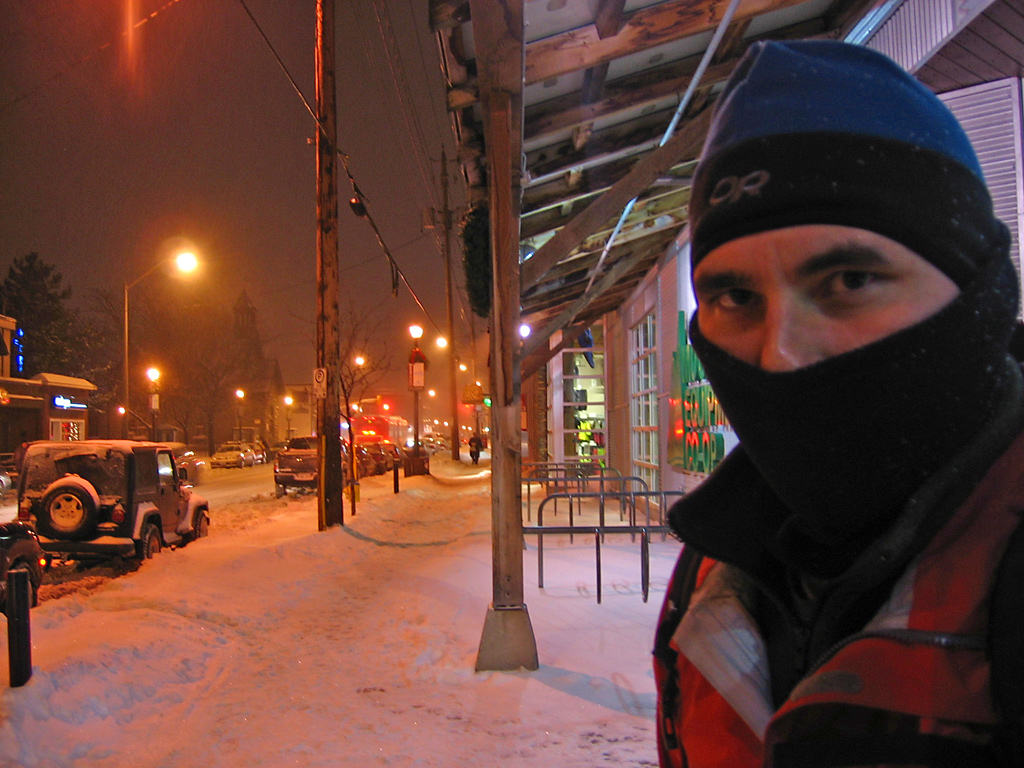
Milan Ilnyckyj looking scary

Through a trek to the Ottawa Mountain Equipment Co-Op and the application of three days’ pay, my respectable collection of wet weather gear has had quite a few degrees of cold capability added into it.

I got some good insulated Gore-Tex gloves (they make me feel less like a mutant than mitts do); I also got a merino wool base layer, a windproof toque to supplement the more attractive one Sarah made me, a fleece neck warmer thing that makes me look like a goon when worn with the toque, a little thermometer, and a couple of miscellaneous knick-knacks, shoe de-stinking agent, and a travel towel (for future trips to nearby cities).

Naturally, the only response to getting new gear is to go experiment with it. One’s first inclination with new gear is to discover its capacities and limits. In its way, the new stuff is like the bicycle was: an enabler of motion, and a gateway to increased capability within the city as it stands.

P.S. I hate plural possessives.

Canada’s science-savvy fifteen-year-olds

Canada’s educators should be proud of the recently released results of the Programme for International Student Assessment (PISA). The test examines the performance of 15-year-olds in science and placed Canada third in the world, after Finland and Hong Kong. Following after are Estonia, Japan, New Zealand, Australia, the Netherlands, and South Korea. Britain is 14th, France 25th, and the United States is 29th.

This is especially welcome news given the ever-increasing importance of basic scientific understanding in contemporary society. In everything from making decisions about one’s own health to voting, having an understanding of at least physics, chemistry, and biology is increasingly necessary. Hopefully, the results of this assessment demonstrate that young Canadians are being well prepared.

More information is available through their website.

Bali talks beginning

Starting tomorrow morning, there will be twelve days of talks in Bali, Indonesia intended to begin the process of drafting a replacement for the Kyoto Protocol, when the period it covers ends in 2012. This particular meeting is mostly about choosing the structure for the real negotiations. Three possibilities are likely:

  1. The parties agree to extend the Kyoto Protocol, keeping in place many of its institutional structures
  2. The parties decide to create a whole new instrument
  3. The talks collapse in acrimony, with no agreement

Which of these takes place will largely depend on the stances adopted by the great powers and major emitters, especially the United States, Russia, China, Japan, Brazil, and the European Union.

Some questions of succession hang over the proceedings. The new Rudd government in Australia has only been in power for a week, and may not have a well developed negotiating position. More importantly, everyone knows the Bush administration will soon be out of power. Leading Congressional Democrats are attending the summit themselves. It remains to be seen what effect that will have.

Ottawa is a frozen wasteland

As much as I enjoyed Ashley’s party tonight, the walk home afterwards has left me convinced that humans should not live in this place. After about forty minutes out there, well insulated, my whole body is in pain. My breath is frozen to my face in painful sheets of ice, and I have had an agonizing cold-induced headache since getting halfway home.

I want to live somewhere saner.

Climate change and the Inuit way of life

Random portrait from the National Archives

At several points in the past, Arctic native groups including the Inuit have been effectively involved in the development of international regimes for environmental protection. Perhaps most significant was the role of the Inuit Circumpolar Conference in the development of the Stockholm Convention on Persistent Organic Pollutants (POPs). Studies done on the human health impact of Arctic POPs on the Inuit provided a big part of the scientific basis for the agreement. Arctic native groups were also effective at pressing their moral claim: chemicals being manufactured elsewhere were poisoning their environment and threatening their way of life.

A similar claim can be made about climate change, though the probable outcome is a lot more negative for Arctic native groups. Relatively few states and companies manufactured the bulk of POPs and, in most cases, less harmful chemicals can be used in their place. The economic costs of phasing out POPs were relatively modest. While the costs of dealing with climate change are a lot lower than the costs that will be incurred through inaction, they are nonetheless many orders of magnitude greater than the costs associated with abatement of POP use.

The threat posed to the Inuit by climate change is also quite a bit more far-reaching. It is entirely possible that the whole Arctic icecap will be gone within twenty years, or even sooner. 2007 was by far the worst year ever recorded for Arctic sea ice. Without summer sea ice, the Arctic ecosystem seems certain to change profoundly. Given the reliance of traditional Inuit lifestyles upon hunting terrestrial and marine mammals, it seems like such conditions would make it impossible to live as the Inuit have lived for millenia. This isn’t even a matter of worst-case scenarios. Even without significant new feedback effects, summer Arctic sea ice is likely to vanish by mid century. Increasing recognition of this partly explains the ongoing scramble to claim Arctic sub-sea mineral rights.

As with small island states, there doesn’t seem to be enormously much hope for avoiding fundamental and perhaps irreversible change in the Arctic.

The Golden Compass under review

It’s a sad day when a Canadian school board pulls your favourite children’s book from the shelves in dozens of libraries because it is allegedly ‘anti-religious.’ To be fair, Philip Pullman‘s The Golden Compass does take a critical stance on dogma and on hierarchical organizations. Elements can be taken as specific criticisms of the Inquisition and other religious abuses. At the same time, the book is engaging, well-written, and excellent. In characterization, creativity, and content it puts the Harry Potter books to shame, while also tackling much more important themes. The book was recognized by with the Carnegie Medal in 1995, and was selected by the Carnegie judges as one of the ten most important children’s novels in the past 70 years in 2007.

While the Halton Catholic District School Board clearly does have some responsibility for the selection of books in its school libraries, this choice is a mistake. If their students are going to have any kind of meaningful religious life, they are going to need to engage with criticisms of faith. That doesn’t necessarily mean giving them each a copy of The God Delusion, but it does require maintaining an atmosphere where questioning and discussion are possible. Simply stripping out high quality books that raise awkward questions is educationally irresponsible and theologically dubious in a faith supposedly based on personal relationships between individuals and God.

[Update: 4 December 2007] Emily has written a post about this book and another about the process of reading it.