
The news doesn’t usually march straight past my bedroom window, banging on pots and pans.
Category: Daily updates
Generally musings of the day, usually accompanied by a photograph
Final Boston photos
After much procrastination and delay, I have uploaded the last of the photos from my trip to Boston with Sasha.
These are pretty much all straight from the camera, whether the camera in question is a dSLR, a point and shoot, or my iPhone. I definitely get more photography done when I keep post-processing to a minimum. Unaltered photos are probably more informative anyhow, though perhaps less beautiful or technically perfect.
Boston was a thoroughly welcoming city and a place which I really enjoyed my time in.
It would be nice to get the chance to live there at some point.
Toronto’s graffiti plan
Generally, I think graffiti is great. While there is certainly a lot of it that is made without skill, much of it consists of skillfully executed art and social commentary. The fact that graffiti is not approved – and that creating it carries a certain risk for the artist – contributes to the degree to which it is artistically and politically interesting. To an extent, graffiti reveals the true thoughts of a city, as opposed to the comparatively inert and uncontroversial thoughts normally reflected by officially approved public art.
Given all of that, I object to Toronto mayor Rob Ford’s new graffiti reporting plan:
[H]e’s going to charge small businesses to remove the graffiti on their walls, even if the graffiti in question is a beautiful mural that everyone, including the business-owner, approves of
I have photographed graffiti in a wide variety of places, from Vancouver to Helsinki to Marrakesh, and much more often than not what I have seen has been an improvement over the blank wall that preceded it. I certainly don’t think that graffiti should be removed just because one person with a smartphone app complains to the city about it. In particular, if the owner of the property where the graffiti was made approves of it, the graffiti should have the same protection under the law as a blank coat of paint would.
The only sort of graffiti that I really object to is when someone artlessly scrawls their name or some banal slogan on a wall or – even worse – on a nicely executed piece of existing graffiti. That and blatantly offensive graffiti I would not object to seeing removed. As for the rest of it, I recommend leaving it where it is.
Graduate school responses
Today, I got back the result for my final PhD application. The process has been a long one.
| School | Application due date | Result |
| University of British Columbia | 01-Jan-2012 | Accepted – 27 FEB 2012 |
| University of Toronto | 16-Jan-2012 | Accepted – 6 MAR 2012 |
| McGill | 15-Jan-2012 | Wait list – 16 MAR 2012 – Rejected – 19 APR 2012 |
| Harvard (GSAS) | 15-Dec-2011 | Rejected – 23 FEB 2012 |
| Yale | 15-Dec-2011 | Rejected – 23 FEB 2012 |
| Columbia | 1-Dec-2011 | Rejected – 1 MAR 2012 |
| University of California, Santa Barbara | 1-Jan-2012 | Accepted – 2 FEB 2012 |
| Duke | 08-Dec-2011 | Rejected – 6 FEB 2012 |
| University of Michigan | 15-Dec-2011 | Rejected – 23 MAR 2012 |
Tally: 3-6, in a competitive field
Just for fun, I used the acceptance and rejection letters I received to make some word clouds:
Accepted:

Rejected:

If you need to tell what the message of a letter is at a glance, knowing these frequencies may be helpful. Also worth noting: the average acceptance letter contained 491 words, the average rejection letter only 116.
The shortest was a terse 90 words – the longest, an eloquent 818.
The magnitude of the original contribution of a PhD
I am reading Estelle Phillips and Derek Pugh’s How to Get a PhD: A Handbook for Students and Their Supervisors. One interesting section is entitled: “Not understanding the nature of a PhD by overestimating what is required”.
Some quotes:
The words used to describe the outcome of a PhD project – ‘an original contribution to knowledge’ – may sound rather grand, but we must remember that, as we saw in Chapter 3, the work for the degree is essentially a research training process. and the term ‘original contribution’ has perforce to be interpreted quite narrowly. It does not mean an enormous breakthrough that has the subject rocking on its foundations, and research students who think that it does (even if only subconsciously or in a half-formed way) will find the process pretty debilitating.
…
We find that when we make this point, some social science students who have read Kuhn’s (1970) work on ‘paradigm shifts’ in the history of natural science (science students have normally not heard of him) say rather indignantly: ‘Oh, do you mean a PhD has to be just doing normal science?’ And indeed we do mean that.
…
You can leave the paradigm shifts for after your PhD, and empirically that is indeed what happens. The theory of relativity (a classic example of a paradigm shift in relation to post-Newtonian physics) was not Einstein’s PhD thesis (that was a sensible contribution to Brownian motion theory). Das Kapital was not Marx’s PhD (that was on the theories of two little-known Greek philosophers).
…
Overestimating is a powerful way of not getting a PhD.
Excluding traffic noise
My latest effort to avoid the constant sound of traffic and streetcar noise in my bedroom consists of wearing DeWalt DPG62-C ‘Interceptor’ Protective Safety Earmuffs over top of foam earplugs.
The earmuffs are rated for 29 decibels of sound reduction, while the earplugs are supposedly good for 32. The sound reduction doesn’t seem to be equal across the range of frequencies I can hear. Birdsong comes right through strangely unaffected, and the rumble of heavy trucks and SUVs remains perceptible, along with the clang and whoosh of streetcars. Together, the two forms of hearing protection do pretty effectively exclude traffic noise, at least when I have my window closed. Whether the whole setup will remain in place overnight is another question.
Wearing the combination is actually a bit disconcerting. There is a constant hiss in my ears, which I think is a combination of the hiss you get from hearing damage with the quiet flow of blood through my ears themselves. If I walk on pavement, each step produces a loud pounding noise. Even walking softly on a wooden floor in socks, I can hear my joints complain slightly when I put my weight on them. For some reason, wearing all this ear protection also makes me more aware of my body, from the mild ever-present pain in my left shoulder to the bodily exhaustion that characterizes the end of another frustrating and largely fruitless day.
We will see whether this combination of tools helps square the circle of a person who is always intensely irritated by traffic noise living in a thin-windowed second-floor apartment overlooking one of Toronto’s busier urban streets.
Ill yet again
For the past few months, I have had some sort of on-again-off-again upper respiratory tract infection / lung irritation. Every time it nearly goes away, I find myself getting sick again.
It may have something to do with the way our bodies dial down the level of immune function during times of stress.
What’s next?
The need to make a decision about school is approaching quickly, and I am feeling uncertain about it.
Indirectly, my experience in Toronto since September is cause for some humility. It hasn’t been at all as I expected it to be. This shows that I have a limited ability to correctly guess what the consequences of big choices will be, even in very general terms. It’s hard not to feel a bit unmoored as a result of that, especially when trying to make a choice with five or more years of direct consequences and lifelong indirect ones.
It has been clear for years that what I am doing now isn’t working. It won’t lead to the kind of life that will be satisfying for me, or a good use of whatever eclectic combination of abilities I possess. I do remember feeling more directed and less aimless while in school. Perhaps those feelings will return if I go back for a doctorate.
I suppose the choice really isn’t so difficult. Continuing with what I have been doing isn’t possible. My attempts to find a climate-related job were singularly unsuccessful. By process of elimination, school is the obvious remaining candidate. Still, I wish I felt more confidence about it.
Shedding stuff in Toronto
I own a lot of reasonably interesting and useful stuff. I need to get rid of some of it, because my apartment is too full of boxes.
Shedding Stuff Toronto – http://stuff.sindark.com
I set up a site to try to sell some of the better things, or at least find people who will make good use of them:
Lark sleep monitor
For the past couple of months, I have been using a Lark sleep monitor. It’s an accelerometer that you wear on your wrist at night that interfaces with your iPhone. It both works as an alarm clock and as a measuring device that provides data on the length and quality of your sleep. You set when you want to wake up and it wakes you at that time with nearly silent vibration (and a backup sound alarm from the phone).
The device has a few obvious uses. If two people sleep in the same bed but normally wake at different times, the Lark would allow one to more easily wake on time without waking the other. The Lark also lets you collect statistics about yourself, and evaluate how well you sleep in different environments and conditions.
For instance, I slept for an average of 8:41 per night when on vacation at my aunt and uncle’s very quiet house in Bennington, Vermont (with one early morning on December 25th). That compares with an overall average sleep time of 7:45 over the past couple of months.
So far, I have collected data for 86 days. More accurately, I have data for 81 of those days and null values for the five days when I wasn’t able to use the Lark – for instance, because I was taking an overnight Greyhound.
My recent sleep stats
This table shows some simple summary statistics:
| Mean | Median | Standard deviation | |
| Time asleep | 7:45 | 7:56 | 2:00 |
| Sleep quality | 8.5 | 8.7 | 0.84 |
| Fell asleep in | 0:37 | 0:30 | 0:34 |
| Woke up (# of times) | 18.9 | 18 | 6.39 |
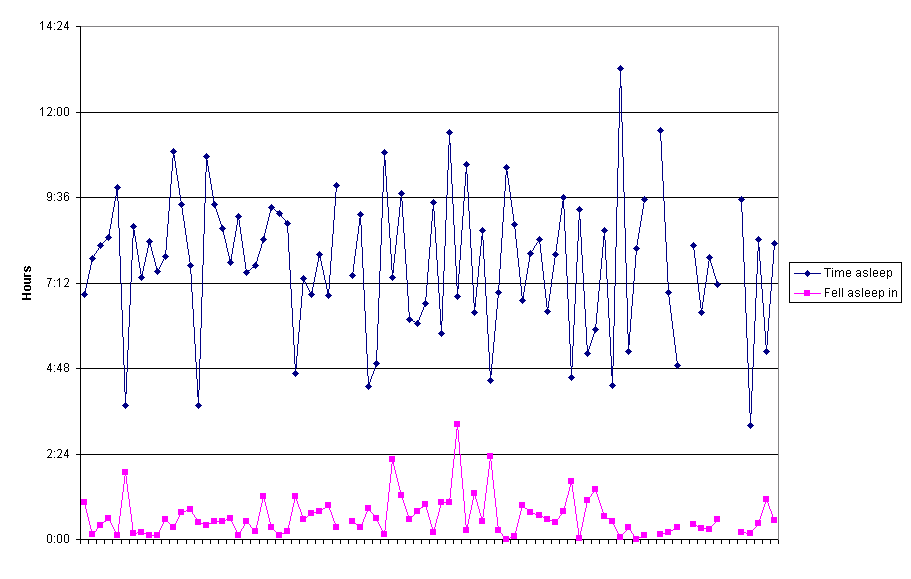
In blue, this time series shows time spent asleep. In pink, it shows how much time was spent falling asleep:
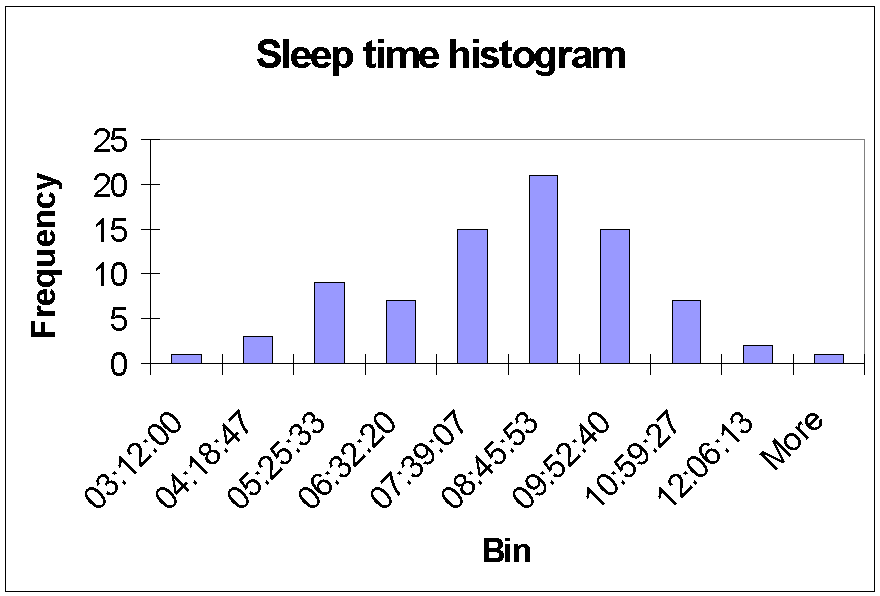
This is a histogram of time spent asleep:
And this shows the frequency of the different qualitative sleep ratings assigned by the Lark software:
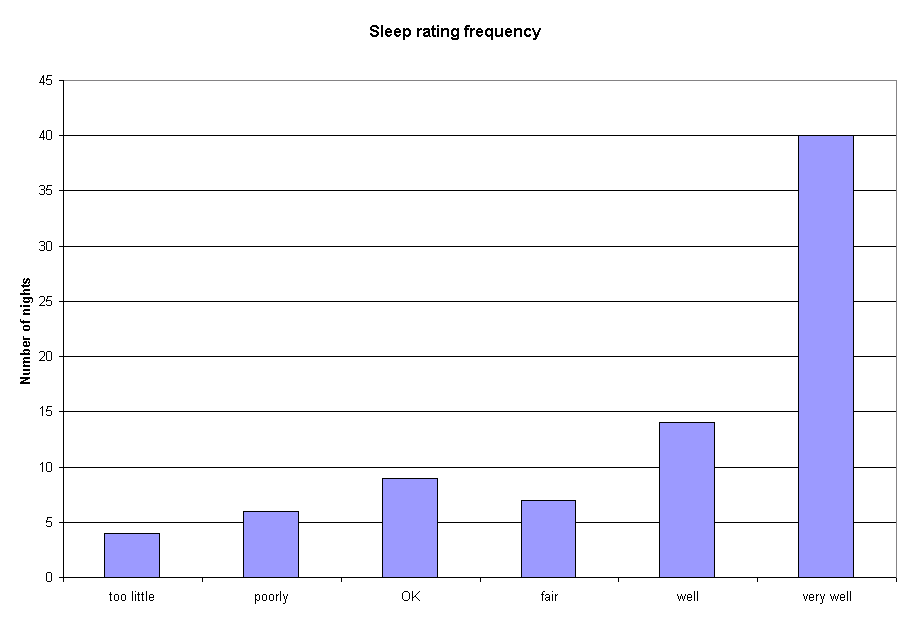
The Lark software informs me that the amount of time it takes me to fall asleep “needs work”, as does the number of times I wake per night. My overall length of sleep and sleep quality it deems “OK”.
The biggest thing that jumps out at me from my own data is the sawtooth pattern of sleep. I tend to alternate between a night with relatively little sleep (about six hours) and a night with relatively much (about nine hours). Given that I usually need to wake up at 6:30am or 6:45am, these correspond to nights when I go to sleep around midnight and others where I collapse around 9:00pm or 10:00pm.
Remember, the Lark distinguishes between time spent falling asleep (the period before the first time of prolonged stillness detected by the Lark) and time spent actually asleep. A night recorded as eight hours of sleep is therefore a night with eight hours of stillness comparable to that of sleep, rather than a night when you spend eight hours in bed. Being able to distinguish those two things may be the most valuable thing about the Lark.
Evaluation of the Lark
Overall, I think the Lark works very well. It has never failed to wake me up, and the iPhone software works well.
One suggestion to all iPhone owners is to put your phone in ‘Airplane mode’ at night. That way, it doesn’t beep or buzz when you get late-night texts and emails. You can still use the Lark in this mode, but you do need to follow a simple procedure:
- Set the iPhone to ‘Airplane mode’
- Manually turn Bluetooth back on
- Connect to the Lark
- Set your alarm time in the Lark software
- Sleep, and be woken
One useful feature the makers of the Lark could add would be the ability to set pre-programmed alarms for different days of the week. For example, you might set your default Monday-Friday alarm for 6:30am or 7:00am, but your weekend alarm for a more reasonable 9:00am or 10:00am.
One side note: it is easy to transfer the basic sleep data from the Lark into your preferred statistical analysis software. For people who don’t want to do that, the company sells an absurdly overpriced (US$$159!) subscription service that keeps track of your data for you online and provides ‘coaching’.