Google’s commitment to renewables

Hilary McNaughton

Google.org – the philanthropic arm of the internet search giant – is seeking to use the cognitive and financial resources of its parent to improve the world. Google has promised to eventually fund the organization using 1% of its equity, profit, and employee time. The real question is whether they will prove able to leverage their particular advantages and achieve outcomes of real significance. There is much reason to hope that they will.

From an environmental perspective, the awkwardly named “RE<C” initiative is the most exciting. The goal is to “develop electricity from renewable energy sources that is cheaper than electricity produced from coal… producing one gigawatt of renewable energy capacity – enough to power a city the size of San Francisco – in years, not decades.” This is certainly an ambitious undertaking. One reason for that is because the true price of coal is not being paid: all the environmental pollution associated with coal mining and burning is being left off the balance sheet, at least in America. If Google can produce renewable technologies that outperform coal economically even in the absence of carbon pricing, it will start to look feasible to begin dismantling the global fossil fuel economy.

It is probably fair to say that meeting this goal would be a more significant contribution to human welfare than everything Google has done so far. Here’s hoping all those brains and dollars come together brilliantly. Of course, as much as we might hope for such a technological rescue, it’s not something to bet on. Even in the absence of breakthrough technologies in renewables, the path to a low-carbon future is pretty well marked out: carbon pricing, regulation in demand inelastic sectors, energy conservation, and massive deployment of existing low-carbon technology.

But why drives on that ship so fast / Without or wave or wind?

A company called SkySails is hoping to reduce fuel usage by large shipping vessels by supplementing their fossil fuel engines with wind power. They estimate that a kite of 160 square metres could, when tethered to a ship, reduce fuel usage by 20%. The company has a video explaining the idea.

It would be very interesting to know (a) what proportion of a time such a system could be used during real-world shipping and (b) how long it would take to pay back the total cost of the system through lower fuel bills.

Fishing should never be subsidized

Milan Ilnyckyj in shadow

The economic case for government subsidies can be made in one of two ways. The first is the argument based on externalities: the idea being that one person’s behaviour creates benefits for others, but that those others do not compensate the actor. An example might be a landowner who refrains from cutting down trees uphill from rivers. All river users benefit from the flood control and lack of silt. In this case, it might make sense for the government to pay the landowner to save the trees – in providing the subsidy, the government encourages a more socially optimal behaviour. This justification doesn’t work for fisheries. Fisheries are a common property resource and, as such, tend towards over-exploitation. Having fishers catch more does not provide anyone else with benefits; indeed, it harms the ability of everyone else to use marine resources. Subsidizing fishing pushes fishers to continue catching fish even beyond the point where it would normally be unprofitable, leading to further depletion.

The second argument for subsidies is the ‘infant industries’ argument. The idea here is that it can take a while for a new business to reach the level of existing businesses in the field. A brand new textile industry in an African state may not initially be able to produce goods at a cost and level of quality competitive with existing industries in Asia. In such cases, you can justify a temporary program of subsidy, intended to get the industry running. Once again, this doesn’t apply to fisheries. If anything, there is too much fishing capacity in the states that subsidize heavily (North America, Europe, and Japan). Excess fishing capacity is being exported into developing states, depleting the resources there.

The one form of subsidy that can be justified in relation to the fishing industry is subsidized training to get out of it. We can recognize that fishers are having an increasingly difficult time making a living, while also recognizing that subsidizing their fuel or equipment will just batter fish stocks further. The solution is to help people to transition into other industries where they can sustain themselves without depleting pools of resources common to everyone. It is always hard for politicians to say that an industry should be smaller, or should not exist at all, but, in the case of fisheries, that is probably the only position that makes economic and ecological sense.

A partial defence of carbon offsets

Harbour Centre, Vancouver

Everybody compares carbon offsets with the indulgences of the medieval Catholic Church. Indeed, a good number of people seem to treat the comparison as the decisive point against them. Offsets allow one person to ‘sin’ by flying or driving a big car, then pay for it by having someone else reduce emissions by a similar amount. While there is certainly potential for abuse, the real issue here is about the intuitive sense of fairness people possess.

Obviously, if someone buys an offset that produces no real reduction in emissions, they have been bilked and the climate has suffered. There are plenty of cases of dubious offsets, including all those based around planting trees. Furthermore, it is necessary not only for the sale of the offset to lead to reduced emissions: it must lead to a reduction of emissions equivalent to the face value of the offset and, crucially, these must consist entirely of reductions that would not otherwise occur. The perfect offset is something like this: (a) a farm releases large amounts of methane, a powerful greenhouse gas (b) in the normal run of things, the farm would have no incentive to stop doing so (c) the sale of offsets changes the economics of the situation, making it most economically efficient to capture the methane, perhaps using it to generate electricity (d) this produces a quantity of real and verifiable reductions that can be sold at the marginal cost of capturing the methane.

In this situation, the argument of ineffectiveness does not apply. What we are left with is the offence against fairness – allowing one person to ‘take more than their share.’ While there is intuitive force behind this position, I don’t think it is very convincing. While it would be better to both moderate one’s consumption and help others to do so, it does seem less objectionable to emit and purchase credible offsets than to emit and simply ignore the consequences of your actions. The critical difference between offsets and indulgences is that offsets (when used properly) actually have a mitigating effect on total greenhouse gas emissions; indulgences never did anything at all, except raise money for those selling them and the ire of those opposed.

Carbon tariffs

It is only a matter of time before the first state imposes an import tariff on goods from countries that are not taking action on climate change. On one level, that is fair enough. If domestic manufacturers are paying for their CO2 emissions through a cap-and-trade scheme or carbon tax, they have some legitimate objections against imports from foreign competitors who are not doing so. That said, the actual experience with the first such tariffs is likely to be a huge legal and political mess.

Membership in the World Trade Organization – something common to most big emitters – carries a number of obligations of varying levels of obscurity and enforcement. You can bet that countries that have such tariffs applied to them will protest such treatment aggressively. It would also be fair to bet that the winner of the contest will be determined on the basis of economic power, rather than the rightness or wrongness of arguments. It is even possible that the resulting compromise will be worse from a greenhouse gas mitigation standpoint than if the argument had never begun.

That said, it is at least logically possible for the global trading system to help in the development of an effective global regime of rules, norms, and decision-making procedures around the issue of climate change. It obviously won’t have an effect on countries that don’t do a lot of trading, but they are probably not the most essential ones to get on board anyhow. What will matter most is which of the two biggest economic blocs will triumph: the United States, still in denial about what solving climate change will require, or Europe, where at least some leading states are starting to get serious.

The Omnivore’s Dilemma

Shops in Vancouver

Michael Pollan‘s superb book tells the stories of four meals and the processes through which they came to exist. At one extreme is a meal of McDonald’s cheeseburgers, eaten in a moving car; at the other, a cooked wild boar he hunted, accompanied by things grown or gathered. Pollan also considers two types of pastoral food systems: one on a mass scale intended to serve the consumer market for organic foods and a truly pastoral farm centred around grass feeding, healthy animal interactions, and sustainability. His descriptions of the four, and comparisons between them, provide lots of interesting new information, and fodder for political and ethical consideration.

Among these, the industrial food chain and the grass-fed pastoral are the most interesting. Each is a demonstration of human ingenuity, with the former representing the sheer efficiency that can be achieved through aggressive specialization and disregard for animal welfare and environmental effects and the latter demonstrating how people, animals, and plants can interact in a much more ethical and sustainable way, albeit only on a relatively small scale. The account of Polyface Farm – the small-scale pastoral operation run by Joel Salatin – is genuinely touching at times, as well as startling in contrast to the industrial cattle feeding and killing operations Pollan describes. While the book heaps praise on the operation, it also recognizes the limitations inherent: we cannot live in cities like New York and get our food from such establishments, nor can the big stores most people shop at manage to deal with thousands of such small suppliers. Unless you are willing to go back to a pre-urban phase for humanity, the industrial organic chain may be the best that is possible.

Pollan’s book is packed with fascinating information on everything from the chemistry of producing processed foods from corn to some unusual theories he learned from mushroom gatherers. Regardless of your present position on food, reading it will make you better informed and leave you with a lot to contemplate.

Arguably, the book is at its weakest when it comes to ethics. Pollan rightly heaps criticism on factory farms, but seems to pre-judge the overall rightness of eating meat. Some of his arguments against vegetarianism and veganism – such as that more animals are killed in fields growing vegetables than in slaughterhouses – are simply silly. No sensible system of ethics considers it equivalent to kill a grasshopper and to kill a pig. I also think that he places too much emphasis on the relevance of whether an animal anticipates death or not. I don’t see how the inability of animals to “see is coming” makes their deaths qualitatively different from those of human beings.

That said, his arguments are generally coherent and certainly bear consideration. He never explicitly spells out the wrongness of eating industrial meat, though it is clear that his implicit argument is based around the conditions under which the animals live, rather than the fact of killing them. This is a sensible position and he is right to contrast Polyface farm with industrial farms on the basis of how they allow or do not allow animals to express their “characteristic forms of life.” Rather than press his argument to a conclusion, he abandons his consideration in a bout of fantasy: talking about how much better the treatment and slaughter of animals would be if farms and slaughterhouses had glass walls.

I highly recommend this book to almost everyone. Modern life is very effective at concealing the nature and origin of what we are eating. This book helps to pull back the veil to some extent. It is also a reflection of the ever-increasing politicization of food. What you choose to eat is an important signal of your ethical and political views, to be judged accordingly by others. Whatever position you end up taking, it will be better informed and illustrated if you take the time to consider Pollan’s thoughts and experiences.

For my part, the book has convinced me that I should strictly limit or abandon the consumption of eggs. His description of egg operations is especially chilling and supports his assertion that: “What you see when you look is the cruelty – and the blindness to cruelty – required to produce eggs that can be sold for seventy-nine cents a dozen.” Other resolutions stemming from reading this book include to try eating more types of mushrooms, improve my cooking generally, and remember that under no circumstances should one accept an invitation to collect abalone in California.


Canadian emissions by province

Canadian emissions by province

The chart above breaks down Canada’s 1990 and 2005 emissions by province. It shows emissions of all greenhouse gasses, measured in megatonnes of CO2 equivalent. It is interesting both in terms of totals and in terms of rates of change. The only jurisdiction where emissions declined was the Yukon, where they fell from 0.6 to 0.4 Mt CO2e. One obvious fact demonstrated by this chart is that it is possible to address Canadian emissions to a significant extent by focusing on just two provinces, with another three making more modest but still substantial contributions.

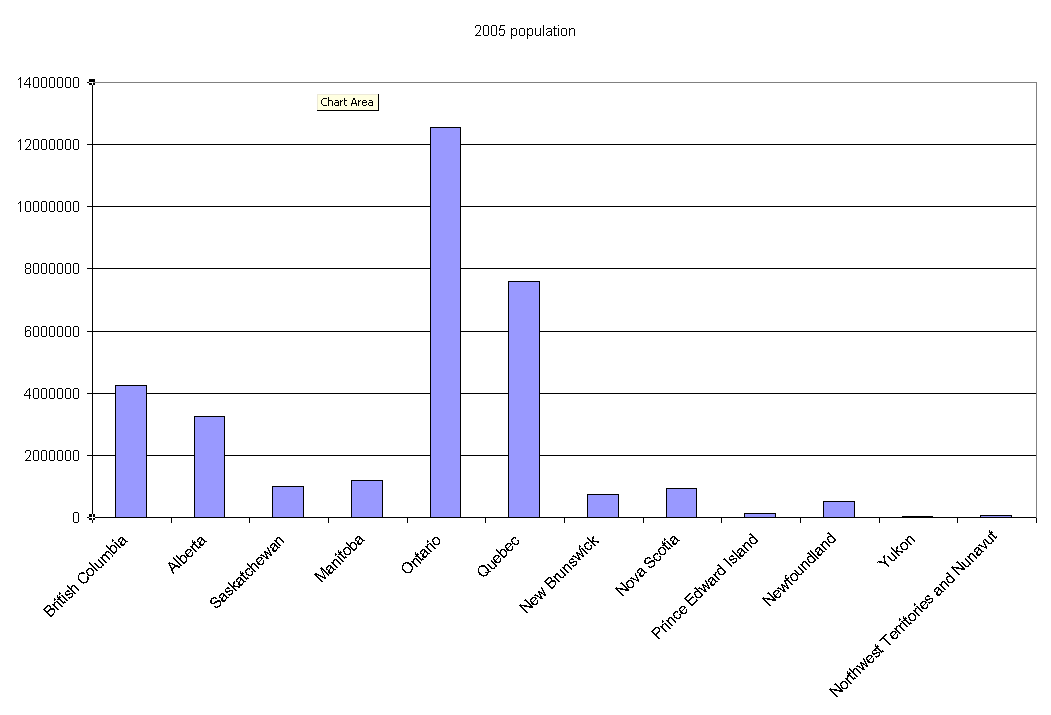
This chart shows the population distribution between the provinces in 2005:

Canadian provinces by population

Of course, it is unfair to directly compare emissions with population. When a driver in Ontario drives using gasoline extracted from the oil sands, Ontario bears some responsibility for those emissions. This is akin to the relationship between emissions and world trade, as discussed before. Even so, there is an obvious disjoint between the level of emissions in Alberta and their share of the Canadian population.

To reach a sustainable level of emissions, it will be necessary for everybody to cut their emissions significantly. That being said, the disaggregation of data can help us to make better choices about where to prioritize. From that perspective, the provincial policies of Ontario and Alberta start to look very important indeed.

Costly cod

Sushi platter

If you want evidence of serious overfishing, look no further than Billingsgate Fish Market in London. Apparently, the price of a kilogram of cod has increased from £6 (C$11.87) four years ago to £30 (C$59.36) today. This is despite how fish is being brought in from ever-father away, concealing the degree to which local waters have been depleted.

Since 2000, cod has been considered an endangered species by the World Wide Fund for Nature. According to one of their reports, the global cod catch has fallen by 70% during the past thirty years and the fish could be commercially extinct as soon as 2020. The WWF report claims that:

[T]he world’s cod fisheries are disappearing fast, with a global catch that has declined from 3.1 million tonnes in 1970 to 950,000 tonnes in 2000. In the North American cod fishery, the catch has declined by 90 per cent since the early 1980s, while in European waters, the catch of the North Sea cod is now just 25 per cent of what it was 15 years ago.

This is consistent with the study in Science by Worm et al. that projected “the global collapse of all taxa currently fished by the mid–21st century.”

Patchwork rules and industry strategy

In many states, a disjoint can be seen between action being taken on climate change at the state or provincial level and inaction at the federal level. Some people argue that such approaches are fundamentally inefficient because they increase uncertainty and the cost of compliance. While this is true in a static sense, it ignores an important element of game theory. Generally, the moment at which it becomes possible to effectively regulate an environmental problem is the moment when industry decides that some form of regulation is inevitable. It then switches its attention from lobbying for total inaction to lobbying for the kind of regulatory regime that suits business best: something as large-scale as possible, with long enough time horizons to guide investment decisions.

This is certainly the pattern that was observed with ozone depletion. Industry went from saying: “There’s no problem” to saying: “There’ a bit of a problem, but it would bankrupt us to fix” to realizing that regulation was inevitable, lobbying for a kind that suited them, and developing superior alternatives to CFCs within a year.

As such, it is entirely possible that grumbling about a “patchwork of regional approaches” signals the approach of an inflection point, beyond which effective regulation and large-scale industry and consumer adaptation occurs.

Killing animals to save them

Nick’s dog Molly

The Inuit Tapiriit of Canada are protesting attempts in the United States to have polar bears designated as an endangered species. They argue that the bears are being killed in sustainable numbers, that a listing in the United States would cut off the supply of hunters, and that such hunting provides vital economic stimulus within their communities. Apparently, the total population of polar bears is estimated at 25,000. Between the summers of 2006 and 2007, 498 bears were killed – 120 of those by commercial hunters who paid about $30,000 for the right to do so. They also hired guides and purchased goods and services within native communities.

The situation raises a number of moral questions. The most obvious is whether it is ethical or prudent to fund conservation efforts through hunting. Unsurprisingly, The Economist says yes, at least for African game. It does make sense to say that ensuring conservation of nature depends on making such conservation in the interests of those who live in the region. After all, they are the only ones with a sustainable capacity for enforcement.

The polar bear may also be a special case. It is estimated that melting sea ice could slash their numbers by two thirds or more by 2050. In response to that, it is possible to argue that saving as many as possible from hunting is justified; it could also be argued that we may as well hunt them, since they are doomed anyhow.

The particular case of polar bears is probably not especially important. Barring dramatic and sudden shifts in the climate policy of most states, it seems unlikely that more than a handful will survive the coming Arctic melt. It is entirely conceivable that all Arctic summer ice will be gone in a few decades and that the bears will only survive in zoos, and possibly by shifting to a new habitat and food supply. The effect those changes will have upon the Inuit are difficult to over-state.

A more general moral question raised by all of this is: “To whom do species belong?” Legally, they belong to the states in which they are found. At the same time, it is part of international law that states are not permitted to take actions that impose ecological costs on other states. Clearly, Brazil or Indonesia burning or cutting down their rainforests has such an effect. The situation is less clear when it is a locally important ecosystem or a single species being considered. Do people in India or France have a right to the existence of polar bears? Is it part of the collective of nature, within which we are all trustees?

It does seem as though there is a certain force to that argument, and a parallel obligation on the part of states not to destroy elements of their natural legacy. Of course, a strong case can be made that allowing hunting to pay for conservation serves rather than violates this principle. Such are the kinds of questions that need to be hashed out within international law and politics as the clash between a notion of state sovereignty predicated on non-interference clashes with the nature of a world as interconnected and full of humans as ours is.