
Shake Hands with the Devil

There isn’t really any appropriate way to talk about a film like Shake Hands with the Devil (2007), given the way in which it is a recasting of a historical episode such as the Rwandan genocide. I suppose one can direct blame, as a response: at the great powers, at the United Nations, at Belgium, at the belligerents, at the genocidaires. Appropriate as that may be, the sheer appalling character of what was undertaken by human beings makes me wonder whether it would have been better if nothing in the universe had ever awoken to cognition, if all the atoms in all the rocks and stars had just interacted dumbly from the unfathomable origin of space and time to the entropic silence that will be the end of it.

One thing that is demonstrated by the experience of watching is the power of film as a medium; having read Dallaire’s book and even seen him speak, the horror was never conveyed with anything approaching the same visceral quality. In response, you can’t help but wonder what we really ought to be doing in Afghanistan now, or in Darfur.
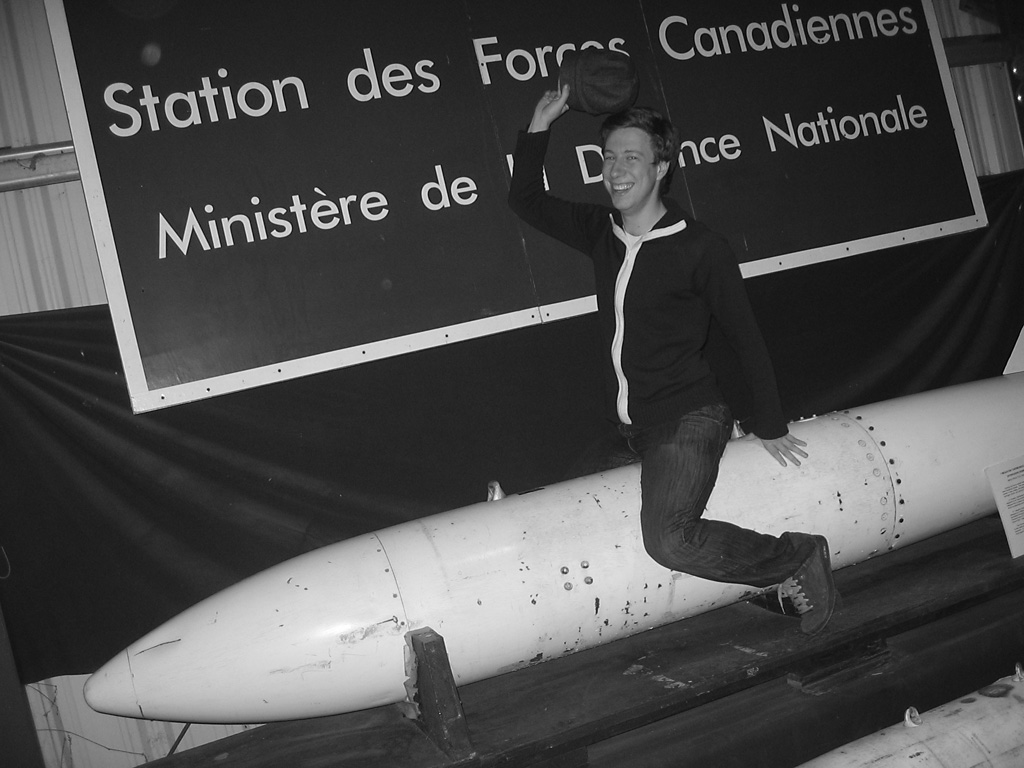

Dr. Strangelove in a nuclear bunker

Marc Gurstein rides the bomb

After today’s orientation, I went with some friends to see Dr. Strangelove in the Diefenbunker – the infamous Canadian nuclear shelter, built to protect top Canadian military and civilian leadership in the event of nuclear war. Diefenbunker is actually a general term for shelters of the type: the one near Ottawa is called CFS Carp. Apparently, there is also one in Nanaimo, B.C. One odd thing is that the shelter has a multi-room suite for the Governor General. Presumably, Canada would not have much need for a local representative of the Queen, after the actual Queen’s entire realm is reduced to a burnt, radioactive plain.

Tonight’s film was followed up by Pho with three fellow employees of the federal government. It was all a distinct social step forward, and Ashley Thorvaldson deserves credit for organizing the expedition.

You can read about the Cold War movies events on the website of the Diefenbunker Museum.

$5000 video contest

Loyal readers have helped my brother Mica win video contests before, and their efforts have been much appreciated. Now, Mica is in the final ten for the Molson Canadian contest mentioned here earlier. If he wins, he gets a nice contribution towards reduced student loans.

This one is a bit more of a pain to vote in than the previous competitions. Firstly, you need to have a Facebook account. Secondly, you need to join the group ‘Molson Canadian Nation.’ Thirdly, you need to sign up as a ‘Molson Insider.’ Unfortunately, this needs to be done with a real email address, since they send you a verification message. By now, everybody probably has a secondary account used for such spam-inviting registrations.

Each Molson Insider can vote once per day, and the final round of the contest runs until Friday. Once properly registered, you can vote here. Only those in Canada can vote. Any support would be much appreciated. More of Mica’s videos can be viewed on his website, where he really ought to put some kind of post about this contest.

[Update: 28 September 2007] The results are back and Mica finished second. As such, he will be getting some sort of prize pack instead of $5000. Thanks to all those readers who voted for him. I think this is the first video contest he has entered that he did not win outright.

Public broadcasters and the web

The existence of the internet changes the economic logic of public broadcasting. Where, at one point, the BBC was a collection of channels, each showing one bit of their vast archive at a time, now much of it is online. That creates a huge database of materials, paid for by taxpayers, and ideally free to be accessed without copyright concerns. Being able to view documentaries like Dangerous Knowledge upon demand is a notable benefit, and one not adequately captured by private sector content generators who are not concerned about societal benefits not captured in their profits.

If all the world’s national broadcasters and other public generators of knowledge would open up their libraries comprehensively, it could make the internet an even more valuable thing than it already is. Unfortunately, that process seems likely to be piecemeal and marked by set-backs. Witness the BBC iPlayer dispute.

Paprika

While the plot is definitely nothing special, the visuals of this film make it entirely worthwhile. Paprika is whimsical, quite beautiful at times, and capable of provoking widespread and audible amusement in the audience. This is a film that should only really be seen in theatres, given how much of the appeal and personality resides in the artwork.

One factor distinguishing Paprika from the wonderful Studio Ghibli films that seem to dominate the mass market for anime in the west is the way in which it has a bit of a dark edge to it at times. Nothing like Perfect Blue, but there were some scenes that would not have been in a PG-rated film, if they had not been animated.

Paprika is playing at the Bytown Theatre for the next week or so.

Lucrative video contest

Readers of this blog have been appreciating my brother Mica’s videos for a long time, and have helped him win a number of video competitions in the past. Now, he is in a contest where the objective is to produce a promotional video for Molson Canadian. While I hope readers of this blog have less mediocre hops and barley beverages in their own fridges, voting for his video might help him win $5000, which he will spend on school.

In order to vote, you must be on Facebook (though that seems to include almost everyone under 30 now). You need to join a group called ‘Molson Canadian Nation.’ If you want an invitation, send me or Mica a message and we will send you one. Voting begins on September 1st, and members of the group can vote once per day.

More details will follow. This will be an excellent way to show your appreciation for Mica’s videos, as well as help reduce the size of his student loans for next year.

[Update: 5:40pm] It seems that only those in Canada can join this group. To those elsewhere: “Thank you for your help in previous campaigns. The advertising imperative in this case does not favour you.”

Parliament light show

On Parliament Hill, they put on a giant multimedia show twice a night. It is called Canada: the Spirit of a Country and it is both preachy and prescriptive. To anyone even slightly wary of government dictating values from on high, it seems a bit disturbing. It definitely seems absurd and over-done.

I hadn’t properly seen it before yesterday, when Emily and I happened across it. While the virtues it expresses are generally admirable, the delivery is incredibly Orwellian. Between psychedelic bursts of light projected across the front of Parliament, it plays videos and expounds in both official languages on the virtues of diversity and cultural exchange, peacekeeping, and the like. It’s like an over-the-top ‘Part of our Heritage’ commercial, though it seems a lot more disturbing. While the message may be an innocuous one, the propaganda approach is off-putting and the overenthusiastic promotion of Canada seems very much like a case of too much effort.

If you ignore the words, the light show itself is quite dramatic, though also profoundly discordant. It is very odd to see huge spinning abstract purple shapes projected all across Parliament, suddenly replaced with a pattern that looks like the razzle dazzle ships of World War I.

Standing within 50m of the war memorial, one might hope that we have moved beyond nationalism. At an aesthetic level, one might at least hope that we have moved beyond the kind of crude, half-deluded, and self-serving nationalism that the light show seems to represent.

Al Gore in a nearby park

In a public park up the road from here, a public screening of An Inconvenient Truth is ongoing. It’s a bit amusing that this should occur tonight, which is far and away the coldest night I have experienced since arriving in Ottawa. Leaving the office at about 6:40pm tonight, it was the first time I have gone through that double set of doors to find the air outside cooler than the air inside our twenty-eight story tower.

You have to wonder what the wider significance of growing public awareness about the climate change issue is. If it will require massive sacrifice to deal with, there is a reasonable change that Monbiot’s assertion is correct:

We wish our governments to pretend to act. We get the moral satisfaction of saying what we know to be right, without the discomfort of doing it. My fear is that the political parties in most rich nations have already recognized this. They know that we want tough targets, but that we also want those targets to be missed. They know that we will grumble about their failure to curb climate change, but that we will not take to the streets. They know that nobody ever rioted for austerity.

Thankfully, it does seem likely that the early stages of mitigation will be relatively painless and will carry corresponding benefits in terms of reduced dependence on foreign oil and reduced air pollution. It is when things really start to bite that the resolution of voters and law-makers will really be tested.

Hollywood physics

Canadian flag

Deficiencies in movie physics can be good fun to dissect and mock, but a recent paper suggests that they are less benign. “Hollywood Blockbusters: Unlimited Fun but Limited Science Literacy” suggests that the absurdities that abound in popular films actually weaken the people’s ability to understand how the world works. The paper concludes that:

Hollywood is reinforcing (or even creating) incorrect scientific attitudes that can have negative results for the society. This is a good reason to recommend that all citizens be taught critical thinking and be required to develop basic science and quantitative literacy.

Specific issues discussed in the paper include projectile motion, Newton’s laws, impulse, buoyancy, and angular momentum. Certainly, some films underplay the dangers of high falls and similar phenomena – as well as playing up the dangers of things like automobiles spontaneously exploding.

Personally, I would prefer a world in which movies portrayed all the sciences in realistic and accessible ways. Unfortunately, such films are in perpetual danger of being ignored in favour of flashy absurdities like the The Core or the egregious recent Star Wars films.

Reading these entertaining reviews is a good after-the-fact vaccine.