Festooned with Foosh mints

Foosh mints

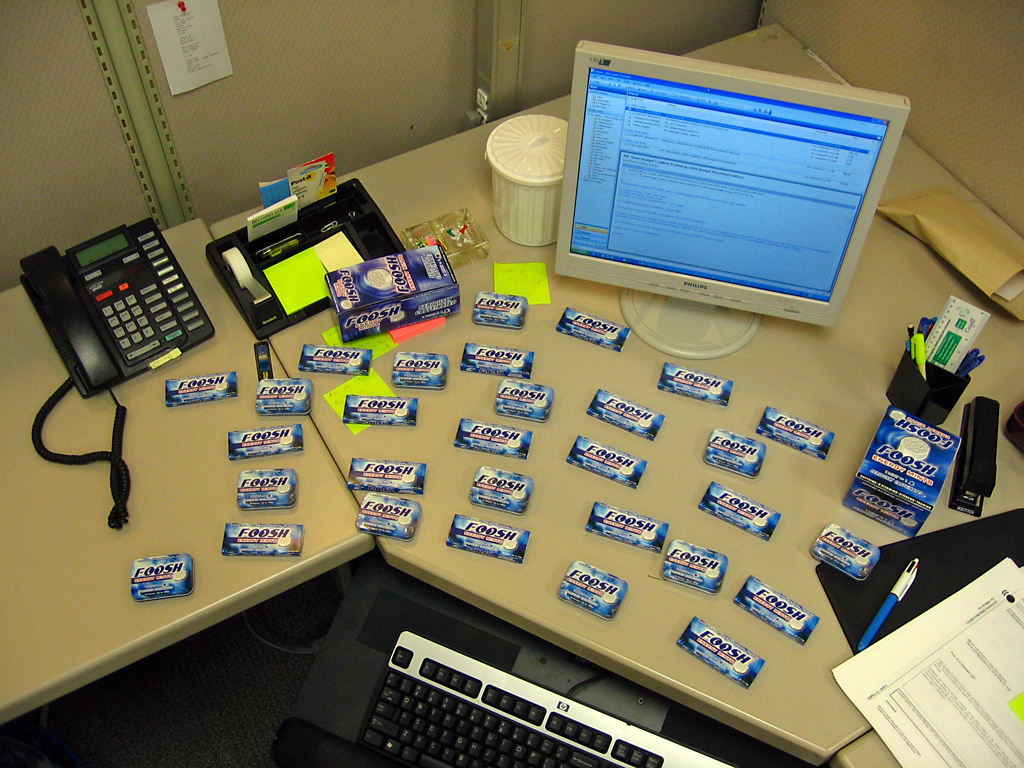
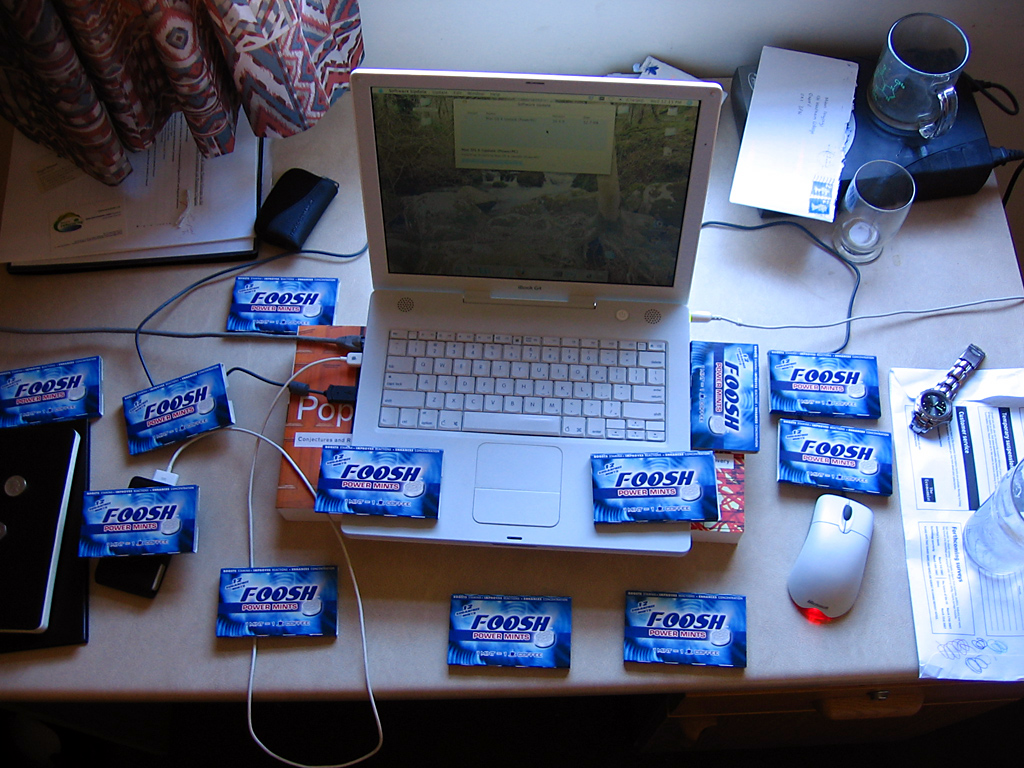
Thanks to a package that arrived today, I have 30 packages of Foosh mints in my cubicle. That represents 28.8g of pure caffeine and twice the number of mints shown in this photo from Oxford.

Mostly, the choice to purchase so many reflects the expense and annoyance of having them shipped from the US. Partly, it reflects the manic desire to accumulate large collections of desirable things that seems to be a prominent feature in human history.

Footprints all over the web – Google Web History

Red brick facade and fire escapes

When I am online, I usually have at least one Google service open. At home, I usually have a Google Mail window open at all times, as well as Google Calendar. At work, it is only the latter. What I didn’t know until today is that whenever you are logged into your Google account, Google is tracking your web usage through a system called Web History. Accessing the system allows you to ‘pause’ the recording and even delete what is already there. While the listings disappear from your screen, there is good reason to doubt whether they vanish from Google’s records.

It is common knowledge that Google saves every search query that gets input into it, and does so in a way that can be linked to an individual computer. The web history service, however, has more troubling implications. Whether you are at work, at home, or at an internet cafe, you just need to be logged into any Google service for it to be operating. Since more than one computer can be logged into a Google account at once, and there is no indication on either machine that this is happening, anybody who gets your password can monitor your web usage, as well as your email and any other Google services you use. Given how common keyloggers have become, this should worry people.

One very helpful feature Google could implement would be the option to show when and where you last logged into your account. That way, if someone has been peeking at your email from London while you have been in Seattle, you know that it may be time to change your password. Also desirable, but much less likely to happen, would be a requirement that services like GMail store your information as an encrypted archive. Even if the encryption was based on your password and a relatively weak cipher, it would make it impractical for either Google or malicious agents with access to their information storage systems to undertake the wholesale mining of the information therein.

The final reason for which this is concerning has to do with cooperation between companies and governments. It is widely rumoured that companies including Microsoft and Yahoo have helped the Chinese government to track down and prosecute dissidents, by turning over electronic records held outside China. Given the increasingly bold snooping of both democratic and authoritarian governments, a few more layers of durable protection built into the system would be prudent and encouraging.

Hollywood physics

Canadian flag

Deficiencies in movie physics can be good fun to dissect and mock, but a recent paper suggests that they are less benign. “Hollywood Blockbusters: Unlimited Fun but Limited Science Literacy” suggests that the absurdities that abound in popular films actually weaken the people’s ability to understand how the world works. The paper concludes that:

Hollywood is reinforcing (or even creating) incorrect scientific attitudes that can have negative results for the society. This is a good reason to recommend that all citizens be taught critical thinking and be required to develop basic science and quantitative literacy.

Specific issues discussed in the paper include projectile motion, Newton’s laws, impulse, buoyancy, and angular momentum. Certainly, some films underplay the dangers of high falls and similar phenomena – as well as playing up the dangers of things like automobiles spontaneously exploding.

Personally, I would prefer a world in which movies portrayed all the sciences in realistic and accessible ways. Unfortunately, such films are in perpetual danger of being ignored in favour of flashy absurdities like the The Core or the egregious recent Star Wars films.

Reading these entertaining reviews is a good after-the-fact vaccine.

The Code Book

Simon Singh’s The Code Book proves, once again, that he is a superlatively skilled writer on technical and scientific subjects. Thanks to his book, I now actually understand how Enigma worked and how it was broken: likewise, the Vigenere Cipher that has been built into this site for so long. This book manages to capture both major reasons for which cryptography is so fascinating: the technical aspects, centred around the ingenuity of the methods themselves, and the historical dramas connected, from the execution of Mary Queen of Scots to the use of ULTRA intelligence during the Second World War.

Anybody who has any interest in code-making or code-breaking should read this book, unless they already know so much about the subject as to make Singh’s clear and comprehensible explanations superfluous. Even then, it may arm them with valuable tools for explaining interesting concepts to the less well initiated.

At the end of the book is a series of ten ciphers for the reader to break. Originally, there was a £15,000 prize for the first person to crack the lot. Now, they exist for the amusement of amateur cryptologists. I doubt very much I will get through all ten, but I am giving it a try. The first ciphertext is on his website and is helpfully labeled ‘Simple Monoalphabetic Substitution Cipher.’ I expect to crack it quickly.

Continue readingThe Code Book

Ottawa blogs

Within a few months of arriving in Oxford, I had sorted out which blogs were worth reading. So far, I have not stumbled across any good Ottawa blogs. Does anybody know of any? Environment blogs, photo blogs, food blogs, travel blogs – all of these are potentially interesting. Personal blogs are better than pundit blogs. High quality writing is the key factor, along with some local information.

M’s PL, XII

(220), (210), (241), (310), (250)
(350), (380), (317), (271), (346)
(222+1), (212), (302), (258), (280)
(127), (100), (556), (452+1), (599)
(621), (633), (590), (392), (387)
(414), (423), (539), (572), (157)
(142), (128), (189), (529+2), (412)
(361+1), (351), (200), (229), (174)
(409), (440), (594), (532), (539)
(608), (259+1), (310), (271), (100)
(143), (98), (478), (530), (599)
(369+1), (343), (321), (370), (375)
(389), (413), (530), (58), (79)
(33), (87), (211+1), (251), (346)
(556), (608), (631), (640), (546)
(579), (549), (492), (481), (429)
(336), (387), (442+1), (219), (213)
(439), (450), (551), (632), (245)
(396+1), (589), (539), (418), (499)
(422), (460+2)

Hint: second Beale cipher.

Data storage

SAW Gallery, Ottawa

This evening, I was at an art gallery watching 8mm, Super 8, and 16mm films shot 25-40 years ago. Most of them were not in pristine quality, but still quite viewable. Afterwards, I got into a conversation with someone who works in archival film storage for the federal government. Contemporary society is generating far more data than ever before. At the same time, virtually nothing is stored at archival quality. An 8mm video or a 35mm negative will be fine in forty years if stored at controlled temperature and humidity. Even dumped in a box in someone’s attic, it is still likely to be comprehensible. The same is not true for how we store data today.

Basically, you have optical and magnetic storage. Optical includes CDs and DVDs, and is further divided between mass releases CDs (which are pressed into metal) and personally made CDs (which rely on dyes exposed to lasers). Neither is really archival. It is quite possible that your store-bought DVD will not work in twenty years. It is quite likely that your home-burned DVD will not work in five.

In terms of magnetic storage, you have tapes and hard drives. Many companies have learned to their detriment that poorly stored magnetic backup tapes can be useless. As for hard drives, they are vulnerable to physical breakdown, viruses, exposure to magnetic fields, corrosion, and other factors.

While is is likely that the products of my early fumblings with Ilford Delta 400 in high school will be intelligible in forty years, it is a lot less likely that my digital photos from Paris will be. That’s ironic, of course, given that the first ones can only be copied imperfectly and at a notable expense, while the latter can be copied perfectly for a few cents a gigabyte.

While some information exists in the form of so many copies that is will likely never be lost (ten thousand unsold copies of Waterworld on laserdisc), there is reason to fear that personal data being stored in the present era will likely be lost before people born today have grandchildren. While that has certainly been the norm for generations past – who would be lucky to have their lives recorded as a birth in a parish register, a marriage, and a death – it seems rather a shame given how cheap and ubiquitous data creation and storage has become.

[Update: 11 August 2010] I forgot to mention it earlier, but one potentially robust way to back up digital files is to print them on paper.

Culinary statistics

Food chart

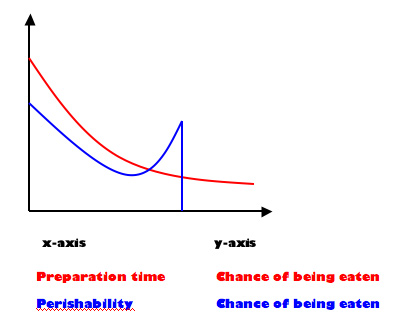
The above demonstrates why I find myself eating so many Kimchi Noodle Bowls and cheese sandwiches. It also helps to reveal why the avocados I eat tend to be either unripe or over-ripe, though the shape of the blue curve is the inverse of what would be rational (barring the sheer drop at the end).