Climate science and policy-making

I wrote the following to serve as a one-page introduction, laying out some of the key items for consideration and listing some of the most accessible and reputable sources of information about climate change. For more information on specific subjects, see my climate change index.

The key elements of the general climate science and policy consensus are:

  • On average, the planet is warming.
  • Most of this is because of human emissions of greenhouse gases.
  • Continued warming would be harmful, and perhaps very risky when it comes to human welfare and prosperity. Anticipated changes include melting glaciers and polar ice, more extreme precipitation events, agricultural impacts, wildfires, heat waves, increased incidence of some infectious diseases, sea level rise, ocean acidification, and increased hurricane intensity.
  • By most accounts, the cost of mitigation is less than the cost of adaptation. Some anticipated changes may overwhelm the capacity of human and natural systems to adapt.

While there is a public perception that there is a lot of scientific disagreement about the fundamentals of climate science, this really is not the case. Back in 2004, a survey of peer-reviewed work on climate science demonstrated this. There is also a notable joint statement from the national science academies of the G8, Brazil, China, South Africa, and India.

To borrow a phrase from William Whewell, there is a ‘consilience of evidence’ when it comes to the science of climate change: multiple, independent lines of evidence converging on a single coherent account. These forms of evidence are both observational (temperature records, ice core samples, etc) and theoretical (thermodynamics, atmospheric physics, etc). Together, these lines of evidence provide a conceptual and scientific backing to the theory of climate change caused by human greenhouse gas emissions that is simply absent for alternative theories, such as that there is no change or that the change is caused by something different.

Readers who are dubious about the validity of mainstream climate science, or unsure of what to think, my page for waverers may be useful.

1) Climatic science and history

There are some good primers available from reputable organizations online. For instance, the United Kingdom’s Met Office has a quick guide.

The Fourth Assessment Report of the Intergovernmental Panel on Climate Change (IPCC) is the most authoritative review of the scientific work that has been done on climate change. The summary for policy-makers for the synthesis report is available online.

For detailed information on the physical science of climate change, the technical summary of the IPCC’s Working Group I report is a good resource. Unlike the summaries for policy-makers, which are vetted through a quasi-political process, the technical summaries are prepared exclusively by scientists.

For Canadians who want to read one book about climate science and policy, I recommend University of Victoria Professor Andrew Weaver’s book: Keeping Our Cool: Canada in a Warming World.

For those looking for a concise history of the entire development of climatic science, starting in the late 1800s, I very much recommend Spencer Weart’s The Discovery of Global Warming. In addition to the book form, it is available free online.

For a more specific history of what we have learned about climate from ice core samples, see Richard Alley’s The Two Mile Time Machine. For an excellent (though somewhat technical) discussion of the relationships between the carbon cycle and biological organisms, see Oliver Morton’s Eating the Sun.

2) Climate change mitigation

Ultimately, the only way to keep the concentration of greenhouse gases in the atmosphere constant is to reach the point where humanity has zero net emissions. Getting there fundamentally requires two things: the shifting of the energy basis of the global economy to low- and then zero-carbon sources, and the stabilization of the biosphere through actions like ending net deforestation. It is widely accepted that setting a sufficiently high price for greenhouse gas emissions is a vital way to drive mitigation actions.

Three excellent books that evaluate options for moving to a low-carbon economy are:

On the costs of climate change mitigation, the most comprehensive work is probably that which has been done by Nicholas Stern, beginning with the Stern Review. The review’s executive summary is also accessible online. More recently, he has argued that the costs of inaction are even more significant than those projected at that time.

On the political and ethical side of things, the best short summary may be Stephen Gardiner’s article “Ethics and Global Climate Change,” published in Ethics. Volume 114 (2004), p.555-600. One key idea related to international equity and climate change mitigation is contraction and convergence: an arrangement in which the emissions from all states eventually fall to zero, but where the per-capita emissions of developed and developing states also converge over time.

My fantasy climate change policy combines a moratorium on coal and unconventional fossil fuels with a hard cap on emissions.

3) Other major climate change issues

Other areas relevant to climate change policy-making include:

  • Abrupt and runaway climate change scenarios
  • Adaptation to climate change
  • Carbon sinks (physical, such as the oceans, biological, such as the forests, and geological, such as rocks that erode and form carbonates)
  • Economics (carbon pricing, risk management, etc)
  • Emission pathways (and their international breakdown)
  • Equity issues (historical responsibility, climate change and development, etc)
  • Global politics and international law
  • Planning and design (cities, buildings, etc)
  • Science (climatic equilibria, models and projections, etc)
  • Sociological and philosophical issues (ethics, communication, political theory, etc)
  • Targets (stabilization concentrations, temperature change, etc)
  • Technologies (renewable energy, transport, nuclear, efficiency, etc)

I can recommend resources in all of these areas, if someone has a particular interest.

4) Good sources of climate related news

Probably the best scientific climate change blog is RealClimate.

Good responses to climate ‘skeptic’ arguments can be found in the How to Talk to a Climate Skeptic series. I also keep track of my own arguments with climate change deniers.

Climate coverage in mainstream media sources is often inconsistent in quality. The BBC and The Economist often publish good information, but also sometimes include incorrect or misleading information.

5) A few key graphics
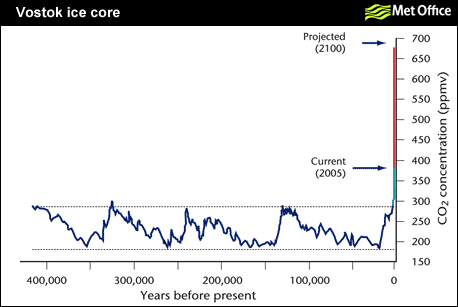
Atmospheric concentration of CO2

This ice core record of carbon dioxide concentrations illustrates one major reason why we should be more concerned about human-induced climate change than about natural variation. Our use of fossil fuels is generating a spike in greenhouse gas concentrations that is set to rise far above anything in the last 650,000 years, at least.

Attribution of climate change, from the IPCC 4AR

The above shows how observed warming is inconsistent with climate models that do not incorporate human greenhouse gas emissions, but consistent with those that do.
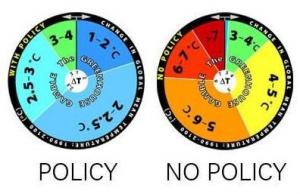
MIT climate roulette wheels

The wheel on the right depicts researchers’ estimation of the range of probability of potential global temperature change over the next 100 years if no policy change is enacted on curbing greenhouse gas emissions. The wheel on the left assumes that aggressive policy is enacted. (Credit: Image courtesy / MIT Joint Program on the Science and Policy of Global Change)

I would be delighted to answer and questions, or suggest further resources in other areas of interest.

Last updated: 23 January 2012

Inheritance law in Europe

Wheat stalks

One thing I didn’t know about continental Europe is that in many countries there inheritance isn’t something that you can allocate in your will. If you want to give it all to charity, tough luck: it is impossible and illegal. Instead, you are obligated to leave a set portion of your total estate to your children, divided equally among them. This is referred to as “forced heirship.” There are even provisions in place to “claw back” money given away in the last few years of life, so as to prevent people from circumventing the heirship law by donating while alive. As such, if you give a big dollop of money to a charity and die a few years later (less than two in Austria, or ten in Germany), the state might take it back and give some of it to your children.

This all strikes me as rather batty and weird. After all, the privilege of being able to assign where your wealth goes after death is a natural extension of private property rights in general (though is reasonably subjected to things like inheritance taxes). Particularly in the case of very wealthy individuals, you could also argue that giving a large set share of the estate to each child will do more harm than good. This is what Bill Gates, Warren Buffet and others have argued, when setting up their wills to give only a small fraction of their wealth to their children. Indeed, one of the major consolations associated with the way wealth tends to concentrate is that people who assemble truly colossal heaps of it often give a lot to charity as they age and die. Gates is certainly an example, as were Carnegie and others. The European system seems more inclined towards the establishment of dynasties. That said, it is certainly possible for people who have been given the ability to choose who will inherit their estate to make the choices poorly. There are definitely worse options than even distribution among children. Cases of people leaving their estates to their pets spring to mind.

In practical terms, there are lots of ways people could work their way around such requirements. They could hold much of their wealth in jurisdictions where the law is different. They could also convert most of their wealth into a life annuity upon retirement. It would be interesting to know what proportion of people use such mechanisms in European countries, and how they are distributed between different levels of wealth.

Three strikes rules for internet piracy

Charline Dequincey with her violin

The British ISP TalkTalk has been working to show why banning people from the internet, based on unproven allegations of piracy, is a bad idea. Specifically, they have highlighted how many people still use WEP to protect their wireless networks from use by strangers, despite the fact that WEP encryption is easily compromised. That means it is easy for someone to use software tools to access a nearby network and then use it for illegal purposes. My own experience with wireless networks has demonstrated that people really will use them for criminal purposes if they can gain access.

Beyond that, the idea of cutting people off on the basis of three accusations alone runs fundamentally contrary to the presumption of innocence in our system of justice. It would inevitably be abused by copyright holders, and it would inevitably lead to innocent people being cut off from the internet, an increasingly vital part of life for almost everyone. Indeed, Finland recently declared broadband access a right.

To me, the fact that laws like this may well emerge in France, the UK, and elsewhere seems like another example of just how badly broken our intellectual property (IP) systems are, and how badly skewed they are towards protecting the rights of IP owners rather than the public at large. We would be a lot better off if patents were granted more selectively, if licensing of them was mandatory, if copyright was less well defended and expired sooner, and if fair use rights were more effectively legally enshrined. Here’s hoping ‘pirate parties’ continue to proliferate, pushing back the IP laws that have become so unfairly weighted towards those who own the content.

After all, it needs to be remembered that there is nothing libertarian or natural about IP protection. Rather, content owners are having their property claims enforced by the mechanisms of the state. The justification for this is supposed to be that doing so serves the public interest; if that is no longer the case, the laws ought to be watered down or scrapped.

Promoting responsible mining

Previously, I described the phenomenon where mining companies leave behind messes that would eliminate their profits if they were obliged to clean them up. Often, however, these liabilities end up being borne by taxpayers in general, who either fund the cleanup or live with the consequences of the contamination.

Now, a private members bill proposes sanctions on Canadian mining companies that violate good governance and environmental standards abroad. Bill C-300 was proposed by Liberal MP John McKay, and has already passed through second reading in the House of Commons.

Extractive industries, including mining, certainly have a checkered history of international operations. While there are certainly examples of projects that take into account governance and environmental concerns, legal reforms that make these more typical are welcome.

Natural selection and species self-destruction

Woman in headphones

Late in The Greatest Show on Earth, Richard Dawkins reiterates a key point from his earlier book The Selfish Gene: namely, that there is nothing in natural selection to prevent a species from engaging in behaviour that is profoundly self-destructive in the long run. As he evocatively puts it:

“But, the planning enthusiast will protest, when all the lions are behaving selfishly and over-hunting the prey species to the point of extinction, everybody is worse off, even the individual lions that are the most successful hunters. Ultimately, if all the prey go extinct, the entire lion population will too. Surely, the planner insists, natural selection will step in and stop that happening? Once again alas, and once again no. The problem is that natural selection doesn’t ‘step in,’ natural selection doesn’t look into the future, and natural selection doesn’t choose between rival groups. If it did, there would be some chance that prudent predation could be favoured. Natural selection, as Darwin realized much more clearly than many of his successors, chooses between rival individuals within a population. Even if the entire population is diving to extinction, driven down by individual competition, natural selection will still favour the most competitive individuals, right up to the moment when the last one dies. Natural selection can drive a population to extinction, while constantly favouring, to the bitter end, the competitive genes that are destined to be the last to go extinct.” (p.389 hardcover)

The natural response to reading such a passage is to consider how it applies to human beings. A superficial reading is a dangerous one, as Dawkins describes at length in The Selfish Gene. It is possible for human beings to plan and to avoid the kind of deadly spiral he describes; it simply isn’t an inevitable product of evolution that we will do so. Probably without realizing it, Dawkins uses a terrible example to try to illustrate this human capability. He cites the “quotas and restrictions,” limitations on gear, and “gunboats patrol[ling] the seas” as reasons for which humans are “prudent predators” of fish. Of course, we are anything but and are presently engaged in a global industrialized effort to smash all marine ecosystems to dust. Nevertheless, the general capability he is alluding to could be said to exist.

In many key places, we need to accomplish what Dawkins wrongly implies we have achieved with fishing: create systems of self-restraint that constrain selfish behaviour on the basis of artificial, societal sanctions. Relying upon the probabilistic force of natural selection simply won’t help us, when it comes to problems like climate change. So far, our efforts to craft such sanctions (which would probably include ‘positive’ elements such as education) have been distinctly unsuccessful.

Perhaps if people could grasp the fact that there is nothing in nature – and certainly nothing supernatural – to protect humanity from self-destruction, they will finally take responsibility for the task themselves. The blithe assumption that a force beyond us will emerge to check the excesses of our behaviour is dangerously wrong. Now, if only people could show some vision and resolve and set about in rectifying the most self-destructive traits of our species, from indifference about the unsustainable use of resources to lack of concern about the destructive accumulation of wastes. In this task, we actually have an advantage in the existence of states that exist largely to constrain individual behaviour. The kind of behaviours that produce the self-destructive spiral in Dawkins’ lions can potentially averted by putting their human equivalents into the shackles of law.

US climate legislation and the Copenhagen talks

Some news sources are reporting that Obama’s top energy advisor is saying there will be no new climate legislation in the US this year. If true, that would mean that the US will be going to the UNFCCC negotiations in Copenhagen with disappointingly little to offer as evidence of progress, reducing the chances that the talk will succeed.

That being said, Joseph Romm is decrying such stories as misleading and old news. He claims that: “for many, many months now the only issue for those who follow DC climate politics has been whether the Senate would pass a climate bill before Copenhagen, not whether a final bill would get onto Obama’s desk before Copenhagen.”

Romm has been playing the role of arch-optimist when it comes to the Waxman-Markey bill and the upcoming Copenhagen talks. Hopefully, his perspective will prove justified in light of future events.

BioBricks and synthetic biology

Frog with leaves in Mud Lake

The basic impulse behind synthetic biology is one that human beings have been acting on for thousands of years: the desire to make living things serve our needs and desires better. We’ve domesticated animals, seriously altering their genomes and behaviours in the process, and turned wild crops into agricultural staples. Now, people aspire to use living things for all kinds of purposes: from synthesizing drugs and fuels to performing computations.

One of the most important developments of the Industrial Revolution was standardized parts. Originally used in firearms, having devices comprised of interchangeable components made maintenance and repair far simpler. Instead of having to make a custom widget designed to fit a particular machine, any standard widget of the right sort would do. To some extent, BioBricks are trying to do the same thing for engineered biological systems. Each consists of a DNA sequence held in a circular plasmid, with standard headers and footers. They include sites for enzymes, which allow the bricks to be chained together. Individual BioBrick ‘parts’ contain information such as how to code a particular protein. They are assembled into ‘devices’ that perform basic functions, and ‘systems’ that accomplish higher level tasks. MIT maintains a ‘catalog of parts and devices.’ There is even an iPhone application that allows the “review, annotatation, design, and implemention of standard biological parts.” An assembly kit adequate for 50 reactions can be purchased online for US$235.

One application of synthetic biology has been to make Amorphadiene, a chemical precursor to the ant-malarial drug artemisinin (mentioned here before). Producing the drug from the shrub in which it was discovered is expensive and tricky. As a result, annual demand far exceeds available supply. Producing it in engineered organisms could therefore make treatment more widely available. Amyris Biotechnologies, working with a grant from the Bill and Melinda Gates Foundation, has produced the drug using such an organism, and is hoping to have it on the market by 2012. The company’s founder hopes to eventually be able to synthesize any molecule found in a plant inside an easy-to-grow microbe.

Another mooted application would be engineering photosynthetic algae to produce and release oils, which could be collected and used as fuels. Such a process could be far more efficient than one based on growing conventional algae and then processing them for whatever quantity of oils they contain naturally.

Of course, synthetic biology does raise safety and ethical considerations. While I don’t think tinkering with genetic material is fundamentally morally different from cross-breeding plants or animals, there may be more danger of unanticipated consequences. Weighing the reality of that risk against the promise of what engineered organisms could do isn’t a straightforward task, especially in situations where the groups bearing the risk and receiving the benefits are not one and the same. Regulating the industry, and establishing legal precedents on things like liability, will be an important part of future policy- and law-making.

Sarkozy’s incoming carbon tax

While Canada’s best effort at a carbon tax ended in failure, one worth about $25 a tonne seems likely to be adopted in France. The new tax is intended to be revenue neutral, with corresponding handouts to households (both those that pay tax and those that don’t) and corporations. Some expect the most significant impact to be on liquid fuel prices. Sweden has been rather more ambitious in this regard, having imposed a tax of about $100 per tonne on oil, coal, natural gas, liquefied petroleum gas, petrol, and aviation fuel used in domestic travel.

Like most carbon taxes, the French initiative includes significant loopholes – including for heavy industry and non-nuclear forms of electricity generation. Even so, it represents a bit of good news in the lead-up to the UNFCCC negotiations in Copenhagen this December. Hopefully, it will be progressively expanded to other emitting activities, at the same time as the level of the tax is progressively increased. Here, Sweden sets an encouraging example: when they imposed their carbon tax in 1991, it was at about 1/4 of its present level.

[Update: 23 March 2010] French government backs down on carbon tax plan

The B.C. government’s forcible relocation law

Frog on a log in Mud Lake

In the run-up to the Vancouver Olympics, a law has been proposed in British Columbia that would allow police officers to forcibly transport homeless people to shelters during ‘harsh’ weather. Once they are at the shelters, they will be permitted to leave at their discretion. While it is never desirable for people to be harmed for lack of shelter, this law strikes me as morally and legally problematic. It is certainly seems contrary to section nine of the Canadian Charter of Rights and Freedoms, which provides protection against arbitrary detention and imprisonment. The question then is whether it is ‘saved’ by section one, which allows for the other rights to be subjected “only to such reasonable limits prescribed by law as can be demonstrably justified in a free and democratic society.”

Under the Oakes test, which has become Canada’s standard but unofficial way of interpreting section one of the Charter, there are a number of requirements for allowing a law that violates a section of the Charter from being ‘saved’ by the ‘reasonable limits’ clause in section one. There must be a “pressing and substantial objective” and the means must be “proportional.” More specifically, the means must be “rationally connected to the objective,” involve a “minimal impairment of rights,” and that the law be proportional to the objective. People dying of exposure could certainly be categorized as a pressing and substantial objective, but I am less sure about whether there is a minimal impairment of rights involved. Certainly, the onus must be on those advocating the law to provide a strong argument for why it is constitutional. Such an argument would have to establish clearly that existing powers on the part of emergency services are inadequate to prevent homeless people suffering and dying during extreme weather, that forcible relocation would help, and that the violation of rights is proportional to the benefit.

The law may also be discriminatory insofar as it is meant to apply only to the homeless. Under the law, it seems like police would treat people differently when they came across them in extreme weather, based on whether they have a ‘home’ somewhere. The law would certainly never pass if it also included provisions for police to forcibly take people with homes back to them, if they happened to be out during an extreme weather event.

It is certainly important that shelters be available for the homeless, and that they be able to access them (especially during times of harsh weather). That being said, it is not clear why police should have the power to forcibly transport people. For one thing, the law risks being abused to clean up Vancouver’s image during the Olympics. Vancouver’s problems with drugs and homelessness are certainly something the Olympic organizers would want to keep out of the media. If they did so, however, it would be a shame; it would show that the city is prepared to simply suppress the visibility of enduring problems, rather than making a serious effort to respond to them.

Arguably, most of the problem of homelessness is the product of a weak social safety net, especially in areas like mental health and the treatment of drug addiction. For people who have others who care about them, it is possible to get reasonable assistance with such problems. For people with serious mental issues and nobody to play an assisting role, things must be much more difficult. Authorizing police to round up people who have committed no crime when it is cold and rainy seems more like an awkward cover-up mechanism than like a policy motivated by genuine concern for human welfare.

Unmanned aerial vehicles

Muskrat (Ondatra zibethicus), in Mud Lake, Ottawa

In most of the world’s militaries – and even in paramilitary groups like Hezbollah – drones and unmanned aerial vehicles (UAVs) are playing increasing roles in combat and intelligence gathering. They are running ahead of convoys in Afghanistan and Iraq to try to spot or jam improvised explosive devices (IEDs). Even as far back as the first Gulf War, they were being used by battleships to target fire from naval guns. Some Iraqi troops even surrendered to them.

Some even go so far as to say that the era of manned fighter aircraft is drawing to a close, and that the American F-22 may be their last such craft. They can be more manoeuvrable than manned craft, since the physical limitations of pilots are no longer an issue. This is an increasingly serious problem as surface-to-air missiles continue to become faster, more advanced, and more widely employed. Due to not being limited by pilot fatigue, UAVs can also have a much more enduring presence. Missions lasting several days have already been undertaken, and future vehicles may be able to remain airborne for weeks or even months. The US Navy has a ‘Broad Area Maritime Surveillance (BAMS)’ program, which aims to provide intelligence coverage of most of the world’s strategic ocean areas, with vehicles capable of loitering for 24 hours.

Of course, the new technologies raise issues beyond military strategy. The ethics of programming machines that employ lethal force will probably become an increasingly important element of international law.