Debates within society at large, and within the scientific community

Elaborating on work discussed here before, Gavin Schmidt provides some information on what distinguishes the most recently developed sorts of climate models for their predecessors, such as General Circulation Models. The newer Earth System Models:

now include interactive atmospheric chemistry, aerosols (natural and anthropogenic) and sometimes full carbon cycles in the ocean and land surface. This extra machinery allows for new kinds of experiments to be done. Traditionally, in a GCM, one would impose atmospheric composition forcings by changing the concentrations of the species in the atmosphere e.g. the CO2 level could be increased, you could add more sulphate, or adjust the ozone in the stratosphere etc. However, with an ESM you can directly input the emissions (of all of the relevant precursors) and then see what ozone levels or aerosol concentrations you end up with. This allows you to ask more policy-relevant questions regarding the net effects of a particular sector’s emissions or the impact of a specific policy on climate forcing and air pollution.

Atmospheric chemistry is clearly a highly complex field. This makes it all the more strange and troubling that such a vast divide exists between debate between experts in the scientific community and debate within society at large.

That said, I suppose these situations aren’t really all that rare. Serious geologists and biologists continue to work out the minutiae of the history of present status of the Earth, at the same time as laypeople and self-styled ‘experts’ maintain debates about whether the world is 6,000 years old and whether all the creatures on it have existed since the beginning of time. By the same token, no matter how sophisticated scientific modeling of the climate becomes – and how much data accumulates demonstrating human-induced warming – there will still be people willing to baldly assert that climate change isn’t happening / is natural / isn’t a problem / is beneficial / is caused by sunspots, etc.

Wetlands and greenhouse gas emissions

Red maple leaf on grass

A recent report from Wetlands International provides a global overview of greenhouse gas (GHG) emissions from wetlands. Neither their present state nor their total greenhouse gas holdings are comforting. Indonesia is the world’s most substantial emitter of GHGs from peat, with annual emissions of 500 million tonnes of carbon dioxide (CO2). That is about 2/3 of Canada’s total emissions. When it comes to stock, Canada leads the world with a troubling 155 billion tonnes of CO2 embedded in peat, enough to add 569 billion tonnes of CO2 to the atmosphere. In total, the 0.3% of the world’s land surface covered by drained peat already generates about 6% of global emissions.

This reinforces two points about climate change mitigation:

  1. Firstly, we need to pay attention to land use changes as well as fossil fuel use, when it comes to cutting down the amount of GHGs humanity is adding to the atmosphere, eventually stabilizing at zero net emissions.
  2. Secondly, if we create enough warming, there are huge stocks of carbon that could be released, pushing that process even further. Pushing the climate system to the point where positive feedbacks become dominant would commit us inescapably to significant additional warming, over and above that created through direct human actions.

While policies like a carbon tax to discourage emissions are a critical part of the solution, humanity needs to accept that our overall physical and biological impact on the planet is so large that we need to give serious consideration to how our collective policies and individuals choices are affecting the future of the climate. Recognizing the carbon intensity of drying marshland is a small but important part of that.

Gorbachev on climate change and the Berlin Wall

Mikhail Gorbachev has written an article for The Times arguing that there are similarities between the battle against climate change today and the fall of the Berlin Wall twenty years ago:

Addressing climate change demands a paradigm shift on a scale akin to that required to end the Cold War. But we need a “circuit-breaker” to escape from the business-as-usual that currently dominates the political agenda. It was the transformation brought about by perestroika and glasnost that provided the quantum leap for freedom for the Soviet Union and Eastern Europe, and opened the way for the democratic revolution that saved history. Climate change is complex and closely entwined with a host of other challenges, but a similar breakthrough in our values and priorities is needed.

There is not just one wall to topple, but many. There is the wall between those states which are already industrialised, and those developing countries which do not want to be held back. There is the wall between those who cause climate change, and those who suffer the consequences. There is the wall between those who heed the scientific evidence, and those who pander to vested interests. And there is the wall between the citizens who are changing their own behaviour and want strong global action, and the leaders who are so far letting them down.

He also calls on the leaders of the US, UK, India and China to attend the Copenhagen summit personally.

Of course, there are major differences between the two cases. The Berlin Wall was effectively a mechanism to hold people back from acting as they wished to, halting the movement of people from East to West Germany, and beyond. Dealing with climate change isn’t about allowing the energy people already have to be put into application, but rather about encouraging and compelling them to behave in better ways, largely for the welfare of others. That being said, it is good to see the historic importance of success or failure on this issue recognized. Hopefully, Copenhagen will go better than people are predicting.

Why conservatives should love carbon taxes

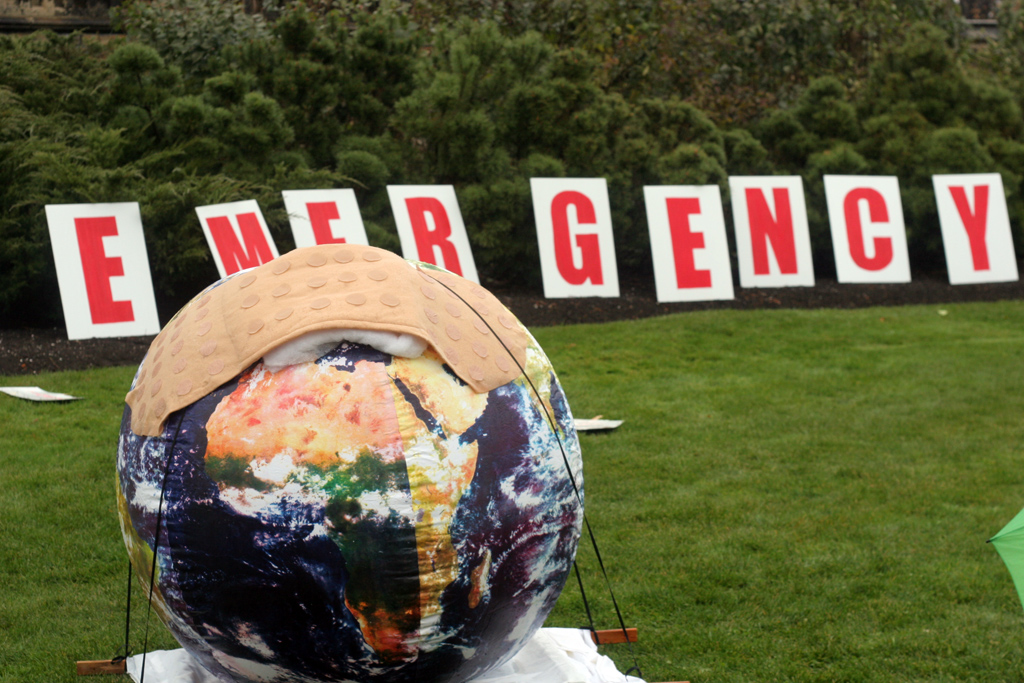
Climate emergency

The National Post – Canada’s right-leaning daily newspaper – has publicly stated that it believes climate change is real, and also that the current government has the right approach to dealing with it. In particular, it praises Environment Minister Jim Prentice for avoiding the “creation of state-managed “green economies” — socialism with a Gaian face.”

Whether such a creation is possible (and whether it would be desirable or not) are questions that can be set aside for a moment. The irony that seems to be paramount when it comes to the relationship between conservatives and climate change is how they stress a desire to interfere in markets and individual choices as little as possible, while rejecting the mechanism that would do that best: a carbon tax. A carbon tax doesn’t force anyone to drive a small car or, terrifying thought, forgo automobiles all together. It doesn’t force people to choose small pets, give up flying, or make other specific sacrifices. It also doesn’t rely upon the government deciding which energy technologies should succeed, whether that means renewables, nuclear, carbon capture and storage, or something else. It encourages low-carbon technological development in the most hands-off and market-friendly way possible.

All a carbon tax does is take the price imposed on strangers by greenhouse gas emissions and makes it ‘internal’ to the decision-making of individuals and other economic actors throughout society. It comes the closest to retaining the libertarian ideal in a world where interconnectedness forces us to take into consideration the consequences our actions will have on others. I have talked before about the irony of how laissez faire climate policies will inevitably fail and force governments to take employ more coercive measures. That outcome can only be avoided by sending a clear price signal on greenhouse gas emissions, and doing so early and at a meaningful level. Indeed, a carbon tax can be said to be a way of protecting property rights, given that it reduces the degree to which emitters will harm the property and prosperity of other people around the world.

It should be noted that the important policy change here is to put a price on carbon emissions, to represent the harm they cause to other people. The establishment of such a price is more important than the precise mechanism through which it is done, whether that is a carbon tax or a cap-and-trade system in which 100% of the permits are sold at auction. The choice of instrument is less important than moving quickly to put a price on carbon in one way or another.

It is an open question whether conservatives will realize the extent to which they are undermining their own aims and ideals through opposition to carbon pricing. Part of that is the paleoconservative stance that climate change isn’t happening, that it is benign, that it is inevitable, etc. Among conservatives with enough basic awareness about the world to know that those arguments have been discredited, we should hope that support begins to grow for the idea of dealing with the climate problem in the way that involves the least expansion of the state and the least infringement on liberty: a carbon tax.

While there may well be cause for accompanying such a tax with other regulations – such as a ban on coal power – at least gaining conservative support for some kind of carbon action would change the tone of the debate. We would finally stop pretending that we can ignore climate change indefinitely while the economy keeps ticking on just fine, and begin to appreciate and implement the steps required to build a low-carbon future.

Milk

Red tow-away sign

Watching Milk was a reminder of the unusual sort of luxury supporting the gay rights movement actually provides. It is the kind of utterly unambiguous moral movement that emerges only rarely: where one side is unassailably aligned with human welfare and human rights, and the other is straightforwardly mistaken from top to bottom.

While it is tragic that significant numbers of educated people – people who think of themselves as ethical – continue to oppose equal rights for gay men, lesbians, bisexuals, and transgendered people, it does seem worth hoping that the movement opposing these basic liberties will falter and die within our lifetimes, at least within the kind of developed states that have largely abandoned bigotry motivated by ill-founded personal revulsion or oppressive religious notions of morality. While it will take longer for the world as a whole to reach such a state, there does also seem to be reason to hope that it will eventually happen.

In the mean time, the movement for gay rights will continue to have a special motivating character, for all those who aspire to a more equitable and less benighted world. It represents one of the purest contests of sense and tolerance against bigotry and violence ongoing in the world today.

From the Cambridge ivory tower to Whitehall

Apparently David MacKay, whose excellent book I reviewed before, has been appointed Chief Scientific Advisor of the Department of Energy and Climate Change in the United Kingdom and given a staff of 50. Apparently, he is advocating that the UK quadruple its nuclear energy capacity, as a stopgap between fossil fuels and the eventual dominance of renewables. Personally, I think it is encouraging that someone who committed so much personal energy to thinking about ways to get off fossil fuels has been given a mandate to help do so, in an official capacity.

My friend Mark let me know about this development.

Climate science and policy-making

I wrote the following to serve as a one-page introduction, laying out some of the key items for consideration and listing some of the most accessible and reputable sources of information about climate change. For more information on specific subjects, see my climate change index.

The key elements of the general climate science and policy consensus are:

  • On average, the planet is warming.
  • Most of this is because of human emissions of greenhouse gases.
  • Continued warming would be harmful, and perhaps very risky when it comes to human welfare and prosperity. Anticipated changes include melting glaciers and polar ice, more extreme precipitation events, agricultural impacts, wildfires, heat waves, increased incidence of some infectious diseases, sea level rise, ocean acidification, and increased hurricane intensity.
  • By most accounts, the cost of mitigation is less than the cost of adaptation. Some anticipated changes may overwhelm the capacity of human and natural systems to adapt.

While there is a public perception that there is a lot of scientific disagreement about the fundamentals of climate science, this really is not the case. Back in 2004, a survey of peer-reviewed work on climate science demonstrated this. There is also a notable joint statement from the national science academies of the G8, Brazil, China, South Africa, and India.

To borrow a phrase from William Whewell, there is a ‘consilience of evidence’ when it comes to the science of climate change: multiple, independent lines of evidence converging on a single coherent account. These forms of evidence are both observational (temperature records, ice core samples, etc) and theoretical (thermodynamics, atmospheric physics, etc). Together, these lines of evidence provide a conceptual and scientific backing to the theory of climate change caused by human greenhouse gas emissions that is simply absent for alternative theories, such as that there is no change or that the change is caused by something different.

Readers who are dubious about the validity of mainstream climate science, or unsure of what to think, my page for waverers may be useful.

1) Climatic science and history

There are some good primers available from reputable organizations online. For instance, the United Kingdom’s Met Office has a quick guide.

The Fourth Assessment Report of the Intergovernmental Panel on Climate Change (IPCC) is the most authoritative review of the scientific work that has been done on climate change. The summary for policy-makers for the synthesis report is available online.

For detailed information on the physical science of climate change, the technical summary of the IPCC’s Working Group I report is a good resource. Unlike the summaries for policy-makers, which are vetted through a quasi-political process, the technical summaries are prepared exclusively by scientists.

For Canadians who want to read one book about climate science and policy, I recommend University of Victoria Professor Andrew Weaver’s book: Keeping Our Cool: Canada in a Warming World.

For those looking for a concise history of the entire development of climatic science, starting in the late 1800s, I very much recommend Spencer Weart’s The Discovery of Global Warming. In addition to the book form, it is available free online.

For a more specific history of what we have learned about climate from ice core samples, see Richard Alley’s The Two Mile Time Machine. For an excellent (though somewhat technical) discussion of the relationships between the carbon cycle and biological organisms, see Oliver Morton’s Eating the Sun.

2) Climate change mitigation

Ultimately, the only way to keep the concentration of greenhouse gases in the atmosphere constant is to reach the point where humanity has zero net emissions. Getting there fundamentally requires two things: the shifting of the energy basis of the global economy to low- and then zero-carbon sources, and the stabilization of the biosphere through actions like ending net deforestation. It is widely accepted that setting a sufficiently high price for greenhouse gas emissions is a vital way to drive mitigation actions.

Three excellent books that evaluate options for moving to a low-carbon economy are:

On the costs of climate change mitigation, the most comprehensive work is probably that which has been done by Nicholas Stern, beginning with the Stern Review. The review’s executive summary is also accessible online. More recently, he has argued that the costs of inaction are even more significant than those projected at that time.

On the political and ethical side of things, the best short summary may be Stephen Gardiner’s article “Ethics and Global Climate Change,” published in Ethics. Volume 114 (2004), p.555-600. One key idea related to international equity and climate change mitigation is contraction and convergence: an arrangement in which the emissions from all states eventually fall to zero, but where the per-capita emissions of developed and developing states also converge over time.

My fantasy climate change policy combines a moratorium on coal and unconventional fossil fuels with a hard cap on emissions.

3) Other major climate change issues

Other areas relevant to climate change policy-making include:

  • Abrupt and runaway climate change scenarios
  • Adaptation to climate change
  • Carbon sinks (physical, such as the oceans, biological, such as the forests, and geological, such as rocks that erode and form carbonates)
  • Economics (carbon pricing, risk management, etc)
  • Emission pathways (and their international breakdown)
  • Equity issues (historical responsibility, climate change and development, etc)
  • Global politics and international law
  • Planning and design (cities, buildings, etc)
  • Science (climatic equilibria, models and projections, etc)
  • Sociological and philosophical issues (ethics, communication, political theory, etc)
  • Targets (stabilization concentrations, temperature change, etc)
  • Technologies (renewable energy, transport, nuclear, efficiency, etc)

I can recommend resources in all of these areas, if someone has a particular interest.

4) Good sources of climate related news

Probably the best scientific climate change blog is RealClimate.

Good responses to climate ‘skeptic’ arguments can be found in the How to Talk to a Climate Skeptic series. I also keep track of my own arguments with climate change deniers.

Climate coverage in mainstream media sources is often inconsistent in quality. The BBC and The Economist often publish good information, but also sometimes include incorrect or misleading information.

5) A few key graphics
Atmospheric concentration of CO2

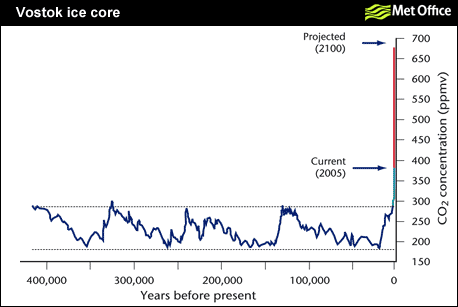
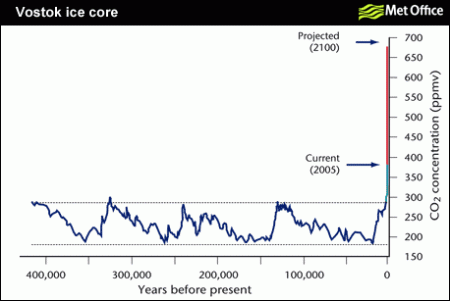
This ice core record of carbon dioxide concentrations illustrates one major reason why we should be more concerned about human-induced climate change than about natural variation. Our use of fossil fuels is generating a spike in greenhouse gas concentrations that is set to rise far above anything in the last 650,000 years, at least.
Attribution of climate change, from the IPCC 4AR

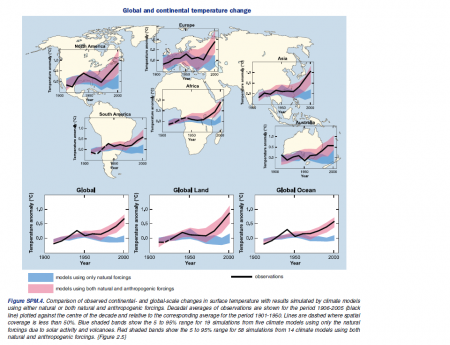
The above shows how observed warming is inconsistent with climate models that do not incorporate human greenhouse gas emissions, but consistent with those that do.
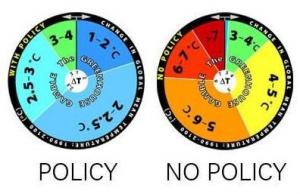
MIT climate roulette wheels

The wheel on the right depicts researchers’ estimation of the range of probability of potential global temperature change over the next 100 years if no policy change is enacted on curbing greenhouse gas emissions. The wheel on the left assumes that aggressive policy is enacted. (Credit: Image courtesy / MIT Joint Program on the Science and Policy of Global Change)

I would be delighted to answer and questions, or suggest further resources in other areas of interest.

Last updated: 23 January 2012

Oil 101

Twigs and branches

Written essentially in the style of a textbook, Morgan Downey’s Oil 101 moves systematically through the major areas of knowledge required for a basic understanding of the global petroleum industry. These include:

  • The history of oil use, including predictions about the future
  • The chemistry of crude oil
  • Exploration for and production of oil
  • Refining
  • Petrochemicals
  • Transporting oil
  • Storing oil
  • Seasonal demand variation, pricing, and oil markets

Downey covers each in a clear and informative manner, though he sometimes delves into a greater level of detail than most amateurs will prefer. For instance, some of the forays into chemistry are at a level of sophistication well above what casuals readers are likely to retain. That said, the book is laid out in a highly structured way, so it is easy to gloss over technical portions without losing track of the overall structure of the text.

One thing the book strongly demonstrates is the enormous amount of expertise and capital that have been developed within the petroleum industry. For instance, the section on how offshore oil platforms are constructed and operated shows what an astonishing number of things can be executed deep underground, from a steel platform above the ocean’s surface: everything from horizontal and vertical drilling to the assembly of steel pipes (cemented in place), the use of explosives, the installation of automatic or remote-controlled valves, the injection of acids and chemicals, etc. The discussion of refining and transport technologies and infrastructure is similarly demonstrative of sustained investment and innovation. While it is regrettable that all of this effort has been put into an industry that is so climatically harmful, it does suggest that humanity has a great many physical and intellectual resources to bring to bear on the problem of finding energy. As more and more of those are directed towards the development of renewable energy options, we have reason to hope that those technologies will improve substantially.

The final portion of the book, about oil prices and forward oil markets, was the least interesting for me, as it deals with complex financial instruments rather than matters of chemistry, geology, etc. Still, for those who are seeking to understand how oil prices are established, as well as what sorts of financial instruments exist that relate to hydrocarbons, these chapters may be useful. Downey does provide some practical advice to those whose organizations (companies, countries, etc) are exposed to changes in oil markets: “The decision not to hedge [Buy financial products that reduce your exposure to a risk of major price changes] should be an active decision. Management should clearly inform investors why they decide to face the full volatility of the oil market when they have an opportunity to manage the risk.” Managing such risks on an individual level has been discussed here before.

All told, this book is well worth reading for all those who are curious about the energy basis for global civilization, why it is established the way it is, and some of the key factors that will determine which way it goes. Downey is a low-key proponent of the peak oil theory. He argues that reserves, especially in OPEC, are inflated and that a peak and bell-shaped drop-off in production are inevitable: probably between 2005 and 2015, provided depletion occurs globally at about the same rate as it did in the United States following their peak in 1970. For those hoping to grasp the implications of that projection, as well as those hoping to plan for a world based on other forms of energy, the information contained in this book is both valuable and well-presented.

British, EU, and US negotiators expect little from Copenhagen

Apparently, the United States has now made clear that they do not expect a climate deal to emerge at Copenhagen this year, when the United Nations Framework Convention on Climate Change (UNFCCC) gathering is to take place. This isn’t really news, but it is certainly disappointing. In a few years, I think people will look back regretfully at how much time, money and political energy were directed at the credit crunch, while the much more important problem of climate change mitigation was neglected.

A big part of the reason for the delay is certainly the difficulty the Obama administration has had getting a climate change bill through Congress. The Republicans deserve a lot of criticism for their caveman mentality on this issue. Their united opposition to meaningful action on climate change is irresponsible and a dereliction of duty, insofar as they are charged with defending the long-term welfare of the United States. While pricing carbon will cause short-term harm to certain industries now, it is the only way to kick off the sustained transition to a low-carbon economy that long-term prosperity ultimately depends upon.