Some carbon capture similes

The media is full of talk about carbon capture and storage (CCS). At the same time, there are only four facilities in the world where it is done. None of them resemble a conventional coal-fired power plant.

As a result, our cost projections for the technology are far more speculative than is commonly acknowledged. It is like we are in the era of the Wright Brothers, and we are trying to sort out the economics of running a major airline.

As I have said before, we had better hope that CCS works, if only because so many different climate change mitigation plans depend on it. At the same time, we really need to acknowledge that there is some chance that it simply will not work, and we will need to find those megatonnes of reduction somewhere else.

That uncertainty also pertains to questions about building more coal power plants. Building them today – with the hope that CCS will eventually become available – is highly irresponsible. It might be compared to jumping out of a plane and hoping you can sew yourself a parachute before you hit the ground.

Thoroughly impressed by TED

Steel girders and sky

Initially drawn in by the Al Gore video, I have been watching lots of the films from the TED conference, and being impressed by many of them. I am more impressed than ever by cephalopods, and some of my idle curiosity about how ants decide what to do has been satisfied. I also learned about some new reasons for which we should be wary about the long-term use of antidepressant drugs.

Putting these short lectures online is an excellent way of demonstrating the power of the internet to distribute ideas. Even for those of us who would balk at flying to California to attend some very neat talks, fiber optic links provide a low-carbon alternative.

Al Gore at TED

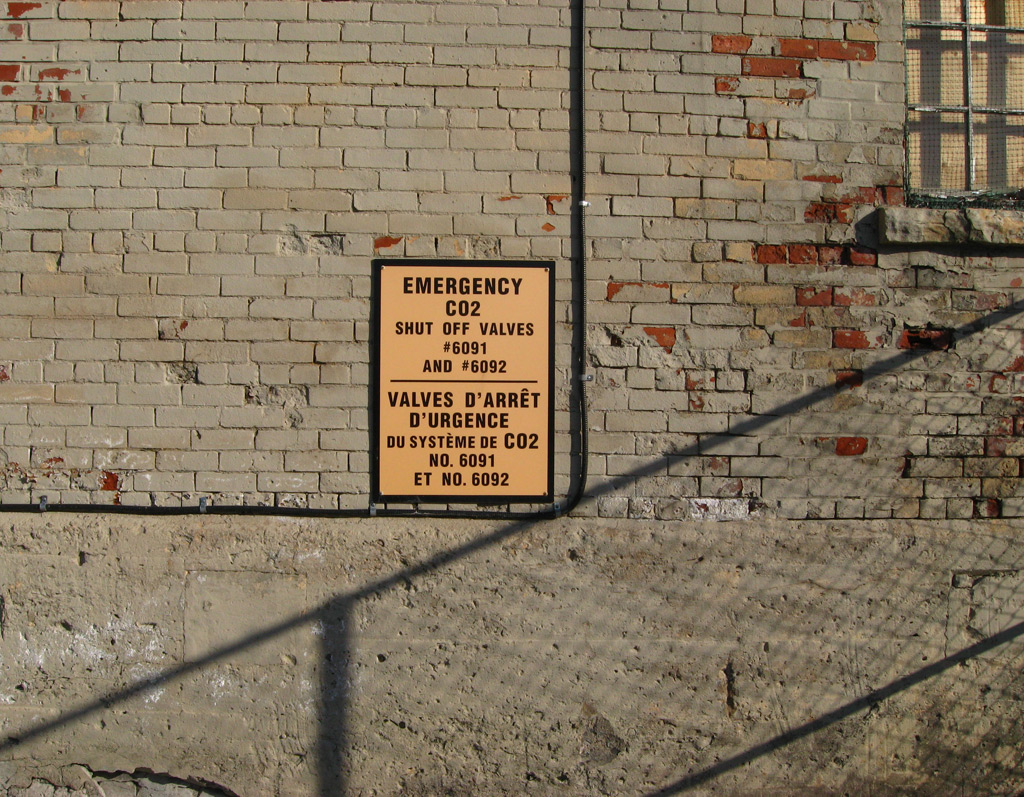
Safety sign

The Technology Entertainment Design Conference takes place annually in Monterey, California. At the most recent one, Al Gore presented an updated version of his climate change slideshow, made famous by his film An Inconvenient Truth.

It seems a bit remarkable for me that when I first saw that film in Oxford, I wasn’t yet convinced about the full extent of the threat of climate change. Since then, I have devoted the majority of my time and attention to this issue. If you have not done so yet, I encourage you to watch the video linked above, and perhaps read some of the posts in my climate change index.

It is not unrealistic to say that climate change will be the defining issue of the next century, and possibly far beyond. Gaining a strong understanding of it is the least we can do as educated people today.

Mintz on carbon taxes

Jack Mintz, who is apparently one of Canada’s leading economists, came out in support of a carbon tax today. Specifically, he suggested that federal taxes on gasoline be expanded to include the taxation of other carbon-generating fuels. This sort of upstream tax on fuels can complement a cap-and-trade regulatory scheme for large emitters by covering sectors of the economy too small to be efficiently addressed through the latter approach. Mintz does not have a reputation as a green champion, making his endorsement all the more suggestive of a general trend towards accepting carbon taxes as one good approach for addressing the massive problem of climate change.

Whereas the carbon tax recently created in British Columbia begins with prices of $10 a tonne, eventually rising to $30, Mintz proposes a federal tax of about $42 a tonne. One of the major issues raised concerns inter-provincial transfers from high emission provinces like Alberta and Ontario to lower emitting provinces like Quebec. That being said, there are many ways in which carbon taxes can be designed. They can be set up so as to not increase the overall tax burden, on account of taxes being reduced elsewhere. They can also be designed so that revenues collected in one province must also be recycled or invested there.

With luck, people will start to realize the opportunities inherent in replacing conventional taxes with carbon taxes. Doing so will offer a strong financial incentive to invest in greater efficiency, cleaner fuels, and more sustainable practices generally.

Hurricanes and climate change action

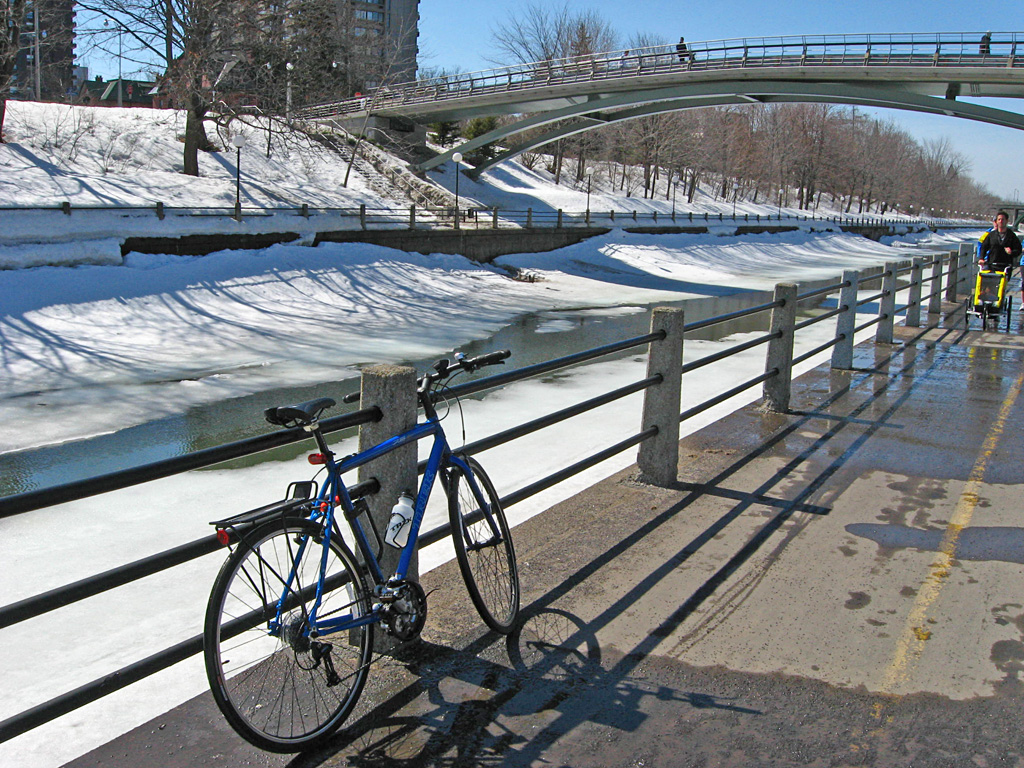
Bike beside the Rideau Canal in spring

At several points in the past, I have mentioned the possibility that the majority of people will not be willing to accept serious action on climate change until at least one big, unambiguously climate related disaster has taken place. The same point is made in Joseph Romm’s book but, whereas I have speculated that it could be vanishing icecaps or large-scale climate induced human migration in Asia, he seems to think that Atlantic hurricanes striking the United States may make the difference.

There is good reason to find this plausible. The strength and frequency of hurricanes both have a lot to do with sea surface temperature (SST). While it isn’t feasible to attribute the occurrence or harmfulness of a particular storm to climate change, it is relatively easy to show a correlation between rising global temperature, rising SST, and more severe hurricanes. Simulations conducted by the U.S. National Oceanic and Atmospheric Administration Geophysical Fluid Dynamics Laboratory led to them concluding that “the strongest hurricanes in the present climate may be upstaged by even more intense hurricanes over the next century as the earth’s climate is warmed by increasing levels of greenhouse gases in the atmosphere.” Within decades, rising SSTs could make the kind of extraordinary hurricane seasons that have proliferated since 2000 the low end of the new scale.

This matters partly because a hurricane-climate change connection would affect Americans directly and very visibly. Insurance prices would rise further, at the same time as more areas became uninsurable and serious questions arose about whether to rebuild at all in some places. The cost trade-offs between insurance, protective measures like higher levees, and storm risk would be thrown into sharp relief. The perceived damages associated with climate change would also shift from being associated with people outside of North America at some distant point in the future to being both physically and temporally immediate.

Obviously, it would be better if serious measures to combat climate change (eliminating non-CCS coal, pushing hard on energy efficiency, building dramatically more renewable capacity, etc) could come about simply as the result of a reasoned assessment of the IPCC’s scientific conclusions and projected associated costs. If, however, it is going to take disasters before people and politicians are ready to embrace real change, we should hope that they will come early, carry a relatively small cost in human lives, and not exacerbate the problem of climate change in and of themselves, as fires and ice loss do.

Air travel and looting

In some ways, engaging with the ongoing debate about air travel and greenhouse gas emissions feels like being among a crowd of looting rioters. People are happily smashing windows, grabbing cameras and iPods. There you stand, wondering what ought to be done.

The easy option is to loot. Your small contribution to the total level of theft and damage will not be recognizable after the fact. Immediate benefits can be secured for yourself, with costs being born by some unknown other person at some point in the future. In choosing to refuse, you accomplish nothing noticeable. Furthermore, you risk cursing yourself in the future for having missed out: for having not gotten ‘while the getting was good.’

The people around you want you to loot. Having a non-looter around is uncomfortable. It draws attention to the way in which the choice to loot is a moral choice, and how it is made on an individual basis. It forces people who are looting to justify their choice somehow – both publicly and in the confines of their own thinking.

The comparison above risks infuriating people and generating accusations of hypocrisy. How can anyone who has flown before say such a thing? It is true that past misconduct damages a person’s credibility. At the same time, it has no bearing on the fundamental rightness of wrongness of the position being adopted. As individuals, we need to consider whether the environmental harm associated with flying is somehow akin to being one tiny node in a million-person mob. If so, we need to question whether it is something we can continue to do.

Hell and High Water

Bridge component

Joseph Romm’s Hell and High Water: Global Warming – the Solution and the Politics – and What We Should Do might be fairly described as an American version of George Monbiot’s Heat. It describes much less intrusive means for responding to the threat of climate change, as well as being more tailored to American politics. It is also less ambitious that Monbiot’s work, since it aims at the stabilization of atmospheric concentrations of greenhouse gasses (GHGs) below 550 parts per million (ppm) rather than 450.

The book is basically divided into two sections: one of which describes the nature and extent of the threat posed by climate change and one talking about solutions. The book is very explicitly focused on what climate change will do to Americans. Romm argues that too much coverage has focused on effects in poor countries, leading Americans to think the impact of climate change on their lives will be minimal.

Romm talks a great deal about how groups opposed to GHG regulation have created and funded a group of irresponsible ‘experts’ trying to convince the general public that major disagreement still exists about the reality and probable impact of climate change. He is very critical of the media, particularly for giving equal attention to the conclusions of a few oil-funded crackpots, compared with those of the enormous majority of scientists and all major scientific assessments.

I have some quibbles with some of Romm’s technological recommendations. I think he is a bit overconfident about the rapidity with which carbon capture and storage and cellulosic ethanol might be deployed. That said, the vast majority of what he says is correct, well defended, and similar to the thinking of others who have considered the questions seriously.

One notable omission from the book is emissions associated with air travel. At no point are they mentioned, either as a problem or an area where policy could yield improvements. As Monbiot effectively highlights, emissions from air travel are among the toughest to address, not least because lots of well-off people who consider themselves environmentalists and support good environmental policies nonetheless want to be able to jet off to South Africa or New Zealand.

Overall, Romm’s book is informative and accessible. He does a good job of bringing the issue home for Americans – de-emphasizing issues like the preservation of nature and international fairness – and emphasizing why they, personally, should be worried. Certainly, the kind of climatic impacts projected by the IPCC for 2030 or so are enough to make any reasonable person extremely nervous. He is right to say that, in a world where GHG concentrations are 650 ppm or more, climate change will be the issue being dealt with by all governments. Equally, he is right to point out that concentrations of that magnitude have a very serious risk of pushing us into a self-reinforcing cycle producing temperature increases of more than 5˚C globally and sea level increases of 25 metres or more. Hell and high water, indeed.

“The Environment: A Cleaner, Safer, Healthier America”

Milan Ilnyckyj on the Alexandra Bridge, Ottawa

A book I am reading at present – Joseph Romm‘s Hell and High Water – drew my attention to an essay on climate change written by Frank Luntz, a political consultant who worked to oppose the regulation of greenhouse gasses.

The leaked memo, entitled “The Environment: A Cleaner, Safer, Healthier America,” provides a glimpse into the strategies of climate delayers that is both informative and chilling:

“The scientific debate is closing [against us] but not yet closed. There is still a window of opportunity to challenge the science…

Voters believe that there is no consensus about global warming within the scientific community. Should the public come to believe that the scientific issues are settled, their views about global warming will change accordingly…

Therefore, you need to continue to make the lack of scientific certainty a primary issue in the debate.”

The cynicism of it all is astounding. To see something as vital as climate change treated as a superficial, partisan rhetorical battle is extremely dispiriting.

The actual document is also oddly unavailable online. I had to use the Wayback Machine to find a PDF of the original leaked document. I am hosting it on my own server to aid people in locating it in the future. Clearly, I cannot vouch for its veracity personally. That said, articles in The Guardian and on George Monbiot’s site accept the document as genuine.

Small change

The New Yorker has an interesting article on American coinage. It focuses particularly on the question of what should be done with small denomination coins, given the ever-higher prices of metals like zinc, copper, and nickel.

It also includes a lot of interesting asides: such as how the American nickel was designed to have a mass of one gram per cent of value, at a time when the American government was flirting with the metric system. The article also features an amusing example of how industry sets us shell groups of ‘concerned citizens’ who are keen to block changes to the law that would be disadvantageous to them. In this case, a major supplier of zinc to the U.S. Mint founded Americans for Common Cents in order to resist moves to eliminate the diminutive coin.

Personally, I think that scrapping the penny is an act long overdue. For years now, I have been picking them out of the change I get back from purchases in order to reduce the mass of stuff being ferried about in my pockets. Even if every price gets increased to the next five cent mark, the benefits from being rid of the bothersome coin will be more substantial.

New nuclear plants, new nuclear waste

These days, nuclear energy is frequently spoken of as being in the midst of a ‘rebirth’ or renaissance, largely because of high oil prices and concerns about climate change. Those concerned about greenhouse gas (GHG) emissions do need to give the technology some credit as a mechanism for producing large amounts of power with relatively limited climatic effects. That is no reason to ignore the problems with the technology – from water use to nuclear waste to long lead times – but it does compel the formulation of a considered response.

One possibility I came up with would be to require firms building new nuclear plants to build geological sequestration facilities for the nuclear waste the plant will produce over its lifetime before the plant can begin operation. That would probably further delay the deployment of the technology, but it would avoid boondoggles like the ongoing conflicts about Yucca Mountain. It would also be a step away from the “act now and worry about the consequences later” mentality that has infected so much of energy and environmental policy.

The response to such a demand, on the part of industry, might offer a better glimpse into what the true costs of nuclear power really are.