
Nuclear slow to come online

Peace Tower and Parliamentary Library

A number of news sources are reporting that Ontario is starting a competitive bidding process for a new nuclear reactor. The seriousness of climate change does compel us to at least consider nuclear as an option, though it is entirely possible that the non-climatic risks involved may rule it out as a good idea.

In any case, one line in one article jumped out at me:

Construction would begin within the next decade.

Recently constructed nuclear plants have tended to face significant delays before and during construction, on account of both construction problems and legal challenges. The overall timeline shows just how challenging it will be to achieve significant emission cuts before 2020 by rejigging large emitters. Hitting 2020 levels of 25-40% below 1990 levels is vital if developed states are to get on the path to deep cuts by 2050 and stabilization in the 450 to 550 ppm range.

CIA given license to torture

President Bush vetoed legislation that would have forbidden the CIA from using certain torture techniques, such as simulated drowning. It seems a clear sign of what we have lost due to excessive concern about terrorism – the understanding that governments are the most dangerous entities in the world. While they generally lack the desire to cause mayhem that defines terrorist groups, the powers governments have are so vast that they can do great harm through simple ineptitude, or a failure to police the actions of their agents. Facilitating torture is an international crime, and for good reason. It is a shame that geopolitics ensures that none of America’s new generation of torturers will even find themselves on trial in The Hague.

Stopping this legislation ensures that a few more people will be tortured needlessly, in violation of international law and the kind of ethics that we are supposedly trying to defend from terrorism. Furthermore, I think it’s likely that decisions like this will be looked back on in thirty years time much as we now look back on using the CIA to arm Osama bin Laden and the Mujahideen in Afghanistan, or help keep Pinochet in power. In the long term and in purely geopolitical terms, it will prove to be an own-goal for the United States – further tarnishing its increasingly shaky reputation on human rights and emboldening governments like China and Sudan to treat the idea even more disdainfully.

This Michael Ignatieff article, which I have doubtless linked previously, does a very good job of treating the subject of torture ethics intelligently. Henry Shue has a less convincing argument.

The viability of cellulosic ethanol

Cat on Parliament Hill

Corn-based ethanol fuels have received a lot of welldeserved criticism lately. This includes criticisms that they take more fossil fuels to produce than they replace, that they have a marginal effect on total greenhouse gas emissions, and that they raise food prices and starve the poor. Ethanol defenders use two approaches to counter-attack. They claim that these problems are not as severe as reported, and they argue that corn ethanol is a necessary step on the road to cellulosic ethanol, which will be made from non-food crops grown in ways that don’t use fossil fuels intensively.

A recent post at R-Squared questions whether that transition will ever occur. Rapier argues:

Cellulosic ethanol, and by that I mean cellulosic ethanol in the traditional mold of what Iogen has been working on for years – will never be commercially viable.

If so, this is bad news for biofuels in general. Rapier points out problems including the large amount of lignin in biomass, the difficulties in transporting such quantities of biomass to refineries, and the energy use involved in drying the stuff out.

Additional criticisms of cellulosic ethanol can be found in a recent study from Iowa State University. According to their economic analysis, cellulosic ethanol will never be produced at the levels envisioned by the American Renewable Fuel Standard, and will only be produced in substantial quantities if it gets three times the subsidy already granted to corn ethanol:

Competition for land ensures that providing an incentive to just one crop will increase equilibrium prices of all. Also, at pre-EISA subsidy levels, neither biodiesel nor switchgrass ethanol is commercially viable in the long run. In order for switchgrass ethanol to be commercially viable, it must receive a differential subsidy over that awarded to corn-based ethanol.

Largely, this is on account of how growing any crop in massively increased quantities will affect factor prices for other crops: from land to labour to farm equipment.

There is no doubt about it, if technology is going to help us transition to a low-carbon society without giving up liquid-fuel driven transport, we are going to need to come up with some awfully clever new ideas.

Pessimism and the Future Leaders Survey

Emily Horn in the ByTowne Cinema

Increasingly, there seems to be a strong correlation between a young person’s level of education and their level of pessimism. Arguably, this is on account of the related correlation between education level and level of interest and engagement with current events. Somebody who never watches the news or picks up a newspaper just has less to worry about.

A recent British survey has produced some numbers that support the pessimism hypothesis. The Future Leaders Survey polled 25,000 applicants to British universities. The findings demonstrate a widespread anticipation of a worsening world:

Asked about likely outcomes for humanity by 2032, the responses are gloomy to say the least. Nine out of 10 surveyed think Africa will still be starving and oil will be prohibitively expensive, and eight in 10 expect more terrorism and the effects of climate change to be hitting hard. Inequality within the U.K. and between rich and poor nations will have worsened, according to around 70 percent of those surveyed. Half expect nuclear weapons will have been used again and that the U.S. will still be in Iraq.

16% of respondents said that they expected humanity to go extinct within a century; 78% of respondents said that could only be avoided through radical lifestyle changes. Admittedly, these are people who are just starting out at university, so it doesn’t demonstrate much about the linkage between education and pessimism. It would be quite interesting to have the same group re-polled in four years time. It would not surprise me if they were significantly more dispirited the second time.

One has to wonder whether this makes today’s society an aberration. Surely, history has been full of people who never really expected the world to change, one way or the other. Periods of history have also included large numbers of people believing that big improvements were possible or even inevitable. I am not sure if the kind of apocalyptic feeling spreading through the most influential segments of the most powerful states has much precedent. One can only speculate about what the long-term consequences might be.

Carbon trading and cost curves

Emily Horn at my doorstep

When it comes to reducing greenhouse gas emissions, there is a spectrum of costs associated with different options. At one extreme are measures that can be taken that would both save money and reduce emissions. At the other end are options that would reduce emissions somewhat, but only at very considerable cost. A McKinsey study discussed here previously included such a spectrum for emissions in the United States: ranging from savings of $90 a tonne for improving the efficiency of electronics to costs of $90 per tonne for hybrid cars. Doubtless, even higher cost options exist.

Domestic trading

Domestic carbon trading is meant to ensure that the cheapest reductions occur first. In the case of win-win options, the fact that a change hasn’t happened yet may reflect a lack of information, a disjoint between who is making the decision and who is paying the cost, capital stock turnover delay, or some other obstacle to action. Trading systems that grant credit for reductions could conceivably help overcome these sorts of problems, but the real purpose is to allow a company that can only cut emissions for $200 a tonne to pay $45 a tonne to somebody who can cut them for $40. That way, polluters pay and the total costs of mitigation are minimized.

International trading

There is certainly some controversy in such domestic systems, but it is relatively scant compared to the disagreement that surrounds international exchanges. For all sorts of reasons, it makes sense that the price of avoiding a tonne of emissions varies wildly globally: both as the result of different kinds of emitting activities (energy emissions, deforestation emissions, process emissions, etc) and different relative factor prices (especially relative costs of labour and capital). Domestic policymakers are thus presented with an economic logic in which the cheapest way to achieve a particular environmental outcome seems to be paying people somewhere else to do it.

Some people object to this on the basis that it is shipping money out of the economy. There is some truth to this. Forcing domestic emitters to make all their reductions domestically would probably create employment for engineers and others who actually carry out the reductions. At the same time, it is highly likely that permitting domestic reductions only would significantly inflate the cost associated with any particular emission reduction target.

While there are lots of legitimate concerns about fraud, measurement, and defining additionality, it seems pretty essential that a large-scale global transition towards a low-carbon economy will require very large international transfers. That is not to say that the US should just pay China to cut emissions by an amount equivalent to X% of American emissions, leaving things at that. The Chinese are already above sustainable levels themselves and will need to make unprompted cuts – either domestically or through trading – if global targets are to be met.

All this is quite aside from the question of compensation for historical responsibility – it is just a question of pragmatism and economics. Giving states the flexibility to mandate cuts at home or induce them abroad creates the best chance of large overall emission reductions; as such, politicians need to stop letting legitimate concerns about proper accounting serve as a cover for a kind of self-destructive protectionism, international trading systems should be designed to be as effective and efficient as possible, and voters should acknowledge the economic realities of carbon abatement.

Climate denial conference

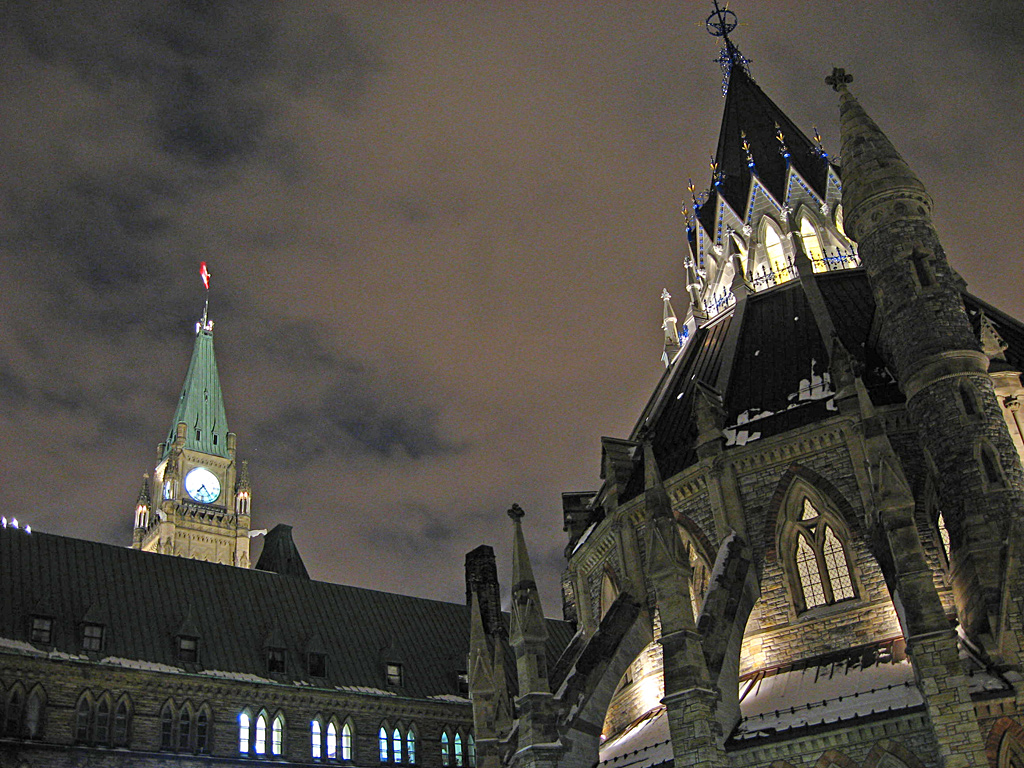
Ominous Ottawa skyline

On various climate blogs, there has been coverage recently about a climate change skeptic conference run by the American Heartland Institute. DeSmogBlog and Grist have been leading the scolding, though the mainstream media seems to have started to cotton on that these people are corrupt, frauds, or seriously misguided. The New York Times and Wall Street Journal both have pieces that are somewhat critical of the validity and motivation behind the conference.

You can argue all you like about what level of greenhouse gases in the atmosphere is represents a tolerable level of risk. You can likewise wade into many fascinating debates about paleoclimatology, climatic feedbacks, and technological development. Nobody has an especially good answer to the question of how climate change mitigation, development, and poverty reduction can be ethically balanced against one another. What you cannot do these days, while retaining your credibility, is deny that the human burning of fossil fuels is causing the planet to warm, and that the consequences of that warming are extremely likely to be harmful to human, plant, and animal life.

The whole thing reminds me of the laughable commercials produced by the Competitive Enterprise Institute. Here are some resources for countering the misguided or disingenuous arguments made by those who challenge the rigorously demonstrated elements of climate change science.

Big picture uncertainty

Buildings in central Ottawa

Climate change policy focuses on constant attempts to make guesses about the future: about economic development in rich states and poor, about patterns of technological evolution, about climatic responses to radiative forcing caused by changes in the gas mixture of the atmosphere. One cannot always evade the feeling that too many uncertainties are being layered. Consider, for instance, the possibility that hydrocarbon fuels will peak in world output within the next few decades. If that happened, most of our ‘business as usual’ economic projections would be badly wrong.

An even more ominous consideration relates to global conflict. When the world is generally doing well, it is devilishly hard to convince states to reduce their greenhouse gas emissions for the universal good. Imagine how hard it would be in a geopolitical environment based around rising tensions and the growing expectation of great power war. We make projections for 2100 without acknowledging that making it from now to then without such a war would be a historical aberration.

In the end, I suppose, cynicism does us little good. The vast majority of ordinary people – and of powerful people – will not believe in the disastrous potential consequences of climate change until they start to manifest themselves visibly. As such, agonizing about them just makes you more marginal to the debate that exists among those not kept awake by fear about the possibility for self-amplifying positive feedbacks in the climate system. We must do the best we can, avoid confusing engagement with the mainstream debate with genuine complacency, and hope that humanity possesses more wisdom than it has ever demonstrated before.

Post-2012 climate conference

The International Institute for Sustainable Development is running a two-day conference in Ottawa about post-2012 climate change policy. 2012 is the end of the first compliance period for the Kyoto Protocol, so ‘post-2012’ is shorthand for whatever international climate regime is to be the successor to Kyoto. Notes will be published on the wiki as they become available.

Notes from previous conferences are also available:

Natural gas and Russian politics

Snowy Ottawa street

The results of the election in Russia yesterday are not surprising, though they are part of a very worrisome overall trend. Bolstered by high energy prices and strategic overstretch on the part of the United States, Russia is regaining some of its nastier old habits. Of course, it is unreasonable and unacceptable to hope that Russia will remain as powerless as it has been since the fall of the Soviet Union. As much as is the case with China, the question of how a powerful Russia will return to geopolitics is an interesting and somewhat frightening one.

Europe’s vulnerability to Russian control of natural gas supplies has been well demonstrated of late. Poorer Central European states are potentially even worse off in the medium term, if Russia manages to build pipelines that go around them. Turning off the heat in Kiev is unlikely when it means doing the same in Berlin. Being able to do the first without the second would further worsen the strategic situation presented to the states in the middle. I expect they are feeling pretty nervous right now, given how generally spineless NATO and the EU have been recently in the face of Russian bullying.

Hopefully, concerns about access to gas will help to advance the drive towards renewable energy in Western Europe, eventually reducing the economic vulnerability of those states to Russian machinations. Such an outcome would have positive consequences in relation to the state of the global environment, and may embolden Europe’s democracies in relation to an increasingly assertive and unapologetically totalitarian Russia.

Obama on gay rights

Billboard frame, Ottawa

Whereas John McCain thinks that it is a principle of “Human Dignity” that the “family represents the foundation of Western Civilization and civil society and… believes the institution of marriage is a union between one man and one woman,” Barack Obama has issued an open letter calling for equal rights for lesbians, gays, bisexuals, and transgendered individuals.

Unfortunately, Obama doesn’t come out and call for the legalization of gay marriage: doubtless due to a political calculation about what homophobia might cost him in a general election. While that is probably smart politics, it is a disappointing thing to see from a candidate that tries to paint himself as so progressive. In fifty or one hundred years, I am convinced that people in liberal societies will see restricting gay marriage as equally unjust as restricting interracial marriage or marriage between different social classes. It’s a shame that even progressives in the United States cannot recognize this now.

In truth, even McCain probably doesn’t have a problem with two people of the same sex getting married for the same reasons – and under the same laws – as any mixed sex couple might. The politics of the American conservative movement simply make it suicidal to acknowledge that.

Previous posts on gay marriage: