Excluding traffic noise

My latest effort to avoid the constant sound of traffic and streetcar noise in my bedroom consists of wearing DeWalt DPG62-C ‘Interceptor’ Protective Safety Earmuffs over top of foam earplugs.

The earmuffs are rated for 29 decibels of sound reduction, while the earplugs are supposedly good for 32. The sound reduction doesn’t seem to be equal across the range of frequencies I can hear. Birdsong comes right through strangely unaffected, and the rumble of heavy trucks and SUVs remains perceptible, along with the clang and whoosh of streetcars. Together, the two forms of hearing protection do pretty effectively exclude traffic noise, at least when I have my window closed. Whether the whole setup will remain in place overnight is another question.

Wearing the combination is actually a bit disconcerting. There is a constant hiss in my ears, which I think is a combination of the hiss you get from hearing damage with the quiet flow of blood through my ears themselves. If I walk on pavement, each step produces a loud pounding noise. Even walking softly on a wooden floor in socks, I can hear my joints complain slightly when I put my weight on them. For some reason, wearing all this ear protection also makes me more aware of my body, from the mild ever-present pain in my left shoulder to the bodily exhaustion that characterizes the end of another frustrating and largely fruitless day.

We will see whether this combination of tools helps square the circle of a person who is always intensely irritated by traffic noise living in a thin-windowed second-floor apartment overlooking one of Toronto’s busier urban streets.

Forms of address

One of the trickier aspects of corresponding with lots of relative strangers is never knowing quite what to call people.

This is all in relation to written communication. In one-on-one speech, I go out of my way not to call people anything at all.

Academic titles

To start with, there is the eternal question of how to refer to an academic who you don’t know. They probably have a title, which might be ‘Associate Professor’ or ‘Assistant Professor’ or just ‘Professor’. Do you call everyone ‘Professor X’? Or do you use the title on their website? What about people who are excessively quick to call themselves ‘professor’? I have seen it on the business card of a doctoral student.

My solution – call everybody with a doctorate ‘Dr. X’. It doesn’t matter if they just got their doctorate yesterday or whether they have won an armload of Nobel Prizes. ‘Dr. X’ is a perfectly polite form of address between strangers.

Exception: close friends and fellow former students. You may have worked half a decade to get that post-nominal P.H.D., but if we were in first year together I reserve the right to call you by your first name indefinitely.

Other titles

I basically ignore them. ‘Reverend X’ and ‘Lieutenant X’ and ‘Engineer X‘ and ‘Mayor X’ and ‘Prime Minister X’ are all liable to be referred to simply as “Mr. / Ms. X”.

Women

It’s a bit embarrassing that there even has to be a space for this, but such are the sexual double standards of our society. There is nothing as neutral as ‘Mr. Smith’ that you can call a woman. Every option carries a political message. Using ‘Miss Smith’ or ‘Mrs. Smith’ means buying into the somewhat absurd notion that a woman’s whole identity changes when she gets married (and when a man’s does not). I use ‘Ms. X’ anytime I can’t call someone ‘Dr. X’. That goes for any stranger, usually until they specifically tell me to call them something else.

Someone who you know nothing about

Say you discover that www.websitename.com has been horribly defaced. You want to contact ‘webmaster@websitename.com’ but you don’t know any part of their name, or whether they are male or female.

In this circumstance, I usually go with ‘Good [time of the day]’ if I am being less formal and ‘Sir or Madam’ if I am being more formal.

Referring to me

I am perfectly happy to have everybody call me ‘Milan’.

Whenever I see a letter for ‘Milan Ilnyckyj, BA’ I know it is UBC writing to ask for alumni donations.

Lark sleep monitor

For the past couple of months, I have been using a Lark sleep monitor. It’s an accelerometer that you wear on your wrist at night that interfaces with your iPhone. It both works as an alarm clock and as a measuring device that provides data on the length and quality of your sleep. You set when you want to wake up and it wakes you at that time with nearly silent vibration (and a backup sound alarm from the phone).

The device has a few obvious uses. If two people sleep in the same bed but normally wake at different times, the Lark would allow one to more easily wake on time without waking the other. The Lark also lets you collect statistics about yourself, and evaluate how well you sleep in different environments and conditions.

For instance, I slept for an average of 8:41 per night when on vacation at my aunt and uncle’s very quiet house in Bennington, Vermont (with one early morning on December 25th). That compares with an overall average sleep time of 7:45 over the past couple of months.

So far, I have collected data for 86 days. More accurately, I have data for 81 of those days and null values for the five days when I wasn’t able to use the Lark – for instance, because I was taking an overnight Greyhound.

My recent sleep stats

This table shows some simple summary statistics:

Mean Median Standard deviation
Time asleep 7:45 7:56 2:00
Sleep quality 8.5 8.7 0.84
Fell asleep in 0:37 0:30 0:34
Woke up (# of times) 18.9 18 6.39


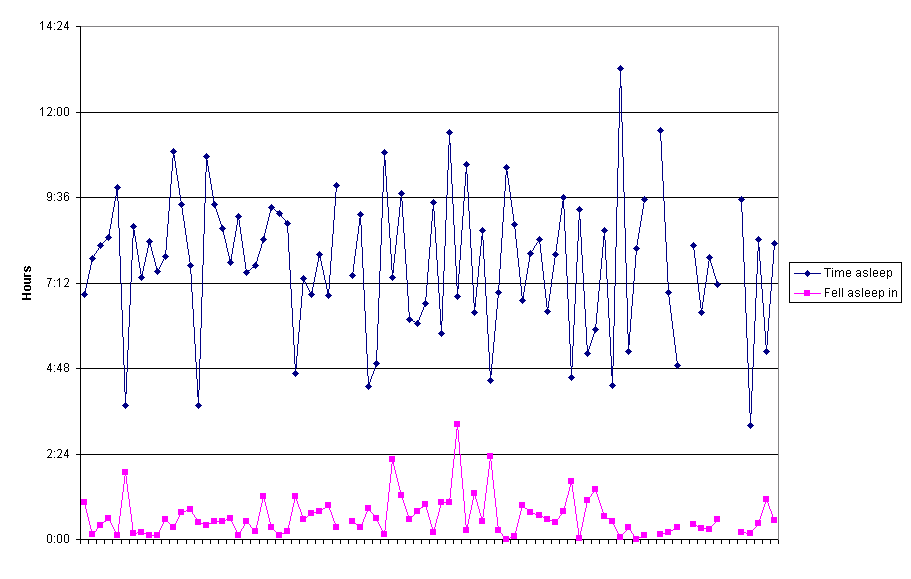
In blue, this time series shows time spent asleep. In pink, it shows how much time was spent falling asleep:

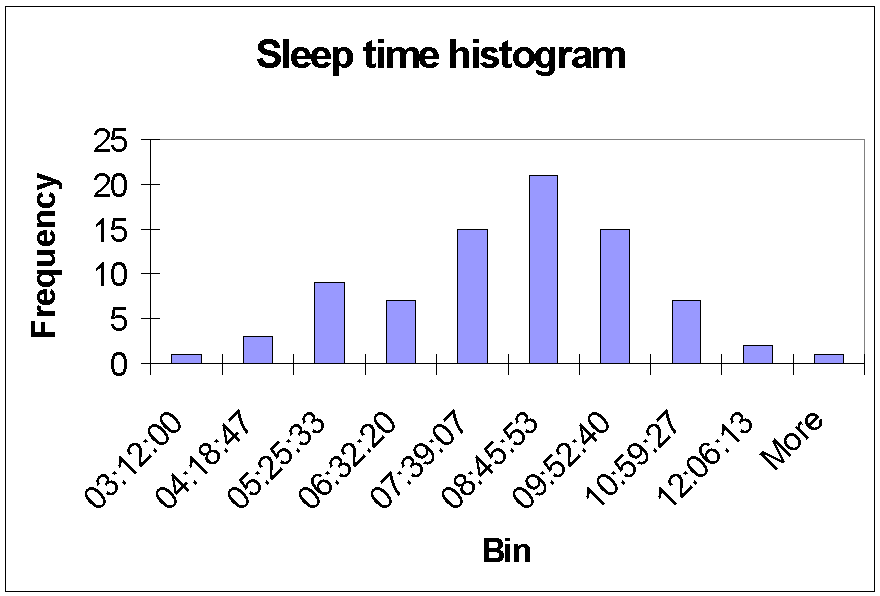
This is a histogram of time spent asleep:

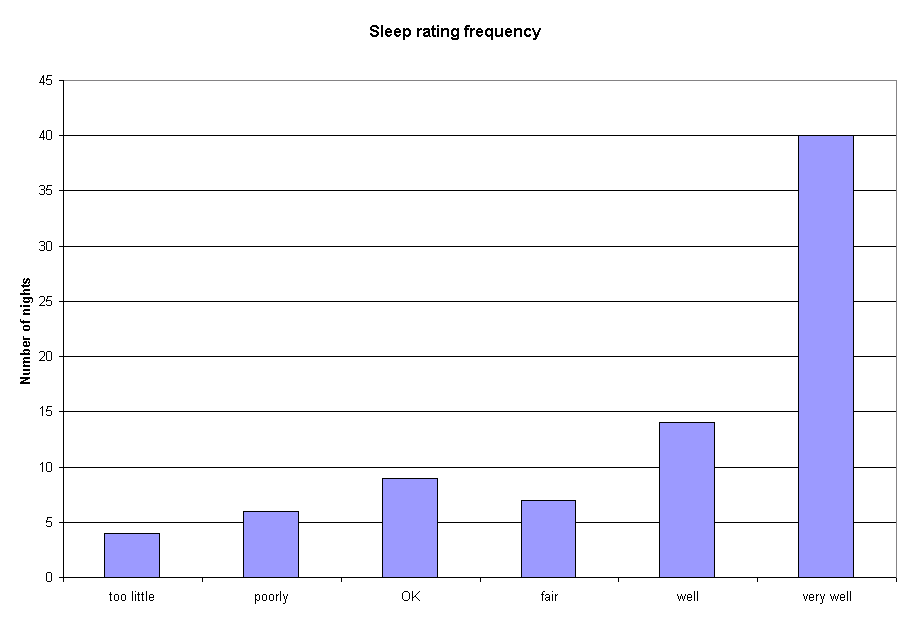
And this shows the frequency of the different qualitative sleep ratings assigned by the Lark software:

The Lark software informs me that the amount of time it takes me to fall asleep “needs work”, as does the number of times I wake per night. My overall length of sleep and sleep quality it deems “OK”.

The biggest thing that jumps out at me from my own data is the sawtooth pattern of sleep. I tend to alternate between a night with relatively little sleep (about six hours) and a night with relatively much (about nine hours). Given that I usually need to wake up at 6:30am or 6:45am, these correspond to nights when I go to sleep around midnight and others where I collapse around 9:00pm or 10:00pm.

Remember, the Lark distinguishes between time spent falling asleep (the period before the first time of prolonged stillness detected by the Lark) and time spent actually asleep. A night recorded as eight hours of sleep is therefore a night with eight hours of stillness comparable to that of sleep, rather than a night when you spend eight hours in bed. Being able to distinguish those two things may be the most valuable thing about the Lark.

Evaluation of the Lark

Overall, I think the Lark works very well. It has never failed to wake me up, and the iPhone software works well.

One suggestion to all iPhone owners is to put your phone in ‘Airplane mode’ at night. That way, it doesn’t beep or buzz when you get late-night texts and emails. You can still use the Lark in this mode, but you do need to follow a simple procedure:

  1. Set the iPhone to ‘Airplane mode’
  2. Manually turn Bluetooth back on
  3. Connect to the Lark
  4. Set your alarm time in the Lark software
  5. Sleep, and be woken

One useful feature the makers of the Lark could add would be the ability to set pre-programmed alarms for different days of the week. For example, you might set your default Monday-Friday alarm for 6:30am or 7:00am, but your weekend alarm for a more reasonable 9:00am or 10:00am.

One side note: it is easy to transfer the basic sleep data from the Lark into your preferred statistical analysis software. For people who don’t want to do that, the company sells an absurdly overpriced (US$$159!) subscription service that keeps track of your data for you online and provides ‘coaching’.

Googling the Cyborg

In his engaging essay “Googling the Cyborg”, William Gibson effectively argues that the expectation that ‘the cyborg’ will be a human being with an electronic eye and a robot arm is mistaken. The cyborg – he argues – exists in the physical interactions between human beings and machines: “The electrons streaming into a child’s eye from the screen of the wooden television are as physical as anything else. As physical as the neurons subsequently moving along that child’s optic nerve”. (The terminology there is strangely incorrect. Cathode ray tube televisions emit photons, which are produced when the electrons fired from the back of the vacuum tube hit a phosphor screen – and the optic nerve is made of neurons, it isn’t a channel that conveys them. No matter.)

Gibson argues that the cyborg is the “extended communal nervous system” that humanity has grown for itself, with all these sensors and processors and network connections.

He also argues that there is a short-changing that occurs, when we deny that the humans who are behind machines are using them as true extensions of their own being. In the context of remote-controlled rovers on Mars, he says:

Martian jet lag. That’s what you get when you operate one of those little Radio Shack wagon/probes from a comfortable seat back at an airbase in California. Literally. Those operators were the first humans to experience Martian jet lag. In my sense of things, we should know their names: first humans on the Red Planet. Robbed of recognition by that same old school of human literalism.

Gibson, William. Distrust that Particular Flavor. p.251 (hardcover)

I am not sure what should be counted as the first cyborg on Mars. Specifically, did it need to be able to move on human command? Or is moving camera shutters enough to count? In any case, hardly anyone knows the name of the person who was controlling it when it first activated on the Martian surface.

The government that hammers tent pegs up our noses

A pattern seems to have developed in the legislative politics of a certain northern country.

The people in power boast that they are going to do something dramatic but somewhat foolhardy: “Watch! I am going to hammer this tent peg up your nose!” or “Let’s make the census optional!” or “Let’s throw people in jail for harmless marijuana offenses!” or “Let’s allow the police and spies to watch everybody’s internet use!”.

After this declaration is made, both the political opposition and experts in the field bring up some of the very reasonable objections to the proposal: “What about my brain?” or “The whole point of a census is that everyone completes it” or “That’s pointless vindictiveness for a non-offence to society” or “That’s an insanely over-reaching way to catch only the stupidest criminal web users”.

But the issue has already become a matter of pride and honour for the government of the day, so they cannot back down or change plans. Occasionally, public and political opposition to the proposal are strong enough to stop it, at which point the government becomes bitter and petulant, stressing how everyone will need to live with the terrible consequences of not following the government’s plan. Often, however, they are able to circle up successfully around their bad idea and turn it into law.

This pattern of behaviour is likely to persist for as long as the opposition is leaderless and split.

Even those who favour the party in power probably realize that the political system only works properly when there is a credible opposition. If there is nobody else who looks capable of forming a government, there are few real checks on the power of the people in charge. That leads to them expressing their own psychological excesses and frustrations in ill-conceived legislation, which is bad for everybody.

Repeated ad infinitum

XKCD is right, this is worth a look today:

List of common misconceptions
From Wikipedia, the free encyclopedia

Note:

  • Nero didn’t fiddle while Rome burned.
  • The ancient Greeks knew that the Earth was spherical, and how large it was.
  • Napoleon was not short. He was slightly taller than the average Frenchman.
  • The Emancipation Proclamation didn’t free slaves in the northern states.
  • The Great Wall of China cannot be seen from space using the naked eye.
  • People did not evolve from chimpanzees.

Etc, etc, etc.

Risk/efficiency trade-offs in pathfinding

Finding my way to a new building, it struck me that two major strategies are possible in urban pathfinding. You can try to follow the most efficient path or you can try to minimize your odds of getting lost. Call those the ‘efficiency’ and ‘reduced risk’ approaches.

Each has some level of appeal. Nobody wants to take an unnecessarily circuitous route, when there is a shorter one available. At the same time, it is foolish to take a path that is nominally shorter but which involves much higher risks of getting lost or having other sorts of trouble.

Shortcuts are a classic example. They speak out to the part of us that seeks efficiency, but they carry special risks. When you deviate from the conventional path, you open the possibility of arriving much sooner than you would otherwise, but you also open the possibility of arriving much later or not at all.

Personally, I am willing to trade a fair bit of efficiency in exchange for simplicity. Even if I can conceivably save time by cutting corners, I prefer to stick to simple routes that I can remember and understand. Subways are good for this – they don’t take you as close to your destination as buses often might, but they are easier to understand.

As an aside, the worst ever solution to the risk/efficiency problem is the ‘try and buzz the head waiter’s home island with your cruise ship‘ strategy. In choosing people to captain cruise ships, there should probably some process to screen out those with such reckless tendencies…

Being unwell

I’ve noticed something that is both odd and somewhat rational: I find that I feel much sicker after I have seen a doctor and had them share my concern. Before seeing a doctor, I always have a nagging sense that I am going to see them about something excessively trivial and they will feel as though I am wasting their time. It’s a bit of a relief, then, when a doctor expresses agreement that you were right to see a doctor and that some sort of medical treatment is suitable.

At the same time, you lose the psychological possibility that you are making far too big a deal out of something tiny. Doctors – after all – face a never-ending stream of sick people. What seems worrisome to you is likely to seem trivial to them. So, when a doctor says that you were wise to seek medical treatment, it is both an affirmation of your inexpert medical judgment and cause for concern, in that nobody likes to have any kind of medical issue.

This is a phenomenon I have experienced before. For instance, after I broke my collarbone, it actually felt much more painful after I had seen the x-rays. They were like a validation of what my brain was thinking already, and they sharpened the experience of being injured.

(I am fine, incidentally. I just need some rest and antibiotics, administered every six hours to stabilize their concentration and reduce the odds of spawning antibiotic resistant prokaryotes.)

Ironic liberal / big government libertarian

When I think about how to characterize my political views, it seems as though there are philosophical positions that I find appealing, but which need to be tempered in response to the strong counterarguments against them.

Ironic liberalism

I can see the sense in what Richard Rorty calls ‘ironic liberalism’. All that old-fashioned stuff about the rights of human beings deriving from god is woefully out of date. All the evidence we have suggests that there is no god (or, if there is, that it is a malicious or indifferent entity). Furthermore, the conversation in political philosophy has largely abandoned theological justifications. Now, we don’t have a terribly convincing story about where rights come from. That being said, I think it is clear that treating people as bearers of rights is a good way of ordering the world. As I understand it, ironic liberalism is about taking that observation and running with it. We have no fundamental reason for believing that people have rights, but the world seems to work better when we act as though they do – so let’s act that way, and let the feelings and consequences follow. Let’s take it seriously when someone asserts that they have a right to do something or have something provided for them (though, upon reflection, we may disagree with their claim). Similarly, we should take it seriously when someone asserts that their rights have been violated.

Rights are not an inherent property of the universe, but they are a good concept that allows us to evaluate the rightness or wrongness of different kinds of human interaction.

Big-government libertarianism

In my experience, libertarians say two kinds of things: rather convincing ones, and exceptionally stupid ones.

A good example of the first case is: “People should have the right to do what they wish with their bodies”. I don’t think it’s an absolute right, necessarily, and I realize that there are situations where people can be pressured into acting against their own best interests. That being said, the general principle that people have a greater interest in their bodies than anybody else – and that our bodies can realistically be thought about as our own property – seems convincing to me.

This general libertarian strand, which asserts that we should be free to make choices as we like so long as they do not harm other is both convincing and politically pertinent. It is connected to debates on topics like drug policy and legislating morality.

A good example of a stupid thing libertarians say is: “We don’t need to regulate health or the environment, because the market will handle it”. Without government regulation, I am sure the abuses committed by corporations and individuals agains their fellow citizens would be hugely more severe. Nuclear power plants would probably routinely dump radioactive waste directly into rivers; sugar pills would get sold as essential medications; the most awful stuff would end up in the meat people buy; and problems like climate change and ozone depletion would be totally ignored, at least until they became incredibly extreme.

Libertarians simply fail to understand how willing people are to act in a selfish way that is harmful to their fellow human beings. The allure of the quick buck at somebody else’s expense is considerable, as demonstrated by much of human history.

We need government to act as a fair dealer, and as an entity that thinks about the long term. Government needs to do things like recognize when dangerous excesses are building up in the economy – whether they take the form of frothy stockmarket conditions, bubbles in property values, or overly rapid inflation. We need a government that acts as an effective intermediary between individuals and large, powerful entities like corporations. We also need a government that keeps itself honest, by having mechanisms to prevent the capture of politicians or civil servants by the industries that they are meant to regulate.

We also need government to provide things that are good for society as a whole, but which individuals are usually unwilling to provide. This includes assistance to the sick, mentally ill, homeless, and so on. It includes education for everybody and fair access to the legal system. We need to have a government with the resources to perform these tasks well. That is partly because it is good for everybody when these kinds of public goods are provided. It is also because the provision of such goods is necessary to respect the rights of individuals (even if those rights are just a highly convenient fiction).

To summarize, we should take rights seriously even if we cannot say with an entirely straight face that they even exist. At the same time, we should be libertarians who truly recognize the essential and unique role played by government and who are happy to make the contributions in terms of time, taxes, and political participation that it takes to keep an effective government operating.

My first exposure to the value of mindfulness

After having my interest piqued by some iTunes University lectures, I have been reading Mark Williams’ and Danny Pengman’s book Mindfulness: An Eight-Week Plan for Finding Peace in a Frantic World. In the midst of a number of urgent projects, I am reading it in fits and starts, so I am not really following the program as prescribed. From the outset, I have also been deeply skeptical about how useful a program that essentially consists of guided meditation could be for managing stress.

Already, however, I think I have taken one fairly valuable thing from the book. When a person is nervous about a subject – and particularly if they are prone to anxiety – it is exceptionally easy to get into a spiral of connected painful and frightening thoughts. For example, something might remind me of the ongoing covert war that is happening in Iran. That, in turn, makes me think about the assassination of scientists, the possible bombing campaigns that could occur against Iranian nuclear facilities, the terror of nuclear weapons themselves, the danger of conventional or nuclear war in the region, and so on. Confronted with thoughts that have powerful emotions linked to them, the mind goes into a ‘problem solving’ mode, but in relation to problems I can do nothing about. The result is counterproductive attempts to either minimalize the seriousness of the issue being considered, or try to find some trite mechanism for explaining why I shouldn’t be worried. “We’re all going to die sometime” is the sort of pathetic rationalization the brain sometimes coughs up when presented with a mortal problem well beyond the capacity of a single human to solve.

My very preliminary understanding of mindfulness is that it is all about being able to pause for a moment and just see things as they are, without wanting or trying to change them. You can simply say: “The possibility of war in the Middle East is deeply frightening”. Looking at the emotional situation that way, simply as an expression of fact, without creating a mental map of linked fears or deploying psychological self-defence strategies, seems to allow the mind to recognize the fear and move on, without trivializing or ignoring the reality of it. It’s possible to just say “that’s tragic” or “that’s terrifying” without getting caught up in the hopeless task of trying to immediately remedy the problem.

This also works with some of the other substantial fears that crop up periodically in a person’s thoughts: from the inevitability of aging and death (both for yourself and for family and friends) to the frightening state of the global environment to the countless terrible injustices that are always ongoing around the world. All of those observations are accurate, well-justified, and emotionally charged. Nothing we can do will make any of those things go away. But pausing for a moment of honest recognition can allow us to keep functioning, despite the frightening and overwhelming character of the world.