Explaining climate inaction

A couple of days ago the New York Times published a long and controversial article by Nathaniel Rich which purports to explain why, despite decades of strong scientific consensus about the seriousness of climate change and the action needed to keep it under control, we’re still on track for catastrophic warming: Losing Earth: The Decade We Almost Stopped Climate Change.

The account is disputed, among others by Naomi Klein who questions the idea that ‘human nature’ is to blame: Capitalism Killed Our Climate Momentum, Not “Human Nature”.

The Economist‘s cover story has a similar theme: The world is losing the war against climate change. I have written before about how inconsistent their coverage is and, in particular, how they have never reconciled their acceptance of the need to confront climate change with the unfaltering priority they accord to continued economic growth.

Open thread: can life be simulated?

Slashdot reports: “Researchers at the Technische Universitat Wein have created a simulation of a simple worm’s neural network, and have been able to replicate its natural behavior to completely mimic the worm’s natural reflexive behavior.”

When it comes to bodies, at least down to the level where quantum uncertainty becomes important, there seems to be no reason why sufficiently powerful computer hardware could not produce an excellent simulation. In the long term, that could allow things like the development and practicing of surgical techniques on simulated bodies; improved testing for safety in diverse applications; and research into animal physiology.

Perhaps brains are different; there may be something about consciousness that keeps it from being modelled by any conventional computer, regardless of its memory and processing capabilities. Still, it’s possible that consciousness can also be simulated, or re-created in a digital form, perhaps with the aid of quantum computers.

Related:

The Fourier transform

Richard Dawkins’ Unweaving the Rainbow includes a great discussion of the scientific uses of the Fourier transform. Most amusingly: “The side-to-side waving of the urine trail on the road was presumably produced by the long [elephant] penis acting as a pendulum (it would be a sine wave if the penis were a perfect, Newtonian pendulum, which it is not) interacting with the more complicated periodicity of the lumbering four-legged gait of the whole animal.” (p. 73)

This video provides an accessible visual explanation of how this mathematical tool breaks down a complicated curve into its constituent sine waves, and some of the useful applications for that transformation:

Canada is still in denial about climate and the bitumen sands

Canada’s bitumen sands continue to be the largest source of growth in Canada’s greenhouse gas pollution, and the biggest barrier to Canada’s fair participation in a global climate change mitigation strategy.

Not only does continued bitumen sands investment perpetuate an industry which undermines Canada’s claim to be serious about Indigenous reconciliation, but giving the industry specially lax environmental treatment would force other sectors to pick up the slack, if that is even possible given the industry’s relentlessly growing pollution.

An article by University of Toronto professor Danny Harvey and Lika Miao now argues that only an oil sands phaseout would allow Canada to meet its (insufficiently ambitious) 2030 emission reduction targets. They see a complete bitumen sands phase out by 2030 as necessary to meet the targets, alongside major action in sectors like energy generation, and emphasize how meeting the more ambitious temperature targets of the Paris Agreement would require much more aggressive action.

All this highlights the chasm between Canadian politics and what would be necessary to curb climate change. Prime Minister Trudeau either doesn’t understand the relationship between fossil fuel use and climatic stability or is choosing to mislead Canadians for political reasons, continuing to assert that Canada’s fossil fuel reserves are usable. That kind of timidity or misdirection serves us all badly, leaving the bulk of Canadians misled into believing that the industry can somehow be compatible with a stable climate.

Ham, the first primate astronaut

Then they led him out again, trying to get him near a mockup of a Mercury capsule, where the television networks had set up cameras and tremendous lights. The reporters and photographers surged forward again, yammering, yelling, exploding more camera lights, shoving, groaning, cursing—the usual yahoo sprawl, in short—and the animal came unglued again, ready to twist the noodle off anybody he could get his hands on. This was interpreted by the Gent [the news media] as a manifestation of Ham‘s natural fear upon laying eyes once again on the capsule, which looked precisely like the one that had propelled him into space and subjected him to such severe physical stresses.

The stresses the ape was reacting to were probably of quite another sort. Here he was, back in the compound where they had zapped him through his drills for a solid month. Just two years ago he had been captured in the jungles of Africa, separated from his mother, shipped in a cage to a goddamned desert in New Mexico, kept prisoner, prodded and shocked by a bunch of humans in white smocks, and here he was, back in a compound where they had been zapping him through their fucking drills for a solid month, and suddenly there was a whole new mob of humans on hand! Even worse than the white smocks! Louder! Crazier! Totally out of their gourds! Yammering, roaring, brawling, exploding lights beside their bug-eyed skulls! Suppose they threw him to these assholes! Fuck this—

At some point in the madhouse scene out back of Hanger S, a photograph was taken in which Ham was either grinning or had on a grimace that looked like a grin in the picture. Naturally, this was the picture that went out over the wire services and was printed in newspapers throughout America. Such was the response of the happy chimpanzee to being the first ape in outer space … A fat happy grin… Such was the perfection with which the Proper Gent observed the proprieties.

Wolfe, Tom. The Right Stuff. Farrar, Straus, and Giroux; New York. 1979. p. 223–4 (italics and ellipses in original)

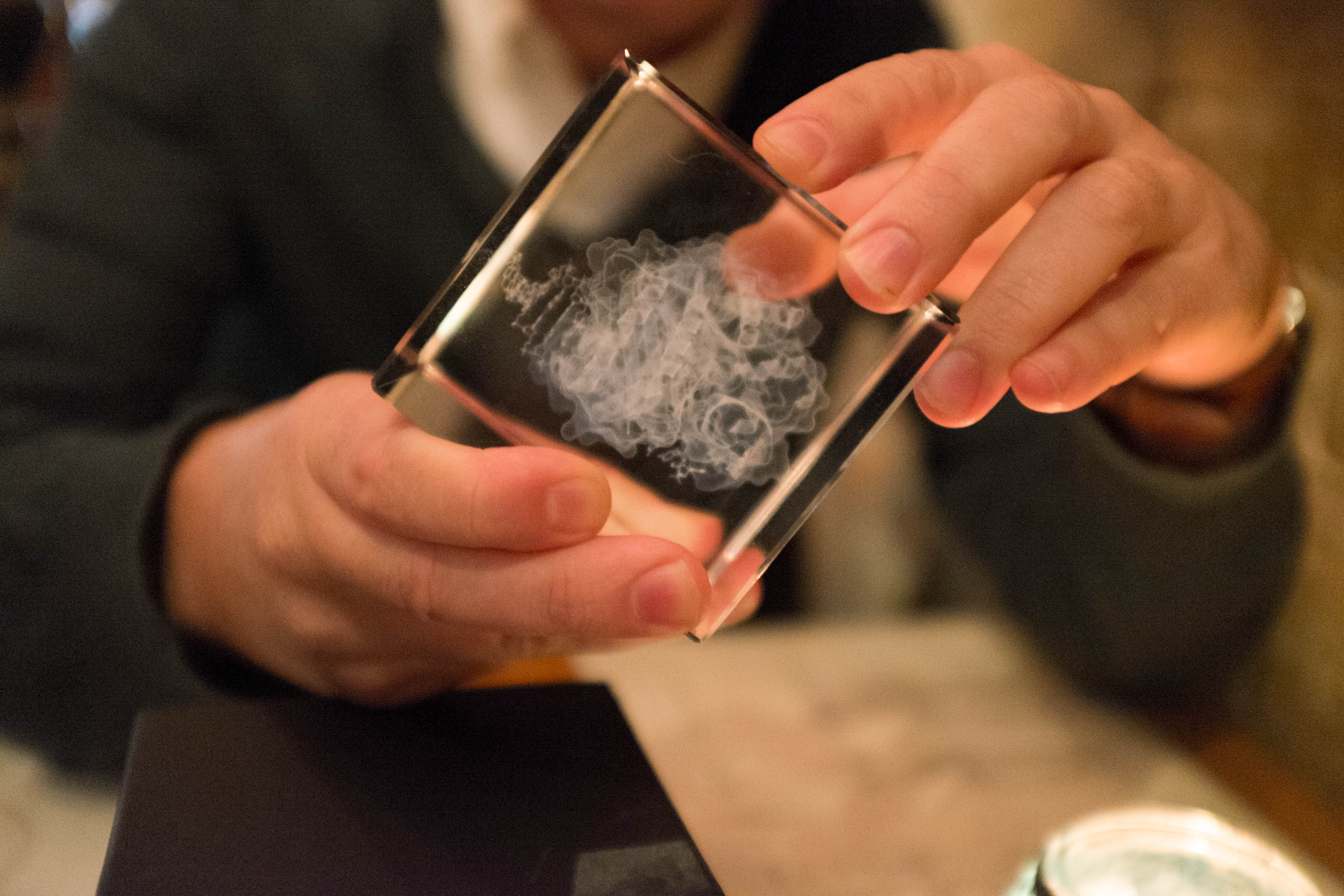
Crystal Structure of a Y-family DNA Polymerase in a Ternary Complex with DNA Substrates and an Incoming Nucleotide

Sulfolobus solfataricus P2 DNA polymerase IV (Dpo4) is a DinB homolog that belongs to the recently described Y-family of DNA polymerases, which are best characterized by their low-fidelity synthesis on undamaged DNA templates and propensity to traverse normally replication-blocking lesions.

By Bathsheba

WPA2 vulnerable

It seems the WPA2 encryption system used by most WiFi networks is badly broken:

This follows recent breaks in core security technologies like SSLStrip and Heartbleed.

People with good security practices like defence in depth and compartmentalization of sensitive information might not be too threatened by this. Those relying exclusively on the integrity of WPA2 may be in big trouble.

What are you sharing on your wireless network? Any file servers, cameras, or other sensitive systems?

Do you run your internet traffic through a second layer of encryption like a VPN and stick to HTTPS/TLS for sensitive websites?

End of the Cassini mission

After a 20-year mission, and to avoid any risk of contaminating Saturnian moons with microorganisms from Earth, the Cassini space probe was deliberately crashed into Saturn’s atmosphere today.

The science it has returned has been stimulating and the imagery spectacular. The watery moon Enceladus now joins Europa among the solar system’s most intriguing life-compatible bodies.

Every kakapo sequenced

New Zealand’s kakapo parrot is equally rare and bizarre: critically endangered, with 154 survivors living on three protected predator-free islands, the birds can’t survive the presence of rats, cats, and other potentially-carniverous mammals, can’t fly, and reproduce slowly and strangely.

The chapter about them is perhaps the most memorable part of Douglas Adams’ excellent non-fiction book Last Chance to See.

Now, the DNA of every living kakapo is being sequenced, with 81 done already.