Automation and the jobs of the future

A recent article in The Economist discussed the likely impacts of technological development on jobs, with an emphasis on which jobs are especially vulnerable to being replaced with hardware or software automation.

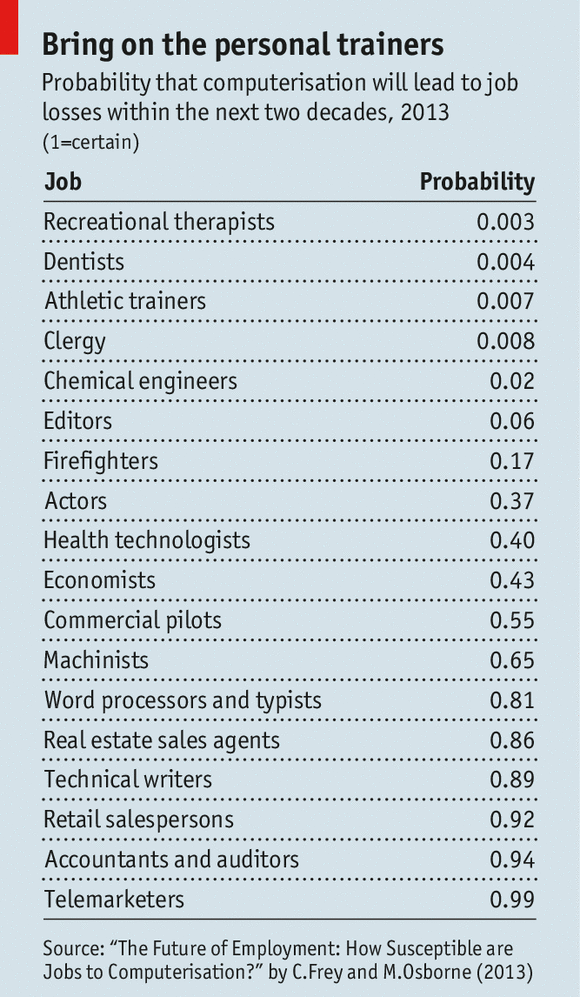
The article included a chart listing some of the jobs projected to be most and least vulnerable, respectively:

Probability that computerization will lead to job losses within the next two decades, 2013

Some bad news for both people working for telemarketing firms and everyone with a telephone is that the telemarketers of the future are expected to be robots.

More disruptive, in terms of people’s career planning, is the set of presently white collar jobs potentially at risk to automation: accountants and auditors, technical writers, and real estate agents are all identified as being at risk. Pharmacists can probably be added to that list.

For now, dentists, athletic trainers, and clergy remain safe from being replaced by software or robots.

Ripley’s Aquarium of Canada

Yesterday, a friend and I visited Ripley’s Aquarium of Canada, a new privately-run aquarium located beside the CN Tower in Toronto. I have uploaded some of the photos already, with more to come.

It’s certainly a spectacle, both in terms of the species on display and the layout of the facility. A big portion consists of tunnels of plexiglass through large underwater habitats, allowing visitors to see many species arrayed around them at once.

I am, however, left somewhat divided about how to feel about the place. Their website says that they have a “Comprehensive Environmental Purchasing Policy”, but it remains the case that the facility is an artificial hotspot of biodiversity, drawn together from around the world and presented for the entertainment and education of paying guests.

I’m open to the argument that people need to see nature and biodiversity in order to value them, and the aquarium does make some allusions to the harm humanity is doing to the global ocean through over-fishing, pollution, and climate change. It’s plausible that some aquarium guests will come away from the experience with a greater appreciation for marine biodiversity, and perhaps a greater willingness to play a role in protecting it.

At the same time, there is a degree to which the aquarium is nature in a box for the privileged. The habitats are full of artificial coral and kelp, and ecological themes are mentioned more than emphasized in the surrounding documentation. The “[p]olicy banning staff use of plastic water bottles on site” seems inadequate compared with the main environmental impacts of the facility, both in terms of the acquisition of so many species – some explicitly labelled as endangered – and in terms of the huge power and water usage the facility clearly requires.

The aquarium was full of beauty and biological novelty and I was grateful to go. I would encourage others to do so as well, though it is probably worth thinking about what such places imply for the human relationship with the rest of nature, as well as the contrast between the energy and expense we are willing to devote to showcasing the diversity of life, at the same time as our large-scale choices are rapidly causing that diversity to diminish in the wild.

Toronto350.org winter 2014 TGM

Tomorrow, Toronto350.org will elect its fifth executive at the termly general meeting.

The group is also likely to create its first formal committees: with divestment committees focused respectively on building student engagement and interacting with the school administration, and an institutional innovation committee focused on how the group should grow and develop its governance structure.

It’s necessary for us to create a structure that shares out work more effectively and deals with some other governance issues, but we don’t want to get stuck in a trap of spending too much of our time and our energy on internal matters, neglecting the campaigns that are the purpose of the organization.

Open thread: drilling for oil and gas in the arctic

Unfortunately, the climate-change-induced melting of the north polar icecap is making it easier to drill for oil and gas in the arctic. Large amounts of fossil fuels are expected to be found in the region, adding to the world’s already dangerously large supplies.

The enthusiasm of companies and governments to exploit unconventional sources of fossil fuels is starkly at odds with the reality that we can only control climate change if we choose not to exploit such reserves – while rapidly scaling back production of conventional oil, gas, and coal.

Open thread: marine protected areas

I have written a number of times before about the unsustainable nature of global fisheries and the sorts of policies that might help combat that.

Marine protected areas have an important role to play in that effort. They constitute sanctuaries in which fish are protected from the hugely destructive fishing technology that is now deployed. Their more extensive establishment could play an important role in maintaining the viability of many important species.

The hostile media effect and imagination of audience

Recent work by Gunther and Schmitt (2004) on the hostile media effect offers a partial clarification of our findings. These authors conducted an experiment in which a purposefully crafted neutral text was presented to experts involved in the ongoing controversy over genetically modified organisms. For one randomized group of experts, this text was presented as a news item; for the other, the identical text was presented as a research paper from a senior undergraduate student. In comparing participants’ evaluations of bias in the text, Gunther and Schmitt found striking differences. Whereas the presentation of the text as a news item yielded extreme and contradictory assessments of bias, the identical text presented as an undergraduate research paper was generally judged to be balanced. The authors argue that this reflects the importance of experts’ “imagination of audience” as a critical factor in their understanding of texts and communications. In this sense, experts are reacting against the media based on their understanding of the competency and vulnerability of the general public: “Partisans may believe that information in a mass medium will reach a large audience of neutral, and perhaps more vulnerable, readers – readers who could be convinced by unbalanced or misleading information to support the ‘wrong’ side.” In short, Gunther and Schmitt’s research suggests that negative views of the media related more directly to experts’ views of the general public than to the behaviours of media institutions themselves.

Young, Nathan and Ralph Matthews. The Aquaculture Controversy in Canada: Activism, Policy, and Contested Science. 2010. p. 149 (paperback)

Force of Nature: The David Suzuki Movie

Yesterday, I was part of a panel discussion and film screening at Hart House. They showed Force of Nature: The David Suzuki Movie, which I found to be ambitious and engaging. It combines footage from Suzuki’s 75th birthday lecture with a biography of his life, including his family’s internment by the British Columbia authorities during world war two, his work at the Oak Ridge National Laboratory, his biological research at the University of British Columbia, as well as his activism and personal life.

The film involved a great deal of travel and one-on-one time with Suzuki, as they visited most of the important places in his life. It was also skilfully mixed with archival footage, though a bit of it may have been misleading (notably, the cut from the Hiroshima atomic explosion to footage of the totally unrelated Castle Bravo thermonuclear test, and the footage of the K-25 gaseous diffusion plant at Oak Ridge, which had nothing to do with Suzuki’s biological research at Oak Ridge).

All told, I definitely recommend seeing the film if you get the chance. It says very little about precisely what should be done to address the world’s environmental problems, but rather a great deal about why we ought to be making the effort.

Canada not on track to meet its (inadequate) climate targets

In the news today:

Canada won’t come close to meeting emissions target: Environment Canada

The latest internal government report confirms Canada is not close to being on track to meet its promised target for emissions cuts by the year 2020.

In fact, the Environment Canada analysis released Thursday indicates the country slipped backward in 2012 in terms of achieving the government’s greenhouse gas emissions target under the Copenhagen Accord.

Under that international agreement, Prime Minister Stephen Harper committed in 2009 to cutting Canada’s emissions 17 per cent from 2005 levels by the year 2020.

Even with long-overdue government regulations on the oil and gas sector, which have not yet been announced, Environment Canada doesn’t foresee a scenario where the 2020 target will be met.

Previously: Can Canada meet the Conservative GHG targets?

The Varsity on fossil fuel divestment

In todays’ edition of The Varsity, there is an interview about the Toronto350.org divestment campaign at the University of Toronto.

In addition to quoting me and the Office of the President, it quotes Justin Lee, president of U of T’s Rational Capital Investment Fund, claiming that we are needlessly politicizing the issue of investment and implying that divestment would be bad for the portfolio. I wish he had read section 4 of the brief, in which we explain why divestment is a smart idea financially. These investments are not compatible with long-term prosperity for the world, since the business plans of these companies are focused on activities that would guarantee dangerous climate change. They are also incompatible with the long-term prosperity of the university itself, since the assumption that these companies will be able to burn all the fuel they own will eventually be invalidated.

Also, the fact that the university has a divestment policy in the first place shows that they understand how their investment choices do have ethical implications which are rightly a concern of the school. This isn’t a matter of needlessly politicizing university investment – it’s about bringing U of T’s investment policy in line with its values and long-term financial interest.