Science and replicability

The basic claim made in published science is that something about the nature of the universe has been uncovered. That makes it distressing when other researchers attempting to isolate the same phenomenon are unable to do so:

For social ‘scientists’ with aspirations of matching the rigour of their peers in the ‘pure’ or ‘natural’ sciences. If different groups of scientists using true double-blind controlled experiments can’t reach compatible conclusions about the world, what hope is there for people trying to deduce causality from historical data?

Limits to a social cost of carbon

In some ways, the idea of a social cost of carbon is fundamentally sound. Adding CO2 to the atmosphere harms people around the world in various ways which can be measured and quantified. Applying that in the form of a carbon price should allow us to better adjudicate between activities where the total benefits exceed the total costs (including climate damage). It should also help us identify where the most cost-effective options are for reducing emissions and mitigating climate change.

At the same time, there are some issues with the approach. For one, it suggests false confidence and draws attention away from the possibility of abrupt, irreversible, and catastrophic outcomes. There are climatic thresholds out there where increased concentrations lead to dramatic global changes and major impacts on human life. Adding $50 (or whatever) to the cost of an activity that adds a tonne of CO2 to the atmosphere conceals these dangers, suggesting that the harm imposed will always be incremental and manageable. Another tonne of CO2 in the atmosphere isn’t essentially equivalent to a little fine everybody pays. Rather, it represents a threatening degradation to the stable climatic regime that has accompanied the existence of human civilization. Moving from relative stability into a realm where global weather patterns are rapidly and violently shifting involves experiences that cannot be easily equated to simple monetary costs.

The social cost of carbon approach also conceals some of the costs of carbon that aren’t easily quantifiable in financial terms. It’s a lot easier to work out the additional cost of desalinating drinking water than it is to estimate the financial value we should assign to losing an ecosystem or having an important cultural site permanently immersed in the sea.

Further, using a single price suggests that the damage from every tonne of emissions is the same. This is essentially true for emissions that happen at the same time – the tonne of CO2 emissions you produce by running your gasoline lawn mower affects the climate as much as the tonne of CO2 I produce by running my gas furnace. However, climate science has convincingly demonstrated that the total harm done by carbon accumulating in the atmosphere isn’t linear across time. Warm the planet by a degree or two and human and natural systems can adapt comparatively easily. By the time you are going from 5˚C of warming to 6˚C, you will probably be experiencing catastrophic new forms of harm that nobody can really adapt to. Using a single social cost of carbon may make this idea harder to grasp, a well.

Applied properly, a social cost of carbon may be a useful tool for helping individuals, firms, and countries internalize the climate damage associated with their choices. In the big picture, however, the challenge for humanity is to control fossil fuel use and land use change such that we don’t cause catastrophic damage to the planet’s natural systems. Achieving that requires a sustained effort to abandon fossil fuels as sources of energy, while protecting carbon sinks. Insofar as a social cost of carbon helps encourage that transition, it is to be welcomed. When it contributes to the miscategorization of the problem as a whole, however, there is cause for concern.

Open thread: energy storage

One challenge with energy sources like solar and wind is that their output varies with local environmental conditions, and not necessarily in ways that correspond to energy demand.

Hence, having energy storage capacity makes them easier to integrate into the grid. There are many options: pumped hydroelectric storage, tidal storage, batteries, compressed air, molten salt, and potentially hydrogen.

It is also possible to balance output from different kinds of renewable stations, using biomass, solar, wind, tidal, and other forms of energy to cover one another’s fallow periods.

Obama climate interview

Thomas Friedman interviews Obama on climate change, and the president explicitly states that we can’t burn all the world’s remaining fossil fuels and that we should keep to the target of keeping warming below 2˚C.

He also endorses a price on carbon.

This makes it seem that Obama does understand the key dimensions of climate change; he just hasn’t made dealing with it a high enough priority to produce the kind of progress that is necessary for achieving the 2˚C target.

Neil Salkus

I was sad to learn today that Neil Salkus – a chemistry teacher of mine in high school – recently died from liver cancer. He was certainly one of my most memorable teachers, with a great depth of knowledge and an even more notable ability to engage with his students and sustain their interest. He also had a remarkable memory for past students, and evidently stayed in touch with a good number of them after graduation.

One echo of his instructional method that endures is the way he described the Avogadro constant as six-point-ought-two-times-ten-to-the-twenty-three: an archaic phrasing which people used as shorthand to refer to his chemistry classes.

Sea-based nuclear power stations

Sea-based nuclear power stations would offer some advantages over the terrestrial sort:

For one thing, they could take advantage of two mature and well-understood technologies: light-water nuclear reactors and the construction of offshore platforms… The structures would be built in shipyards using tried-and-tested techniques and then towed several miles out to sea and moored to the sea floor…

Offshore reactors would help overcome the increasing difficulty of finding sites for new nuclear power stations. They need lots of water, so ideally should be sited beside an ocean, lake or river. Unfortunately, those are just the places where people want to live, so any such plans are likely to be fiercely opposed by locals.

Another benefit of being offshore is that the reactor could use the sea as an “infinite heat sink”… The core of the reactor, lying below the surface, could be cooled passively without relying on pumps driven by electricity, which could fail…

At the end of its service life, a floating nuclear power station could be towed to a specially equipped yard where it could be more easily dismantled and decommissioned. This is what happens to nuclear-powered ships.

The article mentions the Akademik Lomonosov, a Russian ship-based nuclear power system with an output of 70 megawatts. It uses the same kind of reactors that power the Taymyr-class icebreakers. Unfortunately, several such stations are intended to provide power for offshore oil and gas development.

The earliest floating nuclear power station went critical in 1967, inside the hull of a Liberty ship. It provided 10 megawatts to the Panama Canal Zone from 1968 to 1975.

Open thread: thorium-fueled nuclear reactors

Whenever the many problems with nuclear power are raised, there are people who suggest that everything could be fixed with a substantial technical change: moving to generation IV reactors, for instance, or the ever-elusive fusion possibility.

Another common suggestion is that using thorium for reactor fuel could limit concerns about proliferation, as well as (modest) concerns about uranium availability.

I have read a lot of contradictory things on the subject of thorium, so it seems useful to have a thread tracking information on the issue.

First Kerbal Space Program Mun return vehicle

The category ‘Geek stuff‘ doesn’t begin to cover this one. At the same time, I am grateful when ‘Bombs and rockets‘ isn’t about killing real people.

I used to take breaks from academic work by playing Starcraft II, but I haven’t loaded that game once since I got the demo and eventually the full version of Kerbal Space Program (KSP). It’s unambiguously one of my favourite games of all time. Nonetheless, there are several steep learning curves. Each stage of your development in KSP roughly approximates an area of knowledge necessary for real rocket science: maneuvering, orbital mechanics, rocket design, the understanding that a lot of your astronauts will die because of your mistakes (especially if you tinker with spaceplanes).

The full version of the game doesn’t come with a craft that has a decent chance of landing on the Mun and returning safely to Kerbin. I have modified the Kerbal X to be able to do this with amateur piloting skills.

This craft relies on a couple of plugins: MechJeb (fly to the Mun, land, and return home without using it at all for major geek points) and Kerbal Joint Reinforcement (your rocket may shake apart and explode without it).

Here it is: Modified Kerbal X with more fuel and engines and extras to help you land on the Mun (version IV)

Automation and the jobs of the future

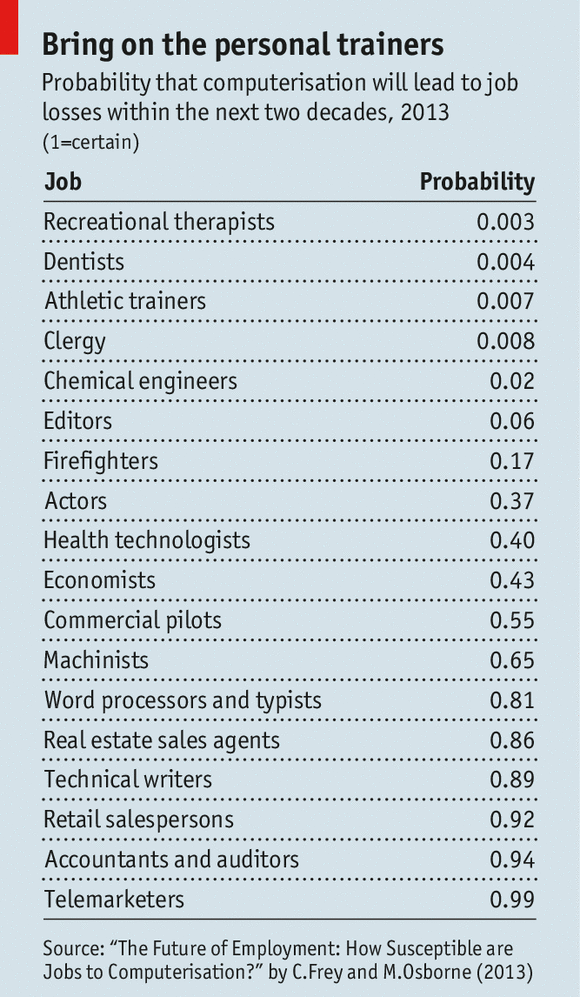
A recent article in The Economist discussed the likely impacts of technological development on jobs, with an emphasis on which jobs are especially vulnerable to being replaced with hardware or software automation.

The article included a chart listing some of the jobs projected to be most and least vulnerable, respectively:

Probability that computerization will lead to job losses within the next two decades, 2013

Some bad news for both people working for telemarketing firms and everyone with a telephone is that the telemarketers of the future are expected to be robots.

More disruptive, in terms of people’s career planning, is the set of presently white collar jobs potentially at risk to automation: accountants and auditors, technical writers, and real estate agents are all identified as being at risk. Pharmacists can probably be added to that list.

For now, dentists, athletic trainers, and clergy remain safe from being replaced by software or robots.