D.L. Rosenhan and the evaluation of sanity

One interesting bit of research described in Sam Harris’ The Moral Landscape concerns the ability of psychiatric hospitals to distinguish the sane from the insane:

Of course, there are many other other ways in which we can be misled by context. Few studies illustrate this more powerfully than one conducted by the psychologist David L. Rosenhan, in which he and seven confederates had themselves committed to psychiatric hospitals in five different states in order to determine whether mental health professionals could detect the presence of the sane among the mentally ill. In order to get committed, each researcher complained of hearing a voice repeating the words “empty,” “hollow,” and “thud.” Beyond that, each behaved perfectly normally. Upon winning admission to the psychiatric ward, the pseudopatients stopped complaining of their symptoms and immediately sought to convince the doctors, nurses, and staff that they felt fine and were fit to be released. This proved surprisingly difficult. While these genuinely sane patients wanted to leave the hospital, repeatedly declared that they experienced no symptoms, and became “paragons of cooperation,” their average length of hospitalization was nineteen days (ranging from seven to fifty-two days), during which they were bombarded with an astounding range of powerful drugs (which they discreetly deposited in the toilet). None were pronounced healthy. Each was ultimately discharged with a diagnosis of schizophrenia “in remission” (with the exception of one who received a diagnosis of bipolar disorder). Interestingly, while the doctors, nurses, and staff were apparently blind to the presence of normal people on the ward, actual mental patients frequently remarked on the obvious sanity of the researchers, saying things like “You’re not crazy. You’re a journalist.”

In a brilliant response to the skeptics at one hospital who had heard of this research before it was published, Rosenhan announced that he would send a few confederates their way and challenged them to spot the coming pseudopatients. The hospital kept vigil, while Rosenhan, in fact, sent no one. This did not stop the hospital from “detecting” a steady stream of psedopatients. Over a period of a few months fully 10 percent of their new patients were deemed to be shamming by both a psychiatrist and a member of the staff. While we have all grown familiar with phenomena of this sort, it is startling to see the principle so clearly demonstrated: expectation can be, if not everything, almost everything. Rosenhan concluded his paper with this damning summary: “It is clear that we cannot distinguish the sane from the insane in psychiatric hospitals.”

Harris, Sam. The Moral Landscape. p.141-2 (hardcover)

I believe this is the research being referenced: Rosenhan, D.L. “On Being Sane in Insane Places.Santa Clara Lawyer 379 (1972-1973).

This doesn’t seem like the most scientific or ethical research, but it is certainly interesting.

IEA: We can only burn 1/3 of the remaining fossil fuel

The International Energy Agency is now mirroring the claim made by Bill McKibben, James Hansen, and others: we cannot burn all the world’s fossil fuels. In their World Energy Outlook 2012, they claim:

“No more than one-third of proven reserves of fossil fuels can be consumed prior to 2050 if the world is to achieve the 2 °C goal, unless carbon capture and storage (CCS) technology is widely deployed”

Carbon capture and storage is arguably more of a rhetorical device which allows companies and governments to assume fossil fuel use than a real technology capable of reducing emissions. As such, it seems fair to say that we face a stark choice between dangerous climate change and abandoning fossil fuels.

Given that the value of fossil fuel companies is based on the assumption that they will be able to dig up and sell all the reserves they own, now might be an especially appropriate time to start divesting from fossil fuels.

Drugs Without the Hot Air: Minimising the Harms of Legal and Illegal Drugs

Psychologically active drugs may be the least rationally regulated part of our society, with one dangerous and addictive drug advertised and available everywhere (alcohol) and only nudges to disocurage the use of another that kills five million people a year globally (tobacco). Meanwhile, police forces and court systems around the world tie themselves up with investigating, processing, and incarcerating people who own or sell small quantities of much less dangerous substances.

David Nutt was appointed as chairman of the British Advisory Council on the Misuse of Drugs in 2008: an expert panel intended to provide non-partisan advice on drugs to the government. He was fired in 2009 after pointing out that the chances of getting hurt from an hour of horseback riding are about 30 times greater than the odds of dying from taking a pill of MDMA (ecstasy). His book Drugs Without the Hot Air: Minimising the Harms of Legal and Illegal Drugs covers some extremely interesting ground in a convincing and well-argued way.

Nutt describes how policy-making in the area of drugs is often driven by a combination of media-enhanced hysteria and an effort on the part of politicians to seem ‘tough’ on the issue. He categorizes many of the harms that result from this, ranging from criminal records acquired by youth (which harm their lives much more than drugs) to harsh restrictions on the availability of painkillers around the world, leaving many with terminal illnesses to die in a great deal of pain.

Nutt also provides a nuanced and interesting description of the nature of addiction, distinguishing between people who rely on steady access to a drug to control and underlying condition (as diabetics use insulin) and those whose use of a drug has been sufficient to give them harsh withdrawal symptoms when they stop using it, which in turn drives them into a cycle of continuous use. Nutt argues that treating addicts as criminals causes a great deal of harm to the addicts themselves and to society at large, through mechanisms including the suppression of scientific research, the discrediting of the law through its obviously unjust application, the enrichment of criminal gangs, increasing the spread of infectious disease, diverting attention from controlling alcohol and tobacco, and the indirect encouragement of more harmful drug-taking practices because safer alternatives are not available.

My copy of the book is sprinkled with a few typographic errors which I am told have already been corrected in the newest printing. It’s also a bit challenging to square a few of the claims about the relative dangerousness of drugs. Early in the book, Nutt describes a complex exercise in which multi-criteria decision analysis was used to evaluate the relative harmfulness of a variety of legal and illegal drugs across sixteen dimensions, encompassing both harm to the individual and harm to society. The ranking found alcohol to be the most destructive drug overall, followed by heroin and crack cocaine. Methamphetamine, powder cocaine, and tobacco follow. Lower in the list are amphetamine, cannabis, GHB, and benzodiazepines. At the bottom of the scale are ecstasy, LSD, and psilocybin mushrooms. Between ecstasy and benzodiazepines – about 1/3 of the way up the harmfulness scale – Nutt lists ‘butane’ – an inhalant. Later in the book, however, he characterizes butane as extremely dangerous and capable of killing people on the first use if misused. Perhaps the scale is based on the proper administration of the drug. Still, it seems like a drug that carries a significant risk of accidental fatal overdose should probably be rated as more harmful than drugs like cannabis which carry no such risk.

Regardless of the exact ranking of harmfulness that is most appropriate, the book contains a great deal of interesting information, as well as an informative chapter on what parents should tell their children about drugs. Nutt argues convincingly that treating drug addicts as people with a serious medical problem makes more sense than treating them as criminals, and lays out a good case for why the supposed ‘War on Drugs’ has failed. He also provides some interesting information on the functioning of the brain and makes some suggestions about how drugs of all sorts could be regulated to reduce harm. He does a good job of pointing out the hypocrisy in our treatment of tobacco and alcohol and makes some sensible suggestions for how states could effectively discourage the use of the latter.

All told, Nutt’s book provides a scientist’s take on the various substances people consume with the desire to change their thinking, as well as the consequences of the production and use of those substances for individuals and society. By repeatedly pointing out the many areas where policies are poorly informed by reality and counterproductive, he makes a strong case for the need for drug law reform. Both for individuals who wish to educate themselves about drugs and for policy-makers who aspire to regulate them more appropriately, this book could be a very useful reference.

Nutt is now associated with the Independent Scientific Committee on Drugs which has a great deal of useful information about drugs and harm reduction on their website.

Talking with brain scientists

There are several neuroscientists living in Massey and the other night one was telling me about glia cells – cells that support neurons by supplying nutrients and insulation, destroying pathogens, clearing out dead neurons, helping to clear the synapse of neurotransmitters, and performing other functions.

There is also interesting research being done on adult neurogenesis, including on where in the brain it takes place and what role it plays in the functioning of the brain.

Even without growth, climate change is a problem

Over at Forbes, Tim Worstall has written something rather silly about climate change:

“This might look like very bad news, that economic growth has pretty much come to an end as an important phenomenon. On the other hand we could regard it as pretty good news as well: for it means that we no longer have to worry about climate change.”

When we talk about economic growth, we are talking about gross domestic product: the sum of all the transactions that happen in an economy in a year.

Climate change isn’t caused by GDP directly, but rather through the burning of fossil fuels. What matters is how much fossil fuel gets burned, not what the size of the economy is. Even with a shrinking economy, climate change is a huge problem if we continue to get the bulk of our energy from oil, gas, and coal. Conversely, a strongly-growing economy built on nuclear or renewable sources of energy could see rising GDP with falling greenhouse gas pollution.

In The Bridge At the Edge of the World James Gustave Speth summarizes our predicament:

“How serious is the threat to the environment? Here is one measure of the problem: all we have to do to destroy the planet’s climate and biota and leave a ruined world for our children and grandchildren is to keep doing exactly what we are doing today, with no growth in the human population or the world economy.”

Our challenge is to find a way to leave most of the Earth’s remaining fossil fuels underground. Reducing our emphasis on economic growth may help with that, but it is not sufficient. It may not even be necessary, if we are successful at building prosperous economies based on zero-carbon sources of energy.

Illuminated timepiece and memento mori

After five years in The Service That Must Not Be Named – and with just a few days left before I leave to resume my studies – I got myself the Marathon Watch Company’s imaginatively-named General Purpose Quartz w/ Date, Type I, Class 1 watch as a kind of retirement gift to self.

The major distinguishing characteristic of the watch is the way in which it uses tritium-filled tubes for illumination. At each hour marker, as well as on the hour and minute hand, there are tiny tubes of phosphor-coated borosilicate glass containing a minute volume of radioactive tritium. This allows it to be easily read in conditions of total darkness. The tritium atoms are constantly undergoing beta decay and turning into helium-3. This process produces an electron with about 5.7 keV of energy and an electron anti-neutrino. The electrons hit the phosphors, causing the glow. The watch glows with radioactive fire, using the transmutation of hydrogen into helium for energy. It also produces antimatter that zips easily through the planet.

While I hadn’t intended it this way, the strongest impression from wearing the watch is that it is a memento mori – a token that reminds a person of their inevitable death. There are a few reasons for this. Most obviously, the tritium decay occurs with a half-life of about 12.32 years. Every time that span passes, the glow becomes half as bright. Ordinarily, watches highlight the circularity of time; we wake and sleep at similar times most days, pay our bills at the end of the month, and so on. The decay of the tritium is a reminder that time runs in only one direction, and there is no undoing what is in the past.

Tritium itself also has some rather ominous associations. For one thing, the gas in the watch was probably made in a nuclear reactor through the irradiation of lithium. For another, tritium is an integral component in modern nuclear weapons: both in the core of ‘boosted’ fission weapons and in the secondary stage of Teller-Ulam configuration thermonuclear weapons. On a more practical level, if the tritium leaks out from the glass tubes and forms tritiated water, it probably wouldn’t be especially good for a person to ingest.

I am pleased with the unexpected thoughts brought on by the watch. Too often, I think, we ignore the reality of our mortality and the urgency of the present moment. It’s easy for life to become routine and automated, with relatively trivial tasks occupying our time alongside relatively trivial thoughts. Being frequently reminded about the unidirectional nature of time – and about some of the terrors of the world – seems to force us to concentrate on what we want to do before we fade and expire.

Dark times

Bill McKibben on the state of the climate change mitigation movement:

“Since I wrote one of the first books for a general audience about global warming way back in 1989, and since I’ve spent the intervening decades working ineffectively to slow that warming, I can say with some confidence that we’re losing the fight, badly and quickly – losing it because, most of all, we remain in denial about the peril that human civilization is in.”

It’s pretty worrisome that some of the most articulate and convincing voices calling for action on climate change are now despairing about humanity’s ability to get things under control.

McKibben’s article talks about how risky warming the planet by even 2°C would be, going on to point out that we are on track to push temperatures up by more like 6°C by 2100. If we want to stay below 2°C, we can only burn about 1/5 of the world’s proven reserves of oil, gas, and coal. Those reserves are worth about $27 trillion, which explains why fossil fuel companies are so desperate to prevent effective action on climate change.

The fossil fuel companies and the politicians that support them are winning the fight over what kind of world will exist in the future, and humanity did more in 2011 to make the problem worse than in any previous year.

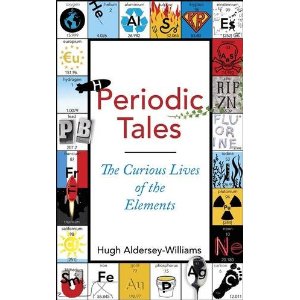
Periodic Tales

Hugh Aldersey-Williams‘ book Periodic Tales: The Curious Lives of the Elements shows off the author’s wide range of knowledge, willingness to investigate, and ability to tell a compelling story. Starting with gold and finishing with a pilgrimage in search of rare earth metals, Aldersey-Williams covers a fair fraction of the periodic tale – identifying the importance of elements not only in chemistry, but in diverse fields including art, literature, and theology. There are also many nice little nuggets of information, such as how Inuit steel tools were made from the nickel-containing natural stainless steel in some meteorites.

In addition to tracking down physical specimens of elements, the author tries to extract some on his own using natural materials said to be abundant sources (urine for phosphorus, kelp for iodine, even testing whether rotting herring luminesces). This admirable curiosity and willingness to undertake experiments adds much to the book.

Despite being about 400 pages, the book is a very quick read. It is well worth a look for anybody who is curious about the building blocks of the world or, alternatively, who is interested in seeing how the process of scientific discovery interacts with other human undertakings.